Showing posts with label Penguins History. Show all posts

Wednesday, June 12, 2019

10 years after 1st Cup, expectations change for Crosby, Malkin


By Tim Benz
https://triblive.com/sports/tim-benz-10-years-after-1st-cup-expectations-change-for-crosby-malkin/
June 12. 2019

Image result for malkin crosby 2009 cup
(AP)

Penguins fans have had a lot of fun anniversaries to celebrate lately.
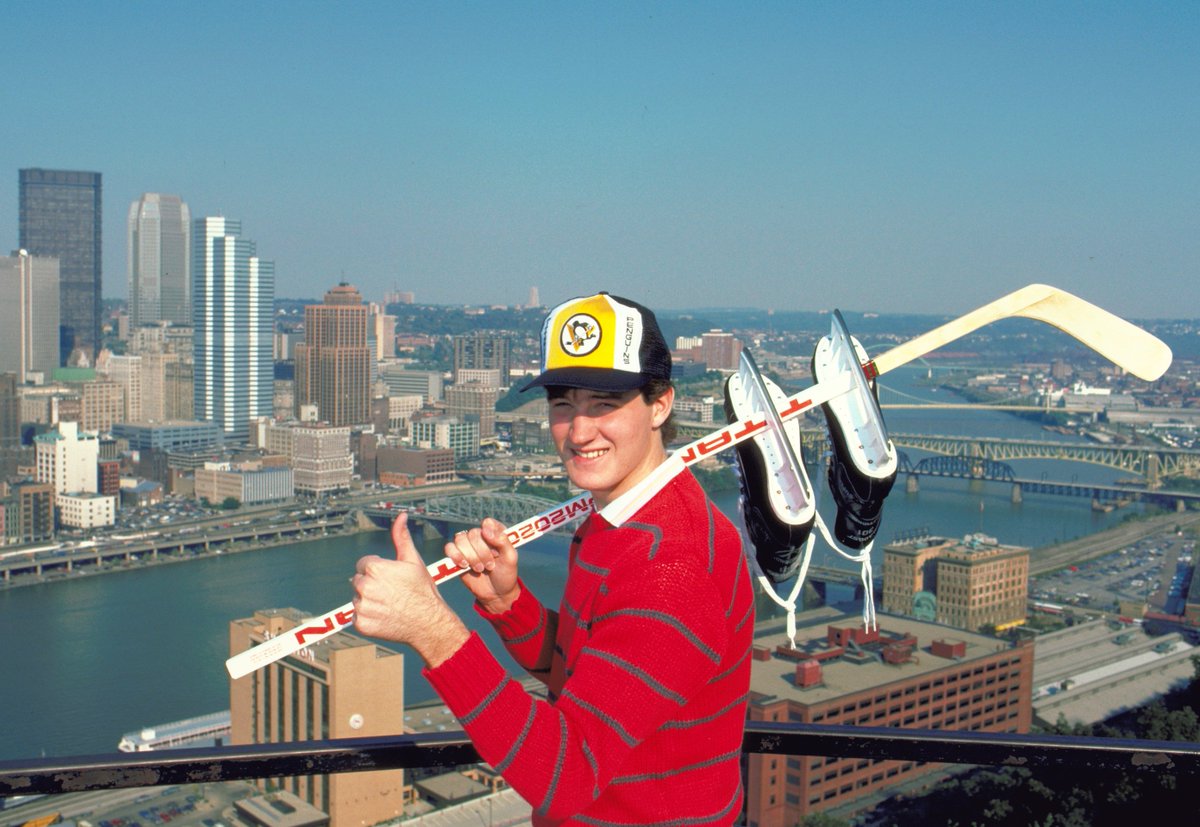
• The 35th anniversary of drafting Mario Lemieux was Sunday.
• The end of this season marked the 30th anniversary of Lemieux’s 199-pointcampaign in 1989.
• Today is the 10th anniversary of the 2009 Stanley Cup championship victory in Detroit.
Fair warning. Your heart may jump at roughly the 8:27 mark of that video. Relax, though. Marc-Andre Fleury still makes the save.
I remember walking down from the press box to ice level that night and having a sense of relief for the franchise.
Because whatever was going to happen over the next 10, or 15, or 20 years of the Crosby-Malkin era, at least it reached its ultimate goal.
And fast, too. It took just three years of Sidney Crosby and Evgeni Malkin playing together in Pittsburgh before hoisting a banner. The eventual championship we all assumed when the duo first hit the ice together in October 2006 was quickly fulfilled.
These Penguins wouldn’t have to wait until Detroit’s dynasty was dismantled. Crosby and Malkin wouldn’t be like John Stockton and Karl Malone in Utah — a legendary pair that simply couldn’t get over the top.
The team wouldn’t be the Bills of the ’90s — or the Pirates or the Steelers of the ’90s, for that matter.
They ended a 17-year Stanley Cup drought in Pittsburgh. Whatever happened next, the Crosby-Malkin era was going to be worth it because they were champs.
At least once.
But, I mean, there were going to be more. Right? If the two-headed monster got one Stanley Cup before either player was older than 22, they were going to win at least three or four more together.
At least!
By the time I arrived on Joe Louis Arena’s ice surface that night, that idea was the exact thought in my mind. It took me all of three minutes to go from “What a payoff!” to “How many more can we expect?”
I wasn’t alone. A lot of Penguins fans assumed the same thing. That’s what made the next seven years so frustrating. Crosby and Malkin were surrounded by so many good players for so long, yet they kept losing to lesser teams in the playoffs.
They kept on getting injured. Melting down emotionally. Blowing playoff series leads.
Thankfully, though, there are now more anniversaries to add to that list. Like another one today for the 2016 Cup team, and the one yesterday for the 2017 championship.
Now the era truly has been fulfilled. Without a doubt. Wallow in those memories. Because technically, the Penguins are as far away from a Cup as they have ever been since No. 87 and No. 71 first began skating together. This is the first year in their partnership that the Penguins couldn’t boast at least one playoff victory.
Even when they got bounced in previous first rounds in 2007, 2011, 2012 and 2015, they at least won a game.
Not this year. And a team that the coach and general manager openly wanted to rearrange back in April may return nearly the same in October because of some onerous contracts that are too difficult to move.
Was it unfair to assume that Crosby and Malkin had multiple championships in them after 2009? I don’t think so. With those two phenomenal talents and the vast assembly of young skill surrounding them in that locker room, you could see it.
You could feel it. They’d get at least one more.
It was a more circuitous route to get back there than I expected. But they did it.
Twice.
And with very few of the complementary parts from the ‘09 team still around them. However, it would be unfair to assume a fourth title for the tandem.
Expecting two or three rings out of Malkin and Crosby when they were in their early 20s may have been greedy. Assuming a fourth now that they are both in their early 30s, like many other mainstays on the team, would be stupid.
Let’s avoid assuming, then. That’s different than doubting, mind you. Because I won’t rule out another championship.
The Penguins have six men on their roster for next season over 30. The Bruins have eight between 31 and 42 right now. They might win the Cup against St. Louis Wednesday in their Game 7.
So maybe these Penguins can reboot, retool and squeeze out another parade. Crosby and Malkin are still special. They are still coming off a 100-point season as a team.
But 10 years changes a lot of things. Perspective, for one.
Expectations, for another.
But not appreciation for what they’ve accomplished. That should always stay the same.
Tim Benz is a Tribune-Review staff writer. You can contact Tim at tbenz@tribweb.com or viaTwitter. All tweets could be reposted. All emails are subject to publication unless specified otherwise.

Tuesday, June 11, 2019

Legends of Hockey : Mario Lemieux

35 years later, Penguins’ drafting Mario Lemieux No. 1 was both easy, complicated


By Mark Madden
https://triblive.com/sports/mark-madden-35-years-later-penguins-drafting-mario-lemieux-no-1-was-both-easy-complicated/
June 10, 2019

Related image

Sunday was the 35th anniversary of the Penguins drafting Mario Lemieux.
That might sound like an easy decision to make. Ultimately, it was.
But there were a few complications.
General manager Eddie Johnston had to quietly maneuver the Penguins into finishing last overall in 1983-84.
OK, so maybe he didn’t do it so quietly.
For example, goalie Roberto Romano won a few starts, and got sent to the minors. Replacing him was Vincent Tremblay, who went 0-4. His goals-against average was 6.02.
“We wanted to see what he can do,” Johnston said then.
Tremblay did exactly as expected. Nay, hoped for.
The Penguins finished with 38 points. New Jersey had 41. Mission accomplished.
Quebec, Minnesota and Montreal made huge bids for the Penguins’ pick.
The Nordiques offered all three Stastny brothers and their first-round pick (15th overall). Peter Stastny, the best of the trio, was 27 and had just compiled a 119-point season. He finished his career with 1,239 points in 977 games and is a member of the Hockey Hall of Fame.
The North Stars dangled all 12 of their draft choices that year. Their top selection was 13th overall.
The Canadiens offered an impressive package of players and draft choices reportedly topped by center Guy Carbonneau, who would go on to win the Selke Trophy three times as the NHL’s top defensive forward.
But Johnston preferred the notion of a center who could score goals, not prevent them — and who could sell tickets, too.
Montreal’s bid also included the fifth pick overall. Canadiens management asked Johnston for a chance to better any offer made by another team.
But, Johnston said, “I went to watch him play (in the Quebec Major Junior league) a few times, and it was a very easy decision. Every time you went to watch him, if he didn’t get seven or eight points, it was an off night for Mario.”
The idea of the Penguins trading the first pick overall seems ludicrous, but it happened fairly often in that era. Good teams fleeced bad teams by offering them the chance for immediate upgrade via veterans.
Montreal won the Stanley Cup in 1971 and ‘79, yet had the first overall choice in those years. (The ’71 pick yielded Guy Lafleur courtesy of the Oakland Seals.) Philadelphia won the Stanley Cup in ’75, but selected first that year. They took Mel Bridgman (who?) and haven’t won a Cup since.
The Canadiens had known about Lemieux for several years. He demolished youth competition in his native Montreal almost from the moment he donned skates.
So, in 1981, they made a deal to get Hartford’s first-round pick in 1984. Hartford finished fourth-to-last the season before (1980-81). The Canadiens hoped the Whalers’ troubles would worsen and deliver Lemieux to Montreal. Hartford got Penguins great and future Lemieux confidant Pierre Larouche as the key component in that swap.
But the Whalers came in fifth worst in 1983-84. Their 66 points (there’s that number) dwarfed the Penguins’ 38.
So, Quebec, Minnesota and Montreal couldn’t make Johnston budge.
Neither could Ken Schinkel, the Penguins’ scouting director.
Schinkel, a former Penguins player and coach, reportedly preferred Kirk Muller, a forward projected to go second in the draft behind Lemieux. All the usual clichés applied: Tougher, grittier, a better two-way player, not French, etc.
Johnston ignored Schinkel. Muller went second to New Jersey and had a decent career: 959 points in 1,349 games. But his resume says minus-147 while Lemieux’s says plus-114. So perhaps Muller wasn’t a defensive wizard.
Johnston also ignored several in owner Edward J. DeBartolo’s organization who wanted to try a quick fix by dealing the pick. But, as Johnston said, “Mr. DeBartolo was at Mario’s first practice and he said, ‘Thank God you didn’t listen to any of those people.’ ”
Johnston selected Lemieux. But contract negotiations with the Penguins were at an impasse. At the draft, held at Montreal’s Forum, Lemieux refused to shake Johnston’s hand or don the Penguins sweater.
But Lemieux signed 10 days later. Once he put that Penguins jersey on, he never took it off. Good thing, too, or this column would appear in the Kansas City Star.
Mark Madden hosts a radio show 3-6 p.m. weekdays on WXDX-FM (105.9).
Categories: Sports | Penguins | Mark Madden Columns

Saturday, September 08, 2018

City mourns passing of hockey legend Ab McDonald


By Paul Friesen
September 5, 2018
Image result for ab mcdonald penguins
Cancer may have taken Winnipeg hockey legend Ab McDonald, but it can’t take the legacy, the friendships or the memories he leaves behind.
One of Winnipeg’s all-time hockey greats, McDonald died, Tuesday, at the age of 82.
The four-time Stanley Cup winner played 15 seasons in the NHL, before joining his hometown Winnipeg Jets of the World Hockey Association in 1972, becoming the team’s first captain and scoring the first goal in franchise history.
Those who saw him play can consider themselves lucky, and those who knew him even luckier.
Friend and former teammate Joe Daley was one of them.
“You really wouldn’t know what Ab did for a living, if you didn’t know – he was so humble,” Daley, a fellow Winnipegger, said, Wednesday. “I never, ever heard him brag about the Stanley Cups or anything like that. He was never bigger than the game or the team he was with.
“I played with him in the minors, I played with him in the NHL, I played with him in the WHA – and he was always the same. He was, ‘OK, what can I do to contribute? Who can I help today?’ ”
Daley became close with McDonald early in his career, getting advice from his older teammate for everything from hockey to finances.
The former goalie and his wife last saw McDonald just over a week ago, his illness confining him to his bed at home.
“I put my arms around him, and geez… it was hard,” Daley said. “I’m glad I had a good visit with him. We were able to tell him how I really felt. Of course, he knew that all along, I’ve told him so many times what he meant to me.
“As a person, there was none better.”
One of the city’s great ambassadors for the game, McDonald was never shy about making public appearances or reminiscing about former teammates or opponents, regaling those around him with a story and that ever-present smile.
A star with the St. Boniface Canadiens of the Manitoba Junior League, Alvin Brian McDonald began his NHL career with Montreal in the 1957-58 playoffs, winning three consecutive Stanley Cups with the Canadiens.
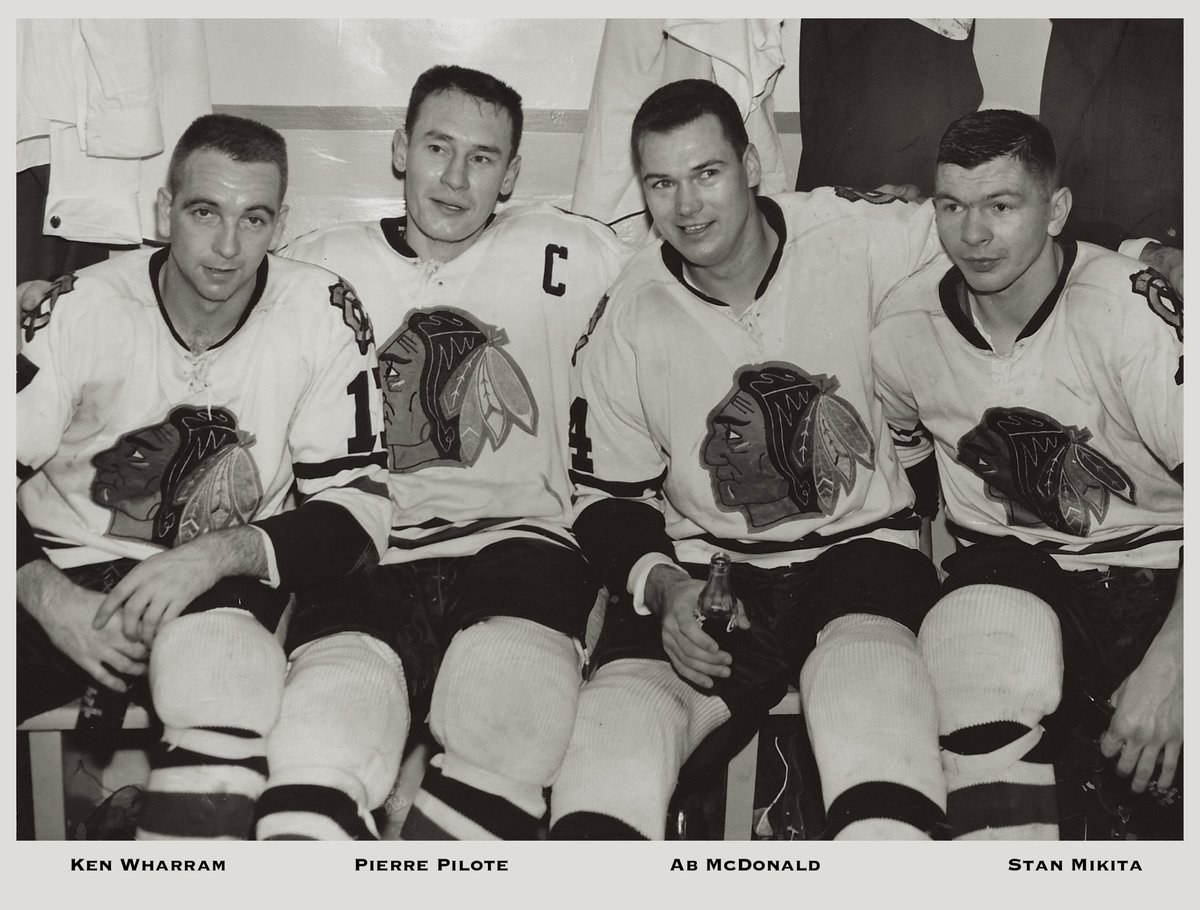
Born on this day in 1933: late @NHLBlackhawks forward Ken Wharram, who with Stan Mikita and Ab McDonald formed his team's Scooter Line (one of several versions). 1961 Stanley Cup champion, 1963-64 Lady Byng Trophy winner, 20 or more goals seven straight seasons
After a trade to Chicago, he won a fourth straight title, scoring the Cup-winning goal for the Blackhawks in 1961.
He also played for Boston, Detroit, St. Louis and expansion Pittsburgh, where he was the first team captain in Penguins franchise history.
He registered 430 points in 762 career NHL games, 50 in 84 playoff games, and played in five all-star contests.
His WHA career included 70 points in 147 games, with eight more in 18 playoff games.
“He wasn’t Bobby Hull and he wasn’t Reggie Fleming, but I’ll tell you what, he was a monster contributor to a lot of teams,” Daley said. “Generally when you’re captain you’re pretty influential in the dressing room and dealing with guys. But his career was pretty awesome, and we lose sight of that.”
McDonald’s passing comes just a month after that of perhaps his closest friend, former Chicago teammate Stan Mikita.
Daley recalled McDonald couldn’t make it to Mikita’s funeral because of his own failing health.
“He and Stan were so close, and now he’s going to have a chance to say hello to him again,” Daley said. “It’s almost eerie when you think of Stan going so recently, and now Abbie’s right there behind him.”
The Winnipeg Jets issued a statement mourning McDonald’s loss and crediting him with helping to reconnect the current team to the Jets of the past.
“We at True North Sports and Entertainment and the Winnipeg Jets hockey club are saddened to learn of the passing of Mr. McDonald,” True North chairman Mark Chipman said. “He was a legend in this city’s hockey history… his reputation as an outstanding teammate carried over into his life after hockey. Off the ice, Mr. McDonald always represented our hockey community proudly.
“He will be greatly missed.”
The Blackhawks, Penguins and Canadiens expressed similar sentiments through statements or on Twitter, as did current Jets captain Blake Wheeler.
“On behalf of all of us who currently wear the Jets logo, I’d like to extend our condolences to the friends and family of the original captain – Ab McDonald,” Wheeler tweeted. “He was a true ambassador for the game and our franchise, as well as a Stanley Cup champion.”
McDonald retired after the 1973-74 season. He was inducted to the Manitoba Sports Hall of Fame in 1996 and is an honoured member of the Manitoba Hockey Hall of Fame.
He is survived by wife, Pat, five children, seven grandchildren, one great-grandson – and too many friends and admirers to count.
“We knew it was coming, and you’re strong until it happens,” Daley said. “But we’ll make it. In his honour. He wouldn’t want us feeling any other way.”
Related:
Home is where the hockey hero is-

Tuesday, June 13, 2017

Penguins stars from their first back-to-back title teams look back 25 years later

June 13, 2017
Pittsburgh Penguins owner Mario Lemieux raises the Stanley Cup Trophy after they defeated the Nashville Predators 2-0 in Game Six of the 2017 NHL Stanley Cup Final at the Bridgestone Arena on June 11, 2017 in Nashville, Tennessee. (Photo by Patrick Smith/Getty Images)
NASHVILLE — The strongest and clearest link between the Pittsburgh Penguins’ past and present stands on the Bridgestone Arena ice, holding court in both English and French. Eighteen years ago, Mario Lemieux spearheaded an investment group to rescue his beloved franchise from bankruptcy and potential relocation, an unprecedented purchase by an active, not to mention legendary, player. And now, towering over the cameras Sunday night, surveying a Stanley Cup celebration for the second straight June, Lemieux could once more relish in the fruits of his financial faith. “It’s something everyone in the organization can cherish for the rest of our lives,” he says. “It’s very special.”
Of course, Lemieux has been here before. A striking number of his colleagues, as well. Like the two color commentators, one employed by the local television rightsholder and another analyzing over the radio airwaves. There’s the director of player development in the booth, and the assistant coach behind the bench. Even assistant equipment manager Jon Taglianetti—his father Peter was also part of the ‘91 and ‘92 Pittsburgh teams that Lemieux captained to back-to-back titles.
Even if Sidney Crosby and the Penguins hadn’t become this century’s first repeat champions by outlasting Nashville in six games, the memories would’ve rushed back regardless. The 2016–17 season marked the 50th anniversary in franchise history for Pittsburgh, which transformed the winter months into an ongoing reunion. Members from the “Early Years”gathered in October; the ‘09 Cup team assembled on Jan. 8, while an “Alumni Salute” Feb. 3 honored the rest.
And so over the first weekend in December, Lemieux and his former teammates found themselves reverting back to old form, telling the same jokes and pulling the same pranks, just like they had a quarter-century ago. “That’s the beauty,” says former forward Troy Loney. “It’s truly like time stood still.”
“A little more gray, a little more girth,” says center Bryan Trottier, “but the whole thing is just fantastic.” They dined together, toured the locker room, took in a home game against Detroit from the owner’s box, watched compilations of their greatest hits in grainy footage on the video screen. “The welcoming back,” defenseman Jim Paek says, “it gives you goosebumps.”
If so, the stories gave them bellyaches. A favorite dinnertime activity was called “shoe checking,” in which someone snuck under the table, plunked ketchup onto a teammate’s tongue, and then clinked a glass for everyone to see who had been hit. “I did that on [coach] Bob Johnson when we were down 2–1 in the first Cup run,” says former forward Bob Errey. “He loved it because he was one of the boys, but [GM] Scotty Bowman was looking at me, like ‘I’m going to trade this guy.’” Today, Errey offers in-game expertise on Penguins telecasts for Root Sports. But once he dipped Lemieux’s glasses in hot wax while the team leader was occupied on the massage table. “About three coats,” Errey reports. “He couldn’t see anything.”
They remember the thrills and challenges of repeating, too. In both postseasons, Pittsburgh needed seven games to escape the first round, against New Jersey and Washington, respectively. “The playoff atmosphere and the hype, you can’t wait for the next day,” says Trottier, the Hall of Famer who somehow served as the third-line pivot on that loaded roster. “You’re looking forward to the next day so much. You don’t want to be the guy who’s going home. You dig deep, you find a way.”
“It’s hard to keep that much emotion all the time,” Loney says. “Everyone wants a piece of you during the year, so you burn quite a bit of it. We were really good about turning the switch off when a game was done.” Most of this happened inside the team hospitality room at the hotel. “We weren’t having a hundred beers, but we were relaxing and mellowing out.” Individual players were critical in this regard, too; backup goalie Wendell Young only appeared in 18 games each season, but Loney remembers his presence as “like having a team psychologist with you all the time, that calming, reinforcing voice, especially in the playoffs.”
Image result for pittsburgh penguins 1992
Certainly the Penguins required mental fortitude. Lemieux was sidelined with back issues for most of ‘90-91, though midseason additions like Joe Mullen and Ron Francis and Ulf Samuelsson fortified the ranks. Then 60 years old, Johnson tragically died of brain cancer that following November, leading Bowman to take over behind the bench. The Penguins struggled at first, but another batch of trades—this time bringing aboard current assistant coach Rick Tocchet, coincidentally enough for Mark Recchi, a front-office official—“woke everyone up, invigorated a different mix and life into the team,” Loney says.
In this regard, Loney draws parallels with Pittsburgh’s current group. Absent defenseman Kris Letang, the workhorse who missed the playoffs after undergoing neck surgery, the blue line nonetheless held together admirably well. Depth forwards like Carter Rowney and Scott Wilson filled in when the likes of Nick Bonino and Carl Hagelin battled injuries late in the spring. “Give this group a lot of credit,” Loney says. “They’re very resilient. We didn’t have the injuries like they had.”
And now comes the fun part. The Penguins reveled deep into Sunday night, first at Bridgestone Arena and then at the Sheraton Grand Hotel in downtown Nashville, before flying back home on Monday morning. Their predecessors went...harder.
Peter Taglianetti still remembers the ‘90–’91 party at Lemieux’s house, when the Stanley Cup somehow wound up in the bottom of the swimming pool and a small chunk cracked off, because he took 35mm pictures and had them blown up as keepsakes. “It sunk to the bottom,” Taglianetti says, “and nobody could hold their breath long enough to go get it. Pretty hard after however many beers. Plus it’s like 100 pounds once it fills with water.”
The next year, following a four-game sweep of Chicago in the finals, the celebration was held at Three Rivers Stadium. “There was a little bit of a rain delay, so they had the tarp down,” Loney says, “and all of a sudden there’s Trottier running around, sliding on the water with the Stanley Cup.”
Asked for his memories in Nashville, Lemieux goes the serious route. “Well, ‘93 we should’ve won the Cup,” he says. “That was our best team. Didn’t go our way against the Islanders.” Loney argues that Pittsburgh simply ran out of gas. “We rode too high during the year,” he says, “pushing too hard for the Presidents’ Trophy, and Mario in the scoring race. We couldn’t find the next gear.” Such will be the challenge confronting Crosby and Letang and Evgeni Malkin in 2017–18, as they embark on a similar three-peat attempt.
But regardless of the result, count on them all reuniting in 2042–43, when Crosby is 54 years old and Malkin is 55, to reflect on these days and, just maybe, shoe-check each other until their sides split.

Wednesday, November 23, 2016

Jaromir Jagr defies his age in younger NHL


44-year-old Panthers forward says he's 'the best I ever felt'


by Amalie Benjamin @AmalieBenjamin / NHL.com Staff Writer
November 20, 2016
Image result for jaromir jagr 2016
Robert Mayer-USA TODAY Sports

SUNRISE, Fla. -- It is hard to look away from the bright, the shiny, the new, the sparkling freshness of the latest crop of wunderkinds in the NHL. It is a generation dawning, a movement emerging so fast that at times it seems to have left the rest of the League behind. There they are, scoring four goals in an NHL debut, unleashing a shot reminiscent of Alex Ovechkin, snaking through and around and past defenders who suddenly morph from All-Stars to pylons.
They are next. They are now.
Yet, down in Florida, a relic remains.
There is so much past in him, in his birth, in Czechoslovakia, a country that no longer exists, in his famous hair now shot through with silver, in his spot on the all-time points list among players long since retired.
Of the top 10 goal-scorers in NHL history, nine are in the Hall of Fame: Wayne Gretzky, Gordie Howe, Brett Hull, Marcel Dionne, Phil Esposito, Mike Gartner, Mark Messier, Steve Yzerman and Mario Lemieux. Of the top 10 points leaders, nine are in the Hall of Fame. The exception, a right wing, sits third on each list, though he is likely to ascend to second in points this season, needing 10 to catch Messier.
That outlier status is one Jaromir Jagr has seemed to court throughout his career, a delicious novelty that worked for him, whether he was wearing a mullet, shilling peanut butter or shilling peanut butter while wearing a mullet.
He is here now, with the Florida Panthers, amidst the stars of the future, among teammates who grew up during the Jagr fever that gripped Pittsburgh in the 1990s, who had his poster on their walls, his jersey on their backs, who saw playing with him as a dream.
His linemate, Aleksander Barkov, born in Finland after Jagr had already won the Stanley Cup twice, was so enthralled with the idea of playing with his idol that he could not concentrate on the action for the entirety of the game after Jagr was traded to Florida -- and Jagr wasn't even in a Panthers uniform yet.
"That game didn't go well," Barkov said.
Jagr has defied time and aging and hockey and physics and many, many defensemen during the past 26 years. He has defied so much of what we expect from athletes, including a mindset, a retirement age, a way of thinking that the body breaks down and eventually takes away that which makes them special.
Sports are a constant reshuffling; the new coming in, the old going out, an endless yielding of the stage. But sometimes, somehow, someone doesn't fit the narrative.
Sometimes the old isn't done yet.
"When I was 10, he was already a star," said 30-year-old Boston Bruins center David Krejci, who, like Jagr, is from the Czech Republic. "He was big. Now he's still a star, so the 10-year-olds in Czech still look up to him. A whole new generation, but he's still around."
A new generation of hockey players. A new generation of fans. Jagr, who'll turn 45 in February, endures.
****
The pounds slipped off, or so he says, making him the envy of the middle-aged set everywhere. It was not so much a conscious decision as a religious one. Or, at least, it started out that way.
Two years ago, Jagr gave up his beloved Diet Coke for Lent, and 40 days later, he couldn't stomach it any longer. He never went back.
Coffee, laden with sugar and cream and caffeine, was harder to kick. His is a family of addicts, with Jagr estimating that his mother would drink 10 or 15 cups a day. He was much the same. But no longer. He is not young anymore, and there are restrictions that come with age, deprivations.
He could not continue whistling past the graveyard. He had to admit that the NHL was different, that the game and its players were changing around him. He did not need to be 240 pounds anymore, didn't need the size and weight. He needed quickness instead, a way for his aging body to move faster and cleaner against the young, lithe 180 pounders that the NHL -- and its general managers -- are embracing.
He had always been big -- "I had 13 pounds when I was born; my bones are naturally heavy," Jagr said -- but it was time to give up that sweet, milky coffee, give up the indulgences, the kind of decision that feels so universal at that age. He ate better, adding fish to his diet this summer.
He noticed differences, felt lighter, was lighter. This season, he is playing at 225 pounds.
"I'm kind of adjusting and, as I adjust, trying different things," Jagr said. "I feel like I always had a talent and I never maximized it, always did enough to be good. Not more than that. But I always felt I always have an extra [level] when I need it. … I never really had to control my food, I never stretched in my life until this year."
He still needs to learn to play at his new weight. He needs to adjust, to find his stride. Some fat was gone, but some muscle was too. His shot was altered slightly, his strength diminished. That, he believes, is returning. He just needs patience.
"Honestly, I feel the best I ever felt," Jagr said. "I know it's funny because the numbers are not there and everybody looks and sees struggle, but I wouldn't change it. I still believe it's going to turn around and I'm going to feel the best and play the best I've played in 15 years. I believe it. If not, I made a bad decision. But I believe I made a good decision."

Image result for jaromir jagr 2016
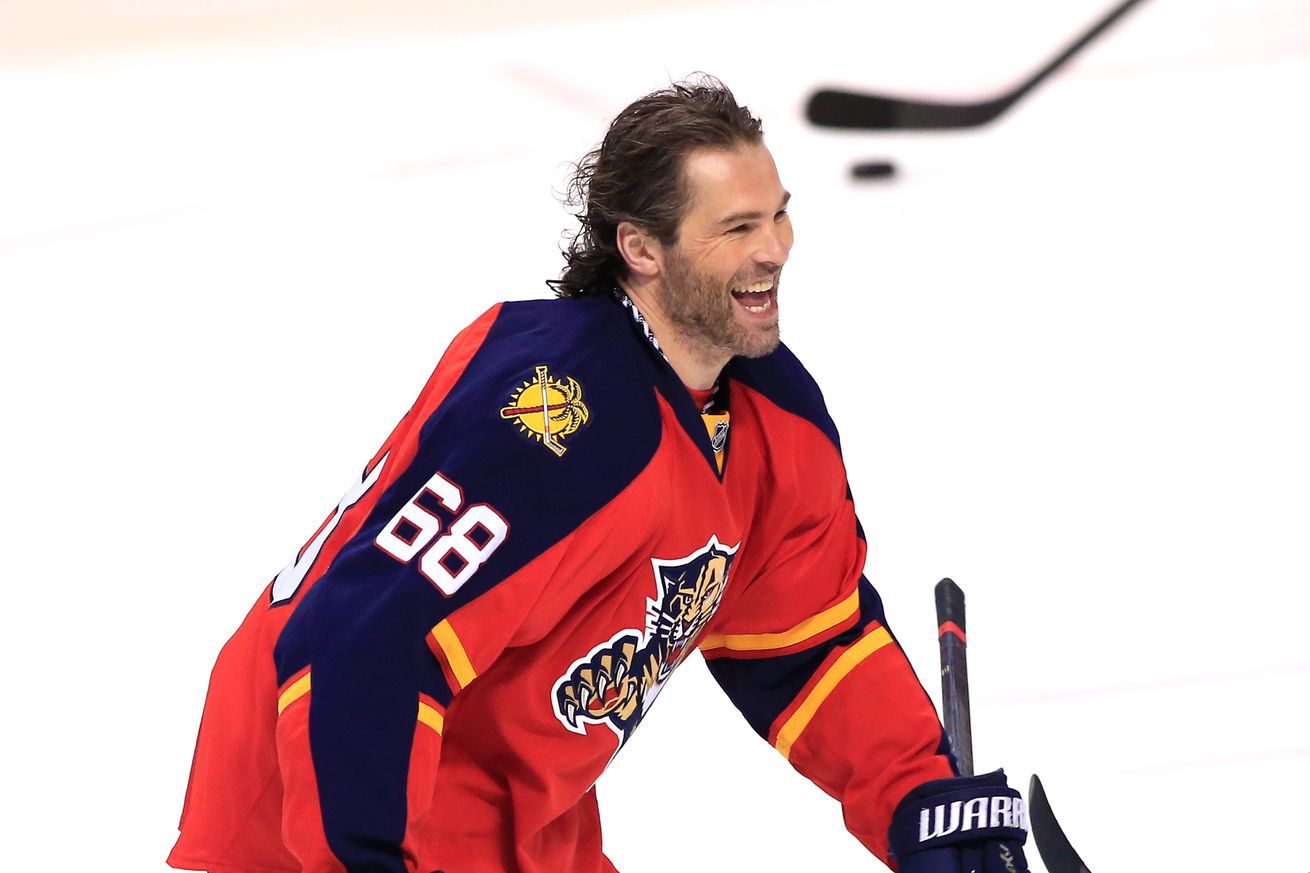
Jaromir Jagr #68 of the Florida Panthers tangles with Sean Couturier #14 of the Philadelphia Flyers at the BB&T Center on March 12, 2016 in Sunrise, Florida. (Photo by Eliot J. Schechter/NHLI via Getty Images)
But he worries. He knows the recalibration is continuing, the results a factor of his new body, of the absence of injured linemate Jonathan Huberdeau, of some poor luck. He did not score in the final seven games of last season, including a six-game first-round loss to the New York Islanders in the Stanley Cup Playoffs. He had one goal in the first 16 games this season.
"You have to understand that there is a time in everywhere, not only in hockey, any job, when you do everything that's possible and the results are not there," Jagr said. "But you cannot quit it. You cannot stop it. You have to go back again, because once you stop, especially when you're old, nobody is going to give you a chance to come back again.
"When you're older, you cannot make any mistakes. You make mistakes when you're younger, you're still going to get the opportunities. People give you a second chance, a third chance; 'they're young and they make mistakes.' When you're old, you don't."
****
Maybe it is that push back, against any hint of weakness, any sense of giving in, that leads Jagr to deny what everyone says. Or maybe it is that he has gone around them, circumvented their expectations and their watchful eyes.
They say he has adjusted his routine this season, skipping morning skates, spending fewer nights slipping into the building alone for his legendary workouts.
"Lately he hasn't been doing the late-night workouts really anymore," Panthers strength and conditioning coach Tommy Powers said. "I think he's starting to realize that rest is a little bit more important.
"Unless he's coming here when I don't know about it. I don't know. But he hasn't been calling me too much late at night anymore. So I'm thankful. I'm getting a little more rest, too, these days."
Incorrect, according to Jagr, who used to require Powers to be available at nearly all times for workouts. He would call him at 9 p.m., 10 p.m., on weekends, during off time, in hotels on the road, at family barbecues at home. But just because he doesn't call, doesn't mean anything.
"No, no," Jagr said. "No, no, no. He just doesn't know."
So it's behind his back?
"I think I do more than before," Jagr said. "I just don't bother [Powers] much."
His coach has stopped coaching him, his strength trainer caters to his whims, his teammates marvel and sometimes follow his lead, adding the ankle weights and the weighted vests and the knowledge that they could never do it all.
"I don't know how he does it," Panthers coach Gerard Gallant said. "I mean, at that age, I don't know how he gets up every morning, comes to the rink and does what he does. He's almost 45 years of age and he doesn't cheat. He does his workouts, he does everything the other players do and he comes to the rink and prepares himself. Freak of nature. I don't know what it is."
****
Even as Jagr rejects the advancing days, as he declines to think about them, he clings harder to the now. His fingernails are not on the ledge, not yet, and perhaps he will give in before that happens, perhaps he will know when his time is up.
He knows he must really be sure, in that case. He must be so sure. There must be no regrets.
Because he knows those players, the ones who have retired and six months later miss it so desperately that they would do anything to return. They become coaches, assistants, radio guys, general managers; they give their lives, their time, to dig their fingers in again. But then, it's not like it was before, it's not like playing.
"I guarantee you if they could change this part with me, they'd do it in a minute," Jagr said.
He knows this. This game is life. And he cannot let it go until it starts to let him go, until the arms get too heavy to hang on any longer and the slipping starts.
"When you're tired and you say, 'I had enough,' but after two months, one month you decided, 'Oh, I'm missing it,' there's no way I can come back," Jagr said. "It's like a big truck. When you stop the big truck, it's tough to start again."
That is not yet. It is not now. He refuses that concept, repeats his desire to play until he is 50, makes others believe, makes himself believe. Because, unlike the rest of us, whose careers stretch on for a lifetime, there has to be an end for an athlete, doesn't there? At some point?
He volleys the question back.
"So that's what you would do?" he asks. "Once you reach your goal and it's something that makes you happy. Let's say you write an article and your goal is to be one day working for the NHL and so all of a sudden you reach the goal …"
He interrupts himself. He has thought of something better, something that makes the crow's feet around his eyes crinkle and fold into themselves, something that makes the light burn brighter in his eyes.
"…Or your goal would be to make interview with Jaromir Jagr," he says, grinning, a faux mullet wig hanging from his locker behind him. "Here we go. And so today you reach that point. So tomorrow you're going to tell yourself, 'I'm not going to do that anymore?' Probably not. It's the same thing."
It isn't, not really. The same skills aren't involved, the same time elements don't have the same effects. But that is the force of Jaromir Jagr, that for that moment -- even if his point is pure fantasy -- you wonder why anyone would ever give up anything so loved, voluntarily.
You wonder why the end has to come for anyone.
****
There remains incredulity in the face of Jagr, a lack of understanding of how he is still doing this, how time has managed to move on for everyone around him and yet stands still for him. He remains an enigma, the rare person who got old, moved to Florida and refused to retire.
"He still acts like a kid, and that's not a disrespectful thing, that's a compliment," Tampa Bay Lightning coach Jon Cooper said. "Like he's a kid at heart. He has fun out there. You watch him in the pregame skates. So he may have a 4 by the start of his [age], but it looks like [he has] a 2."
His development is arrested, with a philosophy that seems culled from the pages of J.M. Barrie. If you refuse to believe in your own aging, in your own deterioration, in your own end, perhaps there never really will be one. And so, day by day, shift by shift, he adds realism to the Peter Pan fantasy.
He won't give in. He won't grow up.
He is 44. He is 24. He is somewhere in between his body and his mind and the skills that haven't yet forsaken him.
Someday, it will be over. He can't think about that, though, any more than he'd like us to. Because to consider it is to begin the process. And for that, he's not yet ready.
"It's the power of the mind, so once you start thinking about it, it's going to happen," Jagr said. "So, no. It's like insurance. Once you start thinking about insurance, you already admit it could happen. I'd rather to take the risk. I go all in. That's my life. I'm all in."

Monday, November 14, 2016

"Pittsburgh is Home" shows Mario Lemeiux and the Penguins in all their glory


By Mark Madden
November 14, 2016
Image result for lemieux crosby stanley cup
Sidney Crosby #87 of the Pittsburgh Penguins and co-owner and chairman Mario Lemieux celebrate with the Stanley Cup after the Penguins won Game 6 of the 2016 NHL Stanley Cup Final over the San Jose Sharks at SAP Center on June 12, 2016 in San Jose, (Getty Images)

Upon initial viewing, I don’t believe there’s ever been a better sports documentary than “Pittsburgh is Home,” a 168-minute chronicle of the Penguins’ first 50 years.
But I would say that. I was there for all of it.
My first reaction to seeing “Pittsburgh is Home” was, gee, I should have got braces as a kid. Interviews with me are liberally sprinkled throughout the film. I wouldn’t call them glamour shots.
My deeper reaction is that it’s not only the Penguins story, it’s my story. From 6-year-old fan to media nitwit, it’s all there, with no stone left unturned. If there was anything I didn’t recall, I remember it now.
Producer and director Leo McCafferty deserves praise for all facets of the documentary, especially the pace. A film of that length often drags, but “Pittsburgh is Home” doesn’t. Just the right amount of time is spent on everything significant.
Mt. Lebanon-born actor/director/producer Joe Manganiello provides excellent narration. Perhaps the “Magic Mike” co-star should have been my visual stand-in.
Heartbreak plays a big role. The Penguins have withstood an inordinate amount of difficult moments, ranging from tragic to dumbfounding: The deaths of Michel Briere and Badger Bob Johnson, Mario Lemieux’s back problems and cancer, multiple bankruptcies and some on-ice losses that seemed scripted by Satan.
But the portrayal of the bad never turns maudlin. In fact, when viewed in the context of the franchise’s triumphs, a kind of nobility emerges that very few sports teams possess (though many pretend).
The film’s star is Mario Lemieux. How could it not be?
Lemieux is Pittsburgh’s best athlete ever, and arguably its best sports owner ever -- it hasn’t been very hard to own the Steelers since 1972.
Imagine if the Penguins had drafted Kirk Muller in 1984. Any Penguins documentary would be a lot shorter and reside in the “Where Are They Now?” file.
One word attaches itself to Lemieux in “Pittsburgh is Home”: resilience. He’s known for elegance far more than grit, but Lemieux never gives up.
Of particular interest is Lemieux’s comeback from cancer in 1993, and not just the miraculous nature of beating a dreadful disease.
Lemieux’s single-minded determination to overhaul the New York Islanders’ Pat LaFontaine for that season’s NHL scoring title is detailed in very honest interviews and, of course, highlights from perhaps No. 66’s greatest assault on the league.
Lemieux had 30 goals and 26 assists in 20 games after undergoing radiation therapy for over a month. He won the scoring title by 12 points despite playing 24 less games than LaFontaine.
Writing that, it seems impossible, but it happened.
The Art Ross Trophy was extremely important to Lemieux. He measured himself by scoring titles and Stanley Cups. Nobody votes on those.
“Pittsburgh is Home” also pays (perhaps inadvertently) homage to one of the Penguins’ unsung heroes over their existence, Paul Steigerwald.
Steigerwald trekked to Florida last season to get a lengthy one-on-one interview with Jaromir Jagr. There was no guarantee the mercurial Jagr would cooperate, not least because he’s been booed every time he’s returned to Pittsburgh since 2001. Steigerwald was the only person who had a chance, and he delivered.
Without Jagr speaking, there would be a huge hole in “Pittsburgh is Home."
The same would be true without Steigerwald. He is all over the documentary, and that’s because he’s been an integral part of the Penguins’ story since joining the team in 1980 as its director of marketing. Steigerwald has been omnipresent, not just involved. Heck, he picked Lemieux up at the airport.
Co-owner Ron Burkle makes an appearance, as does original owner Jack McGregor. Legendary announcer Mike Lange. Former stars like Ron Francis and Paul Coffey. “Pittsburgh is Home” is complete. There’s nothing missing.
I teared up a half-dozen times. This means everything to me.
I won’t be around for the 100-year documentary. Good job they got this one right.
Mark Madden hosts a radio show 3-6 p.m. weekdays on WXDX-FM (105.9)

Where To See It

The viewing schedule for "Pittsburgh is Home," the Penguins' 50-year documentary:
Nov. 15 at PPG Paints Arena -- Film's premiere, at 7 p.m., for season-ticket holders only.
Nov. 18-22 at SouthSide Works -- Shown daily at 12 noon, 3:20 p.m., 6:40 p.m. and 10 p.m. Tickets $5.00. Proceeds benefit the Pittsburgh Penguins Foundation. Visit clevelandcinemas.com to reserve seats.
Nov. 25 on ROOT Sports -- TV premiere at 7:30 p.m. following Penguins-Minnesota telecast.
Nov. 28 -- Entire film available online.