Showing posts with label Pittsburgh. Show all posts

Friday, September 27, 2019

A Renaissance Runs Through It


By John Tierney
https://www.city-journal.org/pittsburghs-comeback
Summer 2019

Image result for pittsburgh
(Darrell Sapp/Post-Gazette)

If you want to see how to revive a city—and how not to—go to Pittsburgh. No other modern American city has worked so hard for so long in so many ways to reinvent itself. It transformed itself from the Smoky City to the Renaissance City in the 1940s, and that was just the beginning. Pittsburghers today refer to that era as Renaissance I because they’re now up to Renaissance III—or maybe IV, depending on how you count.

The past rebirths enthralled urban planners and put Pittsburgh high in the rankings of “most livable” cities, but a problem recurred: fewer and fewer people actually wanted to live there. As the master builders obliterated streets and erected towers, young people left town. I was one of them, having experienced, a few blocks from my parents’ home, a would-be renaissance hailed in the 1960s as the largest urban-renewal project in America.

It was an attempt to revitalize a part of the city called East Liberty, once the third-busiest retail district in Pennsylvania, surpassed only by the downtowns of Philadelphia and Pittsburgh. As a teenager working there in a drug store, I initially admired the planners’ bold makeover, assuming that these experts knew far more than the rest of us. The drugstore owners, who regularly cursed the project’s new pedestrian malls and boulevards and high-rises, struck me as sadly retrograde—until I saw the eventual results. Hundreds of businesses shut down and thousands of residents fled, turning the neighborhood into a crime-ridden wasteland. When I worked at the Pittsburgh Press in 1974, the only story I covered in East Liberty was the shooting of a police officer.

Pittsburghers resolved on yet another renaissance. “Never-Say-Die East Liberty Fights Back,” the Press proclaimed in 1983, but things just got worse as the shutdown of steel mills devastated the city’s economy. My visits back to East Liberty became nostalgic tours of the ruins. There was the deserted Nabisco plant, whose Ritz-cracker aromas had once wafted over our baseball field. There was my dentist’s former office, the Highland Building, erected by Henry Clay Frick and designed by Daniel Burnham (the architect of the Flatiron Building), its stately terra-cotta façade now crumbling and its doors boarded up. There was the YMCA, where we’d played basketball, now abandoned except for the men from the nearby homeless shelter passed out on the sidewalk. There was the corner where my old drugstore stood until a fire of mysterious origin (well, maybe not so mysterious) destroyed it.

The renaissancers kept trying—“Hope in East Liberty,” ran a 1996 headline—but the people kept leaving. By 2010, Pittsburgh’s population was barely 300,000, less than half its size in 1950. Pittsburgh had all the comparative disadvantages of other Rust Belt cities: high taxes, powerful unions, burgeoning pension obligations, inferior public schools, and a decaying infrastructure. East Liberty and the rest of the city seemed a lost cause.

But then, over the past decade, I was stunned to see the ruins come to life. Google’s flag flies over the old Nabisco plant, now an office employing more than 600 of its techies. The renovated Highland Building rents two-bedroom apartments for more than $3,000 a month—a staggering sum to anyone familiar with Pittsburgh real estate, though not quite as shocking to me as what’s happened to the YMCA. The old gym, its peeling paint lovingly preserved, has become the ballroom of a cooler-than-thou Ace Hotel, the homeless men on the sidewalk replaced by a valet-parking attendant.

How did this happen? Outside economic forces were partly to thank: the new money flowing into Pittsburgh from fracking, robotics, health care, and other industries. But some credit goes to the same kind of coalition that led the earlier renaissances: business leaders, philanthropists, nonprofit groups, politicians, and developers. They learned from their predecessors’ mistakes, and the lessons are valuable for any city.


Click on the link below to read the rest of the article:

https://www.city-journal.org/pittsburghs-comeback

Saturday, December 15, 2018

Q&A: Bill Fralic

Pitt Hall of Fame - Bill Fralic

Farewell to Bill Fralic, a larger-than-life legend


By Kevin Gorman
December 14, 2018

Image result for bill fralic

They all had their own stories to share about Bill Fralic, but every conversation Friday with friends, coaches and teammates started the same way:This is a sad day in Pittsburgh. We lost a legend.
That’s the best way to describe Fralic, a larger-than-life legend who died at age 56 Thursday after a long battle with a rare, incurable cancer. To hear his coaches tell it, Fralic was a legend even before he was a legend.
They called Fralic a man amongst boys, a man amongst men, a man’s man. They called him the greatest offensive lineman to ever play college football.
Mostly, they called him a humble and generous friend who gave everything he could, whether it was on the football field or to charitable causes. Fralic owned an insurance company and made more money insuring the commercial trucking business than he did playing football. It was common for Fralic and his wife Susan to pick up the tab, whether it was for tickets to Pitt football and basketball games, dinners with friends at Villa Mosconi Italian restaurant in New York City or by donating golfing trips to Oakmont Country Club for the Bully Ball gala in Atlanta.
“Even as he gained that status, he never changed what he was,” said Andy Urbanic, who coached Fralic at Penn Hills and Pitt and considers like him a son. “He was special in every walk of life.”
Before Fralic was a four-time Pro Bowl pick with the Atlanta Falcons, he was a three-time All-American at Pitt and before that a Parade All-American at Penn Hills and before that an oversized wunderkind who played for the Morningside Bulldogs youth program.
Bill Hillgrove, who covered Fralic at Pitt and later worked alongside him on Pitt football radio broadcasts, loves to tell the story about Fralic’s father asking Joe Natoli if he’d allow an 11-year-old to play for his 15-and-under team. Natoli was adamantly against it, until he saw Fralic, who was already pushing 200 pounds.
“Well,” he said, “we do make exceptions.”
Fralic became not only the exception but exceptional.
Jackie Sherrill tells the tale of Fralic caddying for him at a charity golf tournament, and asking where the 6-foot-3, 235-pounder was going to school. Sherrill meant college. To his surprise, Fralic informed Sherrill that he was only 14 and headed to Penn Hills.
Fralic led the Indians to a prominence, including a pair of WPIAL football championships, and won a WPIAL title as a heavyweight wrestler. He was named Parade national lineman of the year in 1980, and when the WPIAL started its Hall of Fame in 2007, he was a member of its inaugural class.
“Billy was the first of that breed of lineman that coaches were looking for,” Urbanic said. “He was an offensive lineman with a defensive lineman’s temperament. He changed the profile of how they recruited offensive lineman. He just brought a whole different size and skill level to the game. I’ve never seen a lineman — and he played both offense and defense — who was just as dominant on one side as he was on the other. He played every play as if it was his last. He was a dominant force.
“He was such a leader, on and off the field. Very few people have worked as hard at their craft as Bill did. That’s different for an offensive lineman, because they’re doing the grunt work. To do it the way he did, in such a forceful manner, was an indication of what he was going to be and what he turned out to be.”
Image result for bill fralic
Fralic was a sculpted 6-5, 280 by the time he played for the Pitt Panthers, and it only took him putting on pads for teammates to recognize his talent. Fralic started his first game as a freshman, something only Hugh Green and Dan Marino did for Sherrill, and became an anchor of the line at offensive tackle.
“I’ve never seen a freshman come in, especially on the offensive line, and do as well as he did,” said Emil Boures, who played center for the Panthers. “In two minutes, (then-Pitt offensive line coach) Joe Moore came up and said, ‘What do you think?’ I said, ‘He’s the best I’ve seen.’ He was an unbelievable talent on the offensive line. … If he was blocking you, you were going down.”
By Fralic’s senior season, Pitt sports information director Jim O’Brien coined a statistical term to capture Fralic’s penchant for putting opponents on their backside: the pancake block. Fralic would become the first offensive lineman to finish in the top 10 of Heisman Trophy voting, placing sixth as a junior and eighth as a senior.
John Congemi had narrowed his college choices to Alabama, Michigan and Pitt when he saw Fralic on the cover of a game program. The sheer size of Fralic left an indelible impression on the quarterback.
“I went, ‘Wow, if I went to Pitt, I’d love to have this guy as a teammate. I’d hide behind him. He’d be my personal protector,’” Congemi said. “That’s how good he was. He was so dominant. When you were in the huddle, you were happy to see his face on your side, that’s for sure.”
Fralic had a mean streak on the football field that Hillgrove called an indomitable spirit inherited from an uncle, Charlie Mehelich, who starred for the Steelers in the late 1940s.
“He didn’t want to block you,” Hillgrove said. “He wanted to embarrass you.”
Added Sherrill: “If you played in front of him, you were glad when that last second of the 60-minute clock ticked off because he was going to wear you out.”
How dominant was Fralic? At Pitt, he followed Mark May, a Lombardi Trophy winner, and Russ Grimm, a Pro Football Hall of Fame inductee, and played on the same line as Jimbo Covert, a top-10 NFL draft pick. May and Covert have their jerseys retired at Pitt.
Yet, the late Joe Moore didn’t hesitate to call Fralic the best.
“If you can find somebody better, bring him to me,” Moore once said of Fralic, whose No. 79 was retired by Pitt at halftime of his final home game. “I’ve been privileged to find some good ones here, but none better than Bill Fralic. Those kind only pass through once.”
Fralic made it not only fashionable to play on the offensive line but to do so for the Panthers. As a star offensive lineman at Steel Valley, Bill Cherpak idolized Fralic and followed him to Pitt.
“He was the epitome of an offensive lineman,” Cherpak said. “He was dominant. That’s what everybody who was a lineman wanted to be. He was the benchmark.”
Yet, Fralic’s dominance on the football field was exceeded by his generosity away from it. As friends say, he was a better person than a player — if that could be possible.
Fralic’s philanthropy is as legendary in Penn Hills as his football lore, and he continued giving back until the end. In 1999, Fralic donated a large chunk toward the school’s $1 million state-of-the-art athletic center — named in his honor — that houses an indoor turf field, a locker room, weight and training rooms.
“Just an unbelievably generous guy,” said Paul Dunn, a close friend who played right guard next to Fralic at Pitt and stayed at his home upon being hired as an Atlanta Falcons offensive line coach. “I know what he did with Penn Hills. That probably is the way he would want to go out.”
Image result for bill fralic
That will go down as Fralic’s final gesture of gratitude. Last weekend, Fralic paid for Penn Hills’ hotel in Hershey for the PIAA football finals, allowing the team to avoid a one-day trip. The school’s most famous football alum watched from Atlanta as the Indians won the PIAA Class 5A championship.
“It was neat that he got to see Penn Hills win one more championship before he passed,” Penn Hills athletic director Stephanie Strauss said. “I know he loved Penn Hills and followed us all season. Hopefully, we kept his spirits up. It’s heavy hearts here for a guy who’s done so much. It’s sad to lose him so young. He’s a big part of Penn Hills, Pitt and a legend throughout Western Pennsylvania.”
A big part who is a bigger loss. Farewell to Bill Fralic, a larger-than-life legend gone far too soon.
Kevin Gorman is a Tribune-Review staff writer. You can contact Kevin at kgorman@tribweb.com or via Twitter @KGorman_Trib.

Saturday, December 08, 2018

Interview: Sam Nover

{A nice feature from a few years ago... jtf}

By Jim Lachimia
September 16, 2010

Image result for sam nover

Before ESPN became such a media monstrosity, people in Pittsburgh used to get all of their sports news from men like Sam Nover. As one of the mainstays at WPXI-TV for more than three decades, he kept folks in these parts informed with developments on the local and national sports scene each day, doing so with a deep and distinctive voice that could command a room like few others.

After graduating from Eastern Michigan University and doing radio and TV work in his hometown of Detroit for a few years, Nover accepted a job with WPXI-TV (then WIIC-TV) in 1970 and became one of the city’s most popular and respected sports anchors. Except for a brief period when he worked full-time for NBC on the national level in the early-1980s, he was a fixture on the local airwaves until he retired in 2001.

Nover, who turned 68 years old last month, now lives in West Palm Beach, Fla., where he owns a condo on a golf community and wildlife preserve called Ibis Golf & Country Club. He does part-time work for an investment company, Innovative Benefits Consulting, but mainly says, “I’m just loving my life right now. It’s nice to be able to get up each day and do whatever you want to do.”

PM: Every major Pittsburgh team enjoyed historic moments and won championships during your years at WPXI-TV. Are there specific stories or specific moments that stand out for you?
S.N.: Well, how could you as a journalist dream of anything greater than to be in Pittsburgh in the ’70s when the Pirates win two World Series, the Steelers win four Super Bowls, and Pitt wins the national championship? It was remarkable, and I was right in the middle of all of it, you know. And then the big story of the ’80s was obviously Mario Lemieux and the incredible career he launched that translated into Stanley Cups in the early-’90s. I mean, that was all remarkable stuff. Those are the things that stand out in my mind, and just being a member of the industry. I mean the friends that I made, the colleagues I worked with—Stan Savran and John Steigerwald and people like them—who became friends and competitors as well. That was pretty enjoyable.

PM: When did you decide you wanted to become a sportscaster?
S.N.: You have to understand that sportscasting was a labor-of-love for me. I wanted to be a sportscaster when I was 4 years old. I mean, you talk about knowing early in life what you wanted to be? When the other little boys wanted to be a fireman or a police chief or a cowboy, I wanted to be a sportscaster. I remember my dad told me that at 4 years old I used to sit by the radio and listen to [sportscaster] Van Patrick do the [Detroit] Tiger games, and it was Van Patrick I was interested in more than the Tigers. I always wanted to do that, so I lived my dream truly.

PM: OK, you wanted to be a sports anchor or sports announcer from the time you were 4 years old. But when did you develop that distinctive voice of yours?
S.N.: (Laughing) I don’t know. I don’t think I came out of the womb with it, if that’s what you mean. I was never cognizant of my voice until I got into the business and people said, ‘Oh, you’ve got a great voice.’ But my father always had a good, deep, speaking voice, a good resonant voice. You either have it or you don’t, I guess. There’s nothing you can do to control it. It’s a God-given quality. I was blessed with it, but I can tell you that voices don’t make broadcasters. If you’ve got one and you’re a good broadcaster, that’s great. If you’ve got it and you’re a horrible broadcaster, you’re not going to survive with just a great voice.

Friday, November 30, 2018

Jim O'Brien - "Pittsburgh Proud"

Remembering the good old days of the colorful, innovative American Basketball Association


By Jamie Vaught
February 9, 2018

Image result for dan issel colonels
Dan Issel, Kentucky Colonels

If you have followed my sports column over the years, you may have read some of the stories about the old American Basketball Association.
I was a huge fan of ABA which included the Louisville-based Kentucky Colonels.  The colorful league had featured a couple of radical innovations – a three-point field goal (which at the time did not exist in the NBA or college basketball) and the red-white-blue “beach” ball. The Colonels were my favorite pro basketball team. And I loved them even before two UK stars — Dan Issel and Mike Pratt — joined the franchise in 1970.  I didn’t like the well-established NBA very well with that ugly black-looking ball on a black-and-white TV set.
My interest in the Colonels and ABA began when I was in the sixth or seventh grade. Ex-Wildcat Louie Dampier starred with the Colonels during the pre-Issel era, pumping those long three-point jumpers. While Issel was reaping All-American honors during his senior year at UK, my parents, my friend and I traveled to Louisville — a three-hour trip one way — to see the Colonels, who were hosting the Miami Floridians at the 6,000-seat Convention Center.  I remember that 1969 game well because it was the first time I had seen the Colonels play in person. Before a crowd of 3,000, Kentucky defeated the Floridians 115-111 behind 6-9 forward Gene Moore’s 28 points and 22 rebounds with Dampier getting 24 points.
After that matchup, my friend and I had my parents waiting in the car in the downtown arena’s parking lot for about an hour while we obtained autographs from several Colonels players, including Wayne Chapman, whose two-year-old baby, Rex, would be a future UK and NBA star. I could tell that my mom and dad weren’t too thrilled about it. Fortunately, they didn’t fuss about it on the way home.
As you can tell, I was really crazy about the Colonels.
Since then, we made two or three trips to Louisville from our rural hometown of Science Hill in Pulaski County to watch the Kentucky Colonels every season during my high school years. Occasionally, I even sneaked to the hardwood floor a couple of times with my cheap Kodak camera (with basic print film) and sat with other photojournalists to take pictures of my beloved Colonels. Each time though, after sitting for around 10 minutes or so on the floor, a media relations official from the team or a security guard would catch me, forcing me to return to my seat since I didn’t have a proper photo or media credential.
The photos, of course, were very poor quality and dark, but I managed to get decent shots of 7-2 star Artis Gilmore of Kentucky and San Diego coach K.C. Jones of the Boston Celtics fame.
Sadly, our annual trips eventually stopped when the struggling ABA folded in 1976 and sent four of its teams — Denver Nuggets, San Antonio Spurs, Indiana Pacers, and New York Nets (now Brooklyn Nets) — to the NBA.
However, ABA thankfully still hasn’t been forgotten ever since.  Occasionally, there have been books (such as “Loose Balls” by Terry Pluto, first published in 1990) and numerous newspaper articles written about its former players and the visionary league.  In addition, there is a popular website about the former league – RememberTheABA.com – that is filled with photos, fascinating stories, facts and team logos.
That’s not all. Even after its death over 40 years ago, the ABA memories remain alive with a couple of recently-published books.

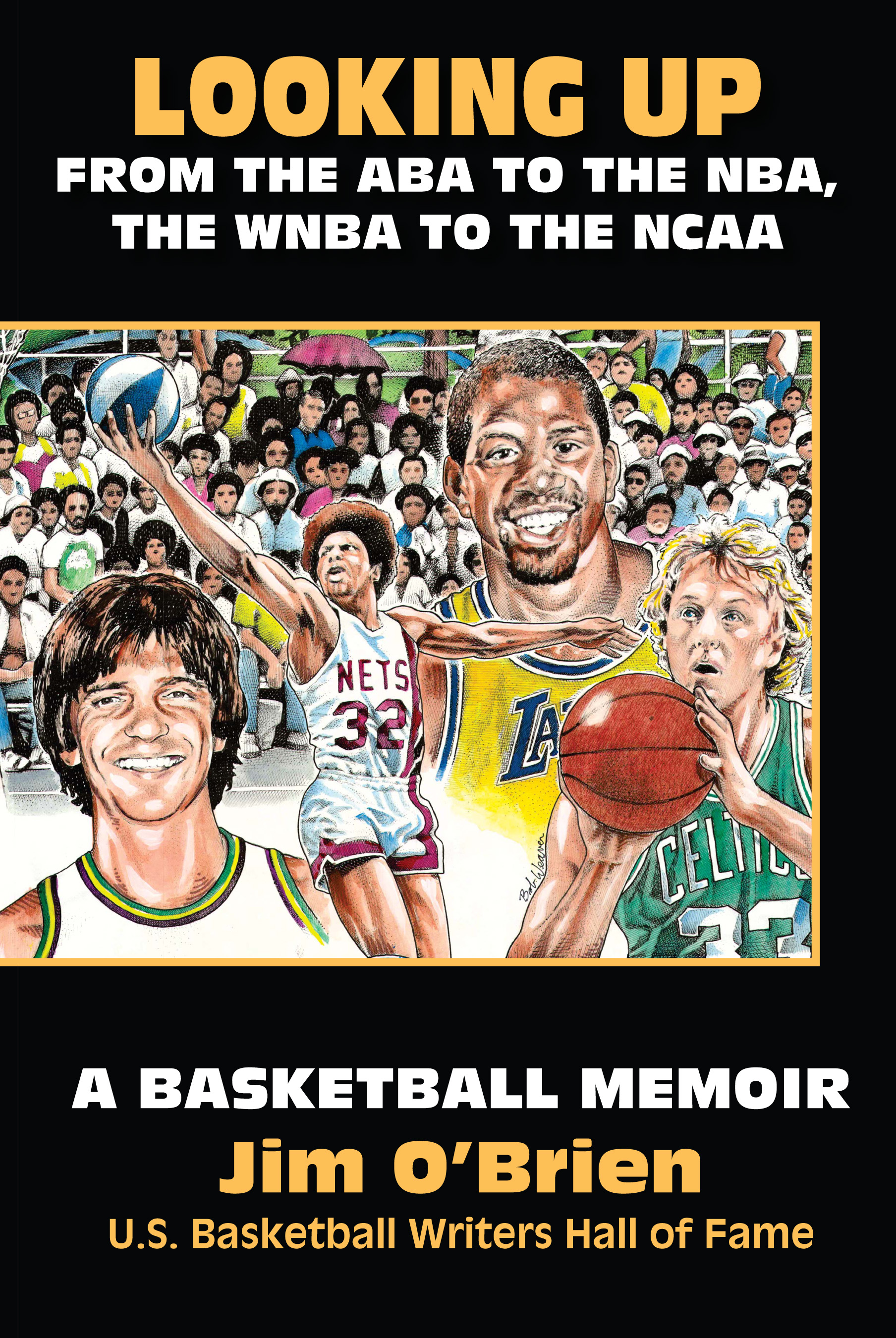
Image result for jim o'brien looking up

Remember veteran journalist and Pittsburgh native Jim O’Brien who wrote a weekly ABA column in The Sporting News, a national publication?  He was called by some as the “Mr. ABA” as he covered the league for seven years.  I visited with him at PNC Park in Pittsburgh last summer when the Pirates played the Milwaukee Brewers and he told me about his new hoops book that was coming out soon.
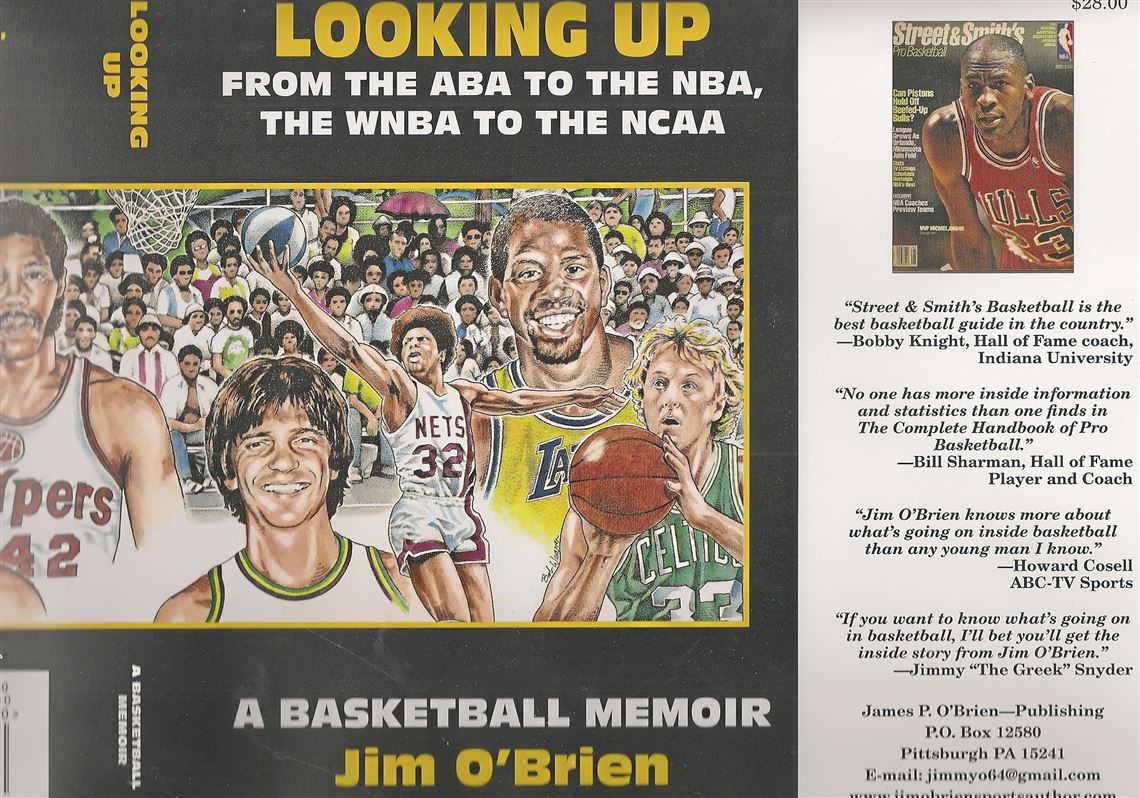
Now published about three months ago, his basketball memoir titled, “Looking Up: From the ABA to the NBA, the WNBA to the NCAA” (James O’Brien Publishing, $28), is loaded with many ABA stories and tidbits. In addition to profiles on well-known ABA personalities such as Bill Sharman, Connie Hawkins, John Brisker, Julius Erving, Dan Issel, and Lou Carnesecca, he also includes chapters on UK coach John Calipari, Jerry West, “Bad Night in Louisville,” Press and Pete Maravich, Charlie Scott, among others.
I have read most of the 480-page paperback and it’s an enjoyable read. I love it.
“The ABA was the most transparent sports league of them all. Writers were welcomed. People wanted to talk to you,” O’Brien told this columnist several years ago. “The league had a lot of colorful owners, coaches and players and they were available to interview.  The league needed recognition and it was a sportswriter’s dream.
“The Kentucky Colonels and Indiana Pacers were my favorite teams to cover. They were first class from top to bottom.  I loved coming to Freedom Hall and staying at The Executive Inn nearby. (Kentucky coach) Babe McCarthy once said of Wendell Ladner, ‘He doesn’t know the meaning of the word fear…as well as a lot of other words.’ (I) had a lot of fun.”
If you’re interested, you can order an autographed copy of the book via O’Brien’s website at JimObrienSportsAuthor.com.
There is another remarkable volume titled “Reborn: The Pacers and the Return of Pro Basketball to Indianapolis” (Halfcourt Press, $29.95) that discusses the story of the birth and first two seasons of the Indiana Pacers, who became one of ABA’s few solid franchises.
Veteran sportswriter Mark Montieth is certainly the right person to write a book about the Pacers’ early days as he grew up in Indianapolis and attended some of their games during the club’s first two years, and later covered the Pacers as a writer for the Indianapolis Star for 12 years. In addition to tons of research he compiled over the years, the author interviewed nearly every player from the first Pacers squad in 1967-68. (Many years ago, Montieth also wrote a book, titled “Passion Play,” which covered coach Gene Keady and his 1987-88 Big Ten champion Purdue Boilermakers.)
As you may recall, the Colonels and the Pacers – separated by 1.5 hours on I-65 — were big ABA rivalries and their intense games drew large crowds.
Former Wildcats like Cliff Hagan (who was a player-coach for the Dallas Chaparrals) and Louie Dampier are mentioned several times in the “Reborn” hardcover, which has over 400 pages, including around 50 photos, many of which have not been published before. If you are an Indiana Pacers or ABA fan, you wouldn’t be disappointed.
More information about the book can be found on author’s website at MarkMontieth.com and you probably could ask about getting a signed copy.
It’s sure an awesome feeling to know that ABA is still alive in memory. Those were the good old days.
Jamie H. Vaught, a longtime columnist in Kentucky, is the author of four books about UK basketball. He is the editor of KySportsStyle.com magazine and a professor at Southeast Kentucky Community and Technical College in Middlesboro. You can follow him on Twitter@KySportsStyle or reach him via e-mail at KySportsStyle@gmail.com.

'Looking Up' : 'The Basketball Diaries' of Jim O'Brien


By Craig Meyer
October 7, 2018
Image result for jim o'brien looking up
There’s a certain point in Jim O’Brien’s “Looking Up: From the ABA to the NBA, the WNBA to the NCAA: A Basketball Memoir” that the reader realizes there’s a fundamental truth spread across the book’s 480 pages — that in most of the basketball tales being told, there’s almost always a connection to Pittsburgh, however large or small it may be.
In a sports-obsessed region, one whose teams and colors are as central to the civic identity as anything else, basketball can exist as something of a forgotten stepchild. With no professional team and a deteriorated pool of local talent, basketball in Pittsburgh can, at best, seem overlooked and, at worst, exist as an object of derision.
But through Mr. O’Brien’s experiences and anecdotes, collected over decades covering the sport in depth, a different world is illuminated.
The book isn’t specifically about basketball in Pittsburgh. Hundreds of pages and dozens of chapters are devoted to some of the most decorated figures in the sport’s history who had no connections to Western Pennsylvania.
In a book that’s personal to some extent — it is a memoir, after all — Mr. O’Brien, who became the first Pittsburgh native inducted into the U.S. Basketball Writers Hall of Fame, deftly connects the sport he loves with the city he loves.
What results from it is an enjoyable and insightful read. For a basketball fan, particularly one who appreciates the nuances of the sport and its history, it’s an immersive experience, even if it may not be that way for those who don’t have a passion for the game.
Click on the link below to read the rest of the article:

Wednesday, June 06, 2012

Pittsburgh: Yes, Clevelanders, there's a lot to love about your sister city

By Eric Susyne and John Kappes                 
The Cleveland Plain Dealer
http://www.cleveland.com/
June 2, 2012


Except for two football Sundays a year, when the colors you wear can spell life or death, Pittsburgh and Cleveland are sister cities.

It's not the architecture. Pittsburgh has more of an East Coast feel to its neighborhoods than Cleveland -- more Queens than West Park.

It's because the two places are so complementary: We have the orchestra and an art museum full of Old Masters; they have Andy Warhol and an internationally celebrated festival of contemporary art every few years. We have the Heights and acres of Tudor homes; they have Shadyside and Squirrel Hill, where old money meets students with nothing going on but the rent.

A weekend by the Three Rivers can make for a great summer getaway. Just be warned: Unless you have a compass strapped to your wrist, abandon all hope of knowing where you are for your first two or three visits. This city of one-way streets, steep hills and detour-laden bridges can be an adventure to navigate.

But there is help. Here is our notebook from a warm May weekend.

Friday: shopping and strolling

After dropping into town via I-279 South and zigzagging onto the Boulevard of the Allies, we headed straight to Walnut Street in the Shadyside neighborhood, east of downtown, for a morning of boutique-hopping and a stylish alfresco lunch.

We parked in one of the public parking lots behind Walnut (beware the resident-only side streets with their pricey parking tickets) and immediately fortified ourselves with espresso drinks and croissants at the Coffee Tree. This airy, open-fronted coffeehouse is a perfect starting point to plot a Shadyside morning or afternoon.

Walnut Street is chock-a-block with a mix of local and national upper-end retailers. One favorite of ours is Toadflax, a chic shop full of exotic flowers, plants, antiques and tastefully curated items for the home.

We continued strolling on Walnut, popping into a branch of Williams-Sonoma, admiring women's designer shoes in the windows of several shops, picking up a jar of locally made cacciatore sauce at a gourmet grocer and sniffing heavy bars of French soap on display at Schiller's Pharmacy.

Imagine that, Cleveland: Strolling and shopping right in the city, not in a suburban mall.

Lunch was a pleasant outdoor affair at Girasole, Pittsburgh's answer to an Italian trattoria. Girasole is a favorite of Pittsburgh's "ladies (and gentlemen) who lunch."

If the weather is good, there is a tiny outdoor patio perfect for a long, lingering meal. We enjoyed a glass of wine and pasta dishes including spaghettini with littleneck clams. Girasole uses specially made pasta from Fede, a Pittsburgh-based company with a passion for Old World pasta-making. (We were strongly tempted to put in a mail order then and there.)

From Walnut Street, it was a short ride to South Highland Avenue, another Shadyside enclave, this one specializing in antiques, home furnishings and independent shops. We loved popping into River House Antiques and navigating the jampacked rooms -- yes, plural -- of authentic 18th- and 19th-century furniture, prints and paintings. (Just remember, as Debbie Harry once sang, that dreaming is free.)

On the other end of the aesthetic spectrum -- but nearby -- is Weisshouse, an ultra-contemporary Pittsburgh furniture store. Between the two, we always enjoy Penhollows, a locally owned gift/book/decor shop.

En route to our accommodations, we stopped on South Craig Street and headed for the Caliban Book Shop, a great example of the dwindling breed of independent, used-and-rare bookstores. You could easily spend an hour browsing the inventory of quality nonfiction, art or history titles. One of us was pried out long before that.

Friday night: charming digs and eats

Driving across town to the South Side, the historic neighborhood across the Monongahela River from downtown, we checked in at the Morning Glory Inn on Sarah Street. The Victorian-style bed-and-breakfast is a convenient and comfortable way to experience an evening on the South Side without having to drive.

The inn has open living-room areas on the ground and second floors, perfect for pre-dinner lounging. Rooms are decorated in period style, right down to the clawfoot tub with brass shower, but with extremely comfy foam mattresses. Rates range from $155 to $450 a night (the latter for a separate guest house). Note that it's often full on weekends from spring to fall for wedding parties, so book early.

A five-block-long walk from the Morning Glory took us to Dish Osteria. An unassuming door on 17th Street leads into one of the most charming restaurants in Pittsburgh.

We swore we were in a true Italian osteria (casual eatery), what with Dish's polished wood tables, muted lighting and authentic Sicilian menu and wine list. We enjoyed a perfect aperitivo (cocktail) at the atmospheric bar before moving to a table and savoring dishes such as carpaccio of tuna with shaved fennel and the lightest ricotta gnocchi imaginable.

We strolled back to the inn via East Carson Street, which is literally lined with bars catering to the 20-something crowd that streams in from across the bridges every weekend, chuckling at the "colorful" language (and high, high heels) of the revelers.

Saturday morning: a cultural beginning

Breakfast at the inn is leisurely and homemade; fresh fruit, juice, buttermilk waffles, good strong coffee and newspapers in a converted, fireplaced kitchen lent a good start to the morning.

Thinking we would have a more cultural and less retail-driven day, we started off at a Pittsburgh cultural institution: the Carnegie Museum of Art.

The Carnegie regularly hosts important special exhibitions such as the recently closed examination of artist/sculptor Maya Lin, along with owning a world-class permanent collection of painting and sculpture.

In the past, we've been lucky enough to be in town for the Carnegie International, a curated, cutting-edge show of contemporary art that the museum hosts every few years (next up in October 2013).
A visit here can be a full-morning event if you also visit the adjacent Carnegie Museum of Natural History, usually ringed in school buses.

Saturday afternoon: sushi and history

After the Sicilian food at dinner the previous night, we were craving sushi. One of Pittsburgh's best Japanese spots was a short drive away. Sushi Two in Shadyside features some of the freshest fish in town, along with reasonably priced specials, guaranteeing a steady lunchtime crowd.

We then made our way to another great Pittsburgh institution: the Frick Art & Historical Center on Reynolds Street, just east of Shadyside. Most people associate Frick with the Frick Collection in New York City; however, Pittsburgh was the home of Henry Clay Frick, the turn-of-the-20th-century industrialist millionaire. Unlike John D. Rockefeller and Cleveland, Frick and his money stayed put.
Within the compound are the Frick home (open for scheduled tours), an extensively manicured yard and gardens, a small yet impressive museum of 18th- and 19th-century European painting (including works by Rubens and Fragonard) and an impressive collection of vintage automobiles.

The latter is especially delightful, with examples ranging from horse-driven carriages to Frick's daughter Helen's sleek 1931 Model K Sport Phaeton Lincoln. She must have been a pistol.

A video presentation on the history of Pittsburgh's auto industry shows early cars being raised up the city's hills on a funicular. Even with modern roads, the traveler can sympathize.

In need of a lift of our own, we enjoyed afternoon tea at the Frick cafe, a lovely formal restaurant on the grounds. We drank special Russian tea and nibbled on homemade scones with jam and clotted cream in the open air on a gorgeous afternoon.

We made our way back to the Morning Glory Inn for some relaxation time before dinner. The New Orleans-style courtyard at dusk is the perfect setting for an evening drink -- we schlepped in our own mini bar -- in preparation for a night on the town.

Saturday night: elegant exploration

We called a taxi and ventured into the Strip District near downtown for dinner and drinks at Eleven Contemporary Kitchen on Smallman Street, an elegant starting point for exploring the area.
(Like Cleveland, Pittsburgh is not a big taxi town, so we had to call back and "remind" the dispatcher twice that we had a tough-to-get weekend reservation at the restaurant.)

The Strip District is a half-square-mile patch northeast of downtown Pittsburgh and a bustling zone of late-night restaurants and bars. Acclaimed television chef Lidia Bastianich, whose son is a business partner of uber-chef Mario Batali, has a restaurant here.

Eleven is definitely an upper-end, "Saturday night out" kind of place. We enjoyed exquisitely crafted martinis (made with Dolin Blanc vermouth and goat-cheese-stuffed olives) and entrees such as grilled swordfish with Italian sausage and mussels.

Back on the South Side, after a much nicer cab experience, we decided on a nightcap at the bar of Ibiza, a bustling, contemporary Spanish restaurant on East Carson catering to a more sophisticated and older clientele than most of the college or sports bars on the street.

We enjoyed the atmosphere and music -- and mused on how irrelevant the Cleveland vs. Pittsburgh debate has become, with each city now boasting great eateries, cultural institutions and unique finds.

Sunday: a favorite stop

Over breakfast at the inn, we navigated a path out of the city (which was more complex than usual, since a marathon had shut down most of the major thoroughfares -- and bridges -- in and out of town). Kudos to Google Maps on our Kindle Fire and the good advice of our evening taxi driver, who pointed us to the obscure but crucial Hot Metal Bridge.

Before leaving the city, we dropped into City Books, a rickety yet beloved bookstore run by a retired Pitt philosophy professor. This shop, nestled on East Carson not far from the Morning Glory, has always been a fond stop for us.

A big portion of our collection of rare art books has come from the shelves here. It's also fun to chat with the owner about the changes the city has seen over the years.

We're always a little worried that it might not be there whenever we return, but the owner manages to hold out and hold on. If it ever did close, it would be a big loss for anyone addicted to book culture.
Car packed, we made our way to Robinson Town Centre, a sprawling suburban mall that is famous for one thing that irks true Clevelanders (because we don't have it) -- a branch of Swedish retail giant Ikea. After an hour of looking at sofas, beds, kitchen implements and trash cans with elaborate, unpronounceable names, we left with tired feet and a $6.99 cheese knife.

By 4 p.m., we were back on the North Coast, where north is a lake and no one bothers with bridges. We said sister cities, after all, not twins.


Eric Susyne is a freelance writer in Cleveland Heights. John Kappes is arts and entertainment editor of The Plain Dealer.


48 hours in Pittsburgh

    Miles from Cleveland: 133.
    Main attractions: Museums (the Carnegie Museum of Art, the Andy Warhol Museum, the Mattress Factory Art Museum); schools (Carnegie Mellon University, the University of Pittsburgh, Duquesne University); high-end shopping (see below); riding the hills on the funicular.
    Don’t miss: Home-decor shop Toadflax (5500 Walnut St.; 412-621-2500) in Shadyside; City Books (1111 E. Carson St.; 412-481-7555) on the South Side.
    Family-friendly attractions: The Children's Museum of Pittsburgh is a huge hit with the under-12 set (and their parents). The Pittsburgh Zoo & PPG Aquarium, Carnegie Science Center and the National Aviary also earn high marks from residents and visitors alike.
    Adult quotient/cool quotient: Although its blue-collar roots still show, a solid 6.5 out of 10 on both scales, with a growing dining scene as well as live music along East Carson Street on the South Side.
    Shopping: Walnut Street in Shadyside has everything from a Sephora and a Benetton to a local shop selling Jimmy Choo and Manolo Blahnik shoes.
    Lodging: Victorian-style bed-and-breakfast Morning Glory Inn, with rooms from $155 (2119 Sarah St.; 412-431-1707 or gloryinn.com); the stately Omni William Penn Hotel, with rooms from about $200 (530 William Penn Place; 412-281-7100 or tinyurl.com/williampenn).
    Dining: Favorites from this trip include Dish Osteria (128 S. 17th St.; 412-390-2012); Eleven Contemporary Kitchen (1150 Smallman St.; 412-201-5656); Girasole (733 Copeland St.; 412-682-2130).
    Getting around: Some areas such as Walnut Street and the South Side are easily walkable, but this is a city of bridges, so a car or taxi remains essential.
    Along the way: Robinson Town Centre (off I-376 at exit 59) for Swedish megastore Ikea (see ikea.com/us/en/store/pittsburgh).
    Total cost for weekend: $850, including about $400 for accommodations and $350 for dining out.

Tuesday, May 03, 2011

Beautiful PNC Park in Pittsburgh is rarely crowded

BY JOE HOLLEMAN
St. Louis Post-Dispatch
http://www.stltoday.com/
Sunday, May 1, 2011
jholleman@post-dispatch.com & 314-340-8254


PITTSBURGH • Going to a baseball game in Pittsburgh is nothing like going to a contest here at Busch Stadium.

Now, don't get me wrong.

Statues of Pirates heroes of seasons past stand guard around the home field, PNC Park; the park is clean, well-designed and boasts a breathtaking skyline view of the city; and the food and drink is from the standard ballpark menu, dozens of delicious and overpriced items.

Where it takes a turn away from St. Louis-style baseball is that, well, no one in Pittsburgh seems to go to baseball games after Opening Day. This conversation actually took place between a traveler and two Pittsburghers (yes, that's what they're called):

TRAVELER • "Last night, there were only about 8,500 people at the game."

PITT-1 • "Well, the Penguins had a playoff game. If they hadn't been playing in town, there'd have been more people at the ballgame."

PITT-2 • "Yeah, like maybe 10,500."

Sad as that story is for Pirates fans, it works in the favor of a Cardinals fan looking to cheer for El Birdos on the road. But let's start at first base:

GETTING THERE

Pittsburgh is a 10-hour drive, about 605 miles, so chances are you will want to fly to this destination. Even though I like to drive, I find that six hours is about all I want to drive for a weekend or three-day trip. Any more than that, and I feel like I spent most of my time off behind the wheel.

Nonstop airfare from St. Louis to Pittsburgh (a 2 1/2 hour flight) was $240, booked about three weeks in advance.

Once on the ground in Pittsburgh, you'll need to either rent a car or taxi into downtown. I chose a taxi service, convinced I didn't need a car for this excursion.

Regular cab fare will run about $40-$50 from the airport to downtown. So I used the Super Shuttle service, which waits until several people sign up before leaving.

The trip downtown cost $20 — with a $5 tip for Sean, who gave me the straight story on sports ("The Steelers are everything"), food ("Gotta go to Primanti's") and urban development ("You're goin' to the North Shore, which was the North Side until developers fancied the name up.")

Except for one short trip downtown, I hung out in the North Side neighborhoods around the ballpark for my entire visit. I walked from my hotel whenever possible. Should you take a taxi from a North Side hotel to the ballpark, the fare would be at most $10, and that includes an appropriate tip.

PLAYING BALL

Walking around PNC Park, it's hard not to feel sympathy for Pirates fans. It seems like every person in this city knows the Pirates have had "18 losing seasons in a row."

Regardless of that albatross of a streak, the area surrounding the park is second to none I've visited. Walking along the city's River Walk, which is on the North Shore of the Allegheny River, there are river kayaking stands, joggers and walkers and stately pedestrian bridges.

Up from the river around the stadium, there are huge statues of Pirates heroes from decades past: Roberto Clemente, Willie Stargell, Honus Wagner and, my fave, Bill Mazeroski caught waving his hat in celebration of his seventh-game, walk-off home run to beat the Yankees in the 1960 World Series.

The beauty continues as you enter PNC, with excellent sight lines from all sections of the park and what I think is the absolute best view offered at any park: The home-to-center field visage that takes in the entire Pittsburgh skyline.

I bought my ticket two weeks before the game, using StubHub to secure a first-row bleacher ticket. The cost is $14 in advance, or $16 the day of the game. Stubhub adds a $4 surcharge. But I thought it would be best to have ticket in hand instead of trying to get tickets once in Pittsburgh.

That was my St. Louis coming out. There are so many tickets available in Pittsburgh, it's not even funny. Even with the season new and the Pirates at .500 when I went, one guy was struggling to get rid of four tickets behind the home dugout, with a free parking pass. All he wanted, he said, was to get the list price.

Dugout boxes are $35; infield boxes are $27 and outfield grandstand tickets are $11. Trust me, and everyone I talked to, there will be tickets available. In a stadium that seats 38,496 people, average attendance is less than 20,000.

But if you want to be absolutely sure you'll have great seats, you can go through StubHub (http://www.stubhub.com/) or the Pirates box office (http://www.pirates.com/).

I'm not a big ballpark tour kind of a guy. If you have a historically significant park like Wrigley, Fenway or Chavez Ravine in LA, then sure. But what can they tell me about a park less than 10 years old? Still, tours are available except on Sundays, holidays and days of afternoon games. They are $7 for adults and $5 for seniors, students and children. Tickets are available online or at the main ticket window at PNC.

When it comes to food at a ballpark, I'm stingy. There are many tasty treats at a game, sausages, dogs, nachos, all good. It's the price tag I find oppressive, and that's the same across the National League.

I did enjoy my stop at Manny's BBQ inside the park. The sandwich featured pulled pork, onion relish AND two pierogis on a bun. It was $7.50 of carnivorous overkill, and I ate every bit of it.

Best of all, former Pirates catcher Manny Sanguillen is usually at the stand, shaking hands and signing autographs. Even at 53, it's fun to meet a guy you still have on a baseball card from your childhood.

KILLING TIME

The Andy Warhol Museum • 117 Sandusky Street, http://www.warhol.org/; 1-412-237-8300. Admission: $15 adults, $9 seniors; $8 students and children.

One of the highlights of a short trip, aside from watching the Cardinals cruise to victory, is finding an excellent side venture to occupy your time that morning and afternoon before the actual ballgame.

In Pittsburgh, The Andy Warhol Museum — simply called 'The Warhol" by everyone — is just that kind of gem. It is the largest museum in the U.S. dedicated solely to the work of one artist.

Located about one-quarter mile east of PNC Park and less than a half-mile from my hotel, I leisurely walked to the museum in 15 minutes. There are seven floors in the museum, but they are somewhat smaller floors. It is quite possible to cover the museum in an afternoon.

Warhol, the undisputed king of pop art was a Pittsburgh native and lived there until he graduated from Carnegie-Mellon Institute and moved to New York to begin his career as an illustrator.

Start your tour on the seventh floor, where selections from Warhol's last important work, the "Last Supper" cycle, dominate the space. Also on this floor is a collection of Warhol's early illustrations for various advertisements, including some beautiful sketches done for I. Miller Shoes.

Of course you'll be able to check out Warhol's famous "Campbell's Soup" series on the fifth floor, where his other most-famous work are displayed: "Three Marilyns," "Jackie 64" and "Elvis (11 Times)."

My favorite piece was on the second floor, where another "Last Supper" work was displayed, a collaboration between Warhol and Jean Michel Basquiat.

In this piece, Jesus and his apostles are represented on 10 boxing heavy bags suspended from the ceiling, broadcasting the traditional Catholic story of Christ's suffering through a powerful blend of classic and pop imagery that also speaks to Warhol's lifelong devotion to Catholicism and Basquiat's sad death from a heroin overdose.

If this interests you at all, set aside two hours minimum to tour it. If you have a free Friday evening, take advantage of the half-price "Good Friday" from 5 to 10 p.m.

Art lovers may also want to check out the Mattress Factory, a modern art museum featuring conceptual room-sixes artworks. It is located in the Mexican War Streets neighborhood. (For more information, call 1-412-231-3169 or go to http://www.mattress.org/.)

If art is not your interest, these attractions are all less than one mile from PNC Park:

• National Aviary, 1-412-323-7235; http://www.aviary.org/

• Children's Museum of Pittsburgh, 1-412-322-5058; http://www.pittsburghkids.org/

• Carnegie Science Center, 1-412-237-3400; http://www.carnegiesciencecenter.org/

EATING, DRINKING

Primanti Brothers • Various locations, http://www.primantibros.com/

Sean, the aforementioned shuttle driver, was not the only person to recommend Primanti Brothers for my first meal in Pittsburgh.

Now famous from appearances on most every food and/or restaurant show on every food and/or travel channel, Primanti's is known for making excellent sandwiches with a handful of fresh-cut fries right on top.

(I didn't bother to mention to Pittsburghers that you can get those in Illinois, and they're called "horsehoes.")

There are now 13 locations of this restaurant, which is open 24 hours a day, seven days a week. But I was told I needed to visit the original site, 46 18th Street in "The Strip," a section of downtown Pittsburgh long known for ethnic food markets and, more recently, nightclubs and restaurants.

Simply put, Primanti's is a joint. The waitresses all seem to have been on the job for a while and have endured their fair share of tourists. They're unfailingly polite, but you can tell they prefer tables full of locals over visitors (like me) with a notebook and camera.

Except for Toni Corradeti Haggerty, a short, feisty Italian woman who manages the original location with a brusque charm.

"Do you have any suggestions," I asked, looking at the menu.

"I suggest you go someplace else," she said without missing a beat.

But once you have decided that you want a half pastrami/half corned beef sandwich with everything, she gets right to work and quickly places a sandwich that has the weight of a full meal.

"Everything here is fresh, sweetie. We make the slaw and the fries every day," Haggerty said.

Even better, there are few places in Pittsburgh that do not sell Yuengling, as good a beer as you can get from a large brewery. We discovered that it takes exactly two bottles of lager to wash down a Primanti sandwich.

Max's Allegheny Tavern • 537 Suismon Street, 1-412-231-1899; http://www.maxsalleghenytavern.com/

If you're like me, you avoid recommendations found in hotel room brochures. I follow advice Calvin Trillin once wrote in one of his food books, which is to ask a regular person in a city you're visiting where he would take his wife to dinner.

So I did that, and was told about Max's. The recommendation was this: "They have great German food and all kinds of beer."

Good enough for me and, being auto-free, I was pleased it was only five blocks from my hotel.

Do you know that feeling of walking into a place in a town and immediately knowing that if you lived in that town, this could easily become your "place." Well, that's Max's.

From hipsters in their 20s, through blazer-wearing business people, to white-haired diners, Max's draws a diverse crowd.

At the bar, they give out bowls of fresh-popped popcorn, with butter if you want it, and will serve up a draft of Dogfish Head 60-Minute in a friendly but not cloying manner. It's a place where you can chat it up with the bartender and patrons or just sit and drink a pint without being bothered.

"Welcome. Whatever" would be a great motto for the place.

And a great dish — from a menu the size of a small book with just about any German dish you'd want — is their Jager Schnitzel. (They serve six different schnitzel dishes.) The brown mushroom gravy was perfect and gave an earthy base for the tender mild-fed veal. Sides of potato pancakes with sour cream and German potato salad rounded off the feast.

I'd like to share another dinner venue with you in Pittsburgh, but when it came to time for my other non-ballpark meal, I went back to Max's and had another plate of Jager Schnitzel.

So as not to be too predictable, I had applesauce instead of potato salad and Kostritzer Black Lager instead of Dogfish.
Thursday, February 10, 2011

Dapper Dan gives Joe Greene lifetime award

Suzie McConnell-Serio, Jamie Dixon, Chip Ganassi also stand tall in spotlight in diamond anniversary celebration at convention center

Thursday, February 10, 2011
By Michael Sanserino, Pittsburgh Post-Gazette
http://www.post-gazette.com/sports/

Michael Henninger/Post-Gazette

Former Steelers player Joe Greene holds up a shirt thrown to him by speaker Vince Sands, chaiman of BNY Mellon, a joking reference to the famous Super Bowl commercial starring Greene.


Who better to honor at the diamond anniversary of the Dapper Dan Dinner & Sports Auction than a man who has six rings?

It doesn't hurt that he wore No. 75 his entire career, either.

Hall of Famer "Mean" Joe Greene accepted the Lifetime Achievement Award at the 75th annual Dapper Dan Dinner & Sports Auction Wednesday night at the David L. Lawrence Convention Center.

The dinner, presented by BNY Mellon, is the largest fundraiser of the year for Dapper Dan Charities, a division of PG Charities, the Post-Gazette's charitable arm. Proceeds will go to the Boys & Girls Clubs of Western Pennsylvania's youth sports and education programs.

Greene, a 1987 Pro Football Hall of Fame inductee and a current advisor to the Steelers, said he was humbled to receive the award. He won four Super Bowls as a defensive tackle and was on the Steelers staff for the two most recent championships.

Several former teammates were there to support Greene and wish him well. Most say they remembered Greene as a leader and a winner, far from his cruel reputation on the field.

That is, until L.C. Greenwood spoke up.

"Joe is the nastiest football player I've ever seen," Greenwood said.

Greene said when the Steelers drafted him in 1969, he dreaded the thought of joining the moribund franchise.

"But thanks to the Chief [Art Rooney], Dan [Rooney] and Chuck Noll, they gave me a chance," Greene said.

The awards dinner welcomed more than 800 guests and dignitaries to pay tribute to the best of Pittsburgh sports in 2010.

In a town known for its devotion to football and a newfound love for hockey, it was two basketball celebrities who took home the titles of sportsman and sportswoman of the year.

Pitt basketball coach Jamie Dixon was recognized as the Dapper Dan Sportsman of the Year. Dixon coached a team of underdogs to success last season. With just one returning starter, he led the Panthers to 25 victories and a second-place finish in the Big East Conference. This season, the Panthers are one of the Top 5 teams in the country.

A Pirates fan since he was a child, Dixon credited the Steelers and Penguins with helping inspire him as a coach.

"I thank the Rooneys, I thank [Penguins president] David Morehouse and the Penguins for giving us a great example for what to be like as we try to build our program to be champions like the Steelers and the Penguins," Dixon said.

Duquesne women's basketball coach Suzie McConnell-Serio, the Sportswoman of the Year, had to hurry to the dinner because she was busy doing what earned her the distinction in the first place -- coaching the Dukes to victory.

"When I got the phone call that I was to accept this award, I was shocked," McConnell-Serio said, "because I really feel like ... we're not where we want to be yet."

It was McConnell-Serio's second Dapper Dan honor, having won the inaugural sportswoman of the year honor in 1999 as a WNBA player with the Cleveland Rockers.

She has led the turnaround of the Duquesne women's basketball team from a program that struggled to compete for a spot in the Atlantic 10 tournament to a program that competes for A-10 titles.

"Now," she said, "our team talks about making it to the NCAA tournament."

Bryant Harper, a student at McKeesport Area High School, was honored as the Eat'n Park Hospitality Group Youth Athlete of the Year.

The evening also paid tribute to Fox Chapel resident Chip Ganassi with the first sports leadership award, which will not be awarded annually.

In 2010, Ganassi became the first car owner to win the Daytona 500 and the Indianapolis 500 in the same year and only the second owner to win both in a lifetime. He added a Brickyard 400 win later in the year for good measure.

"I've always believed my Pittsburgh roots have played a large role in my work ethic and whatever success I've had in sports," Ganassi said. "Maybe it was the tremendous upbringing at the hands of my parents. Maybe it was the success of the sports teams of the 1970s in this town that made me expect to win. Or maybe it was just the good old work ethic that this town has.

"It was probably a combination of all three."

Michael Sanserino: msanserino@post-gazette.com or 412-263-1722.

Read more: http://www.post-gazette.com/pg/11041/1124424-66.stm#ixzz1DYjlqmKO


Tuesday, January 25, 2011

Melded together: Steelers, fans share special bond forged in fire

By KATE HAIROPOULOS
The Dallas Morning News
http://www.dallasnews.com/sports/super-bowl/
Published 24 January 2011 11:54 PM

Steelers fan "Chad" supports his favorite team with his words and wardrobe during the AFC Championship football game between the New York Jets and the Pittsburgh Steelers at Heinz Field in Pittsburgh, PA on Sunday, January 23, 2011. (Photo: Louis DeLuca/The Dallas Morning News)

PITTSBURGH — Len DiNaples Sr. took a swig of Iron City beer and displayed the bottle to an out-of-towner.

“This is what you want,” he said, nodding at the local brew, his white hair engendering trust, as he reclined in a cozy booth at Primanti Bros.

The sandwich shop radiated a Pittsburgh vibe, minus the slow-to-order tourists, many wearing Steelers gear. No Stella Artois or Amstel Light here. Pastrami sandwiches, complete with Weight Watchers-busting fries and coleslaw smothered on top of the meat, are served on wax paper instead of plates.

The working-class soul of this city — gleaming and sagging all at once, currently covered with soot-blackened snow — is undeniably connected to its NFL franchise. The Steelers have long embodied Pittsburgh’s gritty spirit and helped create an unapologetic ego. Now, again, the city’s black-and-gold heart is soaring as the Steelers prepare for Super Bowl XLV on Feb. 6 at Cowboys Stadium.

It’s Pittsburgh’s third Super Bowl appearance in six seasons, stirring talk of another dynasty to match the four Super Bowls won between 1975 and 1980. After the Steelers knocked off the bravado-spewing New York Jets in Sunday’s AFC Championship Game, it’s onto the Green Bay Packers, another franchise that many consider NFL royalty and one that Steelers fans respect.

“The pride of our city is on the line,” said DiNaples, 68, a longtime Pittsburgh resident and season-ticket holder, who wore a leather jacket with patches commemorating the Steelers’ NFL-best six Super Bowl victories. “We have a good chance at No. 7.”

“At the gates of seven” is how the Pittsburgh Post-Gazette put it on Monday’s front page. Local TV news trumpeted “Destination: Dallas” promos after the Steelers’ win. References to Arlington, Fort Worth or North Texas were minimal.

While North Texas’ Super Bowl turn nears, Steelers fans relish the continued prosperity of a team with which they feel an almost religious union.

Pittsburgh’s Sonny Amato, a 30-something, is too young to relive the steel mill closings that coincided with the Steelers’ initial success of the 1970s. But he said the shared identity between the city and Steelers is tangible, as is the respect for the longtime ownership of the Rooney family. Pictures of the late Art Rooney, chomping his iconic cigar, emblazoned with the word “Believe,” are plastered in store fronts.

“It’s about the whole organization, it’s consistency year to year, and that they try to do things the right way,” said Amato, editor of a Steelers’ fan blog, theterribleblog.com, named in honor of Pittsburgh’s famed Terrible Towels waved during games.

A Primanti Bros. pastrami sandwich

The Steelers’ distinctive logo couldn’t be missed during a drive through the city’s core, from men wearing it proudly as they waited for the bus to a glowing neon sign in a pizzeria window.

“You have to understand, we wear Steelers gear all year; it’s part of our wardrobe,” said Jim Coen, owner of a store that hawks all things Steelers, located near Primanti Bros. in the Strip District.

Coen’s father worked in a steel mill that closed in the 1970s. So he still becomes emotional when he describes the connection between the city and the Steelers.

“The city fell to [expletive],” he said. “When that happened, that’s when the Steelers won Super Bowls. And the city had something to hope for.”

Super Bowls are good for business. Fans clamored Monday for AFC championship T-shirts that were only just delivered around lunch time.

Women are huge consumers of Steelers ware; Coen can’t keep women’s sizes in stock. At least they’re easier to find than season tickets. Amato inherited his from his grandmother. Looking to get married? Coming from season-ticket-holding stock may be the asset to flaunt.

Coen’s shop is named Yinzers, derived from a term that could be used much like “y’all” is in Texas. But it also refers to people from Pittsburgh. Or who used to be, Coen said.

Something, though, about the Steelers’ success, mystique or branding, connects with NFL fans well outside the city and even across the U.S. border — much as with the Dallas Cowboys . Fans commonly travel from long distances for games. Alex Martinez Jr. attended Sunday’s frigid game with his father, who were visiting from sunny Cancun.

Wherever members of Steelers Nation live, they’ll tell you this season was not marked for magic from the start. Accused of sexual misconduct, quarterback Ben Roethlisberger was suspended for the first four games for violating the NFL’s code of conduct.

But the Steelers found a way. Again. According to cornerback Ike Taylor, the Steelers are winning so much that perhaps now only a Steelers Nation-vs.-everyone else mentality will do.

“People don’t like successful people,” Taylor said Monday. “Just the tradition we have here, the success, we feel like a lot of people get tired of seeing the same people [win]. {ellipsis} I’m just happy to be a Pittsburgh Steeler.”

Amato said Steelers fans don’t want to be known as cocky, like, say, Yankees fans, but {ellipsis}

“We have been watching a lot of playoff games lately,” he said.

Steelers fans want to believe that they’re watching another dynasty. That the names Roethlisberger, Hines Ward and Troy Polamalu may ultimately carry the same respect as Terry Bradshaw , Franco Harris and Lynn Swann. They want another Super Bowl to celebrate.

“No one else even has six [Super Bowl wins] — we would really set the bar,” said DiNaples, well aware that this rankles Cowboys fans, who claim five Super Bowl wins. “I may be gone by the time someone else gets to seven.

“But by that time, we’ll have eight.”