By Karen Price
TRIBUNE-REVIEW
Saturday, September 16, 2006
Evgeni Malkin's first true jaw-dropping play of his Penguins career came midway through the second half of the team's first training camp scrimmage Friday.
The 20-year-old Russian center, playing on a line with Ryan Malone and Mark Recchi, banked the puck off the back of goaltender Dany Sabourin to score. Afterward, Recchi said what people watching in the stands had been thinking.
"It was a very smart play," Recchi said. "He saw something, and he took it. ... He's as close to Mario in terms of size and what he can do with the puck as we've seen in a while."
It was a big statement, but Malkin, 6-foot-3 and 192 pounds, also made a big impression in his first day practicing and scrimmaging with the Penguins' full complement of players.
Coach Michel Therrien, who said yesterday that he plans to keep lines together as much as possible to build chemistry going into the regular season, praised the Malone-Malkin-Recchi line.
"(Malkin) looked really good," Therrien said. "That line seemed to click. I was really impressed with Malkin the way he played with Malone and Recchi. I thought they played really well together. That's the purpose of our training camp is we're trying to establish our lines quickly so when we start the season we've got a pretty good idea how things are clicking with teammates on lines and defense."
Therrien also had good things to say about his other top forward line made up of center Sidney Crosby between Colby Armstrong, his linemate at the end of last season, and newcomer Nils Ekman, who scored 21 goals with the San Jose Sharks last season.
"Very good," Therrien said of Ekman taking the left side with Crosby and Armstrong. "I liked the way that he skated, and I liked the way that he saw the ice. He's got the speed to play with Crosby."
Yesterday was a first look at the formidable punch the Penguins finally now pack down the middle with Crosby and Malkin both on the roster.
"(Malkin) passes well, shoots well, skates great. ... We've got a great 1-2 punch right now," Recchi said. "They're going to complement each other tremendously, and it's going to be fun to be part of it."
Crosby also had great things to say about the team's newest budding star, who also scored on a penalty shot and made another impressive move to circle away from a defender in the offensive zone yesterday.
"It was just as I expected," Crosby said. "Smart player, fast, and he showed his skill out there. I had skated with him a little bit before and I saw him play. He hasn't changed his game, which is good. The ice surface has changed, and it's a little different hockey, I think, and he's maintained the same game. I think that's a huge reason why he's doing well out there."
Karen Price can be reached at kprice@tribweb.com.
Saturday, September 16, 2006


Friday, September 15, 2006
Obituary: Bill Saul
Obituary: Bill Saul / Steelers linebacker in 1960s, Butler High alum
Nov. 19, 1940 - Sept. 12, 2006
Saturday, September 16, 2006
By Jim McKinnon, Pittsburgh Post-Gazette
 In a 1968 rookie card for Bill Saul, the Butler sports hero is clad in a Baltimore Colts football jersey, though the label below his picture says "Pittsburgh Steelers."
That's how he will most be remembered around here.
Mr. Saul, who left his mark on a number of sports teams from grammar school through college and beyond, died Tuesday at his Baltimore home. He was 65.
The fame began to build in Butler High School, where he starred in football and set records in basketball for the Golden Tornadoes before he graduated in 1958.
Mr. Saul even dabbled in baseball before he went to college.
Over the next four years he played football and basketball at Penn State University.
He was drafted in 1962 by the Baltimore Colts as a linebacker.
He played with the Colts for two years before he was traded to the Steelers, where he played linebacker in 1964 and from 1966-68.
After an abbreviated season with the New Orleans Saints in 1969, Mr. Saul finished his career with a full season with the Detroit Lions.
Coming from a sizable family in Butler, Mr. Saul turned out to be a trailblazer for two of his brothers, twins Richard and Ronald Saul.
Richard played for the Los Angeles Rams and Ronald played for the Washington Redskins.
All three Saul brothers were honored in September 2004 as part of Butler High School football's inaugural Hometown Heroes program at Art Bernardi Stadium.
He is survived by two children, Clifton Saul and Gail Klaben, both of Baltimore; five brothers, Richard of Newport Beach, Calif.; Ronald of Charlestown, W.Va.; Craig of Butler; David of Winter Park, Fla.; and Raymond of Butler; three sisters, Mary Elizabeth Brandon of Franklin, Pa.; Jean Baxter of Butler; and Joan Schomer of Boardman, Ohio; and four grandchildren.
Services will be today at 10 a.m. at the Leonard J. Ruck Funeral Home, in Baltimore, Md.
Memorial contributions may be made to the American Cancer Society.
(Jim McKinnon can be reached at jmckinnon@post-gazette.com or 412-263-1939. )
Nov. 19, 1940 - Sept. 12, 2006
Saturday, September 16, 2006
By Jim McKinnon, Pittsburgh Post-Gazette
 In a 1968 rookie card for Bill Saul, the Butler sports hero is clad in a Baltimore Colts football jersey, though the label below his picture says "Pittsburgh Steelers."
That's how he will most be remembered around here.
Mr. Saul, who left his mark on a number of sports teams from grammar school through college and beyond, died Tuesday at his Baltimore home. He was 65.
The fame began to build in Butler High School, where he starred in football and set records in basketball for the Golden Tornadoes before he graduated in 1958.
Mr. Saul even dabbled in baseball before he went to college.
Over the next four years he played football and basketball at Penn State University.
He was drafted in 1962 by the Baltimore Colts as a linebacker.
He played with the Colts for two years before he was traded to the Steelers, where he played linebacker in 1964 and from 1966-68.
After an abbreviated season with the New Orleans Saints in 1969, Mr. Saul finished his career with a full season with the Detroit Lions.
Coming from a sizable family in Butler, Mr. Saul turned out to be a trailblazer for two of his brothers, twins Richard and Ronald Saul.
Richard played for the Los Angeles Rams and Ronald played for the Washington Redskins.
All three Saul brothers were honored in September 2004 as part of Butler High School football's inaugural Hometown Heroes program at Art Bernardi Stadium.
He is survived by two children, Clifton Saul and Gail Klaben, both of Baltimore; five brothers, Richard of Newport Beach, Calif.; Ronald of Charlestown, W.Va.; Craig of Butler; David of Winter Park, Fla.; and Raymond of Butler; three sisters, Mary Elizabeth Brandon of Franklin, Pa.; Jean Baxter of Butler; and Joan Schomer of Boardman, Ohio; and four grandchildren.
Services will be today at 10 a.m. at the Leonard J. Ruck Funeral Home, in Baltimore, Md.
Memorial contributions may be made to the American Cancer Society.
(Jim McKinnon can be reached at jmckinnon@post-gazette.com or 412-263-1939. )
Wednesday, September 13, 2006
Joe Starkey: Juiced for Jaguars
Additional Stories
Big Ben listed as questionable
Notebook: Cowher expects coverage to improve
Ben questionable for Monday night's game
Washington getting comfortable
Coaches will monitor Parker
Davenport putting past behind him
Joe Starkey
TRIBUNE-REVIEW
Wednesday, September 13, 2006
Something wild is going to happen Monday night.
We know this because the Steelers are playing the Jacksonville Jaguars -- and something wild always happens when these former division rivals meet.
In the aftermath of their most recent matchup, you'll recall, Tommy Maddox was picking garbage off his lawn. A year earlier, rookie quarterback Ben Roethlisberger was picking apart the Jaguars on national television.
Roethlisberger moved the Steelers 56 yards in six heart-stopping plays to put them in position for a field goal and a 17-16 lead with 18 seconds left. It wasn't over, though, until the Jaguars narrowly missed a 60-yard field-goal attempt as time expired.
But then, neither of those games could compare to the time Plaxico Burress spiked a live ball; the time Bill Cowher cocked his arm as if ready to punch a Jaguars player rumbling down the sideline for a touchdown; the time Jerome Bettis nearly died from an asthma attack; the time Kordell Stewart won his final start in a Steelers jersey (on a Dewayne Washington defensive play, no less); or the time Greg Lloyd accused Jaguars receiver Keenan McCardell of calling his wife and proceeded to knock McCardell silly.
Away from the play, of course.
Monday night's game at Alltel Stadium has built-in drama, with Roethlisberger's status in question as he recovers from a Sept. 3 emergency appendectomy. Cowher indicated during his weekly news conference Tuesday that even if Roethlisberger is cleared to play, it's not a done deal. The Steelers are going to be extra cautious.
That's understandable, because Roethlisberger is the franchise centerpiece.
"The kid's been through a lot," Cowher said, referring to both the near-fatal motorcycle accident in June and the appendectomy. "That's the thing I want to make sure of, that he is comfortable and feels good about himself. We'll make the decision at that point."
Here's the dilemma: It seems unlikely Roethlisberger will be 100 percent healthy. Do you play him if he's, say, 85 percent and medically cleared? Do you play him if he practices poorly?
Yes and yes.
There's a reason the big boy got that $9 million signing bonus, and it wasn't to wear a backwards ball cap on the sideline. The Steelers survived a game without Roethlisberger. Charlie Batch played great. But this team will need Roethlisberger's mobility and sublime talent in what promises to be a hostile environment against a very good team.
Even if the Jaguars' pass rush is severely hampered by the loss of Reggie Hayward, Roethlisberger gives the Steelers their best chance. He also has a history of performing well when hurting, so a terrible practice or two shouldn't prevent him from getting the call.
Besides, the Steelers can't afford the luxury of waiting around until he's perfectly healthy. The schedule is too harsh. After Jacksonville comes a home game against Cincinnati -- that didn't work out too well on a short week last season -- followed by trips to San Diego and Atlanta sandwiched around a home game with Kansas City.
That's life as the defending Super Bowl champion.
You have to believe Cowher already has a good idea Roethlisberger will play, but it would be no surprise to see the suspense drawn out until kickoff -- at which time the real drama would begin.
Given the history of this series, one can only imagine what the night might bring.
Joe Starkey is a sports writer for the Pittsburgh Tribune-Review. He can be reached at jstarkey@tribweb.com
Mario doesn't want No. 66 re-retirement ceremony
 Wednesday, September 13, 2006
By Dave Molinari, Pittsburgh Post-Gazette
Mario Lemieux specialized in the spectacular throughout his time in the NHL, but the final act of his playing career will be decidedly low-key.
The Penguins, at Lemieux's request, will not stage an extravagant ceremony to re-retire his No. 66 sweater.
Instead, the sweater will be returned quietly to its previous place of honor near the Mellon Arena roof shortly before the Penguins' regular-season home opener against Philadelphia Oct. 5.
And while there likely will be some sort of acknowledgement -- perhaps a spotlight on the number, accompanied by video highlights of Lemieux -- the night of the Flyers game, there will be a minimum of fuss and fanfare.
"We're not going to do an official retirement [ceremony]," said Tom McMillan, the team's vice president of communications. "Mario's style has always been very understated, and he didn't want to do an elaborate ceremony. We did that back in 1997 [when Lemieux's number was retired for the first time].
"He's excited about this young team, and wants the focus to be on the young guys and the future."
Lemieux retired initially after the 1996-97 season, but resumed his playing career late in 2000. Health problems, particularly an irregular heartbeat, convinced him to retire for good last winter.
He is the franchise's primary owner and is in the process of trying to sell it, but that apparently played no role in his decision to downplay his sweater retirement.
Lemieux, who watched part of yesterday's rookie-camp workout at Mellon Arena while surrounded by scouts and members of the front office, will turn 41 on the day of the opener.
(Dave Molinari can be reached at DWMolinari@Yahoo.com. )
Pirates, KDKA end long radio broadcast marriage
Demographics powered move to 104.7 FM
Wednesday, September 13, 2006
By Bob Smizik, Pittsburgh Post-Gazette
The Pirates' decision to end a more than 50-year radio relationship with KDKA and take their broadcasts to WPGB, which is part of the Clear Channel Communications empire, was strictly business, a point emphasized time and again by Tim Schuldt, the team's vice president of marketing, sales and broadcasting.
Mr. Schuldt, who brokered the deal, had a long list of reasons for the move and all dealt with the advantages of Clear Channel and the large platform of opportunities it presents to enhance the business of the team.
The move, officially announced yesterday, was based on an abundance of studies made by the Pirates and a close watch on the regional market. The team scrutinized the ratings power of the stations involved and, in particular, their demographics.
It was well-known from the start that Clear Channel, which owns about 1,200 stations across the country, would provide the Pirates with a larger audience and younger demographics. KDKA, one of five stations in the region owned by CBS, skewed older and its sister stations did not provide the ratings clout to make up for that.
At the same time, the Pirates announced that all five of their broadcasters, whose contracts expire at the end of this season, will be back next year. Play-by-play announcers Lanny Frattare and Greg Brown and analyst Bob Walk have agreed to three-year contracts. The team exercised the one-year options it had on the services of analysts Steve Blass and John Wehner. Their contracts will expire after the 2007 season.
The Pirates will continue to have total control of the broadcasts and the announcers will remain in their employ.
The Pirates and KDKA had been together almost since baseball games have been on the air. The first radio broadcast was on KDKA in 1921 between the Pirates and Philadelphia Phillies. Records do not detail exactly how long the two were partners, but the current relationship dates to 1955.
Pirates CEO Kevin McClatchy said, "KDKA has been synonymous with the Pirates for more than 50 years. We are extremely thankful to everyone at KDKA, both past and present, for the impact they have had on our organization and the many generations of fans. We have a lot of good friends at KDKA, therefore this was not an easy decision."
KDKA, which was runner-up earlier this year to Clear Channel in bidding for the radio rights of the Steelers, put its best offer on the table, but it wasn't enough.
"We presented them with an offer that was good for us and we thought was good for them,'' said KDKA general manager Michael Young. "It's an amicable parting. We wish the Pirates the best.''
It was as much the Clear Channel stable of stations as it was WPGB (104.7 FM) that won the contract.
"What we really wanted and needed,'' said Mr. Schuldt, "was a firm contractual commitment on secondary and ancillary programming and a cluster of stations that would deliver other audiences that maybe a flagship couldn't."
In signing on with WPGB, the Pirates also join five other Clear Channel stations. Most importantly, they are involved with WDVE (102.5), the rock station that is the ratings leader in the region, WXDX (105.9), which delivers a young male demographic, and WKST (96.1), which has a strong female demographic. The Pirates have found that 40 percent of their fans are females.
John Rohm, regional vice president for Clear Channel, said, "As the single largest media organization in the Pittsburgh market, no other medium can match our market penetration and ability to reach fans. Our years of experience with the Steelers, Penguins and Pitt football and basketball have helped us fine-tune our broadcasts, our delivery system and our talent.''
WPGB will carry all 162 Pirates games, 12 exhibition games, pre- and postgame shows and the Dave Littlefield Show. All advertising revenue derived from those shows will go to the Pirates.
Clear Channel will realize the advertising revenue from auxiliary programming, which is slated to include a call-in show, expected to be an hour in length, after every game. The call-in show, Mr. Schuldt said, is something KDKA could not provide.
But it was the audience and the demographics that won the day for Clear Channel.
"People who have the most propensity to buy a season ticket from us are men in the 25- to 54-year-old age group,'' Mr. Schuldt said. "WDVE is the 800-pound gorilla in that demographic.
"Written in the agreement is heavy cross-promotion on all of the Clear Channel stations. Not only will that recognize 104.7 as our new flagship, but it will detail game times and how to buy tickets. The weight of this is massive.''
Some of the demographic statistics cited by Mr. Schuldt:
* WPGB's audience is 116 percent more likely than the mean to have an advanced college degree; KDKA's audience is 10 percent more likely.
* WPGB's audience is 112 percent more likely than the mean to have a household income of between $100,000 and $149,000; KDKA's is 7 percent more likely.
As for ratings, Clear Channel clearly outranked the CBS Group in all the key demographics, in many cases by more than 2 to 1.
Plans already have been formulated to have the team's announcers regularly appear on highly rated Clear Channel shows. Mr. Blass will make guest appearances on the No. 1-rated "WDVE Morning Show with Jim Krenn and Randy Baughman." Mr. Walk and Mr. Brown will alternate appearances in the morning on WXDX with Tim Benz.
Pirates games will take away a large part of the high-rated "Ellis Cannon Show," which airs from 6 to 8 p.m. on WPGB. Nothing definite has been formulated, but Mr. Cannon is expected to be part of the pregame show.
Unlike those of other Clear Channel sports properties, the Pirates' games are not yet scheduled to be simulcast on WBGG-AM (Fox Sports Radio 970).
Mr. Schuldt, whose primary job is to sell tickets, clearly was a happy man.
"Between WPGB and WDVE, in men 25 to 54, we've got an incredible powerhouse.''
(Bob Smizik can be reached at bsmizik@post-gazette.com. )
Wednesday, September 13, 2006
By Bob Smizik, Pittsburgh Post-Gazette
The Pirates' decision to end a more than 50-year radio relationship with KDKA and take their broadcasts to WPGB, which is part of the Clear Channel Communications empire, was strictly business, a point emphasized time and again by Tim Schuldt, the team's vice president of marketing, sales and broadcasting.
Mr. Schuldt, who brokered the deal, had a long list of reasons for the move and all dealt with the advantages of Clear Channel and the large platform of opportunities it presents to enhance the business of the team.
The move, officially announced yesterday, was based on an abundance of studies made by the Pirates and a close watch on the regional market. The team scrutinized the ratings power of the stations involved and, in particular, their demographics.
It was well-known from the start that Clear Channel, which owns about 1,200 stations across the country, would provide the Pirates with a larger audience and younger demographics. KDKA, one of five stations in the region owned by CBS, skewed older and its sister stations did not provide the ratings clout to make up for that.
At the same time, the Pirates announced that all five of their broadcasters, whose contracts expire at the end of this season, will be back next year. Play-by-play announcers Lanny Frattare and Greg Brown and analyst Bob Walk have agreed to three-year contracts. The team exercised the one-year options it had on the services of analysts Steve Blass and John Wehner. Their contracts will expire after the 2007 season.
The Pirates will continue to have total control of the broadcasts and the announcers will remain in their employ.
The Pirates and KDKA had been together almost since baseball games have been on the air. The first radio broadcast was on KDKA in 1921 between the Pirates and Philadelphia Phillies. Records do not detail exactly how long the two were partners, but the current relationship dates to 1955.
Pirates CEO Kevin McClatchy said, "KDKA has been synonymous with the Pirates for more than 50 years. We are extremely thankful to everyone at KDKA, both past and present, for the impact they have had on our organization and the many generations of fans. We have a lot of good friends at KDKA, therefore this was not an easy decision."
KDKA, which was runner-up earlier this year to Clear Channel in bidding for the radio rights of the Steelers, put its best offer on the table, but it wasn't enough.
"We presented them with an offer that was good for us and we thought was good for them,'' said KDKA general manager Michael Young. "It's an amicable parting. We wish the Pirates the best.''
It was as much the Clear Channel stable of stations as it was WPGB (104.7 FM) that won the contract.
"What we really wanted and needed,'' said Mr. Schuldt, "was a firm contractual commitment on secondary and ancillary programming and a cluster of stations that would deliver other audiences that maybe a flagship couldn't."
In signing on with WPGB, the Pirates also join five other Clear Channel stations. Most importantly, they are involved with WDVE (102.5), the rock station that is the ratings leader in the region, WXDX (105.9), which delivers a young male demographic, and WKST (96.1), which has a strong female demographic. The Pirates have found that 40 percent of their fans are females.
John Rohm, regional vice president for Clear Channel, said, "As the single largest media organization in the Pittsburgh market, no other medium can match our market penetration and ability to reach fans. Our years of experience with the Steelers, Penguins and Pitt football and basketball have helped us fine-tune our broadcasts, our delivery system and our talent.''
WPGB will carry all 162 Pirates games, 12 exhibition games, pre- and postgame shows and the Dave Littlefield Show. All advertising revenue derived from those shows will go to the Pirates.
Clear Channel will realize the advertising revenue from auxiliary programming, which is slated to include a call-in show, expected to be an hour in length, after every game. The call-in show, Mr. Schuldt said, is something KDKA could not provide.
But it was the audience and the demographics that won the day for Clear Channel.
"People who have the most propensity to buy a season ticket from us are men in the 25- to 54-year-old age group,'' Mr. Schuldt said. "WDVE is the 800-pound gorilla in that demographic.
"Written in the agreement is heavy cross-promotion on all of the Clear Channel stations. Not only will that recognize 104.7 as our new flagship, but it will detail game times and how to buy tickets. The weight of this is massive.''
Some of the demographic statistics cited by Mr. Schuldt:
* WPGB's audience is 116 percent more likely than the mean to have an advanced college degree; KDKA's audience is 10 percent more likely.
* WPGB's audience is 112 percent more likely than the mean to have a household income of between $100,000 and $149,000; KDKA's is 7 percent more likely.
As for ratings, Clear Channel clearly outranked the CBS Group in all the key demographics, in many cases by more than 2 to 1.
Plans already have been formulated to have the team's announcers regularly appear on highly rated Clear Channel shows. Mr. Blass will make guest appearances on the No. 1-rated "WDVE Morning Show with Jim Krenn and Randy Baughman." Mr. Walk and Mr. Brown will alternate appearances in the morning on WXDX with Tim Benz.
Pirates games will take away a large part of the high-rated "Ellis Cannon Show," which airs from 6 to 8 p.m. on WPGB. Nothing definite has been formulated, but Mr. Cannon is expected to be part of the pregame show.
Unlike those of other Clear Channel sports properties, the Pirates' games are not yet scheduled to be simulcast on WBGG-AM (Fox Sports Radio 970).
Mr. Schuldt, whose primary job is to sell tickets, clearly was a happy man.
"Between WPGB and WDVE, in men 25 to 54, we've got an incredible powerhouse.''
(Bob Smizik can be reached at bsmizik@post-gazette.com. )
Monday, September 11, 2006
Steelers Remember Reactions to September 11
"This is bigger than football. This is your country and people are dying."
Monday, September 11, 2006
By Ed Bouchette, Pittsburgh Post-Gazette
Terror struck the Steelers deeply five years ago today, just as it did most Americans, and it changed the way they think, act and contemplate their future.
The Steelers have achieved uncommon success in the five years since terrorists rammed two commercial jetliners into the World Trade Center, another into the Pentagon and one far short of its intended target when a passenger uprising caused it to crash into a field in Somerset County. They've won a Super Bowl, and competed in three AFC championship games.
Coincidentally, the Steelers arrived on a chartered jet from Jacksonville the day before the terrorists attacked, having lost the opening game of the 2001 season to the Jaguars. They will prepare this week to fly to Jacksonville for their second game of the season a week from tonight.
Fullback Dan Kreider was in the training room receiving treatment for a calf injury when the news thundered through the team's UPMC training complex that Tuesday morning, an off day for the players. His thoughts were similar to many players who wandered in and out of the trainer's room that day.
"This is bigger than football," Kreider remembers thinking. "This is your country and people are dying."
Many Steelers weren't here yet, still playing in college, such as linebacker Larry Foote, a senior at Michigan then who remains affected by the events of 9/11 five years later.
Foote worries about the future.
"You know these days are coming to an end, I believe, just watching the news and what's going on. Stuff is just crazy. It's going to be a nasty place at any minute. With all these bombs and poverty going on, people are desperate and they're going to do crazy things."
At the University of Florida, Max Starks remembers precisely where he was when his mother called him with the news.
"I was in my dorm room, Hall 95, room 208. It was a Tuesday. I had a late class so I was sleeping in. About 10 o'clock, I got a phone call from my mom: Wake up, wake up, wake up. A plane just crashed into the World Trade Center."
Starks, drafted by the Steelers in 2004 and their starting right tackle, turned on his television.
"It was an eerie feeling. I thought of my freshman roommate, Carlos Perez, who was from Hoboken, N.J. His brother worked in the World Trade Center. The first thing I did was call Carlos. I said 'Carlos, is your brother OK?' He said 'I can't get through, the phones are jammed.' He was really worried.
"Then, I went to class and nobody could focus on class or anything, so the teachers let us out. We went down to the team meeting room and coach [Steve] Spurrier was talking to us about how we have to practice, just in case they still want us to play the game, but 'I don't think the game will be played just for security reasons.' But we need to go about our day, we can't let this mess us up.
"Right before practice, I got a call from Carlos. His brother was late that day for work and missed it by 15 minutes. That was a blessing. It hit that close to home."
Not all of Starks' acquaintances were so lucky.
He coached a powder-puff football team at Florida State. The father of one of his players was a firefighter who died in the WTC collapse.
"It had an impact on everybody for everyday life, not just mine," Starks said. "You look at airport security, you look at things that changed, what's happened in Britain, how the face of this country is changing, how everything's not as private as it used to be, everything has to be open, it has to be out there. You don't feel you have that privacy or that little bit of alone time because someone's watching.
"You have so many people who are so pessimistic about things. I feel the country used to be so much more open about accepting everybody of all cultures. Now, because of this, you start having more prejudice toward other people, minorities, different faiths, of different ethnic backgrounds because of the stereotypes."
Like many business people, the Steelers must fly on jetliners as part of their profession. Because they fly on charters, they may not have the issues that go with flying commercially, but that does not mean they don't worry.
"You think a little more when you're flying, no question about that," Kreider said.
The fullback, who hails from Amish country in Lancaster County, was uplifted by some of the post-9/11 events, though.
"It says a lot about this country as far as the people who stepped up in New York City. I think there are times other countries think we're a spoiled country, but I believe people are resourceful and when the challenge came, people stepped up."
Monday, September 11, 2006
By Ed Bouchette, Pittsburgh Post-Gazette
Terror struck the Steelers deeply five years ago today, just as it did most Americans, and it changed the way they think, act and contemplate their future.
The Steelers have achieved uncommon success in the five years since terrorists rammed two commercial jetliners into the World Trade Center, another into the Pentagon and one far short of its intended target when a passenger uprising caused it to crash into a field in Somerset County. They've won a Super Bowl, and competed in three AFC championship games.
Coincidentally, the Steelers arrived on a chartered jet from Jacksonville the day before the terrorists attacked, having lost the opening game of the 2001 season to the Jaguars. They will prepare this week to fly to Jacksonville for their second game of the season a week from tonight.
Fullback Dan Kreider was in the training room receiving treatment for a calf injury when the news thundered through the team's UPMC training complex that Tuesday morning, an off day for the players. His thoughts were similar to many players who wandered in and out of the trainer's room that day.
"This is bigger than football," Kreider remembers thinking. "This is your country and people are dying."
Many Steelers weren't here yet, still playing in college, such as linebacker Larry Foote, a senior at Michigan then who remains affected by the events of 9/11 five years later.
Foote worries about the future.
"You know these days are coming to an end, I believe, just watching the news and what's going on. Stuff is just crazy. It's going to be a nasty place at any minute. With all these bombs and poverty going on, people are desperate and they're going to do crazy things."
At the University of Florida, Max Starks remembers precisely where he was when his mother called him with the news.
"I was in my dorm room, Hall 95, room 208. It was a Tuesday. I had a late class so I was sleeping in. About 10 o'clock, I got a phone call from my mom: Wake up, wake up, wake up. A plane just crashed into the World Trade Center."
Starks, drafted by the Steelers in 2004 and their starting right tackle, turned on his television.
"It was an eerie feeling. I thought of my freshman roommate, Carlos Perez, who was from Hoboken, N.J. His brother worked in the World Trade Center. The first thing I did was call Carlos. I said 'Carlos, is your brother OK?' He said 'I can't get through, the phones are jammed.' He was really worried.
"Then, I went to class and nobody could focus on class or anything, so the teachers let us out. We went down to the team meeting room and coach [Steve] Spurrier was talking to us about how we have to practice, just in case they still want us to play the game, but 'I don't think the game will be played just for security reasons.' But we need to go about our day, we can't let this mess us up.
"Right before practice, I got a call from Carlos. His brother was late that day for work and missed it by 15 minutes. That was a blessing. It hit that close to home."
Not all of Starks' acquaintances were so lucky.
He coached a powder-puff football team at Florida State. The father of one of his players was a firefighter who died in the WTC collapse.
"It had an impact on everybody for everyday life, not just mine," Starks said. "You look at airport security, you look at things that changed, what's happened in Britain, how the face of this country is changing, how everything's not as private as it used to be, everything has to be open, it has to be out there. You don't feel you have that privacy or that little bit of alone time because someone's watching.
"You have so many people who are so pessimistic about things. I feel the country used to be so much more open about accepting everybody of all cultures. Now, because of this, you start having more prejudice toward other people, minorities, different faiths, of different ethnic backgrounds because of the stereotypes."
Like many business people, the Steelers must fly on jetliners as part of their profession. Because they fly on charters, they may not have the issues that go with flying commercially, but that does not mean they don't worry.
"You think a little more when you're flying, no question about that," Kreider said.
The fullback, who hails from Amish country in Lancaster County, was uplifted by some of the post-9/11 events, though.
"It says a lot about this country as far as the people who stepped up in New York City. I think there are times other countries think we're a spoiled country, but I believe people are resourceful and when the challenge came, people stepped up."
Sunday, September 10, 2006
Ron Cook: Porter, Ward immune to Sports Illustrated cover jinx


Steelers' Porter, Ward immune to Sports Illustrated cover jinx
Sunday, September 10, 2006
Pittsburgh Post-Gazette
Can we finally put that silly Sports Illustrated cover jinx to rest?
Wasn't it just last week that Steelers linebacker Joey Porter decorated the magazine, scowling, heavily tattooed, half-naked and carrying the burdensome tag of "Most feared player in the NFL"? A lot of other players were offended, but it didn't seem to bother Porter much when he picked off that Daunte Culpepper pass Thursday night and took it to the house to clinch the 28-17 win against the Miami Dolphins. Now Bill Cowher might have felt cursed when Porter planted a big kiss on him on the Steelers' sideline afterward, but that had nothing to do with SI.
Then, there's Hines Ward. He was the Sports Illustrated cover choice after the Steelers won Super Bowl XL in February, a game in which he was MVP. The fabulous photograph of him grinning ear-to-ear and skipping into the end zone with the clinching 43-yard touchdown catch against the Seattle Seahawks will go down as a franchise classic, right there with a falling Lynn Swann pulling in a Terry Bradshaw pass over Dallas cornerback Mark Washington in Super Bowl X, and John Stallworth's over-the-shoulder catch of Bradshaw's 73-yard touchdown pass against the Los Angeles Rams in Super Bowl XIV.
That Ward cover might have given you reason for pause. Early in training camp, Ward pulled a hamstring and had to sit out all four exhibition games. He was questionable for Miami until just a few days before the game. But the most amazing thing happened when they turned on the bright lights at Heinz Field. Ward was there for the Steelers, pulling in a 7-yard touchdown pass from Charlie Batch and making three other third-down catches that went for critical first downs.
"That's why they pay you the big bucks," Ward said, shrugging.
"Big-time players make big plays in big games," Porter said, also shrugging.
Did you really think some mythical jinx was going to stop those guys? Or even a bad knee, in Porter's case? Or Ward's bad hammy?
"You know me. I'm not going to miss anything. Not when the games count," Ward said.
He has missed just one game in his NFL career, now pushing hard toward nine years. So what if he had to pop Tylenol before and during the game Thursday night and ride the stationary bike on the sideline to stay loose? Those were minor inconveniences compared to the payoff of his catches and the Steelers' win.
"Everybody was talking about the Dolphins, about how this was going to be their year," Ward said, sniffing. "Well, don't forget. We're the champions."
Ward finished with five catches for 53 yards, numbers that don't fully do justice to his value to the Steelers. He drew double coverage much of the night, including the fourth-quarter play that turned the game. That attention from the Dolphins' secondary left tight end Heath Miller open for his 87-yard touchdown catch.
"I wasn't 100 percent, but I probably was 90 percent," Ward said. "I just wanted to get through this game. Now, we have a long time before the next game [in Jacksonville Sept. 18]. I'll be fine."
Ward paused, then grinned.
"Who needs training camp anyway?"
Porter got more work during the preseason but not much. His knee surgery in the spring was only part of his tumultuous offseason. There was his tiff with President Bush, which was much ado about nothing. There also was his unhappiness with his contract, which was anything but overhyped. He thought seriously of boycotting training camp even though he has two years left on his contract.
Just say Porter probably won't be kissing Dan Rooney or Art Rooney II any time soon.
Hey, maybe it's good that Porter is angry. He took it out on the Dolphins. He shrugged off a lame block by fullback Darian Barnes to sack Culpepper early in the game -- setting a nice tone for the Steelers' defense -- and later sacked Culpepper in the fourth quarter.
"Sacks are what I do," Porter said.
All Porter wanted to talk about was his interception and 42-yard return for a touchdown with 2:59 left.
"I love having the ball in my hands. I'm glad I could show these guys what I can do with it. I've been bugging for some tight end play, but they keep me on defense."
All everyone else wanted to talk about was Porter's kiss. His affection for Cowher has long been known. It was Cowher who convinced Porter he shouldn't take that ugly contract holdout route.
"You guys will make a big deal out of it because it's me who did it, but it's no big deal to me," Porter said of his peck on Cowher's neck. "That's the love I have for coach Cowher. That means more than you'll ever know."
Don't expect to see another kiss, though.
Porter put on the same scowl he had for the Sports Illustrated cameras when asked if kissing Cowher could become a regular part of the Steelers' victory celebrations, right there with the "Who ride?" chant that Porter leads in the locker room after wins.
"I wouldn't count on that," he said. "I'm not a kissy guy."
What Porter is is a big-time player who makes big plays and big bucks.
Maybe the bucks aren't big enough to suit him, but the plays were big enough to fillet the Dolphins.
SI cover jinx?
What cover jinx?
(Ron Cook can be reached at rcook@post-gazette.com or 412-263-1525. )
Friday, September 08, 2006
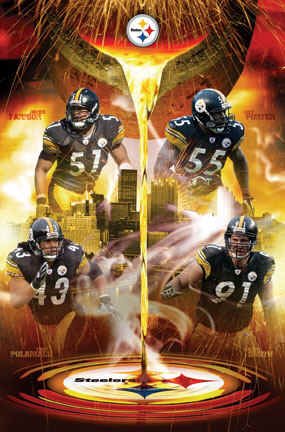
Gene Collier: Porter, Polamalu a Big-Play Pair
Friday, September 08, 2006
Pittsburgh Post-Gazette
Under inordinate pressure even for some nationally televised inaugural NFL protocol, a storied Steelers defense needed a typically monstrous play from one of its validated Super stars.
Troy Polamalu seemed a perfect candidate, but then so did Joey Porter.
So what about both?
Polamalu and Porter, All-Pros a year ago and proving it just about every minute, intercepted fourth-quarter passes in a prime-time cauldron last night, and when Porter returned Daunte Culpepper's second ill-advised throw in consecutive series 42 yards for a touchdown, the Steelers had reached all the way back to Detroit to reconnect some stellar momentum.
What's that saying?
Here we go.
"We know exactly what we have," said Porter after his first career touchdown via interception iced the 28-17 victory against Miami. "We know what we can go out there and do under any circumstances. I pride myself on making plays when I get the opportunity, and tonight I got those opportunities."
By halftime of this television gala they call the NFL opener, it was growing apparent that the absence of No. 7, Big Convalescence, had triggered a more elaborate domino effect than perhaps the big bowl of frothing towel-wavers on the North Side had anticipated.
It apparently wasn't enough that Ben Roethlisberger's extracted appendix would put undue pressure on the Steelers' highly decorated defenders on the night the club began defending its first Super Bowl title in 26 years. As the current from that weekend convulsion crackled through Pittsburgh's systems late last night, there was an odd smoking odor from the special teams as well.
Big Ben's operation, you'll remember, required the signing of third-string quarterback Brian St. Pierre to back up backup quarterback Charlie Batch, who was going from comfortable understudy to national prime-time star in the space of four days. It further required, through the mandatory roster realignment, the dismissal of Chidi Iwuoma, who was not the special teams' captain last year for nothing.
But even with all that, it wasn't until Batch tried to beat Miami's defense deep for the first time, with a fine third-down bullet toward Cedrick Wilson late in the second quarter, that this potentially lethal pressure change came into bright focus. Wilson could not make the catch, even as Miami's Traveras Tillman might have dodged an interference call, and, on the next play, all the negative forces in the Heinz Field atmosphere were momentarily unleashed.
Chris Gardocki launched the football from near his own goal line, sending it away 48 yards to Miami's Wes Welker near the Steelers' sideline. Without Iwuoma flying down the left flank as he had so consistently and effectively over the past four seasons, Welker fielded the punt comfortably and easily eluded Ryan Clark in the open field as he accelerated to full gallop. Forty-seven yards later, Miami was set up at the Steelers' 15, and two plays after that, the Dolphins had the touchdown that convinced Daunte Culpepper there was hope somewhere in the middle of a seething Steelers defense.
Ronnie Brown's 2-yard dive did a lot more than tie the score at 7-7 with 5:14 left in the half, it suggested that this Steelers defense, under tremendous pressure since the removal of Pittsburgh's most famous appendix, was something other than infallible.
Nowhere else had there been even the suggestion that Miami could run against the Steelers, with Brown gaining a total of 9 yards on eight first-half carries, most of them on ill-fated first-down plays. Individually, the defense had been routinely spectacular. Porter was on top of Culpepper early, dumping him inside his 10 for the first sack and JPeezy boot of the new season and the 54th of his career, moving him past Greg Lloyd for fifth place on the Steelers' all-time list of celebrated sackers.
Lloyd wasn't available for comment, but I'm guessing he wasn't happy.
But soon after the special-teams effect had become apparent, the confidence of the defense seemed to short out temporarily. Again the culprit was Welker, a 5-foot-9 backup wideout in his third year out of Texas Tech and not what anyone would confuse with a difference-maker.
Welker got loose in the secondary for 31 yards, and after Brown ran a dump pass 11 more to the Steelers' 28, Welker ran into the area vacated by the blitzing Deshea Townsend and took a simple out pass for 20 more to the 8. A field goal brought Miami within 14-10, and the resultant momentum only ratcheted up the drama for the defense.
"The defense," said a relieved Bill Cowher, "did a very good job in the first half allowing us to stay in that game."
On Miami's first possession after intermission, safety Tyrone Carter fell down just as wideout Marty Booker was pulling in Culpepper's pass, allowing Booker to prance 52 yards to the Steelers' 25, but the truly chilling stuff started on the next play, when marquee Dolphins wideout Chris Chambers finally got loose from Ike Taylor. Taylor then missed a tackle on Brown as he took the ball to the 5, and Brown pounded it home from that point on the next play for the first Dolphins lead on an increasingly uncomfortable night.
The pressure on the defense was building to dangerous levels. Taylor would soon be beaten on three successive plays as Miami moved in Steelers territory, but a pivotal third-and-2 play was busted up by Aaron Smith and Taylor on the series before Heath Miller's 87-yard touchdown catch-and-run.
But after all of that, with a 21-17 lead and six minutes remaining, the Steelers still needed a handful of compelling plays from the kind of compelling players on which this defense is built.
(Gene Collier can be reached at gcollier@post-gazette.com or 412-263-1283. )
Ron Cook: Batch Meets the Challenge

Friday, September 08, 2006
Pittsburgh Post-Gazette
That was some challenge they threw at Charlie Batch last night.
Not Ben Roethlisberger's appendectomy.
Not even the Miami Dolphins and their ferocious defense.
The Bus.
Really, a big yellow school bus.
It rolled through a Heinz Field tunnel and onto the field moments before the Steelers and Dolphins kicked off the NFL season. Out hopped Jerome Bettis -- the one and only Bus, as far as Pittsburgh is concerned -- to thunderous applause that lasted as he waved a Terrible Towel, held up his Super Bowl XL ring for all to see and slowly made his way the length of the field to an end zone set and his new career as an NBC broadcaster.
How was Batch supposed to top that homecoming?
Well, guess what?
The kid from Homestead did in the Steelers' 28-17 win.
"Everybody said we couldn't do it without our starting quarterback," linebacker Joey Porter said in the happy locker room after the Steelers did do it. "This team is bigger than that. Charlie performed the way he's supposed to. He proved a long time ago he can play quarterback."
It wasn't easy. Batch made it hard on himself by fumbling a first-down snap at the Miami 1 early in the fourth quarter as the Steelers were driving for a go-ahead score and a 21-17 lead. You could almost read every mind in Steeler Nation at that point.
Big Ben wouldn't have done that.
True. But what came next after the Steelers' defense gave Batch the ball back at his 13 with 6:25 left? Roethlisberger couldn't have done it any better.
Batch's play fake to Willie Parker was a beauty, his lob of a pass to tight end Heath Miller behind Dolphins linebacker Zach Thomas even prettier. The big tight end somehow managed to outrun cornerback Will Allen to the end zone for the winning score.
It turns out Batch suggested the play to Steelers offensive coordinator Ken Whisenhunt. "It worked exactly the way we drew it up," Batch said.
It was Batch's third touchdown pass of the night.
Yeah, it was a pretty sweet homecoming.
It came at a great time, not just for Batch and the Steelers, but for a grieving city. Like most people in town, Batch tuned into coverage of Mayor Bob O'Connor's funeral earlier in the day. That only added to his roiling emotions at game time.
"I wanted to dedicate this victory to him," Batch said later. "Hopefully, we could ease the grieving process a little. I think, through sports, you're able to do that."
There's not much doubt the late mayor would have loved everything about this night. His city looked fabulous for the NBC cameras. His football team won a big game.
It shouldn't have come as much of a surprise that Batch had a big hand in it. It's not like this was his first big game. He started a couple last season and won 'em both when he hadn't thrown a pass in anger for the better part of two seasons. There was no reason to think he wouldn't get it done this time. He's as healthy as he has ever been and also played extensively in all four of the exhibition games.
It took all of three passes for Batch to shake off what little rust he had. After that 0 for 3 start, he completed 15 of 22 passes for 209 yards, no interceptions and those three touchdowns. His passer rating was a positively Big Ben-like 126.5.
"None of us are surprised," wide receiver Hines Ward said. "The guys are very comfortable with Charlie."
Batch certainly gave the Steelers better quarterback play than Daunte Culpepper did for the Dolphins. Culpepper's two late interceptions -- one by safety Troy Polamalu, the other by linebacker Joey Porter, who returned his 42 yards for the clinching touchdown -- easily trumped Batch's lost fumble in the costly turnover category.
Batch's first touchdown pass went for 27 yards to wide receiver Nate Washington, who made a nice catch over safety Travares Tillman for a 7-0 lead. His second went to Ward -- a 7-yard bullet in the middle of the back of the end zone -- for a 14-7 lead. So much for Ward's hamstring problem.
It would have been a shame if Batch's fumble had denied him of this victory. As it was, the win served two valuable purposes beyond getting the Steelers off to a 1-0 start in defense of their Super Bowl championship.
One, it gave the Steelers reason to believe they don't have to rush Roethlisberger back for the next game Sept. 18 at Jacksonville. If he's not ready until the big showdown with the Cincinnati Bengals at Heinz Field Sept. 24, so be it.
And two, it gave Bettis plenty to talk about on the NBC telecast.
Know this:
Both the Steelers and The Bus were grateful.
(Ron Cook can be reached at rcook@post-gazette.com or 412-263-1525. )
Thursday, September 07, 2006
Joe Starkey: The Truth About Big Ben
PITTSBURGH TRIBUNE-REVIEW
September 7, 2006
Additional Stories:
Clark's center stage
Can they repeat?
Buying ticket online? Prepare for all-out blitz on the wallet
Naming the chase for No. 6 begins
Steelers sign St. Pierre, cut Iwuoma
The key matchup
Fueled for a big season
Profile: Dolphins' Jason Taylor
Bettis expects broadcast to be 'rough'
Bettis playing both sides
Dolphins-Steelers opener matches streaking teams
Batch of trouble?
Can the most successful third-year quarterback in NFL history -- a quarterback who loses a game about as often as he loses an appendix -- possibly be underrated?
Yes, and thank you for asking.
Actually, underappreciated might be the more appropriate term for Ben Roethlisberger, who will miss tonight's opener against the Miami Dolphins on account of his emergency appendectomy Sunday.
The Steelers will not crumble in his absence. Tommy Maddox doesn't live here anymore, so as long as Charlie Batch stays upright, the club should be able to survive even a couple of games without Big Ben.
At worst, they'll split.
But let's not kid ourselves. Roethlisberger is the Steelers' best player. He's the main reason the franchise snapped that pesky, 25-year Super Bowl drought, and he's the biggest key to winning it all again.
He's also one of the top five quarterbacks in football, and I'm not sure I'd rather have anyone else if I needed to win, say, a playoff game in Denver.
What's amazing is that so few people would agree with me.
What's even more amazing is that so many people still consider Roethlisberger to be more a function of the Steelers' system than anything else.
Take Sports Illustrated's Paul Zimmerman -- aka Dr. Z -- who is very good but who deserves an 'F' for his recent assessment of Big Ben. The subject matter was active quarterbacks who might be first-ballot Hall of Famers. Dr. Z began with Tom Brady, Peyton Manning, Carson Palmer, Brett Favre and Roethlisberger.
So far, so good. But in differentiating between Palmer and Roethlisberger, the 'Z Man' writes, "I like Palmer's chances better. He seems to carry the team, whereas Roethlisberger, as effective as he is, is more a product of the system."
How many times have you heard that in the past two years? It's right up there with the line that goes, "The Steelers don't ask Roethlisberger to do too much."
Unless you include the part about them asking him to carry them to the Super Bowl, that is.
Remember, the Steelers' running game wasn't working all that well during the historic run through Cincinnati, Indianapolis and Denver. So, they put their trust in Roethlisberger. They came out passing in all three games, and all he did was ring up the fourth-best three-game playoff passer rating (125.8) in NFL history.
Behind some guys named Montana, Simms and Aikman.
It's true that the Steelers system fits Roethlisberger's talents, and that he's lucky to have so much talent around him. But couldn't the same be said of every great quarterback? The West Coast offense and throwing to Jerry Rice kind of fit Joe Montana's skill set, wouldn't you say?
What's also true of Roethlisberger is that he does some of his best work when "the system" breaks down.
Remember that touchdown pass just before the half in the AFC title game, the one where he scrambled away from pressure and lofted a ball just over 20 Broncos fingertips, to Hines Ward in the back of the end zone? That wasn't in the game plan. Neither was a similar, Elway-like scramble-and-chuck to Ward in the Super Bowl.
You know, the one where Roethlisberger straddled the line of scrimmage before heaving a cross-field cannon shot.
How many other quarterbacks make that play?
Roethlisberger is stunningly efficient, and it's not as if he dinks and dunks his way down the field. He led the NFL in two telling categories last season -- yards per attempt and touchdown percentage.
He obviously had a bad Super Bowl, but, like a pitcher without his best stuff, he battled and stayed in the game. Besides the big pass to Ward, he ran for a touchdown, threw a key block on the gadget-play touchdown and turned a broken play into a first down when the Steelers were running out the clock.
In other words, he found ways to help his team win the game, which is what a complete football player does. And which no quarterback in the NFL does better. Roethlisberger's career record stands at 27-4.
Yeah, 27-4.
Joe Starkey is a sports writer for the Pittsburgh Tribune-Review. He can be reached at jstarkey@tribweb.com
September 7, 2006
Additional Stories:
Clark's center stage
Can they repeat?
Buying ticket online? Prepare for all-out blitz on the wallet
Naming the chase for No. 6 begins
Steelers sign St. Pierre, cut Iwuoma
The key matchup
Fueled for a big season
Profile: Dolphins' Jason Taylor
Bettis expects broadcast to be 'rough'
Bettis playing both sides
Dolphins-Steelers opener matches streaking teams
Batch of trouble?
Can the most successful third-year quarterback in NFL history -- a quarterback who loses a game about as often as he loses an appendix -- possibly be underrated?
Yes, and thank you for asking.
Actually, underappreciated might be the more appropriate term for Ben Roethlisberger, who will miss tonight's opener against the Miami Dolphins on account of his emergency appendectomy Sunday.
The Steelers will not crumble in his absence. Tommy Maddox doesn't live here anymore, so as long as Charlie Batch stays upright, the club should be able to survive even a couple of games without Big Ben.
At worst, they'll split.
But let's not kid ourselves. Roethlisberger is the Steelers' best player. He's the main reason the franchise snapped that pesky, 25-year Super Bowl drought, and he's the biggest key to winning it all again.
He's also one of the top five quarterbacks in football, and I'm not sure I'd rather have anyone else if I needed to win, say, a playoff game in Denver.
What's amazing is that so few people would agree with me.
What's even more amazing is that so many people still consider Roethlisberger to be more a function of the Steelers' system than anything else.
Take Sports Illustrated's Paul Zimmerman -- aka Dr. Z -- who is very good but who deserves an 'F' for his recent assessment of Big Ben. The subject matter was active quarterbacks who might be first-ballot Hall of Famers. Dr. Z began with Tom Brady, Peyton Manning, Carson Palmer, Brett Favre and Roethlisberger.
So far, so good. But in differentiating between Palmer and Roethlisberger, the 'Z Man' writes, "I like Palmer's chances better. He seems to carry the team, whereas Roethlisberger, as effective as he is, is more a product of the system."
How many times have you heard that in the past two years? It's right up there with the line that goes, "The Steelers don't ask Roethlisberger to do too much."
Unless you include the part about them asking him to carry them to the Super Bowl, that is.
Remember, the Steelers' running game wasn't working all that well during the historic run through Cincinnati, Indianapolis and Denver. So, they put their trust in Roethlisberger. They came out passing in all three games, and all he did was ring up the fourth-best three-game playoff passer rating (125.8) in NFL history.
Behind some guys named Montana, Simms and Aikman.
It's true that the Steelers system fits Roethlisberger's talents, and that he's lucky to have so much talent around him. But couldn't the same be said of every great quarterback? The West Coast offense and throwing to Jerry Rice kind of fit Joe Montana's skill set, wouldn't you say?
What's also true of Roethlisberger is that he does some of his best work when "the system" breaks down.
Remember that touchdown pass just before the half in the AFC title game, the one where he scrambled away from pressure and lofted a ball just over 20 Broncos fingertips, to Hines Ward in the back of the end zone? That wasn't in the game plan. Neither was a similar, Elway-like scramble-and-chuck to Ward in the Super Bowl.
You know, the one where Roethlisberger straddled the line of scrimmage before heaving a cross-field cannon shot.
How many other quarterbacks make that play?
Roethlisberger is stunningly efficient, and it's not as if he dinks and dunks his way down the field. He led the NFL in two telling categories last season -- yards per attempt and touchdown percentage.
He obviously had a bad Super Bowl, but, like a pitcher without his best stuff, he battled and stayed in the game. Besides the big pass to Ward, he ran for a touchdown, threw a key block on the gadget-play touchdown and turned a broken play into a first down when the Steelers were running out the clock.
In other words, he found ways to help his team win the game, which is what a complete football player does. And which no quarterback in the NFL does better. Roethlisberger's career record stands at 27-4.
Yeah, 27-4.
Joe Starkey is a sports writer for the Pittsburgh Tribune-Review. He can be reached at jstarkey@tribweb.com
Steelers honor Bettis with a special permanent locker

Thursday, September 07, 2006
By Dan Majors, Pittsburgh Post-Gazette
A couple hundred Steelers fans -- many of them sporting the number 36 on their black-and-gold jerseys -- gathered at Heinz Field yesterday to see the team unveil its latest display of greatness: a locker honoring retired running back Jerome Bettis.
The locker, one of 20 from Three Rivers Stadium commemorating Steelers greats, stands in the Coca-Cola Great Hall, where fans will be able to see it whenever they come to see their team play.
Bettis, who has begun a new career as a television football analyst, was introduced by Steelers president Art Rooney II, who hailed him as "one of the greatest running backs of all time."
Then Bettis took the stage. Just as he had so many times before, he started out kind of slow. But once he got rolling ...
Seemingly at a loss for words as he began speaking, Bettis quickly hit his stride as he shared his thoughts.
"When I retired, I thought everything was great," he said. "Being back here, I didn't think I would miss it as much [as I do]."
He went on to praise the Steelers' organization, the Rooney family, the city and its fans, and thanked them "for the opportunity to live out my dream."
"As my years increased here, and the wins and the losses came, and the hard times came, and ultimately the good times came, I got to see what it's all about," he said.
"I am extremely grateful and honored to put my locker where all the great players who have played in Pittsburgh reside."
One of the highlights of the display, Bettis said, is the robe that he would wear in the locker room after games. At first, he said, the guys all teased him about it.
"But after a couple years, I saw a lot guys wearing robes."
The locker also includes awards Bettis received for his football accomplishments, his civic work and even his bowling. He also included some shoes and a uniform, magazines and playbooks, ballcaps and a bobblehead. And, finally, a photograph of him kissing the Vince Lombardi Trophy after February's victory against Seattle.
"It has really truly been an honor to have played for you," he said, speaking without notes. "To spend 10 years in Pittsburgh and for you all to cheer for me. Thank you, I appreciate it."
Among the fans in attendance was Diana Vetterly, 66, of Avalon, and her son, Tim. Although she isn't a Steelers ticket-holder and has never been to a game at Heinz Field, she said she felt as though she had to be at yesterday's ceremony.
"He's my man. I've always liked him," she said. "I'm disappointed that he's retiring, but it's the right time."
After the ceremony, she was among the fans who edged forward to greet the man they call "The Bus." She was rewarded with a hug and a handshake.
"He deserves all the glory he gets," she said, her eyes filled with tears.
(Dan Majors can be reached at dmajors@post-gazette.com or 412-263-1456. )
Wednesday, September 06, 2006
Malkin Signs With Pens
Malkin beats adversity, is signed, sealed and delivered
Wednesday, September 06, 2006
By Shelly Anderson, Pittsburgh Post-Gazette
More Coverage:
From there to here: How Evgeni Malkin finds himself in Pittsburgh
It took Russian center Evgeni Malkin more than 26 months and some tense moments to get to Pittsburgh from the time the Penguins drafted him second overall in 2004.
It took him about 15 hours to get a sense of what life can be like for an NHL star -- off the ice, anyway.
There was his arrival Monday night at Pittsburgh International, where he signed autographs and was met by a handful of reporters. There was dinner that night at Hall of Fame player and team owner Mario Lemieux's house, where Malkin joined, among others, general manager Ray Shero and players Sidney Crosby and Sergei Gonchar for filet mignon, lobster and a tour of a home full of memorabilia and trophies.
There was his first trip to Mellon Arena yesterday morning, with sights along the way pointed out, including the two North Shore stadiums.
There was the signing of his Penguins rookie contract, three years at $984,200 per year plus incentive bonuses that could top $2 million, followed by a news conference with plenty of lights and clicking cameras.
Malkin, 20, who speaks very little English, watched intently as the team played a promotional highlight video of some of his more spectacular goals. He answered several questions through interpreter Olga McQueen, looking at the questioners but showing little emotion. His few smiles came during the photo ops, when he was presented a No. 71 Penguins jersey by Lemieux and when he posed with others.
The difficult journey is over for Malkin. The Penguins and his agents, J.P. Barry and Pat Brisson, remain braced for a legal battle with his Russian team, Magnitogorsk Metallurg, which could contest Malkin playing in the NHL.
"I expect that something will happen in the next month, but based on the information we're receiving, we feel very strongly about the steps that we're taking under Russian law," said Barry, adding that Malkin stands on strong ground because he signed a one-year contract with Metallurg under duress, then submitted proper two-week notice to nullify it.
Malkin's long transition started about a month ago, when Metallurg, his hometown team in the Russian Super League, pressured him into signing a one-year contract in the wee hours of the morning.
"The next day, after I signed the contract, I was very upset and I looked forward to leaving as soon as I could," Malkin said. "That's why I phoned J.P. Barry and asked for help."
Barry met Malkin when the player slipped away from Metallurg at the Helsinki, Finland, airport. The two remained there five days until Malkin could get a visa to travel to the United States.
"The team was training only 10 miles away, and we were only 1 kilometer from the Russian embassy," Barry said. "We needed to get to the American embassy to get the visa, so we were basically going right by the Russian embassy walking down the road. We had to be quiet and subtle about what we were doing."
Some considered Malkin missing, and there were some fears about his safety or that of his parents in Magnitogorsk.
"When I was in Helsinki, I definitely was a bit concerned, but not that much," Malkin said. "I had the feeling, knowing Mr. [Gennady] Velichkin [general director of Metallurg] for so many years, he wouldn't go for any harsh measures."
Once he got the visa, Malkin flew to Los Angeles and trained there with NHL players. He said he was able to reassure his parents and help soothe bitter fans.
"I can understand my fans pretty well," he said. "When I signed the contract with Magnitogorsk, they felt very happy about me staying in Russia and playing with the club. But after what happened, I'm sure they were upset.
"Later on, I got a chance to call a few friends of mine and explain what was going on, that I was happy about my decision and that it was my dream to come here and play with the Pittsburgh Penguins club. I was always open about my desire to come to North America. My friends understood me, and now I keep in touch with them and my family in Russia. I know that everything will calm down."
And Malkin (his first name is yev-GEN-ee with a hard "G") can get on with his career, one that has seen him shine with Metallurg and in international play, including the Olympics in February.
He will participate in the team's rookie camp starting Friday. Practices Saturday and Sunday will be open to the public from 10-11:30 a.m. at Mellon Arena. Malkin, 6 feet 3 and 192 pounds, has the size and deceptive speed reminiscent of Lemieux, but he also has a strong physical side to his play.
"With his reach and his size, he's got a lot of talent," said Lemieux, who looked to be a hair taller than the newest Penguin.
Lemieux understands the transition Malkin faces.
"I told him that I didn't speak any English until I came to Pittsburgh," said Lemieux, a native of Montreal who was the first overall draft pick in 1984. "I'm the perfect example that you can make it work. I know it's going to take some time, the first year or so, to get acclimated to a new culture, but I'm sure he'll do fine."
Malkin will live with Gonchar, a Russian-born Penguins defenseman.
Shero hopes that will help Malkin be as comfortable as possible and vowed to do whatever it takes to help him thrive.
"Going through what he did to come over, the commitment and courage he showed, makes us feel very good about him," Shero said.
(Shelly Anderson can be reached at shanderson@post-gazette.com or 412-263-1721. )
Wednesday, September 06, 2006
By Shelly Anderson, Pittsburgh Post-Gazette
More Coverage:
From there to here: How Evgeni Malkin finds himself in Pittsburgh
It took Russian center Evgeni Malkin more than 26 months and some tense moments to get to Pittsburgh from the time the Penguins drafted him second overall in 2004.
It took him about 15 hours to get a sense of what life can be like for an NHL star -- off the ice, anyway.
There was his arrival Monday night at Pittsburgh International, where he signed autographs and was met by a handful of reporters. There was dinner that night at Hall of Fame player and team owner Mario Lemieux's house, where Malkin joined, among others, general manager Ray Shero and players Sidney Crosby and Sergei Gonchar for filet mignon, lobster and a tour of a home full of memorabilia and trophies.
There was his first trip to Mellon Arena yesterday morning, with sights along the way pointed out, including the two North Shore stadiums.
There was the signing of his Penguins rookie contract, three years at $984,200 per year plus incentive bonuses that could top $2 million, followed by a news conference with plenty of lights and clicking cameras.
Malkin, 20, who speaks very little English, watched intently as the team played a promotional highlight video of some of his more spectacular goals. He answered several questions through interpreter Olga McQueen, looking at the questioners but showing little emotion. His few smiles came during the photo ops, when he was presented a No. 71 Penguins jersey by Lemieux and when he posed with others.
The difficult journey is over for Malkin. The Penguins and his agents, J.P. Barry and Pat Brisson, remain braced for a legal battle with his Russian team, Magnitogorsk Metallurg, which could contest Malkin playing in the NHL.
"I expect that something will happen in the next month, but based on the information we're receiving, we feel very strongly about the steps that we're taking under Russian law," said Barry, adding that Malkin stands on strong ground because he signed a one-year contract with Metallurg under duress, then submitted proper two-week notice to nullify it.
Malkin's long transition started about a month ago, when Metallurg, his hometown team in the Russian Super League, pressured him into signing a one-year contract in the wee hours of the morning.
"The next day, after I signed the contract, I was very upset and I looked forward to leaving as soon as I could," Malkin said. "That's why I phoned J.P. Barry and asked for help."
Barry met Malkin when the player slipped away from Metallurg at the Helsinki, Finland, airport. The two remained there five days until Malkin could get a visa to travel to the United States.
"The team was training only 10 miles away, and we were only 1 kilometer from the Russian embassy," Barry said. "We needed to get to the American embassy to get the visa, so we were basically going right by the Russian embassy walking down the road. We had to be quiet and subtle about what we were doing."
Some considered Malkin missing, and there were some fears about his safety or that of his parents in Magnitogorsk.
"When I was in Helsinki, I definitely was a bit concerned, but not that much," Malkin said. "I had the feeling, knowing Mr. [Gennady] Velichkin [general director of Metallurg] for so many years, he wouldn't go for any harsh measures."
Once he got the visa, Malkin flew to Los Angeles and trained there with NHL players. He said he was able to reassure his parents and help soothe bitter fans.
"I can understand my fans pretty well," he said. "When I signed the contract with Magnitogorsk, they felt very happy about me staying in Russia and playing with the club. But after what happened, I'm sure they were upset.
"Later on, I got a chance to call a few friends of mine and explain what was going on, that I was happy about my decision and that it was my dream to come here and play with the Pittsburgh Penguins club. I was always open about my desire to come to North America. My friends understood me, and now I keep in touch with them and my family in Russia. I know that everything will calm down."
And Malkin (his first name is yev-GEN-ee with a hard "G") can get on with his career, one that has seen him shine with Metallurg and in international play, including the Olympics in February.
He will participate in the team's rookie camp starting Friday. Practices Saturday and Sunday will be open to the public from 10-11:30 a.m. at Mellon Arena. Malkin, 6 feet 3 and 192 pounds, has the size and deceptive speed reminiscent of Lemieux, but he also has a strong physical side to his play.
"With his reach and his size, he's got a lot of talent," said Lemieux, who looked to be a hair taller than the newest Penguin.
Lemieux understands the transition Malkin faces.
"I told him that I didn't speak any English until I came to Pittsburgh," said Lemieux, a native of Montreal who was the first overall draft pick in 1984. "I'm the perfect example that you can make it work. I know it's going to take some time, the first year or so, to get acclimated to a new culture, but I'm sure he'll do fine."
Malkin will live with Gonchar, a Russian-born Penguins defenseman.
Shero hopes that will help Malkin be as comfortable as possible and vowed to do whatever it takes to help him thrive.
"Going through what he did to come over, the commitment and courage he showed, makes us feel very good about him," Shero said.
(Shelly Anderson can be reached at shanderson@post-gazette.com or 412-263-1721. )
Tuesday, September 05, 2006
Paulino has stronghold on catcher's job
9/3/2006
Paulino has stronghold on catcher's job
Doug Street
Washington Observer Staff writer
OK, let's see a show of hands. How many of you at the beginning of the Pirates' season were thrilled with Ryan Doumit and Humberto Cota sharing the catching duties?
Ryan, Humberto, you're votes don't count. Even your manager and general manager don't have their hands up.
Doumit and Cota were what the Pirates planned to go with until Doumit injured his hamstring in April. The injury opened the door for Ronny Paulino to be recalled from Class AAA April 16 and he has made sure the catching job is his for the foreseeable future.
Paulino made a slow climb through the Pirates minor league system and was even lost to the Kansas City Royals in the Rule 5 Draft fiasco of 2003. But Paulino was returned to the organization before spring training ended. It took him nearly five seasons just to make it to Class AA and another 2 1/2 to reach Class AAA.
Since Paulino got his chance in Pittsburgh, he has impressed everyone with his offensive and defensive skills.
The Pirates weren't sure if Paulino could hit at the major league level. Not only has Paulino hit -- he carried a .318 average into Saturday night's game in St. Louis -- his consistency has been rivaled only by National League batting leader -- and teammate -- Freddy Sanchez.
Here are Paulino's batting averages per month: April .304, May .299, June .308, July .329, August .318 and a 2 for 3 performance in the first game of September. He had two of the Pirates' three hits during Chris Carpenter's complete-game victory Friday night.
Paulino is third among NL rookies with the .318 average and a .370 on-base percentage and second among NL catchers in batting average behind Atlanta's Brian McCann.
Defensively, Paulino has thrown out a respectable 35 percent of base runners (21 of 60) and the pitching staff has a 4.17 ERA with Paulino behind the plate compared to a 6.12 ERA with Doumit and Cota.
Paulino spent little time at Triple-A Indianapolis but benefited by playing in the World Baseball Classic. Though he didn't see much playing time for the Dominican Republic, Paulino said that atmosphere was very beneficial.
Doumit has been injured much of the year and Cota hasn't been productive, so manager Jim Tracy was smart to give the 25-year-old catcher some rest in the right spots. Though he's been their only dependable catcher, Paulino plays one of the more demanding positions and Tracy didn't want to wear him out.
When the Pirates were building their winning teams of the late 1980s and early 90s, they needed a good core group of young players. The Pirates might have that with Sanchez, outfielder Jason Bay, shortstop Jack Wilson, second baseman Jose Castillo, and closer Mike Gonzalez.
Now, Paulino can be added to that group. He may not be the piece that makes the Pirates a winner or contender, but he can have a big role in it.
Doug Street can be reached at dstreet@observer-reporter.com.
Paulino has stronghold on catcher's job
Doug Street
Washington Observer Staff writer
OK, let's see a show of hands. How many of you at the beginning of the Pirates' season were thrilled with Ryan Doumit and Humberto Cota sharing the catching duties?
Ryan, Humberto, you're votes don't count. Even your manager and general manager don't have their hands up.
Doumit and Cota were what the Pirates planned to go with until Doumit injured his hamstring in April. The injury opened the door for Ronny Paulino to be recalled from Class AAA April 16 and he has made sure the catching job is his for the foreseeable future.
Paulino made a slow climb through the Pirates minor league system and was even lost to the Kansas City Royals in the Rule 5 Draft fiasco of 2003. But Paulino was returned to the organization before spring training ended. It took him nearly five seasons just to make it to Class AA and another 2 1/2 to reach Class AAA.
Since Paulino got his chance in Pittsburgh, he has impressed everyone with his offensive and defensive skills.
The Pirates weren't sure if Paulino could hit at the major league level. Not only has Paulino hit -- he carried a .318 average into Saturday night's game in St. Louis -- his consistency has been rivaled only by National League batting leader -- and teammate -- Freddy Sanchez.
Here are Paulino's batting averages per month: April .304, May .299, June .308, July .329, August .318 and a 2 for 3 performance in the first game of September. He had two of the Pirates' three hits during Chris Carpenter's complete-game victory Friday night.
Paulino is third among NL rookies with the .318 average and a .370 on-base percentage and second among NL catchers in batting average behind Atlanta's Brian McCann.
Defensively, Paulino has thrown out a respectable 35 percent of base runners (21 of 60) and the pitching staff has a 4.17 ERA with Paulino behind the plate compared to a 6.12 ERA with Doumit and Cota.
Paulino spent little time at Triple-A Indianapolis but benefited by playing in the World Baseball Classic. Though he didn't see much playing time for the Dominican Republic, Paulino said that atmosphere was very beneficial.
Doumit has been injured much of the year and Cota hasn't been productive, so manager Jim Tracy was smart to give the 25-year-old catcher some rest in the right spots. Though he's been their only dependable catcher, Paulino plays one of the more demanding positions and Tracy didn't want to wear him out.
When the Pirates were building their winning teams of the late 1980s and early 90s, they needed a good core group of young players. The Pirates might have that with Sanchez, outfielder Jason Bay, shortstop Jack Wilson, second baseman Jose Castillo, and closer Mike Gonzalez.
Now, Paulino can be added to that group. He may not be the piece that makes the Pirates a winner or contender, but he can have a big role in it.
Doug Street can be reached at dstreet@observer-reporter.com.
Friday, September 01, 2006
Bettis Doesn't Like Steelers' Chances For Repeat

Jerome Bettis warms up before Super Bowl XL.
Super repeat? Unlikely, says Bettis
Friday, September 01, 2006
By Chuck Finder, Pittsburgh Post-Gazette
Jerome Bettis, television analyst, doubts that the Steelers can repeat as Super Bowl champions because of an unsteady offense that already misses Jerome Bettis, brutish halfback.
"This is a totally different football team now than we had when we went on that run," Bettis said yesterday in an NBC conference call to promote the Miami-Steelers opener that kicks off the network's "Football Night in America" coverage Thursday.
"The question is: Are they capable of repeating? ... That remains to be seen yet. But it's not the same team. It's going to be a work in progress. It's going to be very, very difficult for them to repeat. They've got their hands full.
"They may have to rely on Ben Roethlisberger's arm a lot more than they have the prior two years. ... I'm not certain about the running game, how consistent it will be churning out the tough yards.
"Obviously, with myself not being there, that poses a question."
His retirement, Bettis said, and the lack of a Bus-like halfback could cause the Steelers to alter their style.
"Obviously ... not having that closer in there late in games, that is significant in shortening games," he said. "If they don't have that ability to shorten the game in terms of that physical runner in between the tackles, that's going to be a really big problem. Looking at the roster, you'd say Duce Staley ... would have to fill that role."
"If he makes the team," interjected fellow NBC analyst Cris Collinsworth.
"Exactly," concluded Bettis.
Tilting more toward the pass was a systemic mistake Bill Cowher's Steelers made in 2003, Bettis said.
"When they did go away from [the run], they had one of their worst years, going 6-10," he said. "I don't believe he's going to go to the extreme, but I think he's going to try to open it up a little bit more. Just because the running-back position is a different type of running back now. Willie Parker is not a pounder, 4-yards-and-cloud-of-dust kind of guy. I would hope [Cowher] wouldn't open it up as much as we did back then; that was a bad decision."
Speaking of Cowher, Bettis joked about the coach angrily telephoning him after his Aug. 13 comments on the air about the Steelers' coach potentially retiring at season's end. "He's not confiding in me about it anymore," Bettis said.
"I was just telling what I believe. We have a pretty good relationship about being able to talk through things. He told me how he felt about it. I told him how I felt about it. I don't see it as an issue.
"If I was [still] a player, it might be a problem, though."
Monday, August 28, 2006
Faneca, Ward and Townsend have endured the good and the bad
Monday, August 28, 2006
By Ed Bouchette, Pittsburgh Post-Gazette
They are defending Super Bowl champs now. One, a Super Bowl MVP. Another, one of the most-decorated offensive guards in football. A third, the late bloomer, a starting cornerback who played well enough to hold off two young second-round picks.
Hines Ward, Alan Faneca and Deshea Townsend are at the top of the NFL world as they prepare to help the Steelers defend their championship. Yet, they remember when things weren't going so well in Pittsburgh, when they were so far near the bottom they could not see the top.
They are the '98ers, a trio of players remaining from the draft eight years ago. Two are 30 years old, one is closing in on it. They joined the team when it was on a roll, having barely missed a Super Bowl visit three months before they were drafted. Bill Cowher had coached each of his first six Steelers teams into the playoffs, tying a coaching record held by Hall of Famer Paul Brown. Three of those teams reached an AFC championship game, and one a Super Bowl.
There was no reason to believe it would ever stop.
"You had to think, 'Hey, we're coming to a good situation,' " Townsend said. "You know you're going to a good organization, the championships they've won, Mr. Rooney and how they run their organization."
But in the '98ers' rookie year, the Steelers lost their final five games and finished 7-9. Then things turned poorly. They lost seven of their final eight in 1999 and plummeted to 6-10. Tom Donahoe, the director of football operations and the man who drafted them, was fired after that season. In minicamp that June, an ugly brawl broke out in their locker room. They lost their first three games of 2000 and missed the playoffs for a third consecutive year.
Townsend and Ward, roommates, looked at each other and wondered if they hadn't jinxed the team that drafted them.
"Me and Hines said, 'Man, we must be the reason we're losing,' " Townsend said.
Chuck Noll often noted that steel must go through fire to be strengthened, and the heat was relentless on the Steelers, particularly for the '98ers, who celebrated going to such a successful organization only to wonder what had happened after their first three years.
Looking back now, from atop the perch that includes a 15-1 2004 season and the franchise's first Super Bowl victory in 26 years, one thing the '98ers learned early in their NFL careers is that nothing can be taken for granted.
"I think you appreciate it more when you've been there in the bad times," Faneca said.
The rookie trio did not think the club was in disarray as the 1998 season began, but there were omens. Offensive coordinator Chan Gailey left the team late to become head coach of the Dallas Cowboys. Cowher, no doubt to his everlasting regret, invited quarterback Kordell Stewart to have input on the new coordinator. The hiring of Ray Sherman, whose play-calling duties were usurped by Cowher late in his only season on the job, set Stewart and the offense back through two fired coordinators before Mike Mularkey righted things in 2001.
Yancey Thigpen, the team's best receiver, left in free agency before '98 and an aging Courtney Hawkins tried to replace him. Safeties Carnell Lake and Darren Perry were on their last legs and final season with the Steelers. Linebacker Greg Lloyd was injured, angry and released that summer.
There was more, but there was something bubbling below the ruins of the Steelers' long playoff run. A foundation sprouted that would bring the team back in the new century, starting with Ward, Faneca and Townsend.
"At the time, we were just going through, I guess, a transition stage," Ward said. "We lost a good deal of our veteran guys. It was just a matter of rebuilding. We were going through some new coaches. It was hard overall just to get everyone on the same page.
"And throughout the draft, we started to build our team. The '98 class -- me, Faneca, Deshea -- it kind of went from there. The next year was Joey and his class and as we grew and evolved into our own, we had a pretty good ballclub."
Joey Porter and Aaron Smith in 1999, two more future Pro Bowl players. Another in 2000, Marvel Smith, along with Clark Haggans. Another in 2001, Casey Hampton. The talent restocking that ultimately would bring a Super Bowl victory had begun.
"The one thing about coach Cowher, he stayed the same throughout," Townsend said. "He's been very consistent. That's one thing I'll say if anybody asks me about him is how consistent he is.
"Sometimes when you go through changes, things happen. But the one thing about it, we kept the same focus, did the same things and worked our way out of it."
Not before rock bottom arrived in June 2000. In their final days practicing at Three Rivers Stadium (they moved to the South Side that fall), an ugly fight broke in the locker room in minicamp. It started between linebacker Earl Holmes and halfback Richard Huntley and spread with players swinging wooden chairs and threatening each other.
When the Steelers began the season 0-3, it only seemed to confirm that they had disintegrated.
But, "guys just kept working," Townsend said.
They won five in a row and finished 9-7. They followed by making the playoffs four of the next five seasons, including three AFC title games and one Super Bowl victory.
Starting Friday, the Steelers gear up for a run at a second consecutive championship, knowing through experience that past results do not guarantee future returns but that eight years later the foundation is stronger.
(Ed Bouchette can be reached at ebouchette@post-gazette.com or 412-263-3878.)
By Ed Bouchette, Pittsburgh Post-Gazette
They are defending Super Bowl champs now. One, a Super Bowl MVP. Another, one of the most-decorated offensive guards in football. A third, the late bloomer, a starting cornerback who played well enough to hold off two young second-round picks.
Hines Ward, Alan Faneca and Deshea Townsend are at the top of the NFL world as they prepare to help the Steelers defend their championship. Yet, they remember when things weren't going so well in Pittsburgh, when they were so far near the bottom they could not see the top.
They are the '98ers, a trio of players remaining from the draft eight years ago. Two are 30 years old, one is closing in on it. They joined the team when it was on a roll, having barely missed a Super Bowl visit three months before they were drafted. Bill Cowher had coached each of his first six Steelers teams into the playoffs, tying a coaching record held by Hall of Famer Paul Brown. Three of those teams reached an AFC championship game, and one a Super Bowl.
There was no reason to believe it would ever stop.
"You had to think, 'Hey, we're coming to a good situation,' " Townsend said. "You know you're going to a good organization, the championships they've won, Mr. Rooney and how they run their organization."
But in the '98ers' rookie year, the Steelers lost their final five games and finished 7-9. Then things turned poorly. They lost seven of their final eight in 1999 and plummeted to 6-10. Tom Donahoe, the director of football operations and the man who drafted them, was fired after that season. In minicamp that June, an ugly brawl broke out in their locker room. They lost their first three games of 2000 and missed the playoffs for a third consecutive year.
Townsend and Ward, roommates, looked at each other and wondered if they hadn't jinxed the team that drafted them.
"Me and Hines said, 'Man, we must be the reason we're losing,' " Townsend said.
Chuck Noll often noted that steel must go through fire to be strengthened, and the heat was relentless on the Steelers, particularly for the '98ers, who celebrated going to such a successful organization only to wonder what had happened after their first three years.
Looking back now, from atop the perch that includes a 15-1 2004 season and the franchise's first Super Bowl victory in 26 years, one thing the '98ers learned early in their NFL careers is that nothing can be taken for granted.
"I think you appreciate it more when you've been there in the bad times," Faneca said.
The rookie trio did not think the club was in disarray as the 1998 season began, but there were omens. Offensive coordinator Chan Gailey left the team late to become head coach of the Dallas Cowboys. Cowher, no doubt to his everlasting regret, invited quarterback Kordell Stewart to have input on the new coordinator. The hiring of Ray Sherman, whose play-calling duties were usurped by Cowher late in his only season on the job, set Stewart and the offense back through two fired coordinators before Mike Mularkey righted things in 2001.
Yancey Thigpen, the team's best receiver, left in free agency before '98 and an aging Courtney Hawkins tried to replace him. Safeties Carnell Lake and Darren Perry were on their last legs and final season with the Steelers. Linebacker Greg Lloyd was injured, angry and released that summer.
There was more, but there was something bubbling below the ruins of the Steelers' long playoff run. A foundation sprouted that would bring the team back in the new century, starting with Ward, Faneca and Townsend.
"At the time, we were just going through, I guess, a transition stage," Ward said. "We lost a good deal of our veteran guys. It was just a matter of rebuilding. We were going through some new coaches. It was hard overall just to get everyone on the same page.
"And throughout the draft, we started to build our team. The '98 class -- me, Faneca, Deshea -- it kind of went from there. The next year was Joey and his class and as we grew and evolved into our own, we had a pretty good ballclub."
Joey Porter and Aaron Smith in 1999, two more future Pro Bowl players. Another in 2000, Marvel Smith, along with Clark Haggans. Another in 2001, Casey Hampton. The talent restocking that ultimately would bring a Super Bowl victory had begun.
"The one thing about coach Cowher, he stayed the same throughout," Townsend said. "He's been very consistent. That's one thing I'll say if anybody asks me about him is how consistent he is.
"Sometimes when you go through changes, things happen. But the one thing about it, we kept the same focus, did the same things and worked our way out of it."
Not before rock bottom arrived in June 2000. In their final days practicing at Three Rivers Stadium (they moved to the South Side that fall), an ugly fight broke in the locker room in minicamp. It started between linebacker Earl Holmes and halfback Richard Huntley and spread with players swinging wooden chairs and threatening each other.
When the Steelers began the season 0-3, it only seemed to confirm that they had disintegrated.
But, "guys just kept working," Townsend said.
They won five in a row and finished 9-7. They followed by making the playoffs four of the next five seasons, including three AFC title games and one Super Bowl victory.
Starting Friday, the Steelers gear up for a run at a second consecutive championship, knowing through experience that past results do not guarantee future returns but that eight years later the foundation is stronger.
(Ed Bouchette can be reached at ebouchette@post-gazette.com or 412-263-3878.)
Sunday, August 27, 2006
When it comes to self-motivation, Ward has no peers

Sunday, August 27, 2006
By Ron Cook, Pittsburgh Post-Gazette
Can you picture Terry Bradshaw saying something like this in his prime?
"Don't forget about me."
Can you imagine this from Lynn Swann or any of the other Super Bowl heroes the year after they are named MVP in the big game?
"The young wide receivers on this team are good. Nate Washington, Santonio Holmes, Willie Reid ... They're spectacular players and they're going to do great things. But don't forget about me. I'm still a playmaker. I haven't lost that yet. Yeah, I might be a little older, but I'm no less of a ballplayer."
Do we really need that reminder from Hines Ward?
Of course not.
But I'm here to tell you that hearing it from Ward last week was a beautiful thing.
Not because he has anything to prove.
Because he has done the impossible and found a new way to motivate himself even as he stands on top of the NFL world as the Super Bowl MVP.
Ward's hamstring injury, which has left much of Pittsburgh in a collective hysteria, might turn out to be the best thing to happen to the Steelers this season.
It's OK that Ward might be the most insecure Super Bowl MVP in history. He needs that motivation to be successful. He needs to believe he's the underdog. "I've always played with a big chip," he said. "I have to play with a big chip."
Early on, Ward felt he had to prove he belonged in the NFL after being a third-round draft pick.
Later, he had to show he could start on a team that drafted wide receivers Troy Edwards and Plaxico Burress in the first round. Then, he had to prove he could make the Pro Bowl. After that, he had to show he could get the big money. Then, he had to prove he was worth the big money.
All of it took Ward to extraordinary heights.
But what's left after you kiss the Vince Lombardi Trophy and they name you the Super Bowl MVP?
Thank goodness for that hammy problem.
That doesn't mean it's not a real injury, even a potentially serious one. Ward couldn't play in the Steelers' first three exhibition games and almost certainly will miss the final one Thursday night against Carolina. He said the injury is different than his hamstring injury last season. He had to miss the Jacksonville game -- the only regular-season game he has missed in his eight-year career -- but came back to play the next week.
"I thought it would be the same this time -- miss a week and then come back -- but it's in a different spot," Ward said. "When I cut, I feel it. I know there's nothing torn in there or even pulled. It's just a strain. That's what's so frustrating, that something so minor can be so painful."
There's no question Ward's injury is legitimate.
Just don't be surprised if opposing teams end up paying for it.
Ward has convinced himself there are people out there who think his injury is a signal he's breaking down now that he's 30.
"That's ridiculous," he said, fairly spitting out the words. "I don't see any of my skills fading. It's not like I've gotten slower. My game has never been predicated on speed, anyway. I can still get open and still make plays for you. I've gotten open out here [at training camp] on one good leg."
Ward also has convinced himself people are saying that maybe he spent too much time celebrating in the offseason and not enough training.
Yes, he traveled the world, he said. But he always found a way to work out.
"I'm lighter now than I've ever been. I'm 205 pounds. I played at 210-212 last season."
Maybe most significantly, Ward has convinced himself that people are wondering if he has lost his passion now that he has enjoyed the ultimate success.
"I hear 'em ask, 'What's his motivation?' I'll tell you what it is. I want to win another one." Then, later, "They ask, 'What's his motivation?' Well, watch me. I'll show you. I'm just as hungry as ever. I don't want to be a guy who had some success and let it slip away."
If you saw the look in Ward's eyes, you'd believe him.
That's why it's hard to think Ward won't be ready for the Steelers' regular-season opener against Miami Sept. 7. This is a guy who long has been the ultimate gamer. He's always done whatever it takes to play. Last season, he said he took repeated pain-killing injections to play with his hamstring injury. "I played in the Super Bowl with a sprained shoulder joint," Ward said. "I fell on it in practice the Friday before the game. Saturday was ice and treatment all day. Sunday was shoot it up and play."
That game turned out OK.
The guess here is this season will go pretty well for Ward, too.
Maybe his game will suffer a bit until he gets his timing down with Ben Roethlisberger. But he has played enough with Big Ben to think that won't be a serious problem. It's safe to say he'll still be the first guy Roethlisberger looks for.
Ward said he can't wait.
"Once I do get out there, I'm going to catch a lot of balls and make a lot of plays and knock some people's heads off."
On Sept. 7?
"On Sept. 7," Ward said, steely.
Bad hammy? What bad hammy?
(Ron Cook can be reached at rcook@post-gazette.com or 412-263-1525. )
Wednesday, August 23, 2006
Malkin earns Crosby's admiration in a hurry
Wednesday, August 23, 2006
By Shelly Anderson, Pittsburgh Post-Gazette
Having turned 19 earlier this month, Sidney Crosby is too young to remember the days of hockey stars defecting from Eastern Bloc countries to play in the NHL. But he has heard the stories.
The Penguins' star got a sense of the old days by tracking the events surrounding soon-to-be teammate Evgeni Malkin, the hulking Russian center whose trip from Magnitogorsk this summer has been immersed in tension and foreign intrigue.
For Crosby, it provided not only a history lesson, but also some insight to Malkin.
"I can't imagine [going through that], but I know that for anyone who has a dream of playing in the NHL and a passion to play, this is the league you want to be in. For him, that's the way it is," Crosby said yesterday between sessions of the Penguins' youth hockey school, where he served as a special guest instructor at the RMU/Island Sports Center on Neville Island.
"I think when you get that opportunity, you're willing to do whatever it takes and take those risks to get here. It shows that he wants to be here. He went through a lot of adversity to get here, so, when he does come, I think he's going to want it bad and want to play well and expect a lot of himself.
"That's only going to make everyone around him better."
Crosby has the same agent as Malkin, Pat Brisson, and got a little bit of the inside scoop on Malkin's journey -- being pressured late one night into signing a new contract with Metallurg, then slipping away from the team in the Helsinki airport and hiding in that city until he got a visa last week and flew to Los Angeles, where he has been working out.
"It showed a lot of guts for him to go through that and come over here," Crosby said. "I'm just looking forward to having him here and making him feel as comfortable as possible."
Crosby, the top overall pick in the 2005 NHL draft, is a year younger than Malkin, the second overall pick in 2004. Although he had intense scrutiny as a rookie, Crosby led the Penguins with 39 goals, five of them game-winners, and 63 assists for 102 points.
He had advantages Malkin won't have, such as speaking English (and French) and growing up in a North American culture.
Nevertheless, once the Penguins sign Malkin, the two centers could help give the Penguins a couple of formidable forward lines.
"If we're both at our best and if both lines are at their best, it's going to be tough," Crosby said.
Crosby is eager to get into training camp and see Malkin there.
"I can't wait," he said. "I've played against him and seen him play a lot. I'm just looking forward to getting out there and learning from him, too. Hopefully, we can build some chemistry and make some things happen out there. We're going to be a deeper team and a harder team to play against."
"I think the attitude coming into the season is [that] a lot of guys want to prove that we're a better team than last year. We all have high expectations. We know we're young, but I think we're coming in with the right attitude -- to start off strong and win."
Malkin will be one of many new faces, thanks to changes made by first-year general manager Ray Shero after a 58-point season that left the Penguins second-to-last in the NHL standings.
One of the new players is Mark Recchi, who re-signed with the Penguins after being traded to Carolina in March. Recchi and Crosby had a falling out over a locker-room incident. Recchi and Shero have claimed all was well, and Crosby confirmed it.
"Things happen," he said. "We just have to make sure we move forward. That's the most important thing."
Crosby's stop in Pittsburgh will be brief. Under the NHL's collective bargaining agreement, he can't be compensated, so he paid his way here and donated his time at the youth camp.
On the ice, he smiled nonstop while encouraging the budding players ages 5-17.
"I can remember being 6, 7 years old, Brad Richards [of Tampa Bay] taught me at a hockey school, and now I play against him," Crosby said. "It's kind of funny how things work like that. You always remember those times in your life when you meet people like that. To be able to do it here is nice."
He will return to his hometown in suburban Halifax, Nova Scotia, briefly before heading to Rimouski, Quebec, where he played junior hockey and where he and several other pros will work out before training camps open next month.
After playing in the world championships and vacationing in Europe, Crosby felt like he didn't have a terrifically long offseason.
"It wasn't much of a vacation," he said.
(Shelly Anderson can be reached at shanderson@post-gazette.com or 412-263-1721. )
By Shelly Anderson, Pittsburgh Post-Gazette
Having turned 19 earlier this month, Sidney Crosby is too young to remember the days of hockey stars defecting from Eastern Bloc countries to play in the NHL. But he has heard the stories.
The Penguins' star got a sense of the old days by tracking the events surrounding soon-to-be teammate Evgeni Malkin, the hulking Russian center whose trip from Magnitogorsk this summer has been immersed in tension and foreign intrigue.
For Crosby, it provided not only a history lesson, but also some insight to Malkin.
"I can't imagine [going through that], but I know that for anyone who has a dream of playing in the NHL and a passion to play, this is the league you want to be in. For him, that's the way it is," Crosby said yesterday between sessions of the Penguins' youth hockey school, where he served as a special guest instructor at the RMU/Island Sports Center on Neville Island.
"I think when you get that opportunity, you're willing to do whatever it takes and take those risks to get here. It shows that he wants to be here. He went through a lot of adversity to get here, so, when he does come, I think he's going to want it bad and want to play well and expect a lot of himself.
"That's only going to make everyone around him better."
Crosby has the same agent as Malkin, Pat Brisson, and got a little bit of the inside scoop on Malkin's journey -- being pressured late one night into signing a new contract with Metallurg, then slipping away from the team in the Helsinki airport and hiding in that city until he got a visa last week and flew to Los Angeles, where he has been working out.
"It showed a lot of guts for him to go through that and come over here," Crosby said. "I'm just looking forward to having him here and making him feel as comfortable as possible."
Crosby, the top overall pick in the 2005 NHL draft, is a year younger than Malkin, the second overall pick in 2004. Although he had intense scrutiny as a rookie, Crosby led the Penguins with 39 goals, five of them game-winners, and 63 assists for 102 points.
He had advantages Malkin won't have, such as speaking English (and French) and growing up in a North American culture.
Nevertheless, once the Penguins sign Malkin, the two centers could help give the Penguins a couple of formidable forward lines.
"If we're both at our best and if both lines are at their best, it's going to be tough," Crosby said.
Crosby is eager to get into training camp and see Malkin there.
"I can't wait," he said. "I've played against him and seen him play a lot. I'm just looking forward to getting out there and learning from him, too. Hopefully, we can build some chemistry and make some things happen out there. We're going to be a deeper team and a harder team to play against."
"I think the attitude coming into the season is [that] a lot of guys want to prove that we're a better team than last year. We all have high expectations. We know we're young, but I think we're coming in with the right attitude -- to start off strong and win."
Malkin will be one of many new faces, thanks to changes made by first-year general manager Ray Shero after a 58-point season that left the Penguins second-to-last in the NHL standings.
One of the new players is Mark Recchi, who re-signed with the Penguins after being traded to Carolina in March. Recchi and Crosby had a falling out over a locker-room incident. Recchi and Shero have claimed all was well, and Crosby confirmed it.
"Things happen," he said. "We just have to make sure we move forward. That's the most important thing."
Crosby's stop in Pittsburgh will be brief. Under the NHL's collective bargaining agreement, he can't be compensated, so he paid his way here and donated his time at the youth camp.
On the ice, he smiled nonstop while encouraging the budding players ages 5-17.
"I can remember being 6, 7 years old, Brad Richards [of Tampa Bay] taught me at a hockey school, and now I play against him," Crosby said. "It's kind of funny how things work like that. You always remember those times in your life when you meet people like that. To be able to do it here is nice."
He will return to his hometown in suburban Halifax, Nova Scotia, briefly before heading to Rimouski, Quebec, where he played junior hockey and where he and several other pros will work out before training camps open next month.
After playing in the world championships and vacationing in Europe, Crosby felt like he didn't have a terrifically long offseason.
"It wasn't much of a vacation," he said.
(Shelly Anderson can be reached at shanderson@post-gazette.com or 412-263-1721. )
Sunday, August 20, 2006
Karen Price: Malkin Finally Out in the Open
Additional Stories
Metallurg: Pens engaged in 'sports terrorism'
Agent mum on Malkin's whereabouts
Gonchar: Malkin probably pressured
Malkin files resignation letter
Malkin mystery ends; he skates in LA
Malkin search yielded few clues
Escape to L.A.
Steigerwald excited about Malkin
Gonchar: Malkin staying in Russia
Malkin flees Russian team
Metallurg says it'll take Pens to court
Malkin drama takes another twist
Agent: Malkin wants to be in Pittsburgh this season
Junker: Talented Malkin skating on thin ice
Malkin fires agents -- again
Pens, Malkin's agent opening talks
Details:
The Malkin file:
Who: Evgeni Malkin
Born: July 31, 1986, Magnitogorsk, Russia
Position: Center
Height: 6-3
Weight: 186
Drafted: 2nd overall, 2004
Shoots: Left
Karen Price
PIITSBURGH TRIBUNE-REVIEW
Sunday, August 20, 2006
SANTA MONICA, Calif. -- Evgeni Malkin sat back in the lobby of his luxury beachfront hotel overlooking the Pacific Ocean on Saturday.
He couldn't be farther from the life he left behind in dramatic fashion earlier last week, escaping from his Russian team and life in the tiny, Siberian industrial town of Magnitogorsk. He also couldn't be farther from his family, friends and culture.
Two weeks ago, the Russian hockey star and Penguins top prospect was pressured into signing a new contract with his Metallurg Magnitogorsk in the middle of the night. It was a decision that drove him to tears and a decision that, in the hours immediately following, he knew he couldn't live with.
After his team arrived in Finland days later for a tournament, Malkin fled, hid out in an apartment in Helsinki with his agent and an interpreter while awaiting his visa and finally made it to the United States on Wednesday.
Now he waits under sunny California skies to see what legal drama might unfold as a result of his actions. It wasn't what he wanted to do, but it was what he had to do in order to realize his lifelong dream of playing in the NHL.
Yesterday, Malkin told his story to the Tribune-Review through interpreter Olga McQueen, a native Russian who lives in Vancouver and is working for Malkin's agents, Pat Brisson and J.P. Barry.
"Definitely I never expected anything like that to ever happen to me, but life is full of surprises, good and bad, and this is one of those times," Malkin said. "This is life. Sometimes you have to accept things the way they go or try to alter your situation."
When Malkin disappeared from his Russian team on Aug. 12 and immediately went into hiding just days after signing a new contract, people from Moscow to Moose Jaw were stunned.
Why sign a new contract with a team only to leave them days later? And why flee the way Russian players had to under the Communist regime when the country is now free and anyone can leave at any time?
The story goes back to last summer when team officials made a verbal promise to Malkin that if he played one more year for them, they would support him leaving for the NHL and the Penguins in 2006.
But those same team officials had other ideas, and after a transfer agreement between the Russian Ice Hockey Federation and the NHL fell through on Aug. 2 of this year, it sparked a series of events that led to Malkin's dramatic escape to the United States.
With an easy transfer no longer a possibility, Malkin's then-agents, Newport Sports, took advantage of a loophole in Russian labor law that allows an employee to give two-weeks' notice and walk away from the job, even if the employee is under contract. But what Malkin didn't know was that, inexplicably, his Russian-based Newport agent had turned his passport over to the team.
When Malkin asked for it back, general director Gennady Velichkin refused to hand it over.
So while Malkin himself wasn't being held hostage, his passport was.
Malkin fired his agents at Newport and went back to Brisson and Barry, who represented him for several years up until June. They barely had time to figure out their next course of action before Malkin and his parents were "invited" to a 9 p.m. meeting with team officials at a lakeside business center outside of Magnitogorsk.
That was on Aug. 6.
Team president Viktor Rashnikov started the meeting and, according to Malkin, expressed "his point of view" and the team's interest in Malkin staying another year. But Malkin and his family said that they would not sign a new contract.
"I still wanted to play in the NHL this season," Malkin said.
Malkin said Rashnikov stood up, thanked everyone and left.
But it wasn't over.
Not even close.
Malkin and his family left the office and went outside where they were joined again by Velichkin and another team official who suggested they follow the Malkins home to continue "negotiations."
"They didn't want to give up," Malkin said. "They hoped very much that the contract would be signed at that point at our house."
By this time, Brisson and Barry, who knew the meeting was taking place, were getting concerned. They'd called the Malkin home at 11 p.m. and Malkin's brother informed them that his family wasn't home yet.
Later, McQueen, who was already working with Barry and Brisson, called the house and got Malkin's mother, Natalia, on the phone. She whispered that she could not talk, and told them that Magnitogorsk officials were there in the home, talking to Malkin.
Malkin's Russian advisor and ally of Brisson and Barry, Gennady Ushakov, was also there, but there was not much he could do to help. McQueen relayed to Natalia Malkin that her son had the legal right to get up and leave at any time. But although Malkin said he was never in physical danger, Velichkin was nonetheless pressuring the 20-year-old, preying on his feelings of loyalty to the only team he'd ever known, the town he grew up in and his country.
This continued from midnight until 2:30 a.m., Malkin said, until finally he couldn't stand it anymore and gave in. He signed a one-year deal to stay in Russia even though his only wish was to go to the NHL and play for the Penguins.
He went to his bedroom in tears.
The escape
Malkin felt betrayed. The team had nurtured him throughout his career and had always been there for him, but when he knew it was his time to be in the NHL, he realized they were concerned only with their own interests.
"After I had the contract signed, I felt so upset and I felt deceived by Velichkin," Malkin said. "I felt something had to be done about that, so I phoned J.P. the next day and asked him to help me to leave. I was so determined."
Magnitogorsk was scheduled to play a game in Moscow and then travel to Helsinki for a tournament. His team believed he was staying, and Malkin had to get his passport back in order to leave Russia. So Barry and McQueen planned to meet him in Helsinki, and when Malkin hit Finnish land, he snuck away from the team in the airport, met Barry and McQueen and the three went into hiding in a Helsinki apartment waiting for the U.S. Consulate to re-open so Malkin could get his visa.
He knew it was his only option.
"I was not frightened," Malkin said. "I was calm."
The whole time, Malkin was just blocks from his Russian team, and for that reason his agents hired security guards to ensure the safety of everyone involved.
At no time was Malkin in fear of any physical harm, he said. But he was worried about his family.
"I was very much concerned about my family because I expected Mr. Velichkin to start making phone calls and be not quite polite with my family," he said. "I was also worried that lawyers would start calling and contacting my family trying to get them to sign any kind of documents. Which has already happened. They received calls and were asked to sign papers."
But he knew it was his only choice.
Settling in
Malkin got his visa Wednesday and late that night he arrived at Los Angeles International Airport. Since then he's skated with a few current NHL players including defenseman Rob Blake and forward Anson Carter, dined on steak, found a favorite breakfast haunt in Venice and spent a lot of time swimming in the hotel pool under the warm California sunshine.
"I'm glad that I'm here," Malkin said. "I wish things could have been done in a different way, amicably. It's been a very difficult decision for me to make. But I knew that I had to do that. I do recall that Velichkin said if I leave that there can be a huge, huge scandal, which obviously has happened. But I do know that now that I am in the right place for myself.
"It was the only way, unfortunately."
Malkin's ordeal may not yet be over.
He will remain in Santa Monica with Brisson and McQueen at least through Aug. 28, two weeks after he again gave written notice that he was leaving the team. Velichkin has claimed that the faxed notification is partly illegible and has threatened to sue. While no lawsuits are currently pending, Brisson said that their legal team is forming its own plan right now.
The Penguins' top pick in 2004 (2nd overall) also still has to sign a contract with the team, although at this point that is considered to be a technicality.
But he's a lot closer to being in the lineup on Oct. 5 when the Penguins open the 2006-07 season against the Philadelphia Flyers than he was two weeks ago. And as much as the Penguins and their fans want to see that happen, Malkin probably wants it 10 times as much.
Otherwise he wouldn't have gone through all he did the past few weeks and then brush aside the suggestion that what he did required courage or bravery.
"I believe that anyone who would have such a dream to play in the NHL for a long time would probably have made the same step as I had to do," he said, "to follow the dream."
Karen Price can be reached at kprice@tribweb.com.
Metallurg: Pens engaged in 'sports terrorism'
Agent mum on Malkin's whereabouts
Gonchar: Malkin probably pressured
Malkin files resignation letter
Malkin mystery ends; he skates in LA
Malkin search yielded few clues
Escape to L.A.
Steigerwald excited about Malkin
Gonchar: Malkin staying in Russia
Malkin flees Russian team
Metallurg says it'll take Pens to court
Malkin drama takes another twist
Agent: Malkin wants to be in Pittsburgh this season
Junker: Talented Malkin skating on thin ice
Malkin fires agents -- again
Pens, Malkin's agent opening talks
Details:
The Malkin file:
Who: Evgeni Malkin
Born: July 31, 1986, Magnitogorsk, Russia
Position: Center
Height: 6-3
Weight: 186
Drafted: 2nd overall, 2004
Shoots: Left
Karen Price
PIITSBURGH TRIBUNE-REVIEW
Sunday, August 20, 2006
SANTA MONICA, Calif. -- Evgeni Malkin sat back in the lobby of his luxury beachfront hotel overlooking the Pacific Ocean on Saturday.
He couldn't be farther from the life he left behind in dramatic fashion earlier last week, escaping from his Russian team and life in the tiny, Siberian industrial town of Magnitogorsk. He also couldn't be farther from his family, friends and culture.
Two weeks ago, the Russian hockey star and Penguins top prospect was pressured into signing a new contract with his Metallurg Magnitogorsk in the middle of the night. It was a decision that drove him to tears and a decision that, in the hours immediately following, he knew he couldn't live with.
After his team arrived in Finland days later for a tournament, Malkin fled, hid out in an apartment in Helsinki with his agent and an interpreter while awaiting his visa and finally made it to the United States on Wednesday.
Now he waits under sunny California skies to see what legal drama might unfold as a result of his actions. It wasn't what he wanted to do, but it was what he had to do in order to realize his lifelong dream of playing in the NHL.
Yesterday, Malkin told his story to the Tribune-Review through interpreter Olga McQueen, a native Russian who lives in Vancouver and is working for Malkin's agents, Pat Brisson and J.P. Barry.
"Definitely I never expected anything like that to ever happen to me, but life is full of surprises, good and bad, and this is one of those times," Malkin said. "This is life. Sometimes you have to accept things the way they go or try to alter your situation."
When Malkin disappeared from his Russian team on Aug. 12 and immediately went into hiding just days after signing a new contract, people from Moscow to Moose Jaw were stunned.
Why sign a new contract with a team only to leave them days later? And why flee the way Russian players had to under the Communist regime when the country is now free and anyone can leave at any time?
The story goes back to last summer when team officials made a verbal promise to Malkin that if he played one more year for them, they would support him leaving for the NHL and the Penguins in 2006.
But those same team officials had other ideas, and after a transfer agreement between the Russian Ice Hockey Federation and the NHL fell through on Aug. 2 of this year, it sparked a series of events that led to Malkin's dramatic escape to the United States.
With an easy transfer no longer a possibility, Malkin's then-agents, Newport Sports, took advantage of a loophole in Russian labor law that allows an employee to give two-weeks' notice and walk away from the job, even if the employee is under contract. But what Malkin didn't know was that, inexplicably, his Russian-based Newport agent had turned his passport over to the team.
When Malkin asked for it back, general director Gennady Velichkin refused to hand it over.
So while Malkin himself wasn't being held hostage, his passport was.
Malkin fired his agents at Newport and went back to Brisson and Barry, who represented him for several years up until June. They barely had time to figure out their next course of action before Malkin and his parents were "invited" to a 9 p.m. meeting with team officials at a lakeside business center outside of Magnitogorsk.
That was on Aug. 6.
Team president Viktor Rashnikov started the meeting and, according to Malkin, expressed "his point of view" and the team's interest in Malkin staying another year. But Malkin and his family said that they would not sign a new contract.
"I still wanted to play in the NHL this season," Malkin said.
Malkin said Rashnikov stood up, thanked everyone and left.
But it wasn't over.
Not even close.
Malkin and his family left the office and went outside where they were joined again by Velichkin and another team official who suggested they follow the Malkins home to continue "negotiations."
"They didn't want to give up," Malkin said. "They hoped very much that the contract would be signed at that point at our house."
By this time, Brisson and Barry, who knew the meeting was taking place, were getting concerned. They'd called the Malkin home at 11 p.m. and Malkin's brother informed them that his family wasn't home yet.
Later, McQueen, who was already working with Barry and Brisson, called the house and got Malkin's mother, Natalia, on the phone. She whispered that she could not talk, and told them that Magnitogorsk officials were there in the home, talking to Malkin.
Malkin's Russian advisor and ally of Brisson and Barry, Gennady Ushakov, was also there, but there was not much he could do to help. McQueen relayed to Natalia Malkin that her son had the legal right to get up and leave at any time. But although Malkin said he was never in physical danger, Velichkin was nonetheless pressuring the 20-year-old, preying on his feelings of loyalty to the only team he'd ever known, the town he grew up in and his country.
This continued from midnight until 2:30 a.m., Malkin said, until finally he couldn't stand it anymore and gave in. He signed a one-year deal to stay in Russia even though his only wish was to go to the NHL and play for the Penguins.
He went to his bedroom in tears.
The escape
Malkin felt betrayed. The team had nurtured him throughout his career and had always been there for him, but when he knew it was his time to be in the NHL, he realized they were concerned only with their own interests.
"After I had the contract signed, I felt so upset and I felt deceived by Velichkin," Malkin said. "I felt something had to be done about that, so I phoned J.P. the next day and asked him to help me to leave. I was so determined."
Magnitogorsk was scheduled to play a game in Moscow and then travel to Helsinki for a tournament. His team believed he was staying, and Malkin had to get his passport back in order to leave Russia. So Barry and McQueen planned to meet him in Helsinki, and when Malkin hit Finnish land, he snuck away from the team in the airport, met Barry and McQueen and the three went into hiding in a Helsinki apartment waiting for the U.S. Consulate to re-open so Malkin could get his visa.
He knew it was his only option.
"I was not frightened," Malkin said. "I was calm."
The whole time, Malkin was just blocks from his Russian team, and for that reason his agents hired security guards to ensure the safety of everyone involved.
At no time was Malkin in fear of any physical harm, he said. But he was worried about his family.
"I was very much concerned about my family because I expected Mr. Velichkin to start making phone calls and be not quite polite with my family," he said. "I was also worried that lawyers would start calling and contacting my family trying to get them to sign any kind of documents. Which has already happened. They received calls and were asked to sign papers."
But he knew it was his only choice.
Settling in
Malkin got his visa Wednesday and late that night he arrived at Los Angeles International Airport. Since then he's skated with a few current NHL players including defenseman Rob Blake and forward Anson Carter, dined on steak, found a favorite breakfast haunt in Venice and spent a lot of time swimming in the hotel pool under the warm California sunshine.
"I'm glad that I'm here," Malkin said. "I wish things could have been done in a different way, amicably. It's been a very difficult decision for me to make. But I knew that I had to do that. I do recall that Velichkin said if I leave that there can be a huge, huge scandal, which obviously has happened. But I do know that now that I am in the right place for myself.
"It was the only way, unfortunately."
Malkin's ordeal may not yet be over.
He will remain in Santa Monica with Brisson and McQueen at least through Aug. 28, two weeks after he again gave written notice that he was leaving the team. Velichkin has claimed that the faxed notification is partly illegible and has threatened to sue. While no lawsuits are currently pending, Brisson said that their legal team is forming its own plan right now.
The Penguins' top pick in 2004 (2nd overall) also still has to sign a contract with the team, although at this point that is considered to be a technicality.
But he's a lot closer to being in the lineup on Oct. 5 when the Penguins open the 2006-07 season against the Philadelphia Flyers than he was two weeks ago. And as much as the Penguins and their fans want to see that happen, Malkin probably wants it 10 times as much.
Otherwise he wouldn't have gone through all he did the past few weeks and then brush aside the suggestion that what he did required courage or bravery.
"I believe that anyone who would have such a dream to play in the NHL for a long time would probably have made the same step as I had to do," he said, "to follow the dream."
Karen Price can be reached at kprice@tribweb.com.
Friday, August 18, 2006
Freddy or not, here comes last leg of batting race

Sanchez still swinging hot bat, but how important is title to him?
Friday, August 18, 2006
By Dejan Kovacevic, Pittsburgh Post-Gazette
It is a Tuesday afternoon in Houston, and Freddy Sanchez is bouncing about the visitors' clubhouse inside Minute Maid Park. He has a hello for everyone he sees, a smile for all who acknowledge him.
And, invariably with each encounter, a favor to ask.
"Got any hits for me? I could use a hit."
He is not entirely joking, it would seem. He has gone all of 10 hitless at-bats, and it is driving him buggy.
For some hitters, 0 for 10 means a bad doubleheader. For Sanchez, it spells disaster.
That night, the hits return. The Pirates squeeze out only four against the Astros in a 4-1 loss and seldom achieve solid contact, but Sanchez accounts for half that total with a line-drive single to center and a double to right.
So long, slump.
"Amazing, isn't he?" manager Jim Tracy would say that night. "Nothing stops him."
That sparked Sanchez's ongoing nine-game hitting streak that has kept his season average atop the National League at .346 and, maybe most important, kept him sane.
"I feel like I should get a hit every time up there," he says. "That's what I want every time."
And not for the reason one might think.
"The batting title?" he replies to a question as if insulted. "No, that's not it at all. As far as I'm concerned, our team is playing some decent baseball in the second half, and that's what's most important to me. I want to go out there and get my hits so we have a better chance of winning."
Does he want it?
The temptation is to roll the eyes when an athlete says such things. Perhaps aware of that, Sanchez makes the point more emphatically when asked if the batting title is important to him.
"It's not. It's just not!" he answers with voice rising but smile intact. "Why should it be important? Tell me that. I don't understand that."
He is reminded that no member of the Pirates has won one since Bill Madlock in 1983. He is told that he could add to a franchise legacy in which nearly a quarter of all batting titles won that century -- 24 in all, eight by Honus Wagner -- belonged to Pittsburgh. He hears other names such as Wade Boggs, Rod Carew ...
"OK, I understand all that. I know what it means. But it comes to a point where you can only control half of what goes on. It's not something I'm really shooting for."
And how would he feel if he won it?
"If it happens, I'll just say that's great. It'd be wonderful. But it's not something where I'm thinking about winning a batting title when I go out there."
His coaches and teammates back him firmly on that.
"You're not exactly looking at a selfish ballplayer," first base coach John Shelby says. "For a guy who's supposed to be worried about the batting title ... well, he isn't worried."
Shelby cites a sequence Monday at PNC Park, where the Pirates had men on first and second, nobody out. Golden opportunity to crush a pitch right down the pipe.
Sanchez squared to bunt and placed a perfect sacrifice, drawing polite applause from the 16,279 on hand but also, no doubt, prompting many to wonder why it happened.
"That's what we were thinking," Shelby says. "I went into the dugout and found out he did it on his own."
"I shook my head, too," Tracy says. "But that's just how Freddy thinks. With him, it's team first."
Shortstop Jack Wilson, Sanchez's best friend on the team, confirms the batting title is far from becoming all-consuming. Still, just to be sure, he pulled Sanchez aside two weekends ago in Chicago, just after the last game of that 0-for-10 catastrophe.
"Freddy was furious that day, just because he wasn't getting hits," Wilson recalls. "Well, one of the things I reminded him about his goals coming into the season. You wanted to establish yourself as a major-league starter? You did that. You wanted to show you could play three infield positions? You did that. You wanted to hit .300? OK, well, unless you swing a Wiffle bat the rest of the season, you're going to do that, too. There's nothing to worry about."
Sanchez has, indeed, come a long way.
From a kid with a club foot, told by doctors as a young child he might not walk.
From an 11th-round draft pick by Boston, signed to a $1,000 signing bonus, then trapped behind Nomar Garciaparra on the Red Sox's depth chart.
From a year and a half of waiting out a relentless ankle injury that kept him from playing for the Pirates.
From learning in December that the team had signed Joe Randa to take his spot.
From opening April on the bench, then limited to seven starts in the first 24 games.
It was Tracy who kept him there, and it was Tracy who made him an everyday player once he noticed that .360-plus average simply was not going away.
Now, he is Sanchez's most unabashed supporter.
"Give the player the credit," Tracy says. "You saw where he was at the beginning of the year, how he carried himself, how he never complained. He's the one who put himself in the position he's in right now, and I couldn't be happier for someone like that to have a chance like this."
Whether Sanchez wants the batting title or not, Tracy is making no secret of how much he wants it.
Well, little secret, anyway.
On the day after the All-Star break, Tracy wrote Sanchez's name in the No. 3 spot of the lineup, rather than fifth or sixth where he had spent much of the first half with little protection. Now, Jason Bay would have his back.
Coincidence?
Tracy grins.
"This could be something very special."
How does he do it?
A Sanchez batting title might represent a great defeat for baseball talent evaluators and instructors everywhere. And that is because they cannot pinpoint what he does at the plate.
Listen to Pirates hitting coach Jeff Manto:
"Freddy has such a simplistic style of hitting. There's nothing really to mess with, like a rhythm or form. It's all in his head. It's almost too simple."
Too simple?
"Well, I know it's a cliche to say he does things you can't teach. But Freddy really does things you can't teach."
Even Tracy, seemingly able to break down any baseball minutiae, punts on Sanchez:
"Somehow, someway, he gets the head of the bat on the ball."
Some hitters -- the Pirates' Nate McLouth, for example -- have ultra-mechanical swings. And theirs tend to be most pleasing to the eye of those inside the game. There is a plan, a precision, a consistent path that is followed. Even when hitters such as McLouth strike out, the elegant follow-through can be a beautiful thing.
Sanchez, in contrast, is the prodigy student who aces the algebra test without opening the book. He can pull an inside pitch with a two-fisted tomahawk or lunge outside like Manny Sanguillen to drop a cheesy single into shallow right.
Manto, pressed for more analysis, offers an attempt:
"Freddy has what we call an inside-outside swing. That's the basis for what he does. Other hitters do that. But from there, his bat can take all kinds of different routes to the ball. Whatever it takes."
The end result?
"Bat meets ball."
That sounds like the sole extent to which Sanchez analyzes it.
"All I'm trying to do is hit it here," he says, pointing to the head of the bat. "It's the hand-eye coordination. That's how it's always been for me. I've just always been able to do it. However I swing at it, that's how I swing. Wherever it goes, it goes."
It tends to go everywhere. Sanchez's machine-gun spray of a hit chart shows a virtually even distribution from left field to center to right, six beaten out in the infield, five over the fence.
As a result, as Manto points out, opposing pitchers are not the only ones guessing:
"How'd you like to have to position your fielders against him?"
Other matchup issues abound, if only because Sanchez has yet to show any obvious shortcoming.
He seldom is patient, but he bats .406 when swinging at the first pitch.
He falls behind too much, but he bats an above-average .233 with an 0-2 count and has struck out only 34 times.
He is .457 against left-handers, best in the majors, and .313 against righties.
He is .314 with bases empty, .400 with men in scoring position.
Got any other ideas?
And, for all the surprise that has accompanied his breakout year, these two most basic numbers show why none of this should be considered a fluke: His career average as a minor-leaguer was .318. As a major-leaguer, since joining the Pirates at the start of last season, it is .309.
Can he win it?
Sanchez knows the names. Assuming he wants to, he cannot escape them.
There is Miguel Cabrera, right behind him.
And Chipper Jones, fresh off a 4-for-5, three-home-run outburst Monday.
And Garciaparra, still shadowing him in a way.
Oh, yeah, and Albert Pujols, too.
Keep an eye on this one, as well: Atlanta's 22-year-old catcher, Brian McCann, has a .343 average that is close to Sanchez's, but he does not yet have the required 3.1 at-bats per his team's games. He should achieve that by season's end.
Sanchez laughs when asked to identify the prime threat.
"Are you kidding me? Look at these guys. Miguel Cabrera. Unbelievable player. Chipper, too.
Pujols. It doesn't take a genius to figure out that any of those guys can win it with a month and a half left. That's a lot of baseball."
Sanchez has some factors working against him:
* Twenty of the Pirates' remaining 41 games are against four pitching staffs that rank among the league's top six in lowest opponent's batting averages. That includes seven meetings with Houston.
* The Bay protection plan has not worked out as well as hoped. Because Bay is batting .242 with runners in scoring position, managers have intentionally walked Sanchez four times since the break.
* Only 13 batting champions in history have come from a last-place team.
* He never has been involved in such a race, where leader lists are old hat for most of the rest.
On the other hand:
* His name has been atop the leaders since July 3, so he has had some time to get comfortable there.
* No hitter has been more slump-proof. Since becoming an everyday player May 2, Sanchez has not gone more than two games without a hit. And he has topped .300 each month.
* Sanchez's .394 mark at PNC Park, where he will play 19 games, is 20 points higher than anyone else on his home field.
* He has an excellent chance to sustain his spot this weekend in Cincinnati. He has tortured the Reds like no other opponent -- 13 for 22 -- and will see them in the season's final three games, too.
And when that closing weekend ends ...
"Freddy can be the batting champion," Wilson says without hesitation. "No doubt in my mind. He just needs to be Freddy. Don't read the paper. Don't watch the highlight shows. Just relax, and keep having fun."
That is the plan, according to Sanchez.
So long as those hits keep coming.
"The way I see my goal right now is this: Whether I'm at .360 or .310 and I drop a little bit, I don't like that. I want to stay where I am. Once I set the bar for myself somewhere, that's where I want to stay. Maybe someday I'll realize that's not the bar, not where I'm supposed to be. But not right now."
(Dejan Kovacevic can be reached at dkovacevic@post-gazette.com. )
Subscribe to:
Posts (Atom)

