Sunday, April 27, 2014

Fleury solid in Game 5, which is what Penguins needed

Artem Anisimov #42 of the Columbus Blue Jackets takes a shot in front of Marc-Andre Fleury #29 of the Pittsburgh Penguins in Game Five of the First Round of the 2014 Stanley Cup Playoffs at Consol Energy Center on April 26, 2014 in Pittsburgh, Pennsylvania. (Photo by Gregory Shamus/NHLI via Getty Images)

PITTSBURGH – It started, unprompted from any message on the Jumbotron. Slowly, the chants rose to a crescendo. It wasn’t quite as loud as the cannon that roared before Games 3 and 4 in Columbus, but given the circumstance and who it was for, it was perhaps even more impressive.
Before regular anthem singer Jeff Jimerson even had a chance to belt out the first note, Penguins fans began with a “FLEURY! FLEURY!” chant. As the final seconds ticked off of Saturday’s 3-1 win over Game 5 against Columbus, the chant erupted again.
It’s not the first time Pittsburgh’s fans have had the back of Marc-Andre Fleury after a rough performance, but the Penguins hope it will be the last time it’s required.
“It’s a good boost of confidence, got a little goose bumps going there,” Fleury said. “It was definitely a great feeling, very happy with getting a win here at home tonight.”
Talent has never been a question with Fleury, the easygoing French-Canadian who is easy to root for. His athleticism and side-to-side movement in net are as good as any in the NHL. Confidence and focus have infamously been, at least in recent postseason flameouts, Fleury’s undoing.
Fairly, and all-too-often unknowingly, many attach a stigma to psychology. That's true perhaps nowhere more so than in professional sports, where athletes are expected to be as strong of mind as they are of body.
In the field of play, or in this case, ice, the image of a star player talking out problems on a couch is unthinkable to some, especially in the hockey world where scars and missing teeth are worn as badges of honor.
After last season’s disappointing playoff performance -- yet another in a long line that doesn’t need to be recanted here -- the Penguins’ franchise goaltender worked last summer with a sports psychologist to train his focus and regain his confidence. Though Fleury was outstanding this season and was the Penguins’ best player in the first four games of this tougher-than-expected series against Columbus, that all came unraveled in the final 23 seconds of Game 4 and overtime on Wednesday.
If Saturday was the first true test of the mentally sharper Fleury, he passed. After making 23 saves on 24 shots, Fleury was named the game’s No. 2 star, but the fact is that the 29-year-old was solid, nothing more. Not one save stands out, but it’s a solid start on the road to redemption.
Not that his teammates had any doubts.
“He, obviously, had a bounce-back game for us tonight,” said defenseman Paul Martin. “He played great. Chanting his name before the game was big for him. I think he knows everyone in the room has complete trust in him, and he played great again tonight.”
It helped greatly that the Penguins were able to, unlike Game 4, shut down Columbus completely over the final 40 minutes. Although he allowed Boone Jenner to score after failing to cover up a loose puck in the first period, the Penguins did a much better job taking away the scoring areas from the Blue Jackets.
“I thought we they did a great job, battling to get that second goal,” Fleury said. “We kept going at them. It was good. I thought we played a good game for 60 minutes.”

Penguins rediscover real health


By Dejan Kovacevic 
http://triblive.com/sports/
Published: Saturday, April 26, 2014, 11:04 p.m.


Marc-Andre Fleury #29 of the Pittsburgh Penguins makes a save during the first period against the Columbus Blue Jackets in Game Five of the First Round of the 2014 Stanley Cup Playoffs at Consol Energy Center on April 26, 2014 in Pittsburgh, Pennsylvania. (Photo by Gregory Shamus/NHLI via Getty Images)


Sidney Crosby laughed out loud.

“I'm healthy,” he was telling me, peeling off the pads late Saturday night after the Penguins' 3-1 throttling of Columbus in Game 5 of their Stanley Cup playoff series at Consol Energy Center.
But what about that missing first step?

“I'm healthy.”

The one-handed touches?

The soft shots?

Missing that yawning net, for crying out loud?

“I'm healthy. I'm healthy. I'm healthy.”

He smiled broadly through all of those, and it was a smile that, to be honest, I couldn't read in the slightest.

All right, then. Fine. Maybe Crosby is healthy. He certainly can say it and have it count the most. But it's also worth remembering that “healthy” for an NHL player in the postseason can mean nothing more than “I've still got all my limbs, don't I?”

These guys are tough. And they don't come much tougher than this captain.

So in that spirit — in the spirit of the night, really — I'll respectfully defer to Crosby's own diagnosis, no matter how much more uncomfortable he looked in this game than he had all series, no matter how the seismic impact it could have on the Penguins going forward.

And you know what?

It just might be that nothing could better signify this team's health than that same smile.

Make no mistake: The Penguins have a 3-2 series lead, but it's hardly over. The Blue Jackets will be back at a bursting-at-the-beams Nationwide Arena for Game 6 on Monday, and all “compete level” will need to be rekindled.

But make no mistake about this, either: Those were the wholly legit 51-win, 109-point Penguins who finally came to play in this one.

“We competed hard,” Crosby said. “We played desperate. We played really aggressive. We were on our toes, forced turnovers, created a lot of havoc, generated a lot of chances.”

Right. All 51 shots' worth.

“That's the way we have to play,” he continued. “That's more our style.”

More like it in a lot of ways.

The goaltender … well, more on him in a bit.

The defensemen moved the puck quickly and systematically, finally avoiding that endless string of collisions Columbus had been delivering.

The forwards discovered the front of the net and went with a purpose. Todd Richards, the Blue Jackets' coach, was asked if the shot total might have been deceiving and didn't hesitate: “No, it felt like 51 shots. They came at us.”

Individually, Brandon Sutter kept up his two-way excellence. Chris Kunitz planted himself in front of Sergei Bobrovsky all night. Lee Stempniak did the heavy lifting on Jussi Jokinen's winner. Robert Bortuzzo was “fantastic,” in the words of Rob Scuderi, as a fill-in for Brooks Orpik. And nobody on the home side stepped up his performance quite like beleaguered Kris Letang. That was close to the Letang who took over the Ottawa series last summer.

Equally beleaguered Dan Bylsma contributed a bold, playoff-type move — no misprint — by uniting Crosby and Evgeni Malkin. They weren't dominant, and they still didn't score, but it seemed to confound Columbus.

Maybe that's the real health Crosby was describing. Maybe that's at least the beginning of the burden being lifted from the Penguins and, yeah, their leader. Maybe now these guys might actually have a little fun. Whoop it up. Joke around. Feel good about themselves. You know, the way Columbus' players had been behaving right up until the Penguins slammed them with this reality check through the boards.

Maybe it's OK to laugh stuff off when it doesn't go well rather than envisioning the end of civilization.

Marc-Andre Fleury was fine after the Game 4 in debacle. I believed it then, certainly believe it now. He stopped 23-of-24 shots, was faultless on the one he conceded and, most important, never showed a solitary sign of weakness. Don't underestimate how much that meant to the Penguins or even to a crowd that could have turned on all concerned if he'd looked shaky but, instead, was gleefully chanting his name throughout.

Be very sure Fleury is healthy, in every way.

When I teased him that he bounced back well from the other night, a performance that some hysterics painted as a career-wrecker, I knew the response I'd get would be unprintable. It sure was.

The part I can share: “There was nothing to take from that game. Put it behind you, and move on.”

When I then teased that his heels never left the crease in the third period of this game, he again went unprintable before adding, “I told myself, ‘I'm staying right here.' ”

He fairly erupted in laughter.

What a sight that was after that somber Game 4. After all of these playoffs, too, and even most of the regular season that felt like such a downer. The Penguins, the team that can never do anything right that isn't hoisting a Cup, were enjoying the moment.

Health really can be a state of mind.


Read more: http://triblive.com/sports/-topstories/5983563-74/crosby-game-kovacevic#ixzz305VHvAem 
Follow us: @triblive on Twitter | triblive on Facebook

Saturday, April 26, 2014

Marc-Andre Fleury, playoff disaster, is holding Penguins back from Stanley Cup

April 25, 2014
Marc-Andre Fleury #29 of the Pittsburgh Penguins is unable to stop a shot from Nick Foligno #71 of the Columbus Blue Jackets during the overtime period in Game Four of the First Round of the 2014 NHL Stanley Cup Playoffs at Nationwide Arena on April 23, 2014 in Columbus, Ohio. Columbus defeated Pittsburgh 4-3 in overtime. (Photo by Kirk Irwin/Getty Images)
This is not, surprisingly, about the goals themselves.
The goals are awful, obviously. They're the epitome of the Marc-Andre Fleury-est of playoff performances: Misplay the puck behind the net, give up a critcial tying goal into a gaping 24-square-foot cage to complete a comeback of not one, not two, but three goals. Then you fan on a routine wrister from the line in overtime.
Now your team's series is tied two games to two and you're feeling like the reason why. Very familiar territory.
And still the defenses are rallied. This is a Cup-winning goalie, they say. Look at the all-time playoff wins and losses, they say. Everyone else has been bad as soon as the team gets up a few goals, they say. He played great right up until he conceded those two awful, typical goals, they say.
All of that isn't necessarily untrue. Fleury won a Stanley Cup (five years ago), he's won more playoff games than he's lost (by 11), the Penguins aren't playing very well (because they're not very good), and he did play well in Game 4 (before he gave up two crap goals in 3:13 to lose his team the game).
But let's not act like this isn't a problem, or like we couldn't have seen it coming from miles down the road.
There comes a time when everyone has to acknowledge the simple and uncomfortable truth about Fleury: He's a decidedly average regular-season goaltender, or even slightly below it — when examining only netminders who have played at least 300 games since the 2005-06 lockout (i.e. the guys who have been starters for the bulk of his career), he's 18th of 25 in save percentage — who goes to absolute pieces in the playoffs. Craft all the arguments in his favor you want, but there's no way to put lipstick on a .903 career postseason save percentage, or the fact that this postseason might be his first since winning the Cup in which he posts a save percentage that doesn't start with a 0.8. 
Last year, after he gave up 17 goals in five games and got pulled from the playoff starter role, I wrote that the Penguins should strongly consider buying him out. They didn't, and we were told that he'd gotten his head on straight thanks to a sports psychologist, and he'd get a new goalie coach, and he was still young enough to get this all straightened out sufficiently. The evidence is now pretty sufficient that this is, in fact, not the case. Whatever plagues him when he gets to the postseason is still there.
Again, anyone could have predicted this. You didn't need some advanced hockey insight to say, “Marc-Andre Fleury? Yeah he's gonna be terrible in the playoffs, just like every year.” You didn't need assurances he'd be fine this time around, because you knew, in your heart of hearts, that he of course would not be.
But the problem isn't Fleury's performance on the ice. Well, it is. But it's not the only problem. The other problem, and perhaps the bigger one, is what Fleury does to the rest of the team. And I'm not talking about this nonsense mumbo jumbo of “they know he's going to blow it,” or “they grip their sticks tighter when they're in the defensive zone.”
The Penguins are devoting $5 million per season against the cap to this big-time actor in the annual tragedy of another playoff meltdown. Have been since before he won the Cup. That should tell you something about the general lack of vision most NHL general managers have when it comes to evaluating goaltender performance; while this current deal, which runs through the end of next season, was signed after Fleury went .921 in the regular season (though in just 35 games) and then .933 in the playoff run that resulted in a six-game defeat at the hands of the Red Wings, it followed a season in which he went .906 regular-season and .880 playoffs.
That he won the Cup in the first year of that deal ensured people in Pittsburgh would think he was worth the money forever. But over time, his frailties have become more apparent, and his contract and status as the clear No. 1 haven't changed. This is what that big money buys you, apparently.
And that's really the problem here. The Penguins aren't playing badly because it's the playoffs and they're not playing badly because they don't trust Fleury. They're playing badly because half their roster can't cut it. Tyler Dellow did the legwork to demonstrate just how bad Pittsburgh's third and fourth lines are at driving play. The second graph in that post illustrates just how badly they get buried.
Part of the reason for that is that Marc-Andre Fleury is viewed by Ray Shero and the other Penguins brass as an acceptable way of spending $5 million: League-average in the regular season, and a catastrophe in the playoffs. Pretty much guaranteed. It's Evgeni Nabokov all over again, with nary a lesson learned. The point is that this kind of money could be far better allocated to employing a cheaper goalie — one who can more ably not-explode in the playoffs and give you a roughly equivalent performance in the regular season; the stats say there are plenty out there — and then fixing up the bottom half of the team so that it at least resembles something an NHL team that's always talked about as somehow being a Cup contender actually needs to get to that point.
Evidence of the Penguins' depth issue is right there next to Sidney Crosby: Since the trade deadline he's been playing alongside Lee freakin' Stempniak, who wasn't even a top-line guy for the Calgary Flames. Stempniak has been fine, don't get me wrong, but this is the depth you're looking at in real life. Guys who are getting minutes much bigger than they should (Craig Adams and Tanner Glass and Rob Scuderi and Brooks Orpik, all of whom have corsi relative numbers that should have been flushed down the toilet) are still being used in high-leverage situations, and the Penguins are paying the price.
People have, in the wake of this latest meltdown, taken to blaming Sidney Crosby and Evgeni Malkin for the team's woes, which is something I'll never understand. They're the best players on the team, and neither of them have a goal, but they're driving play to ludicrous extents (58.8 percent at 5-on-5 with the score close for Crosby, and 56.9 percent for Malkin) while playing big minutes. Crosby's on-ice shooting percentage is 4.2 percent. 
Think that lasts? And he still has four assists in four games. So too does Malkin. They also both have 12 shots. Their alleged lack of production can be criticized, but if you think they're to blame for this mess, then you're not paying any kind of attention.
This is not, last I checked, the NBA, where one or two stars can be the difference between a good or bad team. No one can play as large a percentage of his team's hockey games as LeBron James or Kevin Durant do for theirs. If Crosby or Malkin or Ovechkin or Bergeron could play 45 or 50 minutes a night, their teams would score a lot more goals. Right now, the Penguins are still scoring 3.5 per game, which is a pretty damn good number. They're also allowing 3.5 per, and that's the issue. It's one that can't fall on Crosby and Malkin's shoulders. When those guys are on the ice, the Penguins are consistently being put in a far better position to win. It's no coincidence that it's largely those guys and their linemates, and the D pairings who share the ice with them, that are above water in terms of relative corsi. Eight Penguins are in positive territory in this regard (Crosby, Malkin, Orpik, Chris Kunitz, Brian Gibbons, Matt Niskanen, Paul Martin, and Olli Maatta), one (Jayson Menga) is even, and the rest are getting crumpled. Those are the guys who should be answerable.
And those are the guys who should be replaced with better players, but for the Pens' cap allocation problems. It's not just the $5 million for Fleury, though that's perhaps the most egregious. It's also the money for Orpik and Rob Scuderi (whose relative corsi is second-worst on the team at minus-10.3 percent, behind only Kris Letang's minus-12.5, but you gotta figure the latter still isn't anywhere near 100 percent).
Which is why it's funny that people are also blaming Dan Bylsma. He hasn't helped his cause any in the last few years, but neither has his team's depth. He can't put Crosby or Malkin out there every other shift, and thus he's going to see his team beaten back by opponents that, on paper and in theory and by reputation, shouldn't be as good as them. The talk that he's going to get fired if the Penguins flame out too early is starting up, and this time it's more believable than ever. He had excuses before, and he really has none now. At least, not insofar as people think this is some kind of a championship-caliber team. Which they do, and they shouldn't.
This is on Shero as much as it's on Fleury. Not that anyone in Pittsburgh will ever acknowledge it.
You can't fault the team for putting a combined $17.4 million toward Crosby and Malkin, even if it is 27 percent of the salary cap this year. They're two of the three or four best players on the planet. But that other 73 percent? It's not being spent very wisely, and Fleury is the poster boy for that. It isn't Fleury's fault, of course. If someone offers you an average of $5 million a season to play hockey, you take it. Gotta look out for yourself.
But even if it's not his fault, Fleury is the primary reason the Penguins are in this position, facing all these questions from top to bottom, both on the ice and in the ledgers.
Ryan Lambert is a Puck Daddy columnist. His email is hereand his Twitter is here.
Related:

Analysis: Fleury's positional play not a worry:

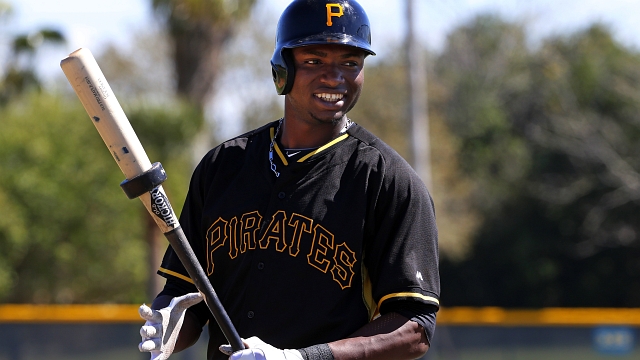
Pirates prospect Gregory Polanco is baseball's Next Big Thing


By Albert Chen
April 25, 2014

In 20 games at Triple A this season, Gregory Polanco is hitting .420/.460/.679 with four home runs.(Gene Puskar/AP)

The Next Big Thing is almost here. Are you ready to believe? Or are you already rolling your eyes?

The Next Big Thing is a 6-foot-4, 220-pound man-child who's being compared to everyone from Andrew McCutchen to Jadeveon Clowney. His name is Gregory Polanco, and he's the X-factor in the National League Central race, the sleeper pickup in your fantasy baseball league and one of the most enthralling prospects in the game; no player in the minors right now -- not Archie Bradley, not Oscar Taveras, not Byron Buxton -- is more deserving of a ticket to The Show.

"Who does he remind me of? Barry Bonds," says Double A Altoona manager Carlos Garcia, who managed Polanco last summer. "He has that kind of power. But he does it all -- he hits for power, he hits gap to gap, he can lay down a bunt, he runs well, defensively he can cover so much ground in centerfield and rightfield." Garcia also mentored a young McCutchen, who won last year's NL MVP award, in the Pirates' system. "Not taking anything from Andrew," he says, "but when Andrew was in the minor leagues, he was nothing close to Polanco. This kid has the potential to be one of the best ever."

So, are you ready to believe? Or are you rolling your eyes?

The numbers the 22-year-old Polanco is putting up at Triple A Indianapolis would be hard to replicate on your PS4. On Thursday, Polanco hit a solo home run, a go-ahead double and an infield single, finishing a triple shy of the cycle with his 11th multi-hit game. He improved his line for the year to .420/.460/.679 and now has four home runs, five doubles and two triples in 20 games. This insane start comes after a winter in which he won both the MVP and Rookie of the Year awards in the Dominican Winter League. With Travis Snider and Jose Tabata struggling in the Pirates' rightfield platoon, Polanco's promotion to Pittsburgh would seem imminent, though service time issues could keep him in Indy into June.

"You still use the word raw with him because of his age," cautions Indianapolis manager Dean Treanor, who has been working with Polanco on his transition from center to rightfield. "His arm's big, but he's got to acclimate himself with the angles.

"This kid loves to run," Treanor continues. "His strides are so big, it's like he takes two steps and he's gone from second to home. He's like a young colt on the bases. But the small things, he needs to work on -- his leads, when to be aggressive. But he's progressing, because this kid is willing to do everything to get better."

Five years ago, Polanco was a teenager in the Dominican who was spindly and somewhat awkward. "He looked like a sick giraffe," says Rene Gayo, the Pirates' director of Latin American scouting.

At the Club Payero complex in Santo Domingo, Polanco was being sold to major league teams by his buscone as a lefthanded pitcher. There was a problem: This particular southpaw had no heat on his fastball, no secondary pitches and absolutely no interest in pitching. Still, the buscone's asking price for the boy was $150,000. The best offer on the table was $70,000. The buscone refused to lower his price.

One afternoon Gayo happened to see Polanco in the outfield when his team had a shortage of players. He liked how Polanco played the position so effortlessly, with such joy, and he loved the boy's short swing and quiet approach at the plate. So uncomfortable on the mound, the boy was a natural in the outfield.

"Hey man, you're a pretty good outfielder," Gayo said to Polanco after one practice.

"That's what I am -- but they've got me pitching. I don't like pitching," said Polanco.

Gayo told the buscone that he'd give him his $150,000 -- but only if Polanco would be an outfielder. "Do whatever you want with him," the buscone said.

The Pirates' use of analytics has been a large part of the narrative in Pittsburgh, and yes, the organization has done a brilliant job using data analysis in its decision-making. But old-school scouting has also played a role in the team's success, particularly creative international scouting -- and we're not just talking about the Disney movie stuff. One day seven years ago, Gayo saw a raw shortstop on the fields of Santo Domingo and imagined that he could be an outfielder. He signed Starling Marte for $80,000. Marte is now Pittsburgh's starting leftfielder. One day Gayo saw a sick giraffe trying to throw baseballs off the mound and imagined he could be a star outfielder. Polanco looks on his way to becoming just that.

"The only thing he's doing right now that surprises me is the way he runs," Gayo says. "I would never have thought he'd run like that. He was so big, you thought he would run the 60 in 7.4. Which would be fine. But the way he runs now is like Marte. It's like [projected top NFL draft pick Jadeveon] Clowney. To run the way he does at his size, that's insane."

Polanco grades as a 70 runner on scouts' traditional 20-80 scale for evaluating a prospect's abilities, and he will make an immediate impact in the Pittsburgh outfield with his plus-plus defense. But now that he's shortened up his swing -- and done so without giving away any power -- he also looks like he's ready to be an impact bat in a struggling lineup. The Pirates were 9-14 entering play on Friday, already 7½ games behind the first-place Brewers. While it's too early for panic, it's hard to ignore the struggles of the offense, which ranks 26th in the majors in batting average (.229), 25th in OBP (.301), 21st in slugging (.370) and 22nd in OPS (.671).

Last year McCutchen had his MVP season and Marte broke out with an impressive campaign in his first full year. Now here is Polanco, the final piece in what could be, in a few years, the best and most dynamic outfield the game. It's easy for Pittsburgh to dream about what an outfield of McCutchen, Marte and Polanco would look like at PNC Park for years to come. As for 2014, the Pirates want an NL Central title and another trip to the postseason, and the giraffe with the magical swing can help get them there.

But it is impossible to know exactly what kind of player Polanco will be in the majors, of course. A few years ago, Eric Hosmer looked like he was headed toward All-Star games and MVP awards. Mike Trout was better than we all imagined. In any case, the Next Big Thing is almost here.

Are you rolling your eyes? Or are you ready to believe?


Read More: http://sportsillustrated.cnn.com/mlb/news/20140425/pirates-prospect-gregory-polanco-next-big-thing/#ixzz2zzTCtTwx

Friday, April 25, 2014

Only thing intense about Pens is scrutiny of its roster

The difference between the Penguins and Blue Jackets is exemplified by their fans: At Columbus, everyone stood up during Wednesday’s overtime. At Consol Energy Center this past Saturday, many spectators left during OT.
If you can’t beat the low seed, you can at least beat the traffic.
The Penguins are in a deep malaise. Perhaps they can snap out of it and win the Stanley Cup. Or maybe it’s nothing a different coach and 10 new players can’t fix.
The Penguins have one foot on a pedestal and the other in 2009. Their entitlement is tangible. When a foe has the temerity to actually compete, the Penguins go limp. “How dare you?” The organization is soft from top to bottom.
There’s plenty of blame to go around. GM Ray Shero deserves more scrutiny than he’s received. This team is flawed in the assembly. Certain management and coaching idiosyncrasies have taken bad and made it worse.
The Penguins’ bottom-six forwards are putrid. Too much vanilla, too little height, not enough bash and crash. Brandon Sutter is playing OK, but he’s a stick figure. He can’t win battles. Craig Adams is washed up. Brian Gibbons and Jayson Megna are minor-leaguers. Joe Vitale isn’t much better.
Beau Bennett is too often on the wrong line and the wrong wing. He’s a first-round talent, but plays second fiddle to Lee Stempniak, a rental winger who was bottom-six at Calgary, one of the league’s worst teams.
If Bennett isn’t good enough, shame on Shero for drafting him 20th overall in 2010. Same goes for Simon Despres (30th overall in 2009). If they are good enough but aren't being used right, shame on coach Dan Bylsma. Somebody goofed.
If you're a Penguin and want nurtured, be a little engine that could. Don’t be talented.
The Penguins’ top-six forwards are considered good, and mostly (usually) are. But Stempniak was bottom-six at Calgary, and he’s skating with Crosby. Jussi Jokinen was bottom-six at Carolina, and he’s skating with Malkin. You can’t polish excrement. But Shero’s roster construction leaves no choice.
The signing of Rob Scuderi seemed a good idea. But he’s played sub-par. At 35, with three more years on his deal, Scuderi isn’t likely to get much better.
The Penguins should have committed to using Despres or Robert Bortuzzo and used cash spent on Scuderi to sign a winger. Scuderi isn’t what he was, and the Penguins have stockpiled defensemen in obsessive fashion. If you draft them, play them. Trust them. If you won’t, because you don’t, why were they drafted? Have you failed them in development?
In retrospect, the Penguins should have traded Malkin or Kris Letang, using the return to restock the team’s depth. But now Malkin has a no-trade clause that he has zero intention of ever waiving. Letang’s no-trade kicks in July 1. Who would deal for Letang between now and then given his health issues?
None of these issues caused Marc-Andre Fleury’s mistake behind his net Wednesday, or Crosby and Malkin netting a big, fat donut so far in these playoffs. But everything adds up. Mistakes were made.
The Penguins may eliminate Columbus. They probably will.
But what happens after that? Can this team regenerate its performance and its psyche to the point where it could beat, say, Boston? Seems doubtful.
If Bylsma gets sacked but Shero doesn’t, Bylsma’s likely successor would be Barry Trotz, recently fired by Nashville. Shero and Trotz worked together with the Predators.
Trotz would be a bad hire. The Penguins should aspire to better than being Nashville.
Hire ex-Philadelphia coach Peter Laviolette. He would provide a much-needed kick up the backside. The Penguins should be more like the Flyers. Better to be too intense than not intense enough.
Mark Madden hosts a radio show 3-6 p.m. weekdays on WXDX-FM (105.9).

Where's joy in Penguins country?


By Joe Starkey 
http://triblive.com/sports/
Published: Thursday, April 24, 2014, 10:33 p.m.


What shaped up as the NHL's least-interesting first-round matchup has morphed into something wild, riveting and wholly unprecedented.

Elias Sports Bureau confirmed Thursday that never before has the winning team rallied from two or more goals behind four times in a series, let alone four in a row.

“It's unreal,” said the man from Elias.

So is this: The Columbus Blue Jackets are playing the 109-point Penguins to a standstill.

As such, the hockey world is sure to turn its eyes toward Game 5 on Saturday in Pittsburgh — home of a joyless hockey team and its joyless following.

Welcome, friends, to the No Consol-ation Energy Center, where the burden of great expectations has ruined the fun for everyone and where good seats still were available for Game 5 as of Thursday afternoon. They'll tell you the motto is “It's a Great Day for Hockey,” but that's a lie. It's more like, “Hurry up and win the Cup.”

This town has no time for a 2-2 series against an opponent rife with playoff neophytes.

This team, somewhere along the road years ago, stopped reveling in the ride.

Observing Sidney Crosby this season, you never would have known he was racing toward the Hart Trophy on a first-place club. It felt more like a five-month trip to the dentist. Evgeni Malkin isn't seen long enough at any one time to get a vibe for his mood, though you have to believe it wasn't good after he FAILED TO REGISTER A SHOT in Game 4. Marc-Andre Fleury and Kris Letang have been beaten down beyond recognition.

I wonder what the late, great Bob Johnson — author of the “It's a Great Day for Hockey” quote — would say to these guys. Maybe he'd tell them to remember their childhoods, when they dreamed of situations like the one Game 5 will present.

Maybe it's time the Penguins and their fans took a lesson from Columbus, the way a bitter old man, ruminating on a park bench, might gain a spark of clarity in observing an exuberant child.

Did you see the headline in the Columbus Dispatch after the Blue Jackets blew a 3-1 lead and lost Game 3?
“Blue Jackets Having Too Much Fun to Dwell on Loss”

This is supposed to be fun.

Why isn't it fun anymore?

Why can't the roller-coaster ride of playoff hockey be even remotely enjoyed?

What happened to this team, to this town?

One reflects the other, you know, each defined by pronounced highs and lows with little in between. Everyone seemingly is so focused on the Cup that scant attention is paid to the process.

I tell you, the air of superiority combined with the suffocating pressure makes it stink like crazy inside and outside of that state-of-the-art, extra-comfy Penguins locker room.

Dan Bylsma actually said, in plain English on Thursday, that his team isn't trying hard enough.

Columbus, meanwhile, is just discovering hockey.

You saw that in the way its players poured off the bench like the 1980 Miracle on Ice team the other night. You heard it in the way its fans kept chanting “C-B-J” when the Blue Jackets fell behind 3-0 (in contrast to Penguins fans booing their team in Game 2 even though it was leading 3-2).

Of course, it would be unrealistic to totally adopt the Columbus mindset. The magical days of a franchise's rise never can be duplicated. The early-1970s Steelers, last year's Pirates, the Penguins of 2008 and '09, those times cannot be recaptured. Expectations naturally begin to impede on the innocent bliss.

But that doesn't mean it's time to get all old and cynical.

Fleury on Saturday could use the same chants he heard in a darkened Mellon Arena before Game 6 of the '09 Final. His teammates could create their own positive energy by realizing how fortunate they are to be here and by remembering the many examples of teams — including last year's Boston Bruins and some of their Penguins ancestors — who barely survived first-round upset bids and pulled themselves together.

If that doesn't happen, if the Penguins don't survive, we'll know it's time for change.

In the meantime, we've got a wild series on our hands. Saturday doesn't have to have the same vibe as last year's Game 5 against the New York Islanders, when all you could feel was impending doom until Tyler Kennedy scored.

No, Saturday should be fun.

It should be a great day for hockey.

Joe Starkey co-hosts a show 2 to 6 p.m. weekdays on 93.7 FM. Reach him at jraystarkey@gmail.com.


Read more: http://triblive.com/sports/joestarkey/5983382-74/penguins-game-team#ixzz2ztsb8QKF 
Follow us: @triblive on Twitter | triblive on Facebook

Thursday, April 24, 2014

Pittsburgh Steelers schedule analysis


By Scott Brown
http://espn.go.com/blog/pittsburgh-steelers
April 23, 2014


» NFCEast | West | North | South » AFCEast | West | North | South » Predictions

Breakdown: Consecutive 8-8 seasons have not taken away from thePittsburgh Steelers' broad appeal, at least to TV executives. The Steelers play five prime-time games -- that is the maximum teams are allowed unless granted a waiver by the NFL -- including two Monday night contests on ESPN. The Steelers host the Texans on Oct. 20. They play another Monday night game on ESPN a month later when they visit the Titans. Both of the Steelers’ games against the Ravens will be prime-time affairs, including Sept. 11 in Baltimore. The 8:25 p.m. game marks the Steelers’ only Thursday night game of the season. No stretch of the schedule looks particularly daunting, though the Steelers play four of their first six away from Heinz Field. Coach Mike Tomlin is probably pleased that the Steelers have 10 games scheduled for 1 p.m. and only one contest scheduled for the 4 p.m. ET slot. I’ve always gotten the sense that the players prefer early games or night ones since the latter provide a bigger stage. The schedule, in that sense, makes it a little easier on the coaches. 

Complaint department: Yo, NFL, did I not make it clear that I prefer the bye week to come somewhere in the middle of the season and not right before Thanksgiving? The Steelers and Panthers are the last teams to get a bye as each is off in late November. That is not any better for beat-up players than it is for whiny beat writers who want to catch their breath. Early back-to-back night games on the road (Ravens and the Panthers) aren’t exactly a treat either, and couldn’t you have spaced out the Bengals games a little better? The Steelers visit Cincinnati on Dec. 7 and host their AFC North rival on Dec. 28, the final day of the regular season. Props for sandwiching two home games around Christmas. 

Roads less traveled: The most favorable aspect of the Steelers’ schedule is it keeps them close to home even when they are on the road. The Steelers only play one game out of their time zone, and they are only an hour behind when they travel to Nashville, Tenn., for a Nov. 17 game against the Titans. Long-distance travel has not agreed with the Steelers under Tomlin. Since 2007, the Steelers are just 2-7 when playing outside of the Eastern and Central time zones. If minimal travel isn’t enough of a boost for the Steelers they only play two road games against teams that had winning records last season -- the Panthers and Bengals. 

Strength of schedule: 23rd, .469 | Vegas over/under : 8.5 

Steelers Regular-Season Schedule (All times Eastern) 
Week 1: Sunday, Sept. 7, Cleveland, 1 p.m. 
Week 2: Thursday, Sept. 11, at Baltimore, 8:25 p.m. 
Week 3: Sunday, Sept. 21, at Carolina, 8:30 p.m. 
Week 4: Sunday, Sept. 28, Tampa Bay, 1 p.m. 
Week 5: Sunday, Oct. 5, at Jacksonville, 1 p.m. 
Week 6: Sunday, Oct. 12, at Cleveland, 1 p.m. 
Week 7: Monday, Oct. 20, Houston, 8:30 p.m. 
Week 8: Sunday, Oct. 26, Indianapolis, 4:25 p.m. 
Week 9: Sunday, Nov. 2, Baltimore, 8:30 p.m. 
Week 10: Sunday, Nov. 9, at NY Jets, 1 p.m. 
Week 11: Monday, Nov. 17, at Tennessee, 8:30 p.m. 
Week 12: BYE 
Week 13: Sunday, Nov. 30, New Orleans, 1 p.m. 
Week 14: Sunday, Dec. 7, at Cincinnati, 1 p.m. 
Week 15: Sunday, Dec. 14, at Atlanta, 1 p.m. 
Week 16: Sunday, Dec. 21, Kansas City, 1 p.m. 
Week 17: Sunday, Dec. 28, Cincinnati, 1 p.m.