Sunday, January 14, 2007

Ron Cook: Sanchez Best Choice for Dapper Dan Award


Pirates' Sanchez is the best man in a strong field as the Dapper Dan Sportsman of the Year

Sunday, January 14, 2007

Pittsburgh Post-Gazette


You know it's been a pretty good year when you can't put a check next to Willie Parker's name or Sidney Crosby's name for the 2007 Dapper Dan Sportsman of the Year award. All Parker did for the Steelers was run 75 fabulous yards into Super Bowl history and follow it up with a team MVP season. Crosby hasn't won a Stanley Cup for the Penguins yet -- give him time, it's coming -- but, at 19, he's become the best player in the NHL and shown he has a chance to be -- sorry, Mario -- the greatest player in Pittsburgh hockey history, assuming that history lasts longer than June.

You know the competition for the Dapper Dan award is stiff when you can't bring yourself to vote for Pitt's Jamie Dixon or Penn State's Paul Posluszny. Pitt and Penn State people don't seem to agree on much, but they'd have to admit Dixon is a phenomenal basketball coach who has built Pitt into a national power, and Posluszny could play linebacker for any college team in America.

You know the Dapper Dan field is ridiculously strong when West Virginia's Rich Rodriguez and John Beilein should finish down in the voting. They're central figures in what maybe is the hottest college athletic program this side of Gainesville, Fla. Rodriguez as the football coach who delivered the Big East Conference's greatest victory in the 2006 Sugar Bowl and Beilein as the basketball coach who plugs in new players and keeps winning because of his estimable system.

Any one of those six sports figures would be a deserving winner of the prestigious Dapper Dan award in any other year.

But not this year.

You ultimately will help to decide the honoree with your votes, but it says here the award should go to the guy who overcame a club foot as a child, a serious ankle injury that cost him most of two years in the minor leagues, and the short-sightedness of his Pirates general manager and manager to win the 2006 National League batting title.

Freddy Sanchez.

The batting championship alone is enough to win Sanchez the Dapper Dan award. He put together six incredibly consistent months, hitting .333, .360, .380, .301, .355 and .320 on his way to a final average of .344, the highest by a Pirates player since Roberto Clemente hit .345 in 1969. He led the league with 53 doubles and was remarkable in the clutch as evidenced by his .386 average with runners in scoring position. He also was a versatile and steady fielder, making just 10 errors in his 92 starts at third base, 27 at shortstop and 18 at second base.

Sanchez's success was no surprise. He always seemed to hit well above .300 as a minor leaguer in the Boston Red Sox's system. He also has a long history of working toward his goals, no matter the adversity. Doctors wondered when he was young if he would walk normally because of that club foot. Baseball executives wondered if he would make it in the big leagues because of that ankle problem that required surgery and cost him most of 2003 and 2004.

Sanchez answered all of the doubters, including Pirates general manager Dave Littlefield and manager Jim Tracy.

Sanchez didn't figure in their plans as a starter going into last season even though he finished the 2005 season by hitting .306 after the All-Star break. Littlefield signed Joe Randa as a free agent to play third base, a decision he soon would regret. Tracy didn't turn to Sanchez as his starter at third until after Randa went on the disabled list with a foot injury in early May.

Less than 21/2 months later, Sanchez played in the All-Star game at PNC Park, having been swept in as a National League reserve on the groundswell of fans' write-in voting.

Perseverance should get Sanchez the Dapper Dan award.

But there's so much more to Sanchez's magical season.

The man did the impossible by keeping people interested in the woeful Pirates in the franchise's 14th consecutive losing season. More than 1.86 million fans went to PNC Park, at least in part, to see Sanchez. They loved his effort. They loved his humility; hits weren't important to him because of the batting title, he often said, they were important because they helped the team. Most of all, they loved his production.

Certainly, Sanchez was the reason a crowd of 25,004 came to PNC Park for the season's otherwise meaningless final game Oct. 1 against the Cincinnati Reds. Fans, waving their "Go Freddy!" placards, wanted to see if Sanchez could hold off Florida's Miguel Cabrera for the batting title. He did it in extraordinary style, getting singles in his first two at-bats to finish the year with an even 200 hits.

If you listen closely, you still might be able to hear the echoes of the "Fred-dy! Fred-dy!" chants.

It's nice to think we'll hear them again in three months at the David L. Lawrence Convention Center.

On the night of April 15, when they officially make Sanchez a Pittsburgh sports legend by giving him the Dapper Dan award.


--------------------------------------------------------------------------------

(Ron Cook can be reached at rcook@post-gazette.com or 412-263-1525. )

Saturday, January 13, 2007

Joe Starkey: McClatchy's Tenure a Disaster


PITTSBURGH TRIBUNE-REVIEW
Saturday, January 13, 2007


One of the worst ownership reigns in baseball history, Pittsburgh sports history and perhaps even professional sports history is about to end.

If you're a Pirates fan, you better pray another one isn't about to begin.

Major League Baseball on Thursday is expected to approve a change in the Pirates' hierarchy. Bob Nutting, the team's chairman of the board, will replace Kevin McClatchy as principal owner. McClatchy will remain chief executive officer.

In a sense, little has changed. The Nutting family already controlled the franchise purse strings, while McClatchy administered the baseball part of the business.

But it's impossible to dispute the portion of the Pirates' news release Friday that listed the team's roster of principal owners and finished like this:

"Kevin McClatchy (1996-2007)."

It's painful to sit here and hammer McClatchy, because he is a good man who meant well and worked hard. He helped to keep baseball here when it looked as if it would leave, and he pushed for the building of PNC Park.

Problem is, professional sports executives are measured by one statistic - won-loss record -- and McClatchy lost like few ever have. He compared his tenure to a ride at Kennywood. If so, it was the Pittsburg Plunge.

McClatchy lost for 11 straight years, extending the Pirates' losing streak to an unfathomable 14 years overall.

That is just two short of tying Major League Baseball's record for futility, set by the Philadelphia Phillies from 1933-48.

Go ahead and blame baseball's economic system, if you like. Just realize that McClatchy did very little to stand up for the mid- and small-market teams. The Pirates' public silence in the wake of MLB's latest collective bargaining agreement, signed a few months ago, was deafening.

"Would I say I gave a 100 percent ringing endorsement of the deal? No," McClatchy said yesterday in an interview he and Nutting conducted with the Pittsburgh Tribune-Review. "But it was a deal that was going to get done - and it did beat the alternative of shutting the game down."

Not from the Pirates' standpoint, it didn't. Sure, they're running a tidy little business, making a nice profit, but Nutting said it best yesterday, when asked about the perception that his family would rather make money than win.

"The reason the Pirates exist," Nutting said, "is to win baseball games."

Under McClatchy, the Pirates lost 996 baseball games, an average of 90 per season. Only the Kansas City Royals (1,037) lost more during his tenure.

Maybe local beer wholesaler Frank Fuhrer knew what he was doing in July of 1996 when he sold his $5 million ownership stake in the Pirates. A few months earlier, McClatchy, then a 32-year-old California newspaper heir and owner of the Class A Modesto (Calif.) A's, led a 28-man purchase of the Pirates for about $80 million.

Fuhrer soon realized the ship was off-course.

Upon selling his stake, Fuhrer said, "I know enough about these things to know things usually don't work out as well as wide-eyed kids think they will."

Hard to believe, but Pittsburgh once adored the wide-eyed kid. You can look it up. McClatchy's autograph was the hottest item at PirateFest of 1996, and after an Opening Day win over Florida in 1996, Pirates manager Jim Leyland gave McClatchy the game ball.

A year later, Baseball America labeled the Pirates' farm system "the best in baseball." That year, a team with a paltry $9.5 million payroll somehow contended for a division title.

On July 12, 1997, a crowd of 44,119 at Three Rivers Stadium watched Francisco Cordova and Ricardo Rincon combine on a 10-inning no-hitter. ESPN carried the final few innings and focused on McClatchy, who was being hailed as baseball's boy wonder and whose "five-year plan" to produce a winner seemed well ahead of schedule.

But that was before the 1998 team lost 25 of its last 30 games in the worst Pirates' finish since the Eisenhower administration.

That, too, was before the likes of Kevin Young and Pat Meares were signed to ridiculous contracts, before McClatchy predicted a 90-win season in 2000, before Lloyd McClendon was promoted to manager without a shred of experience ("We got the guy we felt would get us winning the fastest," McClatchy said at the time), before the Pirates claimed a $30 million loss three years into their tenure at PNC Park and before McClatchy raised season-ticket prices after a 100-loss season in 2001.

He learned from the price-hike mistake - the Pirates haven't raised season-ticket prices since - but it looks as if he did not improve on Cam Bonifay with the hiring of current general manager Dave Littlefield.

Just last season, the Pirates experienced their longest losing streak (13 games) of modern times.

"I feel good that we saved this team and that families are going to be able to watch baseball for a long time in this marketplace," McClatchy said. "I think when you look at PNC Park, we're proud of putting that together. I think it's the best ballpark in the country.

"Disappointments? Obviously, the record. I do, as some people probably understand, take this to heart."

I believe that.

I also believe it'll be hard for anyone - including Bob Nutting - to top an 11-year losing streak.


Joe Starkey is a sports writer for the Pittsburgh Tribune-Review. He can be reached at jstarkey@tribweb.com

Bob Smizik: Nutting Makes Himself Visible at Long Last


Saturday, January 13, 2007

Pittsburgh Post-Gazette

Bob Nutting, the chairman of the Pirates, stepped out of the shadows yesterday for first-time meetings with the Pittsburgh media. Nutting was front and center as he and CEO Kevin McClatchy had a series of approximately 30-minute sessions with individual media outlets in the Pirates' offices.

The men met with about 10 different news outlets and for most, if not all the media members, it was the first time they had seen Nutting, let alone met him. That is an unusual situation for the owner of a major sports franchise.

Nutting long preferred very little public contact when it came to the Pirates. But such an approach wasn't working. Since it became widely known that his family had taken controlling interest in the Pirates and he was the man making the major decisions for the franchise, Nutting has not been popular with Pirates fans -- although no one really knew him.

McClatchy has been the face of the franchise since he bought it in 1996. Once extremely popular and hailed as the man who saved baseball in Pittsburgh, he became the obvious target for fan unhappiness over the team's poor play, which now measures at 14 consecutive losing seasons. Of late, though, he has shared that role with Nutting.

Dressed casually in a button-down blue shirt with no jacket or tie and wearing sharply creased dark gray trousers and black shoes, Nutting made an impressive appearance. He's a tall man with a thick shock of black hair and bears a distinct resemblance to a young Mario Lemieux. Nutting looks enough like Lemieux that if he removed his glasses and stood in one of the sky boxes at Mellon Arena and waved down to a capacity crowd, he likely would get a standing ovation.

He comes across a bright, well-spoken and sincere in the belief of wanting a winning team in Pittsburgh. How far he will go financially to achieve such a goal remains to be seen.

The purpose of the media gatherings was to introduce Nutting, who previously had refused one-on-one interviews, and at the same time announce a minor reshuffling within the organization. The Pirates have asked Major League Baseball to ratify a "change in control" within the franchise. Nutting will replace McClatchy as the man who speaks and votes for the Pirates on baseball business. It is the most minor of changes because even when McClatchy was voting, he was speaking for the Nutting family.

Nutting spoke with Post-Gazette reporters for approximately 30 minutes and vehemently denied, with strong backing from McClatchy, that he and the other owners are pocketing profit, which is a widely held belief by the media and fans

"That is absolutely inaccurate," he said. "The ownership group is not taking money out of the team and putting it in their pockets. We are not moving profits."

To which, McClatchy added, "We are not paying ourselves dividends and we're reinvesting every penny that we've made back into the club."

Another way for ownership to take profit out of a team is to pay themselves excessive salaries. When asked about that, McClatchy offered a surprising answer.

"Bob doesn't take a penny from the team, so I'd say he's underpaid. My salary is probably on par with other CEOs or a little bit below."

If Nutting and McClatchy are being honest, and there is no reason to believe that is not the case, the profit the team is making is either being plowed back into player development or, more likely, being used to pay down debt. It certainly is not going toward player salary. The Pirates' payroll remains among the lowest in baseball.

Nutting went to great pains to point out he is interested in winning and has no desire to have a profitable but losing team.

"Questioning my commitment or my family's commitment to winning, I think that's completely inappropriate."

Nutting presented a picture of a team on solid financial footing that is equipped to handle the nearly impossible scenario of winning in a small market with a limited budget. He also emphatically endorsed McClatchy, who, he said, had his "unconditional" support.

It was a public relations step forward for the Pirates. But, on the field, little has changed. The Pirates remain a team in desperate need of additional talent, and that's something a suddenly media-friendly chairman of the board can't change.


--------------------------------------------------------------------------------
(Bob Smizik can be reached at bsmizik@post-gazette.com. )

Friday, January 12, 2007

Bay recovers from knee surgery


By Rob Biertempfel
PITTSBURGH TRIBUNE-REVIEW
Friday, January 12, 2007


Jason Bay could've had his knee surgery in early November, but a baby got in the way.

The Pirates' all-star left fielder was bothered last season by grinding and soreness in his left knee. When it did not improve after a month's rest at the start of the offseason, he opted to have orthoscopic surgery.

"But my wife was due in the middle of November, so I couldn't leave," Bay said. "The baby was, for good reasons, holding things up."

Kristen Bay gave birth to a daughter, Addison, on Nov. 19. Nine days later, Jason Bay flew from his home in Arizona to Pittsburgh to undergo surgery.

"They cleaned it out," Bay said. "It makes a big difference; I can tell that already."

On Thursday, Bay was examined by team doctors at PNC Park. He has not swung a bat nor done any full-speed running for more than a month, but he expects to be ready for spring training.

"I fully anticipate being ready for playing games," he said. "If anything, I might not be out there sprinting on the first day or two. Ultimately, the main goal is to be ready by the first game in April. The way things are going right now, hopefully, I'll be ready way before that."

Position players are not required to report to spring training until Feb. 27. So there's still plenty of time for Bay to rest ... and change diapers.

"Everything's been quiet -- other than the baby," Bay said, smiling. "It's been nice to be around for that."

Note: Tomo Ohka's agent said the free-agent pitcher has received four contract offers, but he would not say if one of them is from the Pirates. Jim Masteralexis said two of the offers are two-year deals and the other two are one-year deals. "You can tell from how hoarse my voice is, I've been doing a lot (of negotiating) the past few days," Masteralexis said.


Rob Biertempfel can be reached at rbiertempfel@tribweb.com or (412) 320-7811.

NHL All-Star Game: Shero campaigns to get more Penguins on team


Friday, January 12, 2007

By Shelly Anderson, Pittsburgh Post-Gazette


SUNRISE, Fla. -- Although reluctant to talk about it, Penguins general manager Ray Shero has been doing some behind-the-scenes lobbying lately.

Shero said he feels his team should be represented by more than center Sidney Crosby at the NHL All-Star Game Jan. 24 in Dallas.

"I'm not sure how many of our guys will go, but certainly with [Evgeni] Malkin, [Jordan] Staal, guys like that, we have players who can go," Shero said.

Crosby, who leads the NHL with 65 points, got word that he was a starter for the Eastern Conference and by far the overall top vote-getter Tuesday night just as the Penguins were coming off the ice from a 3-2 loss at Tampa.

Like Shero, Crosby is pushing hard for spots for his teammates.

"We will be well represented," Crosby predicted.

The balance of the rosters for the Eastern and Western conference teams will be announced by the NHL tomorrow afternoon, sometime during the Penguins' game at Philadelphia.

Malkin led all rookies in scoring before last night with 41 points, including 20 goals, in 38 games. Staal, 18, had 15 points and was fourth among rookies with 12 goals. He led the league with five short-handed goals and was seventh in shooting percentage (.211).

Malkin finished fifth in Eastern Conference balloting for forwards with 399,081 votes. The Penguins' Marc-Andre Fleury finished third among Eastern Conference goaltenders with 346,530. He is 17-12-5 with two shutouts, a 2.89 goals-against average and a .904 save percentage.

If they don't make the main All-Star squad, Malkin, Staal and several other Penguins are eligible for the YoungStars game Jan. 23. Fleury likely isn't. In general, the YoungStars are under 24 and on their entry-level contract. Fleury is 22, but is on his second contract.

Crosby said he would be surprised and disappointed if he doesn't get to share the All-Star experience with other Penguins.

"It's fun for everybody to have our team supported like that," he said. "We have a young group of guys who are probably experiencing this kind of thing for the first time, so it's nice that we're all doing it together that week. We can enjoy our time there and grow from that, too."

It has been four years since the Penguins have sent anyone to the All-Star Game. There was no game last year because of the Winter Olympics. There was no game in 2005 because that season was wiped out by a work stoppage. In 2004, no Penguins were selected -- although defenseman Brooks Orpik and winger Ryan Malone participated in the YoungStars game.

It was 10 years ago that three Penguins made the Eastern Conference All-Star team. That year, Mario Lemieux, Jaromir Jagr and Kevin Hatcher made the team, but Jagr missed it because of injury.

This could be the first of many All-Star trips for Crosby, who garnered a whopping 825,783 votes.

If the Penguins are able to build something from their corps of young players, perhaps they can return to the years of having multiple entries on All-Star teams.

They will have a way to go to match the 1991-92 game in Philadelphia, where the Penguins -- coming off of their first Stanley Cup championship -- sent five players. Four were starters for the Wales Conference, Lemieux, Jagr, Kevin Stevens and Paul Coffey. They were joined by Bryan Trottier.

For now, the Penguins will be happy if Crosby doesn't go alone, even if a teammate or two or three goes to the secondary game.

"Even the YoungStars game, it's a great experience -- [Atlanta's Ilya] Kovalchuk, [Ottawa's Dany] Heatley, guys like that have played in it," Shero said. "It's great for them. It's great for the league. I'm hopeful that our younger guys get recognized. It would be a great step for our organization."


--------------------------------------------------------------------------------

(Shelly Anderson can be reached at shanderson@post-gazette.com or 412-263-1721. )

List swells to 5 with addition of Gailey

Friday, January 12, 2007

By Gerry Dulac, Pittsburgh Post-Gazette

The Steelers will add another familiar name to their list of coaching candidates when they interview Georgia Tech coach Chan Gailey, one of their former offensive coordinators, about replacing Bill Cowher.

Gailey, 55, will meet tomorrow with team chairman Dan Rooney, president Art Rooney II and director of football operations Kevin Colbert about returning to the team where he was an assistant coach from 1994-97. Gailey will be the fifth and, apparently, final candidate to interview for the position.

After they interview Gailey, the Steelers will begin paring their list of candidates and conduct second interviews next week with those who make the final cut.

They already have interviewed four candidates for the position -- offensive coordinator Ken Whisenhunt, offensive line coach Russ Grimm, Minnesota Vikings defensive coordinator Mike Tomlin and Chicago Bears defensive coordinator Ron Rivera.

Whisenhunt is scheduled to have a second interview today with the Arizona Cardinals, who are looking for a replacement for fired Dennis Green. Grimm had a first interview earlier this week with the Cardinals.

The Steelers have no immediate timetable to name a successor to Cowher, who resigned last week after 15 seasons as head coach. But it is possible an announcement could be made by the end of next week.

Gailey, who already has interviewed with the Miami Dolphins about replacing Nick Saban, could not be reached for comment.

Gailey has long been considered a favorite of Cowher, who hired him in 1994 to be the Steelers' wide receivers coach. When he feared he was going to lose Gailey to another team after Super Bowl XXX in 1995, Cowher did not re-hire offensive coordinator Ron Erhardt and promoted Gailey to the position.

After two years as offensive coordinator, Gailey left to become head coach of the Dallas Cowboys, leading them to back-to-back playoff appearances and winning the NFC East title in 1998.

The Cowboys, though, fired him after two seasons, and Gailey joined the Miami Dolphins as offensive coordinator in 2000 and '01, working under head coach Dave Wannstedt. In seven of his eight seasons as an offensive coordinator in the NFL, Gailey always has had a 1,000-yard rusher, including Jerome Bettis with the Steelers.

Gailey, though, desired to return to college coaching, and he became head coach at Georgia Tech in 2002. He has led the Yellow Jackets to a 37-27 record in five seasons, including a 9-5 mark this season which ended with a 38-35 loss to West Virginia in the Gator Bowl

Gailey also was a head coach at Troy State University and Samford University and has a 61-38 record in eight seasons as a college head coach.


(Staff writer Ed Bouchette of the Post-Gazette contributed to this report. Gerry Dulac can be reached at gdulac@post-gazette.com or 412-263-1466. )

Thursday, January 11, 2007

Whisenhunt: Backers say body of work makes hin easy choice


Thursday, January 11, 2007
By Gerry Dulac, Pittsburgh Post-Gazette


Ken Whisenhunt got his degree in civil engineering at Georgia Tech, but he never really wanted to build bridges. Instead, he wanted to build a football team, construct a winning foundation, assemble the necessary parts of a franchise that had an infrastructure as solid as tungsten steel.

None of that is necessary with the Steelers. They do not need an architect to rebuild a tattered franchise or build a winning tradition. With five Super Bowl trophies on display in their South Side offices, they do not need someone to reinvent the wheel. They just want someone to keep the wheel rolling.

That's why Dan Henning, a former NFL head coach who worked with Whisenhunt as a player and assistant coach, wonders what the Steelers are waiting for to name a replacement for Bill Cowher.

"Next to player personnel in the National Football League, continuity is the next best thing," said Henning, who is offensive coordinator with the Carolina Panthers. "Kenny knows the Steelers' organization, they know him. They're not getting an unknown quantity. They know the quality of his work, the way he gets along with people. It's a tremendous advantage in transition."

Henning was head coach of the Atlanta Falcons from 1983-86 when Whisenhunt was a tight end/H-back there. He later coached with him for one season with the New York Jets, Whisenhunt's last coaching stop before joining the Steelers in 2004. Henning was also head coach with the San Diego Chargers from 1989-91.

"When we drafted him, he was a quarterback/tight end who could do all things. All those qualities he had as a player have transitioned for him as a coach. I don't know if there are any candidates out there who have all those qualities rolled into one.

"There is an old saying: A prophet in his own land is scorned. It's disappointing to me they haven't jumped on Kenny. Sometimes you hesitate because nobody is perfect. I can tell you this -- nobody knows for sure if somebody will be a successful head coach. You can only gauge based on the credentials and their body of work. Kenny has all that."

Whisenhunt had an indistinguishable career as an NFL player, catching 62 passes for 601 yards and six touchdowns in nine seasons with the Falcons (1985-88), Washington Redskins ('89-90) and Jets ('91-93). In college, he finished as Georgia Tech's second all-time receiving yardage leader (1,264) and fourth in receptions (82).

But it has been as an NFL assistant coach where Whisenhunt's career has been almost meteoric. He joined the Baltimore Ravens as tight end coach in 1997, was special teams coach under Chris Palmer with the Cleveland Browns in '99 and joined the Jets for one season before Cowher hired him to coach the Steelers' tight ends.

Now he could be the Steelers' next head coach. He has interviewed with three other NFL teams since the season ended, making him perhaps the most marketable head-coaching candidate in the league.

But Whisenhunt, 44, doesn't want to coach those other teams as much as he wants to coach the Steelers. That's part of the reason he lost an opportunity this week to replace Jim Mora Jr. as coach in Atlanta. Not that anyone would know underneath that calm, placid exterior.

"What people miss when they deal with him is that he's low-key, but very, very competitive, very focused," Henning said. "He wants to win and his actions follow through with that."

Whisenhunt has always been calm, even-tempered. But it does not belie his intensity, his toughness, nor does it adversely affect his performance.

That was apparent as far back as 1980 when Georgia Tech, in a game against unbeaten and No. 1-ranked Notre Dame, asked Whisenhunt to play quarterback after injuries felled its starter and top backup after a couple series. The Yellow Jackets were 1-8 at the time. And Whisenhunt, a walk-on freshman, wasn't really a quarterback. He was a receiver/defensive back.

But he kept Georgia Tech in the game, and the Yellow Jackets managed a 3-3 tie that derailed Notre Dame's season.

"You knew he was athletic, but when he stepped in to play in that Notre Dame game, you knew the guy had more," Ben Utt, a former NFL guard who was captain of the 1980 Georgia Tech team, told the Atlanta Journal Constitution. "Especially in hindsight, just the composure you have to have to be able to do that."

Whisenhunt has always done that, whether on game day or on the practice field, whether in uniform or coaching sweats.

"He has this calm presence about him that he will function as if he did it all his life," said former Georgia Tech coach Bill Curry. "He never panics and he's absolutely brilliant.

"He'll make the call that makes the most sense, that requires calm and presence. He won't be plucking things out of the air or choking on a hot dog. Coaches do all kinds of crazy stuff; there is a legion of ways they can panic in those situations. This guy is cold-blooded in the clutch."

Whisenhunt did not always want to be a football coach. When he retired after eight seasons as a tight end/H-back in the NFL, he thought about being a professional golfer, not a far-fetched thought for a person who grew up in Augusta, Ga. So he worked on his game for six months at Willow Springs Country Club in Roswell, Ga., lowering his handicap to 4 and even qualifying for the 1994 U.S. Mid-Amateur.

But, at age 31, staring at the same reality that eventually smacks most professional athletes who desire to be professional golfers, Whisenhunt thought it was time to do something else.

So he called his old position coach with the Falcons, Rod Dowhower, who was in line to become head coach at Vanderbilt University. Whisenhunt asked him if he needed an assistant coach. And, in 1995, a new career was started.

"I didn't know if I felt I could really succeed at it, but I thought it felt like the right thing to do," Whisenhunt said. "If there's anything that felt right, it was that first year at Vanderbilt. I got back into the game."

It began the ascent that has seen Whisenhunt go from position coach to Steelers offensive coordinator in 2004 to maybe the most viable -- certainly the most-interviewed -- head-coaching candidate in the NFL. Last week, a whirlwind tour took Whisenhunt and his wife, Alice, to Atlanta, Arizona and back home to Pittsburgh to interview with the Miami Dolphins in Wayne Huizenga's private jet.

He was the first person Falcons owner Arthur Blank wanted to interview and probably could have had the job if he didn't want to wait to see what would happen with the Steelers. Now he is among what is believed to be a field of four, competing with Russ Grimm and two other candidates -- Chicago Bears defensive coordinator Ron Rivera and Minnesota Vikings defensive coordinator Mike Tomlin -- to become head coach of the team whose offense he has directed the past three seasons.

"Tough guy, extremely tough," Dowhower said the other day from Cape Creek, Ariz., where he is retired from coaching. "A tremendous competitor.

"They asked him to do things that were never asked of a tight end before in Atlanta and that's slam-block 300-pound tackles. And he would do it over and over and over again. Never said a word."

Former Pitt coach Foge Fazio was a linebackers/special teams coach with the Falcons, and he always remembered Whisenhunt's toughness. When Fazio went to the Jets and head coach Bruce Coslett was looking for a tight end, he recommended Whisenhunt, who ended up playing three seasons in New York.

"He was always in there watching film and he knew the playbook inside and out," Fazio said. "He knew everyone on that offense and where they were supposed to be. He knew the pass protections. He knew all that. He knew what everyone was doing."

He still does, mainly because of his job description.

When Whisenhunt replaced the pass-happy Mike Mularkey as offensive coordinator in 2004, the Steelers jumped from No. 31 to No. 2 in rushing in the NFL and became the first AFC team to win 15 games in a regular season. When they needed to win their final four regular-season games last season to make the playoffs -- a streak that ended with the Super Bowl championship -- the Steelers leaned on their running game to average 185 yards rushing in that stretch.

But Whisehunt saved his best for the playoffs, and everyone around the NFL noticed.

The Steelers developed into one of the league's most diverse, explosive and productive offenses, a unit that was maddening to defend because of the big-play ability of quarterback Ben Roethlisberger and the threat of hammering the opposition with the run. The Steelers averaged nearly 28 points a game in their eight-game winning streak and scored on 13 of 28 possessions in the AFC playoffs.

And, yet, there were specific instances of his artistry:

After falling behind, 10-0 and 17-7, in Cincinnati, he pulled out a gadget play that resulted in a 43-yard touchdown from Roethlisberger to Cedrick Wilson to highlight a 24-point run.

In Indianapolis, he put in a special play to tight end Heath Miller that resulted in a 36-yard completion on the second play of the game, immediately setting the tone for what would be a 21-18 victory.

In the AFC championship game in Denver, Whisenhunt put in two plays he thought could work against the Broncos' defensive scheme, one that resulted in Roethlisberger's pump-fake 12-yard touchdown to Wilson, the other a 12-yard touchdown run by Jerome Bettis that was negated by a penalty.

That stamped him a candidate to be an NFL head coach.

"Nobody knows how someone will do until they're a head coach," Dowhower said. "That's all relative to the team you're with and the people you're able to hire and players you have. But I have no doubts he will be. The results will be based on the types of players he has and the support he has. I think he'll handle the rest."

Grimm: His knowledge of game makes him logical pick


Thursday, January 11, 2007
By Ed Bouchette, Pittsburgh Post-Gazette

Russ Grimm, star quarterback and linebacker in high school, fumed that day Jackie Sherrill told him he would join the ranks of those nameless football players, offensive linemen.

Grimm, a sophomore at Pitt who passed up his dream to go to Linebacker U at Penn State over a perceived snub, was no offensive lineman. He was Dick Butkus, Jack Lambert, Mike Curtis. He punished offensive linemen; now, Sherrill wanted to convert him into one, and a center at that? No way.

"He was ticked off," said Foge Fazio, the assistant coach who recruited Grimm for the Panthers. "He was going to transfer to West Virginia. He was mad and didn't come around to our workouts."

Grimm called Joe Pendry, the assistant coach who recruited him for the Mountaineers. Two days later, Fazio convinced Grimm to attend the Panthers' workout. There, standing before him, was Pendry.

"I talked Jackie into hiring Joe as our offensive line coach," said Fazio, laughing about the scene this week while driving to his winter home in Florida.

Grimm reluctantly accepted the new assignment, something Sherrill says today that he advised him was coming.

"He had growth potential," Sherrill said. "I kept kidding him, 'Russ, you're going from fullback to quarterback to linebacker; you keep eating, you're going to go down' [to offensive line]. Sure enough, he went down."

And up, and up, in weight and stature. Grimm was the center on one of Pitt's great lines in 1979-80 that included tackles Mark May and Jim Covert and guards Emil Boures and Paul Dunn, Grimm's roommate. He then moved to guard after the Redskins drafted him in the third round and became one of the famous Hogs that helped forge three Super Bowl victories in Washington.
Grimm made the NFL's all-1980s team as its first-string guard. Among his Redskins linemates were May and Joe Jacoby.

Today, he's a finalist for the Pro Football Hall of Fame and the Steelers' head-coaching job. It could be a good month for Grimm, 47.

"I hope he gets both, he deserves it," said Joe Bugel, his line coach and mentor in Washington, where Bugel has returned as an assistant. "I always felt he'd be one heck of a football coach. He's super smart -- the guy can make a difference on the sideline with the best of them. He's a leader; guys will follow, and he can kick your butt in a lot of different ways. He'd be good for that football team."

Grimm, a native of Scottdale, Pa., who played at Southmoreland High School, began his coaching career under Hall of Famer Joe Gibbs with the Redskins in 1992, first as tight ends coach and later as offensive line coach under Norv Turner. He joined the Steelers as their offensive line coach in 2001 and added the title of assistant head coach in '04.

He revels in the Hogs image, a down-and-dirty guard who bulldozed the way for Hall of Fame running back John Riggins. Yet, his reputation among those who know him is as a sharp former quarterback who knew every player's assignment and could analyze a defense and what it was trying to do.

"He was probably one of the smartest players I ever played with," said Boures, who also played for the Steelers in the 1980s. "That's saying a lot because I played with a lot of great guys. He was probably the smartest player as far as recognizing film work and the whole bit."

Said Sherrill: "He was very intelligent as a player and very aware because he's played all those positions. The game came easy to him. He moved to offensive line and it was easy for him."

His former teammates and coaches believe his training as a quarterback and linebacker in high school probably helped develop that awareness. When the Redskins once were down to two healthy quarterbacks, Gibbs was asked who his emergency No. 3 would be and he pointed to Grimm.

"Everything he ever tried, he was successful at," said John Bacha, his football coach at Southmoreland, where they named the field after Grimm last year. "He was my best athlete and he was a good quarterback. He was good on rollouts, he'd get on the corner with that 210 pounds and had the option to run or throw."

Grimm also played center on the Southmoreland basketball team and threw the javelin.
"He could have been a four-sport star," Bacha said. "He could have left the track, walked over and hit a baseball out of the park. He was an exceptionally good athlete."

Grimm's reputation as a coach grew quickly once the Steelers hired him. The Chicago Bears were ready to hire him as their head coach in 2004 but Grimm balked when told management would help him pick his staff. Gibbs wanted to hire him as his offensive coordinator when he returned to the Redskins in '04, but Grimm was under contract to the Steelers, who did not want to lose him. They promoted him to assistant head coach.

"He's been our little hidden secret for many years now," Steelers All-Pro guard Alan Faneca said. "He'll make a great head coach."

Grimm, who coached from the sideline with the Steelers, presented the halftime adjustments to the players in the locker room for their offense and worked closely with coordinator Ken Whisenhunt on the game plan.

"When he talks, they'll listen," said Fazio, who coached the 2000 season with Grimm with the Redskins. "A lot of people in the league go to Russ for advice on pass protection. You have to be a bright guy to know all the defenses."

"I know of no better football man," said Dunn, now an assistant on Dave Wannstedt's staff at Pitt. "He's a guy who knows the X's and O's of the game, a guy who can discuss coverages and blitzes and footwork from a technique standpoint of the defensive backs and linebackers, too. His knowledge of the game is superior."

Grimm is known as a teacher, a prankster and someone who can be demanding.

"He's going to teach all day and let you go out and do what you have to do," Faneca said. "He's not the kind of guy to say something just to say something. He's not going to beat a dead horse on the sideline. But he'll let you know when you mess up and he's going to correct it.

"When he first got here, I thought I knew a lot and we were doing complicated things before. But when he got here, that completely changed. Our learning of the game up front just grew tremendously."

Can he crack the whip?

"Are you kidding me?" Boures said. "I know I wouldn't want to be on the other end of it."

Yet after almost every game, Grimm is host to a tailgate party in the Steelers' parking lot for everyone who wants to attend, coaches and players. Many of them did, win or lose.

"That's a good thing for team camaraderie," Faneca said. "Besides being together on the practice field, it was good hanging out time."

Dunn noted that while Bill Cowher was a competitive person, he never met anyone as competitive as Grimm.

"He wants to win in everything he does."

Pitt played in the 1980 Gator Bowl against South Carolina, where Grimm would go up against a good nose tackle, Emanuel Weaver. The late Joe Moore, who coached Grimm at Pitt after Pendry and became close with him the rest of his life, used the kind of psychology that Grimm would later adopt as a coach.

In practices leading up to the Gator Bowl, Moore told both Pitt guards to remind Grimm that they would help him block Weaver on every play.

"That just ticked Russ off," said Boures, one of those guards. "He came to us and said, 'Don't come near me.' "

Pitt mauled South Carolina, 37-9, in no small part because Grimm smothered Weaver -- without help from his guards.

It's that kind of sense of purpose that Grimm brought to coaching.

"He's from the area, grew up in the area, played ball at Pitt," Mark May said. "He's blue-collar. He was hard-nosed and physical and that's the way he's going to coach."

Crosby Youngest to Start All-Star Game


By Associated Press and the TRIBUNE-REVIEW
Wednesday, January 10, 2007

As was expected, Sidney Crosby was named the starting center on Tuesday for the Eastern Conference at the All-Star Game on Jan. 24 in Dallas.

Crosby, who led from the first week of voting, becomes the youngest player voted to start in the All-Star Game since fan balloting began in 1986. The record was previously held by former Penguins forward Jaromir Jagr, who at 19 years, 11 months was sixth months older than Crosby when he was voted to start for the Wales Conference in 1992.

"It's an honor," Crosby said. "Growing up watching it, I never would have dreamed of playing in it, so to have the opportunity to share that with a lot of great players is nice. Hopefully, some other guys here are in it as well so I can share it with them. It's a nice accomplishment and something I'll try to enjoy."

Crosby got a league-leading 825,783 votes.

The last time the NHL All-Star Game was held was in 2004. The Penguins were not represented in that game, although Ryan Malone and Brooks Orpik participated in the YoungStars Game. Both Mario Lemieux and Alexei Kovalev were voted starters to the 2003 All-Star Game, although Lemieux did not play due to injury.

"It's a different experience, especially when you're so young," coach Michel Therrien said of Crosby starting in the game. "Every aspect of your career that you face is always going to help. I'm sure he's going to have a great game when he's going to go there."

Crosby will join three Buffalo Sabres in the starting lineup for the Eastern Conference -- Sabres center Daniel Briere, defenseman Brian Campbell and goalie Ryan Miller.

The Sabres are the first team to place three players in an All-Star starting lineup since fan balloting began in 1986. They will be able to show off the standouts who carried them to the top mark in the East this season after Buffalo fell a win short of the Stanley Cup finals a year ago.

Washington's Alex Ovechkin, last season's rookie of the year, and Montreal defenseman Sheldon Souray round out the East lineup that features five first-time All-Stars. Only Souray was elected before, but he didn't start in 2004, the last time the NHL staged the game.

The 2005 contest was canceled because of the yearlong lockout, and none was scheduled last season because the NHL took a break for the Turin Olympics.

Out West, reigning NHL MVP Joe Thornton of the San Jose Sharks was elected to his second straight All-Star start, but back in 2004 he captained the Boston Bruins.

Thornton garnered 663,931 votes, the most among Western players and second only to Crosby overall in balloting that was conducted online and by cell phone. The center will be flanked by Sharks teammate Jonathan Cheechoo and Colorado's Joe Sakic, in his fourth All-Star start.

Nicklas Lidstrom of the Detroit Red Wings takes his familiar place on the back line, elected to start for the seventh straight time. He will be paired on defense with Anaheim's Scott Niedermayer, who will make his first Western appearance after representing the New Jersey Devils three times.

Vancouver goalie Roberto Luongo will make his first start in his first season with the Canucks.
Complete rosters for the game and the young stars contest, to be played the night before, will be announced Saturday.

Pittsburgh Tribune-Review staff writer Karen Price contributed to this report.

Crosby to start All-Star Game


Crosby top vote-getter in Eastern Conference, will start All-Star Game

Wednesday, January 10, 2007
By Shelly Anderson, Pittsburgh Post-Gazette

TAMPA, Fla. -- Penguins center Sidney Crosby is looking forward to hanging out with hockey's best when he goes to his first NHL All-Star Game later this month in Dallas.

He just hopes he doesn't make a pest of himself.

"It's only a few days, but you get a chance to meet great players, great leaders of the game," Crosby said yesterday. "You get a chance to learn something, even just pick up something hearing about their experiences. But, hopefully, I won't be bothering any guys for advice or anything."

There's every chance it will be Crosby, 19 and in his second NHL season, who shows people a thing or two at the Jan. 24 game in Dallas.

The league's leading scorer with 65 points, Crosby was announced not only as an Eastern Conference starter but also as the leading vote-getter either conference in online balloting.

Crosby, 19 years, 5 months, is the youngest player elected to start by the fans. Joining him will be three Buffalo Sabres -- center Daniel Briere, defenseman Brian Campbell and goalie Ryan Miller-- Washington forward Alex Ovechkin and Montreal defenseman Sheldon Souray. Crosby is six months younger than former Penguin Jaromir Jagr was in 1992 when he started for the Wales Conference.

The Sabres are the first team to place three players in an All-Star starting lineup since fan balloting began in 1986.

Out West, reigning NHL MVP Joe Thornton of San Jose led the vote-getters . He will be flanked by Sharks teammate Jonathan Cheechoo and Colorado's Joe Sakic. Nicklas Lidstrom of Detroit will make his seventh start in a row on defense, teaming with Anaheim's Scott Niedermayer. Vancouver's Roberto Luongo will start in goal.

The remainder of the squads, as well as the YoungStars rosters, will be announced today.

Because of the 2006 Olympics, the NHL didn't have an All-Star Game last season.

Penguins general manager Ray Shero hopes Crosby can use the All-Star stage to dispel any aspersions that might have been cast toward the Penguins' star.

"It's really nice to see him get it this year," Shero said. "Last year, from the outside, there were some questions in terms of him complaining to the refs. I don't know about that, but this is what you hear. It was out there. But he plays hard. He's a leader. I know [the All-Star selection] is a great compliment to him."

Shero considers Crosby's place among the starting All-Stars to be more than just a reward for his prolific play.

"This is a kid who studies and respects the game. Some kids might not know who a Stan Mikita was. He really does. He's respectful of the game. So, when he's around the great players, it will be great for him."

With scoring-friendly defense in All-Star games, Penguins coach Michel Therrien said there's no telling what Crosby could do offensively in a game full of the top skill players.

"I'm sure he's going to enjoy it," Therrien said. "It's going to be a new experience for him, too. He's only 19 years old. He's going to face a lot of new experiences. Every aspect of your career that you're facing is going to help you. I'm sure he's going to have a great game."

(Shelly Anderson can be reached at shanderson@post-gazette.com or 412-263-1721. )

Tuesday, January 09, 2007

Ron Cook: New coach faces many big decisions


New Steelers coach will have many big decisions to make
Tuesday, January 09, 2007
Pittsburgh Post-Gazette

The next Steelers coach will step into a pretty sweet situation. The team, though aging in a few spots and underachieving in a few others this season, has better talent than its 8-8 record.
There's no reason it can't challenge the Baltimore Ravens in the AFC North next season, especially if the Ravens end up with a Super Bowl hangover. The Steelers won't turn the ball over 37 times in 2007. Ben Roethlisberger won't throw 23 interceptions. For sure, Big Ben won't be in another motorcycle accident or have a second emergency appendectomy.

But the new man still will have a lot of work to do and plenty of questions to answer.

What to do with linebacker Joey Porter? He didn't have a good year, yet is scheduled to make $5 million next season in the final year of his contract and count $6.6 million against the team's salary cap. Does he get an extension? Do they bring him back for one more year at those big numbers? Do they ask him to take a pay cut? Or do they release him and spend that money elsewhere?

Which of the Steelers' starters do they want to lock up for the long haul? Safety Troy Polamalu, guards Alan Faneca and Kendall Simmons, defensive end Aaron Smith, linebackers Porter and Clark Haggans and fullback Dan Kreider are entering the final year of their contracts in 2007. The time to do new deals is before next season. If the players are allowed to become free agents in '08, they'll likely be gone. Some team will overpay. Remember the Washington Redskins with Antwaan Randle El after last season? The Tennessee Titans with Chris Hope?

What positions do the Steelers target in the NFL draft? The team is not expected to be a big player in free agency, per franchise policy. Help has to come from the draft. Do you want depth on the offensive line, especially with center Jeff Hartings considering retiring? Or at cornerback, where Deshea Townsend is aging and Ike Taylor badly underachieved this season? Or how about outside linebacker, where Porter and Haggans had poor seasons?

The Porter issue will be the sexiest of the offseason. He wasn't happy with his contract this season and considered holding out before being talked out of it by then-coach Bill Cowher. "I definitely feel that I have outplayed the contract that I am under," Porter told the NFL Network at the time. "What I bring to the team ... it's not just me out there playing football. Me being the leader I am and the response I get from my team."

It's hard to imagine Porter agreeing to a pay cut. There's also no way the Steelers give him an extension with a big raise. He'll be 30 in March and his game is based on quickness. He was terrific down the stretch in 2005 -- virtually carrying the Steelers to the Super Bowl with 41/2 sacks in the final four regular-season games and three in the playoffs -- but he didn't have a sack in the final four games this season. His sack total dropped from 101/2 to seven.

Porter probably will be back next season only because the Steelers don't have much depth at his position. But don't be shocked if he's a salary-cap victim.

It's easy to say the Steelers should do new contracts with Polamalu, Faneca and Smith, much harder actually to pull it all off. Baltimore's Ed Reed set a high bar for safeties in the summer with a six-year, $40 million extension, which included a staggering $15 million signing bonus.
Minnesota's Steve Hutchinson established a ridiculously high bar for guards after the 2005 season when he left Seattle as a free agent for a seven-year, $49 million deal, which included $16 million guaranteed. As for Smith, he's already pulling down big dollars; his contract calls for $4.5 million next season, a sizable number for a defensive end who is asked to play the run more than sack the quarterback.

The guess here is the Steelers won't be able to do extensions with all three. It will do what it has to do to keep Polamalu and take its best shots with Faneca and Smith. Hopefully, it will secure one or the other for the long term.

The Steelers should be able to keep Kreider. He'll come at a reasonable salary because there's not much demand for fullbacks in the NFL. Simmons, who lost his starting job for a couple of games this season to Chris Kemoeatu, and Haggans, who turns 30 tomorrow and saw his sacks total drop from nine in '05 to six this season, shouldn't be priorities.

Then, there's the draft.

When a team misses the playoffs, it clearly has needs. The Steelers must look hard at offensive linemen, especially if Hartings retires and it looks as if they can't do an extension with Faneca. It also should consider a cornerback unless it's convinced Taylor can snap out of the funk he sunk into virtually from the day last summer when he signed a $22.5 million contract that included a $6.4 million bonus. But the No. 1 need clearly is at outside linebacker. The defense wasn't nearly as strong this season without Porter and Haggans as serious pass-rushing threats. Picking a pass-rushing linebacker early could ease the sting of losing Porter and/or Haggans.

Memo to the new coach:

No need to say thanks for the free advice.

Monday, January 08, 2007

Cowher & Noll: Different approaches, same success

Mike Bires
Beaver County Times
01/07/2007

Chuck Noll and Bill Cowher, the only head coaches of the Steelers for the past 38 years, went about their business with opposite personalities.

Even their nicknames imply differences between the two Pittsburgh icons.

Noll is "The Emperor."

Cowher is "The Jaw."

Once when asked if he had charisma, Noll said, "Yes, in my yard ... where it belongs," in reference to a rose he grew at a home in Upper St. Clair.

Meanwhile, for the past 15 years as Noll's successor, Cowher has coached with an outward passion unmatched by any of his contemporaries.

"I'm an emotional guy," Cowher said Friday when he announced he's stepping down after a 15-year run with the Steelers. "I get mad if I lose an 18-hole golf match or if I lose to (personnel director) Kevin Colbert in a game of racquetball, which is like once a year. I am never going to lose that."

Tunch Ilkin, an analyst for the Steelers Radio Network, had the unique experience of playing for both Noll and Cowher, even if it was just one season under the latter.

"Two totally different personalities," said Ilkin, a former offensive tackle. "Chuck was much more serious. Some might say stoic, but I'd say serious. He wasn't the kind of guy who would crack jokes with the players. He didn't get close to his players. He kept that distance. Bill is just the opposite. He was more like a big brother to the guys. Chuck was more like a dad."

Still, there was something about Noll on Jan. 27, 1969, and something about Cowher on Jan. 21, 1992, that impressed Dan Rooney enough to hire both men.

Thirty-eight years ago, after taking over the day-to-day operations from his father, the late Art Rooney Sr., Dan Rooney changed the fortunes of a struggling franchise by hiring Noll. Twenty-three year later, Dan Rooney saw many of the same qualities in Cowher.

Noll, the secondary of the Baltimore Colts at the time, was just 37 years old.

Cowher, the defensive coordinator of the Kansas City Chiefs at the time, was just 34 when he was hired.Both, however, would go on to become larger-than-life symbols of the Steelers' dynasty.

"You don't even try to compare yourself to a man like Chuck Noll," Cowher said. "I didn't come close to doing the things he did. No one will. He was one of a kind."

With 209 career wins, Noll ranks fifth on the NFL's all-time victory list. With 161 wins, Cowher ranks 13th.

Noll was 4-3 in AFC championship games and 4-0 in the Super Bowl. Cowher was 2-4 in AFC championship games and 1-1 in the Super Bowl.

"It just goes to show you that there are different ways of getting things done," said Dick Hoak, who retired Monday after serving 35 years as the Steelers' running backs coach (20 with Noll, 15 with Cowher).

"Bill's more of a motivator, a player's coach. Chuck wasn't as open. He believed that if you are here at this level, you should be able to motivate yourself."

When Noll first coached the Steelers in 1969, Cowher was 12 years old and playing for the Crafton Little Cougars midget football team.

Twenty three years later, Noll called it a career at a hastily called press conference at Three Rivers Stadium. He was making $700,000 a year at the time. Because Noll retired on short notice the day after Christmas, his press conference didn't get the coverage it deserved. But on Friday, nearly 75 media types crammed into a room at the Steelers' headquarters on the South Side of Pittsburgh to witness the resignation of Cowher, who earned a $4 million pay check this year.

"The quality and characteristics that we were looking for when we hired Chuck and Bill are things that we are looking for today," team president Art Rooney II as the Steelers began their search for a new coach for the first time in 38 years.

Rooney II can only hope he'll be as lucky as his father was when he hired Noll and Cowher, opposites in so many ways, but legends in their own right.

Times sports writer Mike Bires can be reached online at mbires@timesonline.com.

©Beaver County Times Allegheny Times 2007

Cowher left his mark on his sport


Mike Bires
01/07/2007
Beaver County Times

By stepping down as coach of the Pittsburgh Steelers, Bill Cowher leaves behind a legacy that places him among the most successful and most identifiable coaches in National Football League history.

Over the past 15 years, the man with the most famous jaw in professional sports had his share of critics. But now that he's decided to put his coaching career on hold, his whole body of work with the Steelers is viewed as a masterpiece.

On Friday when Cowher officially announced his resignation, Steelers owner Dan Rooney called him "one of the great head coaches of his time."

Rooney isn't alone in holding Cowher in such high esteem.

No, Cowher didn't change the way the game is played. And no, he didn't scheme up any ingenious strategies that will be copied by future coaches.

But in an era of pro football parity where free agency and a salary cap can dramatically change the fortunes of a franchise from one season to the next, Cowher made the Steelers highly competitive for most of his regime.

"He's going to the Hall of Fame," said Mike Golic, an ESPN pro football analyst who co-hosts a national radio show. "It's a credit to the Rooney family for providing the franchise with so much coaching stability. But certainly Bill deserves credit for what he's done. I mean, come on now. Don't you think his record speaks for itself?"

With a lifetime record of 161-99-1, Cowher ranks 13th on the NFL's all-time victory list, playoff games included. He ranks 12th with 149 regular-season wins.

Only seven men ever coached for the same team longer, and all seven have already been inducted into the Pro Football Hall of Fame. To put Cowher's accomplishments into perspective, consider that NFL teams have made 391 head coach hires since the league started in 1920.

Since 1992 when Cowher succeeded Noll, 105 head coaches were hired throughout the league. During that time, the Steelers posted the NFL's best regular-season record."

Bill Cowher leaves a great legacy," said Vic Carucci, a senior writer for NFL.com. "Yes, he only won one Super Bowl for a franchise that won multiple Super Bowls in the 1970s. But his consistency of success stands for a lot. I think the Rooneys should be commended for their part in the continuity during Bill's years with the Steelers and resisting change even when they may have been tempted to do so (when the Steelers missed the playoffs from 1998-2000). But for the most part, the Steelers have been very competitive throughout the Cowher years."

"Bill also brought an identity of toughness and a sense of accountability that were signatures of his teams. We all know how the Steelers have always been such a big part of Pittsburgh's identity. I don't know of a single person - and I'm including Jack Lambert and Terry Bradshaw - who personified that identity more than Bill Cowher. That drive of his ... that passion ... that chin ... his teams were always extensions of himself."

Big game loser?

Critics suggest that Cowher didn't win enough in Pittsburgh. They point to his record of 2-4 in AFC championship games - including 1-4 at home - and say Cowher didn't do enough to get the Steelers to the Super Bowl more often.

There are critics who still say, despite the Steelers' Super Bowl victory last season, that Cowher couldn't win the "big one."

Former Steelers running back Jerome Bettis, who retired the night the Steelers beat the Seattle Seahawks in Super Bowl XL, disagrees.

"People say he couldn't win the big one. People say he didn't win enough championships and that only one wasn't enough ... I can't believe that. That's sad," said Bettis, who's now an NFL analyst for NBC Sports. "He's not the reason (for those losses in the AFC championship games). He's the reason this football team has been so consistent over the years."

Jim O'Brien, a Pittsburgh-based sports author, also scoffs at those who say Cowher underachieved. "Fans can be so unrealistic," O'Brien said. "Too many fans think the Super Bowl should be the last game on the Steelers' schedule every year, but that isn't the way it is in the NFL these days. Of course, Cowher contributed to that way of thinking because of his own mantra of 'We aren't satisfied unless we win the Super Bowl.' A lot of people don't realize that for as great as Joe Namath was, he only took the (New York) Jets to one Super Bowl."

Bill Cowher's legacy is safe," O'Brien added. "He's never been more appreciated than now, after he's gone. Cowher had a tough act to follow in Chuck Noll. But I think it's hard to imagine anyone coming in and doing better than Cowher has (over the past 15 years). "If you ask Steelers right now about the prospects about who the next Stcelers' coach will be, the majority of people will say there's nobody out there better than Cowher."

Favorably compares with Noll

When Noll guided the Steelers to those four Super Bowl titles in the 1970s, no less than nine future Hall of Famers played in Pittsburgh - defensive tackle Joe Greene, quarterback Terry Bradshaw, running back Franco Harris, wide receivers Lynn Swann and John Stallworth, center Mike Webster, linebackers Jack Ham and Lambert, and cornerback Mel Blount.

It appears that only four future Hall of Famers were part of the Cowher era - cornerback Rod Woodson, center Dermontti Dawson, guard Alan Faneca and Bettis.

Still, during the Cowher era, several Steelers achieved individual milestones. Ex-linebacker Jason Gildon established the franchise's all-time sack record (77).

Running back Barry Foster set the franchise's single-season rushing record (1,690 yards) in 1992, Cowher's first year on the job. This year, Willie Parker set the team's single-game rushing record (223) and became the first Steelers back to rush for over 200 yards twice in his career.

Over the past several years, wide receiver Hines Ward has set several pass-catching records, including most career catches (648).

And last year, Ben Roethlisberger became the youngest quarterback to lead his team to victory in the Super Bowl.

"Bill Cowher led us through one of the most successful eras in franchise history and has my lasting respect and admiration," Rooney said.

"Let me tell you what Bill Cowher's legacy is," added Golic, who played defensive tackle for nine years in the NFL. "He's a player's coach. He knows when to get in your face or when to pat you on the back. He's a player's best friend, but still everyone knows that he's the coach and expects things done his way.

"About the best compliment I could give the guy is that I wish I could have played for him."

©Beaver County Times Allegheny Times 2007

Saturday, January 06, 2007

Bob Dicesare: Penguin's phenoms double the impact


1/6/2007
The Buffalo News

The Pittsburgh Penguins were mired in a five-game losing streak, begging for offensive production, when coach Michel Therrien decided to unite his superheroes, pair Batman with Robin.

There had been occasions late in games when desperation had moved Therrien to such a tactic, prompted him to shift rookie wunderkind Evgeni Malkin from center to the right flank of Sidney Crosby, the NHL's supreme offensive force. And every time the move was made a wondrous magic seemed to ensue, which got Therrien to thinking that tip-toeing the balance beam was best left to gymnasts.

"Why not start it from the start?" Therrien said Friday morning. "That's the philosophy."

If rival coaches shudder over the notion of Crosby as a facsimile of Wayne Gretzky, the idea of Malkin portraying Jari Kurri escalates the nightmare. Buffalo Sabres coach Lindy Ruff could have been speaking on behalf of the Eastern Conference when he said pregame Friday that he'd prefer separation to facing the two in tandem, the more widespread the chasm the better.

Like "out west," Ruff said. "One in L.A. and one in San Jose."

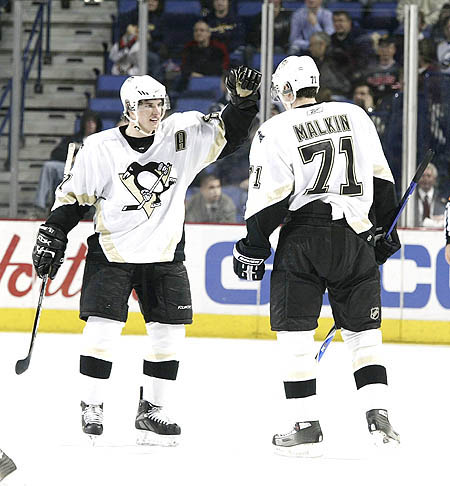
The Penguins arrived at HSBC Arena Friday night riding a two-game winning streak, which could have been dismissed as trivial were it not for the dulcet harmonies of Crosby and Malkin in concert. Sid the Kid struck for two goals and four assists to tighten his grasp on the NHL scoring lead. The Genie chipped in with a goal and two assists, seizing the top rung among rookie scorers. The connection's been instant between two players, one from Nova Scotia, one from Russia, with little more than youth, a uniform and stirring talent in common.

"The language barrier obviously is there right now, but it's funny to be able to play to someone you can't really talk to and still find spots out there and read off each other," Crosby said. "Hockey's kind of a universal language."

Crosby, at 19, has fast become the face of the new NHL, the brightest light in a constellation of young stars. His presence, and depth of performance, tends to steer attention away from Malkin, 20, the first player in 79 years to score in his first six NHL games. But there was no overlooking Malkin during Pittsburgh's 4-2 win over the Sabres, not when he wheeled deftly, effortlessly in the Buffalo zone to set up a Jordan Staal goal, not when he accepted a cross-zone pass and jolted Ryan Miller's water bottle with a laser of a slap shot for goal No. 19, not when he was heralded as the game's first star.

Malkin alongside Crosby could be a duo here today, gone tomorrow, given how coaches toy with their lines. At the same time, it's hard to imagine Therrien tinkering with a combination that heightens Crosby's senses, broadens his vision, as if anyone thought that were possible.

"I think that it opens your mind a bit more," Crosby said. "When you're playing with someone that creative you might make a few more high-risk plays that typically you might not make because you know that someone like him is going to be really ready for it.

"It goes that other way when he has the puck. You might go into spots where maybe not every guy in the league might be able to make that pass but someone like him could. I think you just open your mind to a few more ideas but at the same time it's still hard work and in that sense it doesn't change much."

And to think Malkin's still feeling his way around, acclimating, as was Crosby's challenge last year, although to a lesser extent.

"For him this year it's a learning process, learning about the NHL and learning about the culture, learning, first of all, the language," Therrien said of Malkin. "I'm really impressed for a young kid coming in to play like he's playing. And he's going to get better. There's no doubt in my mind he's going to get better."

e-mail: bdicesare@buffnews.com

Pens Stun Sabres, 4-2


Penguins win third in row, stun Sabres, 4-2
Saturday, January 06, 2007
By Dave Molinari, Pittsburgh Post-Gazette

BUFFALO, N.Y. -- Do not take this victory as a sign that the Penguins have arrived.

That's way too much to read into one game, even one as impressive as the Penguins' 4-2 victory against Buffalo at HSBC Arena last night.

But it is perfectly reasonable to view these 60 minutes as evidence of how far this team has come. And what it is capable of doing as it moves toward the second half of the season.

"Tonight was a good test, especially in their building," said Penguins defenseman Ryan Whitney, who scored one goal and set up another. "And we did a good job."

Good? Not really. Good isn't nearly good enough to go on the road and defeat a team that has the best record in the Eastern Conference. That is a serious threat to get through the regular season with the NHL's finest record and should enter the playoffs as one of the favorites to win the Stanley Cup.

There are lots of good teams in the NHL. The Sabres are several notches above them.
"This is a confident group that's grown together for a few years," Penguins coach Michel Therrien said.

The Penguins haven't had their core group intact that long, and they're not going to be on anyone's short list of Cup contenders, but the confidence born of their victories against Carolina and Toronto was impossible to miss, as they never let the Sabres put them on their heels for a significant stretch.

"We might have had a few shifts where they were cycling [the puck in the Penguins' end]," center Sidney Crosby said. "They have a great team and speed, and that's going to happen."

The victory was the Penguins' third in a row and raised their record to 18-15-6. It also ended a streak during which they lost six games to the Sabres and tied another.

While the Sabres had insisted before the game that they were more concerned about the Penguins in general than any individual, they clearly were aware of the challenges posed by Crosby, who had an assist to raise his league-leading points total to 62.

"He's got it all," Sabres coach Lindy Ruff said. "He's a tremendous skater, a tremendous stick-handler. He's good in every area. I don't think the kid has any holes. He's got everything."

Before the game, Ruff was asked whether he would prefer to deal with Crosby and Evgeni Malkin as linemates or centering their own units.

"Watching them play, I'd rather see them on separate lines right now," he said. Laughing, he added, "With both of them out West."

It didn't work out for him, on either count.

Buffalo took a 1-0 lead at 14:44 of the first period, when Derek Roy golfed a shot past goalie Marc-Andre Fleury from the bottom of the right circle. That goal had to be a psychological boost for the Sabres because Fleury had allowed just one goal in his previous two starts.

"Their goaltender, the last couple games, almost looked unbeatable," Ruff said.

So had the Fleury's teammates, which likely is why spotting Buffalo a lead didn't faze them.

"Even when it was, 1-0, them, I don't think we went into a shell at all," Whitney said. "We just battled back."

The Penguins pulled even on a power-play goal by Whitney at 7:26 of the second, as he took a cross-ice feed from Crosby and beat goalie Ryan Miller from near the inner edge of the left circle.

The Sabres countered with a power-play goal of their own at 10:50, after center Paul Gaustad hurled his body into the boards behind the net to stop a clearing attempt by Fleury. The puck caromed off Gaustad and went to Daniel Briere, who threw it in front to Chris Drury and watched him bury a shot behind Fleury.

"My mistake," Fleury said. Perhaps, but even though Drury's goal gave Buffalo a 2-1 lead, it did not deflate the Penguins.

Jordan Staal tied the game again at 13:38, when he flipped a backhander past Miller for his 12th of the season, and Malkin got the winner 2.3 seconds before the intermission, as he hammered a slap shot past Miller from above the right dot for his 19th.

Although the outcome wasn't finalized until Dominic Moore scored into an empty net with 12.7 seconds left, the Penguins never wilted under Buffalo's third-period pressure.

"We had a big effort," Therrien said. "And we deserved to win."

And to be satisfied with how, for at least one night, they measured up against one of the league's elite clubs.

"It was a good test," Crosby said. "We looked at it the right way. We respected them, but we had confidence that we could beat them."

(Dave Molinari can be reached at DWMolinari@Yahoo.com. )

Joe Starkey: Cowher a lock for Hall


Joe Starkey
PITTSBURGH TRIBUNE-REVIEW
Saturday, January 6, 2007

Sculptors at the Pro Football Hall of Fame should probably get a head start on Bill Cowher's bust.

It might take them a decade or three just to finish the chin.

No matter what happens in the interim, Cowher, 49, is a mortal lock for Canton -- and not because he wore the most hideous sweater ever displayed at an NFL news conference Friday, when he announced his resignation after 15 memorable seasons as Steelers coach.

That's not a valentine to Cowher, who had a terrible final season and was far from perfect during his tenure here. It is merely a statement of fact.

How can they keep Cowher out of the Hall when Bud Grant and Marv Levy, with nary a Super Bowl title between them, are in?

Cowher will coach again. Be sure of that. We have not seen the last classic Cowher spittle shower. But even if he becomes the next Art Shell -- even if he never wins another game -- he belongs in the Hall of Fame.

Look at the list of coaches Cowher passed in career playoff victories (12) as the Steelers swept to a Super Bowl victory last season. In alphabetical order: Bill Belichick, Tom Flores, Bud Grant, Mike Holmgren, Marv Levy, Vince Lombardi, John Madden, Bill Parcells, Dan Reeves and George Seifert.

That included a signature victory when Cowher's Steelers beat the Colts in Indianapolis. You'll recall that was a Colts team many were ready to immortalize.

The men ahead of Cowher on the all-time playoff victory list could form a Mt. Rushmore of NFL coaches -- Tom Landry (20 playoff wins), Don Shula (19), Joe Gibbs (17) and Chuck Noll (16).
Pretty impressive stuff, though Cowher's close friend and mentor, San Diego Chargers coach Marty Schottenheimer, went overboard yesterday when he said, "(Cowher) certainly stands at the same level as Coach Noll."

They might be in the same neighborhood. They're not in the same house.

Cowher's career winning percentages of .619 overall and .623 in the regular season actually eclipse Noll's marks of .572 and .566, but Noll made a habit of winning Super Bowls, while Cowher made a habit of losing AFC Championship Games on home turf.

"You don't even try to compare yourself with a man like Chuck Noll, and I didn't come close to doing the things he did," Cowher said yesterday, the same day Noll turned 75. "No one will. He was one of a kind. You don't even put yourself in that shadow.

"I think it's important when you step into that chair, you have to do it your way. You have to be yourself."

Credit Cowher for meeting the immense challenge of replacing Noll. Sports history is littered with athletes and coaches who folded under the pressure of following a legend.

Schottenheimer can vouch for Cowher's steely will. It was Schottenheimer, then coach of the Cleveland Browns, who hired the 28-year-old Cowher to run his special teams in 1985 -- and who couldn't shake a determined Cowher when it came time to hire a defensive coordinator in Kansas City in 1989.

"I had a couple of other candidates, and he was just relentless in trying to convince me he was prepared to do that job," Schottenheimer said. "I eventually gave him the position, and he did a great, great job for us. The rest is history."

A storied history, at that. Cowher's replacement better be ready to hit the ground running. He'll be following not one Hall of Fame-caliber coach, but two.

Joe Starkey is a sports writer for the Pittsburgh Tribune-Review. He can be reached at jstarkey@tribweb.com

Scott Brown: Cowher fearless of challenges


Scott Brown
PITTSBURGH TRIBUNE-REVIEW
Sunday, January 7, 2007

The kid from Crafton became a symbol of the area he left and later returned to in pursuit of his football dreams.

Bill Cowher stepped down as head coach of the Steelers on Friday after 15 seasons, and his body of work with one of the NFL's most storied franchises has earned him immortality in Pittsburgh and likely in the Pro Football Hall of Fame.

Taking the reins of a franchise that meandered into mediocrity at the end of the Chuck Noll era, Cowher led the Steelers to eight division titles, six appearances in the AFC championship game and one Super Bowl title.

He also won a significant off-the-field battle in a power struggle that ended with general manager Tom Donahoe's resignation after the 1999 season.

Emerging from that and his only back-to-back losing seasons, Cowher returned the Steelers to prominence this decade.

The Steelers' 21-10 win over the Seattle Seahawks in Super Bowl XL put a topper on Cowher's resume and provided some personal vindication, since his teams gained a reputation for shrinking on football's biggest stages.

"We've had some disappointments, the AFC championship games when you get so close," Cowher said. "I can honestly say that was the fuel that brought me back and made me appreciate things."

The Steelers' 2-4 record in AFC title games, in fact, is one of the few substandard numbers associated with Cowher's reign.

The Steelers won 62 percent of their regular-season games during his time here and made the playoffs 66 percent of the time.

Perhaps Cowher's most impressive number is his longevity. He was the longest-tenured coach in the league. NFL coaches generally come with the kind of expiration dates found on milk cartons.

"The track record for (NFL) head coaches and heart disease, heart attacks and mental breakdowns and all that other stuff is pretty high and there is a reason," Baltimore Ravens coach Brian Billick said. "It used to be, what have you done for me lately, meaning from one year to the next, but any more it is, what have you done for me in the last 10 minutes."

The franchise's history and the fact that the Steelers are an institution make expectations here as high as anywhere.

But Cowher met them head-on, just as he might have a ball-carrier during his playing days. An erector-set jaw punctuated his fiery demeanor and demanding approach to coaching.

He personified Western Pennsylvania grit, and that trickled down to his players.

"He's the best motivating coach I've ever been around," said Rod Woodson, a star defensive back for the Steelers from 1987-96. "I think he gets the most out of his players on a year-in and year-out basis."

Cowher wasn't much older than some of his players when he became the NFL's youngest head coach at the age of 34.

At times during his career, he seemed to be playing the game as he coached it -- who can forget the time in Jacksonville when it looked like he might leap off the sideline and tackle a Jaguars player who intercepted a pass? -- his passion so evident that it might as well have been another piece of clothing.

"I am an emotional guy," Cowher said. "I am never going to lose that."

One gradual change Woodson noticed: Cowher went from being a "rah-rah" coach to one who understood that he didn't always have to yell to get his point across.

"A raised voice," Woodson said, "and a stern voice are two different things."

Cowher commanded respect from his players no matter which voice he used.

A lot of that stemmed from his approach. Cowher generally eschewed mind games.

"He'd leave his door open and say, 'If you have a question, ask it, but don't be afraid of the answer,' " said Jerome Bettis, who retired after last season as the second-leading rusher in franchise history. "That's all you want. He had a great attitude in the way he went about coaching all of his players."

Even those who didn't agree with his decisions more often than not respected them.

Take Kordell Stewart.

The star-crossed quarterback led the Steelers to the 1997 AFC title game in his first full season as starter.

But Cowher benched Stewart several times during his career and opted for Tommy Maddox in 2002 when Stewart struggled.

"I'm not going to say he treated me fairly, but he did what he thought was in the best interests of the football team," Stewart said. "He'll be remembered as a tough-nosed guy."

Indeed, Cowher's piercing glare complemented his jutting jaw. He didn't hesitate to fix it on a player who had blown an assignment or a reporter who dared to question him.

Cowher came off as distant and, at times, standoffish in relation to the media. His prickly relationship with the press could be seen when he chastised local reporters in December for assuming he wouldn't answer questions about his future.

Cowher's uncertain future with the Steelers loomed over his final season with the team and generated its share of fan criticism.

Some saw Cowher as having his body in Pittsburgh and his heart in Raleigh, N.C., where he and his wife, Kaye, bought a multimillion-dollar home soon after Super Bowl XL.

Bolstering that argument were the rash of turnovers that buried the Steelers' hopes of repeating as world champions.

Cowher, however, didn't lose his players after a 2-6 start, as the Steelers refrained from public sniping at one another despite disappointing results.

"It's always a reflection of the head coach," linebacker Joey Porter said of the way the Steelers, who won six of their last eight games, stuck together.

For all of the intensity and toughness he exuded, Cowher apparently showed his players a side the public rarely saw.

"I don't think you can deny that Coach Cowher is the kind of guy that likes to have fun and is definitely a players' coach and is definitely a little more loose than a lot of the coaches," center Jeff Hartings said. "I think the biggest thing I learned is that you can have fun and still have success as an NFL player. I didn't really know if that was possible coming from five years in Detroit."

Anything probably seemed possible to Cowher after he succeeded the legendary Noll as head coach.

He had grown up in Crafton, a small community where football is part of its fabric. He accepted a scholarship to North Carolina State after being overlooked by the major schools in this area.

The Carlynton High graduate made the NFL as an undersized linebacker and played five seasons before going into coaching. He got his start with the Cleveland Browns under Marty Schottenheimer, and he later served as a mentor of sorts to other assistants who have won NFL head coaching jobs, including Cincinnati's Marvin Lewis.

When asked what he learned from Cowher, Lewis, a former Steelers linebackers coach, said, "That each and every day you have to find a way to make players better and get them to play hard and enjoy the game."

Cowher expertly straddled that line -- getting players to have fun while also making them accountable -- and he may well do it somewhere else.

After all, coaches don't seem to retire as much as they transition to TV work for a couple of years and then return to the game energized, not to mention with a huge contract.

"There is no timetable," Cowher said of a possible return to coaching. "The only sideline I'll be sitting on is up in the stands and watching my kids play basketball in the next couple of years."

Steelers players hoped for different outcome to the end


But most were not shocked and most expect him to return to coaching in not too distant furture

Saturday, January 06, 2007
By Ed Bouchette, Pittsburgh Post-Gazette

Most Steelers players believed Bill Cowher would resign, yet in true football vernacular they wished for a Hail Mary pass that would keep him as their coach right until the end.
It never came.

"I'll tell you what, it's not a shock, we all knew what way he was leaning," defensive lineman Chris Hoke said. "We held out hope he'd stick around. As players, we have a lot of respect for coach and love playing for him. Now that it's official, there's a knot in your stomach."

Cowher, 49, resigned yesterday with one year left on his contract, saying "it's time" after 15 seasons as Steelers coach.

Jerome Bettis can relate to that on two fronts. He too made a retirement decision twice -- once opting to return to the Steelers in 2005 and last February quitting for good. As an NFL studio host for NBC-TV, he angered Cowher last August when he predicted on a broadcast that he believed his old coach would quit at the end of the 2006 season.

Yesterday, though, Bettis was in no mood to say "I told you so."

"It's definitely a sad day for the city of Pittsburgh and the Steelers because coach Cowher was a great coach,'' said Bettis, who was in the city yesterday to tape his weekly show on WPXI-TV. "A lot of people mention our championship, but one championship doesn't do the justice he deserves.

"To be able to keep a team as competitive as he did for as long is a feat in itself. The numbers he was able to put up in Pittsburgh are second to none. I really think lot of people don't give coach enough credit in terms of creating the organization that was built to sustain the test of time."

There was one great difference for Bettis because once he retired, he knew there was no turning back. Cowher can leave the game for several years and return as a coach. Bettis and other Steelers expect him to do that.

"I think we'll see him coaching at some point," Bettis said. "I think right now he needs to recharge the batteries. The way he coaches is all or nothing. Money is an issue but I don't think it's the driving force of everything for coach."

One source said not to be surprised if Cowher does not try to get the Carolina Panthers' coaching job if John Fox is fired in the next year or so. Charlotte is a shorter commute to Raleigh than is Pittsburgh.

"When he takes his year off and comes back, he'll be rejuvenated and refreshed," tackle Max Starks said.

"He's a great coach. He's been doing it 15 years. He definitely deserves that break. You don't want to be that coach who's burnt out when you finally step down and take that break. Then you're like Joe Gibbs, an old guy trying to come back.

"I hate he's going, but I respect him so much. It hurts, but it's totally understandable."

Quarterback Charlie Batch believes Cowher will return to coach.

"He has a lot of coaching left in him," Batch said. "I wouldn't be surprised. He said he needs to be reenergized. Who knows what will happen four months from now. If someone offers you $10 million to come out of retirement, that's 10 million reasons.

"It wouldn't surprise me to see him come back into coaching next year or five years from now. That's what he's been doing for a long time, not just the past 15 years, but coaching and playing."
Hoke said part of Cowher's success did not just come when he coached his team into the playoffs or to Super Bowl victories. Some of it occurred this past season after they went 2-6 and things could have turned ugly.

"With a lot of coaches, the team would have fallen apart,'' Hoke said. "He did a good job keeping us together and motivating and rectifying what went wrong and not being a jerk about it. He wasn't yelling and screaming at people. He's a great motivator and he was not going to go about it in the wrong way."

(Ed Bouchette can be reached at ebouchette@post-gazette.com )