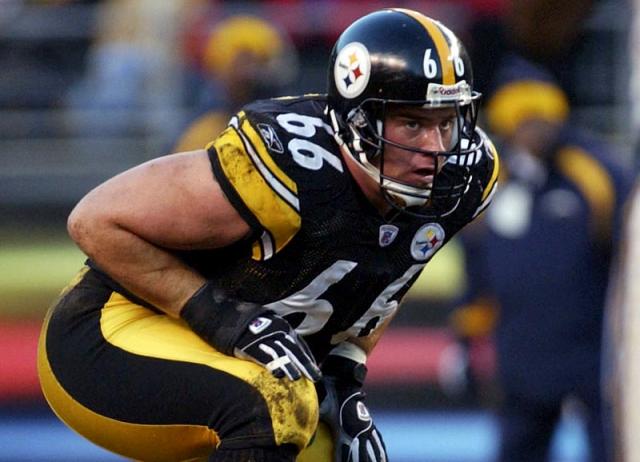
San Diego Chargers lose to the Cincinnati Bengals 17-10 at Qualcomm Stadium last September. Ladarius Green hauls in this pass play for a 30 yard touchdown in the second quarter. — Sean M. Haffey/San Diego Union-Tribune
Weapons. Weapons. Weapons.
The list of them grows for Pittsburgh, who according to ESPN's Adam Schefter will sign Chargers tight end Ladarius Green, a player with obvious playmaking ability but who was situated behind Antonio Gates for four seasons in San Diego.
Contracts can't be completed until the new league year begins at 4 p.m. ET.
The Steelers feel Green is an adequate blocker, which is crucial for this offense, and he has flashed big-time potential at 6-foot-6, 240 pounds with decent speed. He scored four touchdowns in the Chargers' first six games last year. The question becomes: How does he respond from a sluggish second half of the year (11 catches for 125 yards in his final eight games while dealing with some injuries)? Otherwise, it is hard to complain with this signing, assuming the money is right.
It wouldn't be a shock to see Green earn around what Jordan Cameron got a year ago: a two-year deal worth around $15 million. Salary cap inflation could change that.
Green is not a Heath Miller replacement, or at least the Steelers won't look at it that way. This is a chance to sign an impact player at a position of need. And fifth-round pick James will be involved in the offense. The Steelers like him.
This frees up the Steelers to do what they need to do in the draft: bolster the defensive backfield.
The Steelers had around $12.6 million in salary cap space this week, according to ESPN's Roster Management System. Deals for William Gay, Heyward-Bey and Robert Golden will take close to $5 million in 2016 space. The Steelers can create more, of course.
Heath Miller #83 of the Pittsburgh Steelers runs the ball against Dan Connor #52 of the Dallas Cowboys at Cowboys Stadium on December 16, 2012 in Arlington, Texas.
But Miller's importance to the Steelers can't be overstated, based on everything he offered the franchise for 11 years.
Pass catching.
Run blocking.
Toughness.
Locker-room leadership.
Smarts.
Every intangible in the football manual, he embodied it. No player seemed to capture the blue-collar vibe of Pittsburgh football more than Miller.
His retirement at age 33, which the Steelers announced Friday afternoon, forces the team to reimagine new offensive possibilities while trying to replace a workhorse.
For years, Ben Roethlisberger's safety valve over the middle of the field was Miller. That's gone now.
Miller was still productive. His athleticism waned a bit in his final years, but he could still get open. Five yards, turn left or right, catch. His hands remained elite.
There's no surefire option to replace that dependability at this point. After all, this wasn't a player holding out too long. He moved on with something left.
Miller will be missed beyond the catches and yards: Steelers fans love Miller, chanting "Heeeeeeeath" every time he corralled a pass over the middle. With several franchise records for tight ends, including receptions (592), yards (6,569) and touchdowns (45), Miller has the stats to accompany the tenure and the Super Bowl pedigree. That might be enough to get him into the Steelers ring of honor one day. Coaches absolutely loved this guy. Todd Haley and others have routinely called him one of the best teammates they've ever seen. He wasn't overly vocal but would pull players aside when the time was right. That's the stuff you can't manufacture.
The Steelers have work to do on offense without Miller: The Steelers like fifth-rounder Jesse James, but he's hardly a guarantee to replace Miller. The Steelers will develop him, see how he grows, but a depth chart of James and Matt Spaeth won't get it done. The Steelers can design more plays for slot receiver Markus Wheaton over the middle to compensate for Miller's loss. But Wheaton's not an inline tight-end blocker. That might be the hardest part of Miller's game to replace, the versatility from snap to snap.
This could change the Steelers' draft plans: Tight end was never a position of need. The Steelers always could take that off the board in the past. That changes now. Arkansas’ Hunter Henry is considered the draft's top tight end, and he could be available at No. 25 overall. If the Steelers love his skill set, they have to consider him. They would have done so anyway, considering Miller's age, though any draft pick could have integrated with Miller to form a potent duo. With the Steelers' fast-paced, quick passing game, this is a chance for the team to add speed and dynamic playmaking on the inside. Not that Miller wasn't dynamic -- he certainly was for parts of his career -- but speed was never his thing.
From a business sense, Miller's retirement helps, but that's not the point: For you cap-space lovers, Miller's retirement takes about $4 million off the books. ESPN's roster management system has the Steelers at around $14 million in cap space once the new salary cap hits. They'll have enough space to maneuver. Though I never got the sense the team was going to cut Miller. He's still valuable on and off the field. A pay cut, maybe. A recent Pittsburgh Post-Gazette report said Troy Polamalu was given a retire-or-get-cut ultimatum, so who knows, maybe Miller got that. But Miller had more left than Polamalu did at his retirement point, in my opinion. Fretting over a few million in exchange for uncertainty at the tight end position wouldn't make sense. That's why the Steelers must like their contingency plan, whatever it is.
In this Sept. 10, 2015, file photo, Pittsburgh Steelers tight end Heath Miller runs after catching a pass against the New England Patriots in the first half of an NFL football game in Foxborough, Mass. Steelers tight end Heath Miller retired on Friday, Feb. 19, 2016, after an 11-year career with the franchise that included a pair of Super Bowl titles. (AP Photo/Winslow Townson, File)
PITTSBURGH (AP) -- Heath Miller stood at his locker last month, the sting of a playoff loss at Denver still fresh in the Pittsburgh Steelers tight end's mind.
The thought of going through the process all over again was too much to consider.
''I don't know,'' the ever polite Miller said when asked if he would return in 2016. ''At this point, I've always said take it one year at a time and we go from there.''
Even with a team he felt on the cusp of another Super Bowl, even with another $4 million due in 2016, Miller chose to stay home with wife Katie and their four children. Miller retired in typically understated fashion Friday, ending an 11-year career featuring a pair of NFL championships while winning over his teammates and an ardent fan base with his work ethic and reliability.
No news conference. Just a call to the Steelers and a simple statement.
''I will always cherish and value the special bonds that I formed with my teammates,'' Miller wrote. ''It was truly an honor for me to take the field with them.''
FILE - In this file photo from Nov. 21, 2010, Pittsburgh Steelers tight end Heath Miller (83) is sto …
The 33-year-old finishes with 592 career receptions, 6,569 yards receiving and 45 touchdowns, all franchise marks for a tight end. The two-time Pro Bowler's reception total is sixth most by a tight end in league history.
''Heath Miller was as great a combination of character and football player as I have ever been around,'' general manager Kevin Colbert said. ''Heath helped us win many games, including two Super Bowl championships, while also being an important part of our community.''
The Steelers drafted Miller 30th overall in 2005. He quickly developed chemistry with Ben Roethlisberger, the quarterback often calling Miller the best teammate he's ever had at any level. In an era when most tight ends were either primarily blockers or oversized wide receivers, Miller was both.
Highly durable, Miller missed just eight games over 11 seasons. Every reception he made at Heinz Field - and more than a few on the road - met with a roar of ''Heeeeath.'' He remained an important part of Pittsburgh's high-powered offense in recent years even with wide receiver Antonio Brown and running back Le'Veon Bell developing into All-Pros.
Miller caught 60 passes for 535 yards and two scores in 2015 while also serving as a mentor to rookie Jesse James, who credited Miller with teaching him how to be a professional.
FILE - In this file photo from Feb. 6, 2011, Green Bay Packers' Desmond Bishop tackles Pittsburg …
''It's hard to find reps when you're playing behind a guy like Heath,'' James said. ''He's seen it all. But he helped build confidence in myself, and the team in me.''
That's what Miller did, and why his decision had his name trending on Twitter minutes after it was announced. The Steelers launched a (hash)ThankYouHEEEATH campaign on Friday afternoon, an ironically new school way to show appreciation for an old school player who would have fit right in on the Super Steelers of the 1970s.
''Congrats to my brother Heath Miller on a tremendous 11 year career!'' tweeted former Steelers tackle Ramon Foster. ''Spoke softly, but carried a big stick!'' A complete TE, & great friend!''
Brown tweeted ''Heathhhhhhh,'' while Pittsburgh Penguins owner and Hall of Famer Mario Lemieux offered congratulations. While the announcement may have been a surprise to some, running back DeAngelo Williams said he and linebacker James Harrison - who is mulling coming back for another season at age 38 - tried to persuade Miller to stick around for one more run.
FILE - In this file photo from Oct. 7, 2012, Pittsburgh Steelers tight end Heath Miller (83) warms u …
''The chants of 'HEEATH' will be missed at Heinz Field and around the entire NFL,'' president Art Rooney II said in a statement. ''Heath is the most accomplished tight end in team history and his efforts will not soon be forgotten.''
And perhaps not easily replaced. There is no truly signature Miller moment, perhaps because he treated nearly every play the same regardless of the circumstances. It's that sense of professionalism that made him so respected in the Steelers' locker room, one that saw another major piece of the franchise's latest renaissance walk away.
Miller joins an increasingly long list of recent retirees that includes Troy Polamalu and Ike Taylor, both of whom left the game last March. The two longtime defensive stars, however, waited to get a look at the job market for 2016 before making it final. Not Miller. His final act may as well have been emblematic of his decade-plus with the team.
The timing provides the Steelers a bit more cap relief heading into free agency. It also gives them plenty of time to find a college prospect or target a veteran on the open market to join a group that includes James and Matt Spaeth.
Friday, however, was about celebrating a player's humble approach and quiet relentlessness.
''Teammate, friend, brother,'' Roethlisberger posted on his Facebook page. ''Words aren't enough to express what I'm feeling and how blessed I feel. (hash)Heeeath.''
---
Online:
AP NFL websites: http://www.pro32.ap.org and https://www.twitter.com/AP-NFL
SAN FRANCISCO — Kevin Greene has been through the routine before and he knows exactly how it works.
If he hears a knock on his hotel room door during from Pro Football Hall of Fame president Dave Baker the day before the Super Bowl, it's good news — it means you are a Hall of Famer.
Greene finally heard that knock.
“It was a very large knock,” Greene said.
And it ended a long wait for the former Steelers linebacker.
Greene was one of eight who were elected to the Pro Football Hall of Fame during the NFL Honors award ceremony at Bill Graham Civic Center. Greene, who played for the Steelers from 1993-95 and was part of the famed “Blitzburgh” defense, has been eligible for the Hall of Fame the past 12 years and was a finalist the past four.
“I was bouncing off the wall,” Greene said. “I was excited. There were a wide variety of emotions that were going through my body and mind. I had my wife and kids there to sit me down and calm me down.”
Greene joins Brett Favre, Marvin Harrison, Orlando Pace and Tony Dungy along with senior members Ken Stabler and Dick Stanfel. Former 49ers owner Eddie DeBartolo was elected as a contributor.
Former Steelers guard Alan Faneca was eliminated in the first round of cuts from 15-10 in his first year of eligibility. Faneca played 10 of his 13 seasons with the Steelers making nine consecutive Pro Bowls and six All-Pro honors in seven years.
As for Greene, he had a stellar career the spanned 15 years that included stops with the Rams, Steelers, Panthers and 49ers. He accumulated 160 sacks in his career, which are third most behind Hall of Famers Bruce Smith (200) and Reggie White (198).
“I always felt that I belonged,” Greene said. “(Rams) Coach (John) Robinson put me in the mold of Lawrence Taylor and asked me to do the things that L.T. did, and I did my best to do it.”
It wasn't always smooth for Greene.
He was a fifth-round pick out of Auburn by the Rams in 1985 but didn't break into the starting lineup until four years later. Greene put together back-to-back 16 1⁄2-sack seasons.
“I had to pay my dues for the first three years,” Greene said. “I had to run down on kickoff team and punt team, punt return and kickoff return and all that stuff. I did it all. I was begging for an opportunity. John Robinson threatened to send my butt back down to Alabama one more time asking him for playing time.”
Greene went on to post 10 sacks in different 10 seasons. He made five Pro Bowls and was an All-Pro three times, but his career seemingly hit its stride when he joined the Steelers in 1993 as a free agent.
Greene collected 35 1⁄2 sacks from 1993-95 as he joined Greg Lloyd to form a pair of dynamic pass rushers and help the Steelers reach Super Bowl XXX.
“If a tackle wanted to bail back and deal with his speed rush, Kevin was strong enough to run over him,” former teammate Chad Brown said. “If the tackle wanted to get in a physical fight with Kevin, Kevin was quick enough to run around him. If a guy had some strength and speed, Kevin had some shake and bake to get by him. He understood what he needed to do and what skill set he needed to beat them.”
Others selected:
• Favre played 19 seasons and finished with three straight league MVP awards, 297 consecutive regular-season starts and a Super Bowl title. Favre made 11 Pro Bowls. He passed for 508 touchdowns and 71,838 yards — both behind only Peyton Manning.
• Pace played 13 years in the NFL, 12 with the Rams, and was a prototypical left tackle. Pace made seven straight Pro Bowls from 1999 to 2005 and was voted to the All-Pro team three times in a five-year span.
•Harrison had four straight years of 100-plus catches, culminating with 143 in 2002. Harrison caught 1,102 passes for 14,580 yards and 128 touchdowns.
• Dungy played for the Steelers in 1977-1978 and returned three years later as their secondary coach before serving as their defensive coordinator from 1984-88. Dungy was a head coach for 13 years with the Buccaneers and Colts and won 139 games, including Super Bowl XLI.
• Stabler got in as a senior candidate after being a finalist in 1990, '91 and 2003. Stabler played 15 years in the league, the majority of that with the Raiders. Stabler died of colon cancer in July.
• DeBartolo was selected to the Hall of Fame as a contributor. DeBartolo, a Youngstown native, owned the 49ers for 23 years and won five Super Bowls in a 14-year span.
• Stanfel played offensive line for the 49ers and Lions.
On an off week, Alan Faneca runs about 20 miles. If he’s training for half-marathons, which is fairly often, he logs at least 30.
His conditioning has made a huge impact in his post-NFL days, and the leaner Faneca was on hand Saturday in San Francisco as the Pro Football Hall of Fame selection committee revealed its inductees. But Faneca didn't make it in his first year of eligibility.
Faneca played 13 years, resulting in six All-Pro seasons at guard. Faneca's physical transformation has been almost as impressive -- shedding 100 pounds from his 320-pound playing frame since leaving the league in 2010.
When Faneca lost his first 30, he noticed he stopped the old-man grunting when getting up from the floor after a play session with his daughter.
Now, he's a lean 6-foot-5, 220 pounds. He’s, almost literally, two-thirds the man who opened holes for Jerome Bettis in Pittsburgh. He wanted a healthy post-football lifestyle with minimal joint pain.
Here’s how he did it: oatmeal and fruit for breakfast, chicken with all other meals, low carbs, lots of vegetables, no alcohol -- save one day a week -- and 100-calorie snacks between meals to sustain metabolism.
“It’s been tremendous,” Faneca told ESPN.com via phone before packing up to go to San Francisco. “I knew I was onto something good. It has helped my body, my knees out. It’s definitely taken some of the stress out of my body. I’m cheating the doctors before I start to need bionic parts.”
Faneca has fielded calls from several former offensive linemen from his pro or college days asking for weight-loss tips. He’s happy to oblige.
Faneca played his best years with the Pittsburgh Steelers, who selected him in the first round of the 1998 draft and watched him move defenders for 10 seasons. He played his last years with the New York Jets and Arizona Cardinals.
He worked to be the consummate teammate, a positive locker-room guy who never turned down the Pro Bowl all nine times. He made the 2000s all-decade first team.
But it wasn't enough for HOF status. Most of the nearly 20 guards in the Hall needed more than one cycle for entrance. Kansas City Chiefs great Will Shields, an all-decade second-teamer, was eligible for four years before his 2015 induction.
Former coach Bill Cowher was vouching for his guy, telling Steelers.com that Faneca basically “redefined” the guard position by his versatility to block “at the point of attack, but also block in space.” Faneca was the catalyst for Willie Parker’s 75-yard score in Super Bowl XL. The right side was open all the way.
When it comes to the week leading up to the voting, though, Faneca was doing less lobbying and more savoring of the moment.
“It’s special enough to be here on this short list,” Faneca said before the results were known. “I haven’t really thought about [the outcome]. You feel you put your best foot forward on the playing field; now it’s an awkward feeling knowing how people officially felt about your playing career. But it’s an honor being a first-time guy making the short list.”
James Harrison and Santonio Holmes making plays in Super Bowl XLIII
Funny thing about the five greatest plays in Super Bowl history: Two of them happened on the same drive.
Two others happened in the same game.
That leaves a whole bunch of plays in 49 years worth of Super Bowls. But with apologies to Marcus Allen, Lynn Swann and others, I'm going with these five:
5. INSANE, JERMAINE
If ever there was a time for Al Michaels to dust off the “Do You Believe in Miracles?” line, this was it. Seattle's Jermaine Kearse, on a potential go-ahead drive, somehow caught a 33-yard pass that tipped off his hands, then both legs, then his right hand before settling into his grasp as he rose from being flat on his back. Or something like that.
Cris Collinsworth said, “I can't believe he didn't get up and get in the end zone.”
If he had, we'd be talking about maybe the greatest play in football history. Instead, only minutes later, this happened ...
4. BUTLER DID IT
I had never seen New England's “Director of Football Research” Ernie Adams — the mysterious figure in Bill Belichick's shadows — until an NFL Network piece on Malcolm Butler's amazing interception that sealed Super Bowl XLIX. Adams, as it turned out, diagramed Seattle's goal-line pick play for practice that week. Butler did not play it correctly in practice but in tandem with Brandon Browner played it perfectly in the game.
What rarely gets talked about is how amazing it was that Butler, burned on Kearse's incredible catch, held onto the ball despite a collision forceful enough to send him and receiver Ricardo Lockette reeling.
3. HOLMES AT LAST
A play after Santonio Holmes let Super Bowl XLIII slip through his hands, he made one of the great clutch catches of all-time, tip-toeing the back of the end zone.
But in one man's opinion — the man who called the winning play (“62 Scat Flasher Z Level”) — the throw was even better.
“Probably the best throw I've ever seen,” Bruce Arians told me at Steelers camp five months later.
Indeed, Ben Roethlisberger fired a bullet into a window the size of an ant. Holmes was his third option.
After his drop, Holmes was approached by tight end Heath Miller.
“He tapped me on my hip and kept telling me, ‘Tone, don't worry, it's coming right back to you,' ” Holmes recounted to me recently. “I didn't want to hear it. But once the next play was called, it was all smiles.”
2. BOOK OF DAVID
Every time I watch this Super Bowl XLII play — and we're probably going on 700,000 times — I expect Eli Manning to get sacked and David Tyree to drop the ball, instead of pinning it with one hand to his helmet. Neither ever happens.
“They needed a miracle on third-and-5,” said the late, great Steve Sabol on NFL Films. “And they got two.”
1. THE LONGEST YARDS
Somebody should dedicate one of those “30 for 30” documentaries to James Harrison's 100-yard interception return in Super Bowl XLIII. Or perhaps a full-length feature film. Goodness knows, it had enough interesting characters, action, subplots and drama.
An unforgettable ending, too.
The Steelers were leading, 10-7, with 18 seconds left in the first half. The Cardinals were first-and-goal at the 1. Harrison was supposed to blitz but dropped into coverage. Kurt Warner never saw him. And thus began on odyssey that saw Harrison escape at least six would-be tacklers on his way to the then-longest play in Super Bowl history.
He nearly stepped out of bounds. He nearly didn't break the plane. He nearly passed out.
The part of the play that has always stood out to me: Steelers' defenders taking off like fighter planes to pave Harrison's way. Ten yards into his journey, all 10 teammates are in the television frame sprinting. Ryan Clark blew somebody up. Deshea Townsend toppled Warner. Brett Kiesel and Lawrence Timmons peeled back for big hits. LaMarr Woodley got the last block.
Harrison, doing his best Darrelle Revis from that punt return against West Virginia, kept chugging along. At the end, he pulled Larry Fitzgerald — literally sledding on Harrison's legs — into the end zone as Steve Breaston knocked Harrison to the ground.
If they showed a thousand clips of that play right now, you'd watch every one of them. So would I.
It's the greatest play in Super Bowl history.
Joe Starkey co-hosts a show 2 to 6 p.m. weekdays on 93.7 FM. Reach him atjraystarkey@gmail.com.
Twenty-six players got named to the NFL’s official all-time Super Bowl team. Seven played for the Steelers in the 1970s. That team’s coach, Chuck Noll, also got the nod.
The honor wasn’t diluted: 11 players on offense, 12 on defense, three specialists and one coach. The team was picked by Pro Football Hall of Fame voters.
One team composes 31 percent of the roster. None but the great, and the Steelers of the 1970s still dominated.
Some things about the all-time Super Bowl team seem odd. The New England Patriots have won four Super Bowls since 2000, but were represented only by kicker Adam Vinatieri. Vinatieri and ex-Baltimore linebacker Ray Lewis are the only picks that won a Super Bowl since the turn of the millennium. The team skews ancient.
Some of the response locally was odd. The minute the team was announced, Twitter reacted: “Criminal to leave off (John) Stallworth and (Terry) Bradshaw.” Right, because who did Joe Montana and Jerry Rice ever beat?
Stallworth and Bradshaw were great players who had great Super Bowls. Bradshaw was a two-time Super Bowl MVP. But Montana took that award thrice. Those Steelers may be the best team of all-time, but they’re not the only great team ever.
But that’s typical of Yinzer Nation: The Steelers of the 1970s have nine players in the Pro Football Hall of Fame, but fans clamor for L.C. Greenwood and Andy Russell.
Greenwood and Russell were great. But that team has been immortalized enough.
The all-time Super Bowl team produced two particularly gratifying choices:
Noll is the coach. I grew up believing Noll was the greatest coach ever, and nothing that’s happened since has deterred me from that notion. Bill Belichick is the current-day version, but he’s a cheat. Noll won, and won with dignity. That concept is foreign to Belichick, and to most of today’s NFL. Noll never embarrassed himself.
Jack Ham got picked. Ham is also on the NFL’s 75th anniversary all-time team. But Ham occasionally gets short shrift, like when he was left off the NFL Network’s “Top 10 Steelers” program in favor of, among others, Hines Ward. Huh?
Ham and Lawrence Taylor are the NFL’s best outside linebackers ever. They were extremely different in style, obviously.
Only a handful of Steelers compete with Ham when you’re talking significance to the franchise. Joe Greene changed the Steelers. Mel Blount changed football. Terry Bradshaw played the money position, as does Ben Roethlisberger. Then there’s Ham.
Every Steeler selected to the all-time Super Bowl team was a relatively obvious selection: Franco Harris, Lynn Swann and Mike Webster on offense. Blount, Greene, Ham and Jack Lambert on defense.
Pittsburgh football fans live in the past far too much, especially given the Steelers’ more recent successes.
But the Steelers of the 1970s were a true juggernaut, and it’s nice to get an occasional reminder that isn’t locally manufactured.
How will players from the Steelers teams that won the 2005 and 2008 championships be remembered? Not like the team from the 1970s. Had they won the 2010 title, it closes the gap. But, with the Steelers, a mere runner-up finish doesn’t enhance.
Roethlisberger should be right up there. Troy Polamalu, too. Fan favorites like Ward, Jerome Bettis and James Harrison will be romanticized past even their very legitimate value.
But no latter-day Steelers are on the all-time Super Bowl team. Seven Steelers from the 1970s are. It’s as impressive as nostalgia gets.
Mark Madden hosts a radio show 3-6 p.m. weekdays on WXDX-FM (105.9).
The roster:
OFFENSE
Joe Montana, QB; Jay Novacek, TE; Emmitt Smith, Franco Harris, RB; Lynn Swann, Jerry Rice, WR; Mike Webster, C; Art Shell, Forrest Gregg, T; Gene Upshaw, Larry Allen, G.
DEFENSE
Reggie White. Charles Haley, DE; Joe Greene, Randy White, DT; Lawrence Taylor, Jack Ham, OLB; Ray Lewis, Jack Lambert, ILB; Mel Blount, Deion Sanders, CB; Ronnie Lott, Jake Scott, S.
SPECIAL TEAMS
Adam Vinatieri, PK; Ray Guy, P; Desmond Howard, KR.



 Subscribe today! Click here for our subscription offers