Imagine a long, cold, dark winter without the Penguins.
No cheering. No booing. No Stanley Cup. No Malkin or Fleury or Sid (assuming he comes back). No warm memories or sunny hopes.
In his new book, "Breakaway," Tribune-Review investigative reporter Andrew Conte describes how Pittsburgh came closer to such a reality than most people realized. Publisher Blue River Press of Indianapolis will release the book on Tuesday for sales in bookstores and online at www.breakawaypenguins.com.
Frustrated by seemingly endless obstacles to building an arena considered vital to the club's survival, Penguins owners Mario Lemieux and Ron Burkle weighed moving the team to one of several potential landing spots. Of all the locations, Kansas City had put together the most attractive offer.
The Kansas City Penguins? It could have happened.
"When it came down to it in the end, the deal in Kansas City was actually sweeter (than the proposed arena in Pittsburgh) because they could begin making money right away," Conte said.
"Even with the arena deal here, they had to wait three years until they got the arena opened. So if they go to Kansas City, the deal there is comparable to the deal with the new arena here, but you get to start making money right away."
Team owners considered a scenario in which the Penguins moved to Los Angeles, and the Kings relocated to Kansas City, according to Conte.
In the end, of course, the Penguins moved across the street, swapping their original home -- the small, outdated Civic Arena known as "The Igloo" -- for the modern, spacious Consol Energy Center.
Conte, who covered the legalization of casino gambling in Pennsylvania and the arena negotiations, two weighty topics that were inextricably connected, tells the story in "Breakaway." It is a story, as he puts it, "of the Penguins from bankruptcy to the new arena, and from last place to the Stanley Cup." Conte spent more than two years researching and writing the book and conducted dozens of interviews.
Hockey is a violent sport, apparently not entirely confined to the ice. Among the book's revelations is how talks grew so testy that it appeared fisticuffs might break out in a meeting room during a particularly heated moment. Then-Pennsylvania Gov. Ed Rendell became so angry that he "snapped," called team attorney Chuck Greenberg "a liar" and gave every appearance of going further.
Those in the room worried that Rendell might get physical. Allegheny County Executive Dan Onorato stood up and advanced toward the governor, as if he might need to restrain him. The deal appeared to be falling apart. As Conte quotes Greenberg: "I really thought that if I had given him any cause to be incited, a line might have been crossed that would be very difficult to undo."
Rendell said later that he was trying to send a message with his voice and intimidating presence, Conte writes. "I like to create that impression," Rendell told him. "Part of it is real, and part of it is acting."
Conte reports that the deal nearly fell apart a second time, during a secret meeting in New Jersey.
In addition to describing the political and business machinations, Conte reveals -- with help from the reporting of Karen Price, then the Trib's hockey writer -- the intricacies of superstar Evgeni Malkin's departure from Russia and his strange and alarming "disappearance" that accompanied it. Malkin's interview with Conte was the only time he discussed his departure since joining the Penguins.
Even with a large and colorful cast that includes, among others, Rendell, Lemieux and Burkle -- who played an active role in the Marian Hossa trade and promoting Dan Bylsma to head coach -- Conte said that ultimately Penguins fans are the book's "heroes."
The fans, he said, showed up at the casino license hearings in force, wearing Penguins jerseys. The fans continue to support their team through lean years and fat ones, and they persuaded the owners to keep the club here.
"The fans get a lot of credit for sticking with their team, even when it looked like it was gonna leave town," Conte said. "The fans were still there. The fan base here was really the tipping point for why the team stayed."
Something very strange is going on in Pittsburgh. The perennially superb Steelers defense is off to another great season, ranking first in passing yards allowed per attempt and fourth in points allowed, with the Steel Curtain giving up fewer than 18 points per contest.1 That's de rigueur by now. Something is missing, though, that doesn't make much sense. For some reason, the great Pittsburgh Steelers defense has stopped forcing turnovers.
Through five games, the Steelers have just two takeaways. That is the second-lowest total for any team through its first five games since 1990,2 and it's coming from a unit that averaged more than two takeaways per game last season. If you assume that the defense's 2010 turnover rate was an accurate reflection of its abilities, the odds against this measly turnover rate happening in 2011 are 785-to-1.
It's not even like the Steelers have had particularly bad luck. They've forced three fumbles in those five games and recovered one of them, a year after they forced 1.5 fumbles per game. Their one interception came last week, on a Matt Hasselbeck pass that was tipped. The schedule hasn't brought them a slate of stingy offenses, as their five opponents have averaged 1.6 turnovers per game when they haven't played the Steelers.
This would be easier to understand if the Steelers defense was also playing poorly, since we could attribute the decline to some combination of a slipping Troy Polamalu and a decrease in sack rate,3 but this mix of great performance and no turnovers is almost unprecedented. It raises two questions that we'll use history to try to answer: Is it possible for the Steelers defense to continue to play well without forcing turnovers? And, whether it's possible or not, will the turnovers come back?
Fake It 'Til We Make It
While we expect the Steelers to force turnovers more frequently over the final 11 games of the year, let's play devil's advocate and pretend it doesn't happen. Obviously, takeaways are an essential component of a defense's success, but are there teams over the past 20 years that have played great defense without creating turnovers?
As you might suspect, while they exist, those defenses are few and far between. Only four teams since 1990 have ranked in both the top five in (fewest) points allowed and bottom five in turnovers forced over a full season, and nobody's done it since the 2003 Bills. Better than 75 percent of the teams who finished in the top five in points allowed over that time frame did so with an above-average turnover rate. If the Steelers don't start forcing turnovers soon, it's going to be extremely difficult for them to maintain their elite level of performance on defense.
Takeaways: That Ball and Chain
Do teams that start the season sans takeaways swing back toward normalcy and start generating turnovers, or is a slow start indicative of a real problem with the defense? To answer that question, we can use the correlation coefficient, which we introduced in our Wednesday piece on the point spread. The correlation coefficient measures the relationship between two sets of variables and can tell us if one is a strong predictor of the other. What we're trying to figure out is whether a team's takeaway total during its first five games does a good job of predicting the same team's takeaways during the final 11 games.
The answer is a very swift no. Less than 2 percent of the takeaway rates posted by teams during the final 11 games can be explained away by the variance of their takeaway rates during the first five. It's a useless indicator. Put it this way — since 1990, the top 10 percent or so of teams in takeaways through the first five games each forced 14 or more turnovers. In the final 11 games of the year, they averaged a total of 21.6. Meanwhile, the bottom 10 percent or so of teams during the first five games of the year each forced no more than five turnovers. In their final 11 games, they picked up an average of 19.0 takeaways. After those initial five games to start the year, the difference between the teams that looked like takeaway factories and the ones that looked like they were incapable of forcing turnovers was just one turnover per every four games.
So, good news, Steelers fans: Polamalu & Co. should start creating takeaways sometime soon. This week seems like a great place to start, as they'll host rookie quarterback Blaine Gabbert and the lethargic Jaguars offense at Heinz Field.
Steelers nose tackle Chris Hoke in action against the Titans at Heinz Field. At age 35, Hoke is one of the older members of the team.
(Chaz Palla/Tribune-Review)
The Steelers were going to have one last grasp at glory with this aging group. That was the sentiment of just about everyone, as I recall, right about the time Aaron Rodgers was done slicing up their secondary in the Super Bowl.
If that's changed since then, it's only in this way: The Steelers have to see it now, too.
Whether it's on the scoreboard, on the upside-down depth charts, in the video sessions or in the packed trainer's room, it's got to be clear to everyone that this is it. One and done. The NFL's second-oldest roster has been so hyperbolically inconsistent that, even if this 3-2 season ends up a success, it doesn't look sustainable in the slightest.
Fine, then. Embrace the old.
It's worked, that win-one-for-the-Bus atmosphere in which the older players lead that final battle cry.
Be that team.
The Steelers have scoffed at the notion that they're old, as if it's some distorted narrative. But that mindset was what led to the complacency on display in Baltimore, Indianapolis and Houston. They strutted into those cities like cocky teenagers, with neither the passion nor the preparation of their opponents. Contrast that to the humbled, well-prepared, stay-within-yourself veterans who systematically dismantled Tennessee last weekend.
I'll take the humbled version, thanks.
Besides, to my eye, the heart of this team -- Ben Roethlisberger's perseverance aside -- has been embodied by some of the older players.
Chris Hoke couldn't have known this summer if he would return to the Steelers. The burly backup nose tackle was as beloved as anyone on the roster, but being 35 years old and taking a decade's worth of NFL beatings had him unsigned until August.
"I wanted to play," Hoke said. "I'm so glad the Steelers called."
It showed. Before his first drill at Latrobe, Hoke performed his familiar "Hokey Pokey" jig, cracking up teammates and coaches. But he also went to work. One afternoon, I saw Hoke alone on the St. Vincent College grass, bashing three tackling sleds in 80-degree heat as if they were mortal enemies.
The payoff came against Tennessee. In his first start, Hoke was active and aggressive, so solid that some crazily called for starter Casey Hampton to lose his job.
Later in the locker room, I witnessed Hoke's real victory: He politely paused our interview to hug his sons: Cade, 9, and Nathan, 7. The younger, wearing a No. 76 jersey with the nameplate "DAD," looked up at the old man the way that kid in the Coke commercial did at Joe Greene.
"This is what it's all about, man, right here," Hoke said, grinning wider than a chin strap, as he hoisted Nathan up high. "I love these guys. I love playing football. I love playing for the Steelers. For me, to come back and have a game like this, contribute to a win ... this is a big deal for me and my family."
Be that player.
Left tackle Max Starks went "from his couch to a game ball," as offensive coordinator Bruce Arians described it, with a superb debut against Tennessee. But there was more to it. Or less, actually.
Starks is just 29, but he had swelled to 400 pounds, which is still a fifth of a ton even on a 6-foot-8 frame. That had to look to the world like a guy ready to retire, and it's possible the thought at least crossed his mind. But he joined a gym in Arizona and went on a diet that was the rough equivalent of fasting. Just like that, 60 pounds vanished.
"I've achieved a lot in this game, especially being part of two champions," Starks said. "Anybody else might have been happy with that and rode off into the sunset. But I knew I had something left to give to the game of football."
Be that player.
Those guys are hardly isolated examples: James Farrior, 36, had runners blowing by him for a month but made 13 tackles last weekend. Hines Ward, 35, couldn't get open or hold onto the ball but handled both elegantly last weekend. Troy Polamalu, 30, was outraced by a tight end in the opener but was ablaze last weekend.
They realize this won't last beyond the coming winter, that this illustrious group is nearing the end.
PITTSBURGH (AP)—Sidney Crosby has traded in his white helmet. There’s still no telling when the Pittsburgh Penguins star will be able to do the same with his practice jersey.
The former MVP’s comeback from concussion-like symptoms took a major step forward Thursday when he was cleared for contact by team doctors for the first time since being injured last January.
Crosby wore a black helmet like the rest of his teammates during a morning skate prior to Thursday night’s showdown with Washington. The 24-year-old had been wearing a white helmet during workouts to indicate he wasn’t to be touched.
While there were no major collisions, the simple change in headgear is another positive sign that the sport’s biggest star is close to returning.
“This is a good step in the right direction and we’ll see how it goes the next little bit,” he said.
How long that “next little bit” will last remains unclear. Crosby, as he’s done for the last 10 months, refused to put a timetable on when he’ll be ready to play.
Part of the problem is Pittsburgh’s cramped early season schedule. Thursday’s game is the team’s fifth in eight days and the next three weeks are nearly as busy, leaving little time for full-contact drills.
“I have to get hit at some point during practice but we’re playing so much it’s hard to get that right now,” Crosby said.
Coach Dan Bylsma says he may try to find some extra practice time for Crosby to help get him acclimated but added Crosby’s participation in nearly every drill during training camp means Crosby might not have that much further to go.
“He’s been with the line, he’s been in drills, he’s covered some drills that have contacted,” Bylsma said. “He was wearing a different color helmet but he’s been in those situations.”
While his teammates have done their best to protect their captain during practice, Crosby has admitted to some jostling at times with no recurrence of the symptoms that have sidelined him since take head shots in consecutive games in early January.
“Everything has gone really smooth,” Crosby said.
The question becomes who will be the first player to take it to the game’s best player. Bylsma said it will be up to Crosby to mix it up, but doesn’t think it will take long for the seven-year veteran to get a teammate’s attention.
“Sid’s the type of player that he instigates contact,” Bylsma said. “He’ll do something that will warrant that from a player. He’ll go out and do something. … I think every training camp when Sid’s been healthy he’s always ended up in some kind of jostling where the ire’s gotten up on both guys and that’ll happen again because of the way Sidney competes.”
The team is in no rush to hurry him back. The Penguins are off to their best start since 1994-95, going 3-0-1 in their first four games.
Their play has taken some of the pressure off Crosby, who insists he’s not frustrated or anxious even as his return inches closer to reality.
“When you’ve waited this long, you just want to make sure you do everything right and it’s exciting if anything,” he said. “I don’t think it’s hard to be patient at this point. We’re getting closer and we just want to make sure I respond to everything well in the however next long it is.”
Photo: Sidney Crosby takes part in a team practice in Vancouver, British Columbia October 5, 2011. The team was preparing for their game against the Vancouver Canucks to start the NHL hockey season October 6. Crosby is not expected too play. (Reuters)
PITTSBURGH, PA - OCTOBER 11: James Neal(notes) #18 of the Pittsburgh Penguins celebrates his goal in the third period against the Florida Panthers on October 11, 2011 at CONSOL Energy Center in Pittsburgh, Pennsylvania. Pittsburgh defeated Florida 4-2. (Photo by Jamie Sabau/Getty Images)
The Washington Capitals did what they always do. They beat the Penguins in Pittsburgh. Their 3-2 win in overtime at Consol Energy Center Thursday night made it eight regular-season wins in a row here.
This time was different, though.
This time, the Penguins were able to go home feeling good about themselves because of great news about Sidney Crosby earlier in the day and a big goal-scoring game by James Neal.
But many of their fans among the sellout crowd? Not so much.
They should have gone home feeling ashamed of themselves. They embarrassed the Penguins and the city when they raucously cheered Arron Asham's knockout of Capitals center Jay Beagle even after it was clear Beagle was more than a little bit hurt and couldn't get up without help from the medical staff. It was bad enough that Asham made a lights-out, sleeping gesture with his hands after the fight, a classless move for which he quickly apologized after the game. It was much worse that many in the crowd kept cheering even as Beagle was receiving medical attention.
How do those fans sleep at night?
They don't deserve having Crosby and Neal on their team.
Crosby was cleared for contact in practice in the morning. It appears we no longer will have to wait months or even weeks for his return from his concussion. Barring a setback, he should be back in the lineup in a matter of days.
It doesn't take a genius to figure out what the world's best player will mean to the Penguins when he is playing again. Heck, I'm thinking even the morons who cheered Beagle's distress can figure that one out.
But Neal's game also was huge. He scored both Penguins goals, giving him four in the first five games. That doubles his total last season in 27 games -- including playoffs -- after he joined the team from Dallas at the trade deadline.
Suddenly, the projections for Neal to get 30 goals this season don't seem so outrageous. They especially don't seem outrageous if he keeps playing with Evgeni Malkin -- as he did against the Capitals -- or with Crosby when he returns. He didn't get the chance to skate with either last season because of injuries to the two stars.
"Geno or Sid, I'll gladly play with either one," Neal said, grinning.
Malkin set up both Neal goals in this game after missing the previous two games with some vague "soreness" issue in his lower body. Linemate Steve Sullivan took Malkin's drop-pass in the first period and fired a cross-ice pass to Neal, who drilled the shot through goaltender Tomas Vokoun to give the Penguins a 1-0 lead. Malkin then found Neal with a pretty pass on the power play late in the third, and Neal buried the shot to pull the team into a 2-2 tie.
"It's great to play with him," Neal said of Malkin. "You saw how good he is. He was flying."
We also saw Neal's scoring capability. All summer, people wondered if the Penguins wingers were good enough to produce goals. So far, Neal has eased their concerns.
"James scores goals," Penguins coach Dan Bylsma said. "He's got a great shot. He's a faster skater. He's a hard skater to the net."
It helped that Neal scored his first goal of the season -- on the power play, no less -- on his first shot in the opening-game win Oct. 6 at Vancouver. He added the clinching goal in the third period in the 4-2 win Tuesday night against the Florida Panthers.
"It couldn't have worked out better for me getting that first goal early like that," Neal said. "I thought I had a great summer. I couldn't wait to get back here to redeem myself."
Neal took a lot of criticism in the spring for getting just one goal in the first-round playoff loss to the Tampa Bay Lightning after getting just one in the final 20 regular-season games. The Penguins traded promising young defenseman Alex Goligoski for this guy? Are you kidding?
Neal admitted he pressed, trying to justify the deal. That made things worse. The new season meant a new start for him. He's still just 24 and scored at least 22 goals in each of his first three NHL seasons. It took a while for him to adjust to the Penguins, but it's looking as if the wait might end up being worth it.
"I feel a lot more comfortable," Neal said. "When you get traded, it's tough. You get a call at practice and your whole life is upside down in seconds. The next thing you know, you're on a plane and in a hotel room in a different city. You have to leave your team. You have to leave your friends ...
"But you make new friends. The guys here have been unbelievable. I'm very lucky to be in this spot. This is a great organization. There are so many great players here. I'm excited about how good this team really is."
It will be a lot better once Crosby gets back. It will be hard to beat if he and Malkin stay healthy. And, certainly, it won't hurt if Neal keeps scoring goals.
I'm liking the Penguins' chances a lot more when they play the Capitals Dec. 1 in Washington. Actually, I'm even liking 'em when the Captitals return here Jan. 22.
And so did Pittsburgh's Pirates when Bill Mazeroski swung his bat and hit the ball over Forbes Field's distant left field wall. Yankee hopes were dead, the seventh game was over and the Pirates had won their first World Series in 35 years.
In one of baseball's most exciting moments, Bill Mazerowski hit the 9th inning home run in the 7th game that defeated the New York Yankees for the 1960 world championship. In doing so, Mazeroski became the first player in World Series history to to hit a game ending home run in the seventh game.
AN UNFORGETTABLE FINISH FOR AN UNUSUAL SHOW
The 1960 World Series ended just a week ago, but the Great Debate it engendered is still raging everywhere except, possibly, on TV. The question: Did the Pirates win on their remarkable determination and higher over-all level of skill, or did the Yankees lose through an amazing sequence of mischances?
The answer to Part 1 of the question is yes, and the answer to Part 2 is no. Certainly the Pirates got some breaks (see opposite page), and they took advantage of them, as a good ball club will. But the Yankees got breaks, too. They had to face perhaps the best Pirate hitter, Bob Skinner, in only two games; he missed the others because of an injured thumb. Dick Groat, the National League batting champion, was still recovering from a broken wrist. If there was one bad hop in the Series, there were a dozen for each team, a fact Casey Stengel admitted after it was all over. If a Bill Skowron home run curved foul, so did one by Vernon Law. The Pirates had breaks, the Yankees had breaks, and breaks have a way of evening out.
Hardly anyone has mentioned what really happened: the Pittsburgh Pirates, playing the same kind of baseball they played all year, beat a New York Yankee team which was playing over its head. If anything, the Pirates were subpar. With a season-long team batting average of .276, they were able to hit only .256 in the Series—and that, more than anything else, is a tribute to the ability of Whitey Ford. The Pirates were shut out only four times all season—never by Warren Spahn or Lou Burdette, not by Don Drysdale or Sam Jones or Mike McCormick or Larry Jackson—yet Ford did it twice in two attempts.
Not once could a Pirate pitcher throw a complete game, not even Vernon Law, who completed 18 during the regular season, or Bob Friend, who completed 16. Law beat the Yankees twice in three tries and he made them look bad, but Law was pitching with an injured ankle and he needed help in all three games from Roy Face. What happened to Friend is anyone's guess; during the season he was as good a pitcher as Law, sometimes better, yet the Yankees drove him out three times. Vinegar Bend Mizell failed, too. Harvey Haddix pitched very well for six innings, which is the way Haddix pitches. As for Face, he saved three games, and the surprising thing is that he failed to save a fourth, for Roy Face is the best relief pitcher in the business. So the Pirate pitching was generally subpar, too. But the Pirates won in seven games.
During the 1960 season the Yankees batted .260. They set an American League home run record of 193, but only one Yankee hitter was over .300 ( Moose Skowron at .309), and not another was over .284. Yet in the World Series the Yankees hit .338 as a team. Elston Howard was .462, John Blanchard .455, Mickey Mantle .400, Skowron .375, Bobby Richardson .367, Tony Kubek .333, Yogi Berra .318. Richardson, in particular, was sensational. A .252 hitter with one home run and 26 runs batted in for the year, Richardson set records for runs batted in during a game (six) and during a Series (12). As a team the Yankees set records for most hits (91), most runs (55), most RBIs (54) and highest batting average. It was a spectacular performance, but if anyone thinks this is the way the Yankees play baseball all the time he has not seen much of them in the last two years.
Until the final game, it was a World Series lacking in many things. The three games which the Yankees won were so one-sided that pity for the Pirates was the predominant emotion; there was no suspense at all. If suspense existed in the three early Pirate victories, it was there merely because of an awareness of what the Yankee hitters might do, not because of what they did. The Yankees, once behind, seemed content to stay there.
There were only two stolen bases, both by the Pirates in the first inning of the first game. Bill Virdon's wonderful catches and a superb job at third base by Don Hoak supplied most of the fielding excitement; the two shortstops made a total of five errors, and the two fine second basemen had nothing but routine chances.
Then came the seventh game.
It was not a great game, in the sense that a no-hitter or a 2-1 victory in 11 innings is. In some ways it was not even a good game. There was only one error, which did not affect the outcome, but there were several bad plays by both infields, and the pitchers on both sides made far too many mistakes. Yet it was one of the memorable games of World Series history. The Pirates won 10-9, and no one who was there will ever forget it. For dramatic impact, for climax piled upon climax with never an anticlimactic moment, it was unique. There are many who say it was the most exciting baseball game ever played. Some say it was the most exciting game that ever will be played.
The Pirates were ahead 4-1 in the sixth inning when Danny Murtaugh decided to take Vernon Law out. Rocky Nelson had hit a two-run homer off Bob Turley in the first inning and Bill Virdon had singled to center off Bill Stafford. Bill Skowron homered in the fifth for New York. Now in the sixth Law had given up a single and a walk, and it was apparent with each pitch that his ankle was hurting. So Murtaugh patted Law on the shoulder, took the baseball from his hand and called in ElRoy Face.
But now the Yankees caught up with Face. Mantle singled, and a run scored. Berra, whipping his bat around in the strange, violent arc which has turned so many previous World Series games upside down, hit a tremendous fly ball, up, up into the upper deck in right field. The ball was fair by inches, and when it came down the Yankees were ahead 5-4.
In the eighth the Yankees scored twice again off Face on a walk to Berra, singles by Skowron and John Blanchard and a double by young Cletis Boyer into left field. The score was now 7-4, and this seemed to be the end. But the Pirates would never have been in the World Series in the first place if they did not specialize in coming from behind in the eighth and ninth innings. That is the way the 1960 Pittsburgh Pirates won ball games all year.
Gino Cimoli batted for Face and singled into right field. Bill Virdon hit a hard, skipping ball down to shortstop and, on the Pirate bench, Danny Murtaugh saw the double play coming, and he winced. But as Kubek moved into position to field the ball, it took a last quick hop over his outstretched glove and hit him in the throat. Tony fell backwards to his right, the ball dropped six or eight feet to his left, toward second base, and by the time Richardson got there to pick it up both Cimoli and Virdon were safe.
Kubek went off to the dugout and into the hospital with a bruised larynx, and up came Groat with two men on base and no one out. Perhaps the bad hop was the key moment of the game, the big turning point. In any event, it was a tremendous break for the Pirates—and they exploited it.
Groat lined a hard single into left field, scoring Cimoli and knocking Bobby Shantz out of the game. Jim Coates came in to pitch. Skinner bunted the runners along. Nelson flied out. Clemente, swinging wildly at bad pitches, topped a weak dribbler down toward first base. Skowron was playing deep, and he was slow getting to the ball; when he finally picked it up and turned to throw to first, there was no one there. Coates had failed to cover, and whether the Yankees could have caught the flying Clemente or not, they never had the chance. If this was a break for the Pirates, and it was, the Yankees—not Fate—provided it. Virdon scored, and Groat went to third.
It was then that Hal Smith hit his home run. Not many people know much about Hal Smith. They confuse him with the other Hal Smith who catches for the Cardinals, and they forget that this Hal Smith won half a dozen games for the Pirates this year with home runs and that he hit .295 while sharing the catching job with Smoky Burgess over the season. Coates worked the count to two-and-two and then threw a good fast ball across the plate just below the belt. Hal Smith swung and the ball was gone. It went over the left field fence just to the left of the 406-foot sign, and Berra, who was playing out there, did not bother to chase it very-far. He knew it was gone, too.
This caused quite a bit of noise in Forbes Field. It lasted while Groat danced hilariously across the plate, and it grew louder as Clemente came leaping down the line like a kangaroo. It grew to an indescribable ear-splitting confusion of sound as Smith stomped on the plate too, a huge grin crinkling his face into a hundred happy lines that stretched back to Kansas City and Quincy and Ventura and Twin Falls and all the places in baseball where he has been.
This should have been the ball game, for here was Bob Friend ready to keep the Yankees down.
Not the seventh-day Yankees. Richardson singled, a little looper into left. Dale Long, batting for Kubek's replacement, Joe DeMaestri, singled hard into right, and Murtaugh took Friend out. Harvey Haddix got Maris to pop out, but then Mickey Mantle came through with a single into left center field which drove in Richardson and sent Long around to third. Stengel sent in McDougald to run for Long. It was then that the curious 1960 Series produced its most curious play.
Berra swung and hit a hard ground ball down the first base line. Nelson was there; he gloved it, picked it up and stepped on first base for the out. Then he straightened up, drew back his arm to throw down to second to complete the double play—and suddenly realized there was no reason to throw, for Mantle was standing within a few feet of him. Nelson is a good ballplayer, but Mantle is younger and his reflexes are quicker. He dived safely back into first base, eluding Nelson's frantic stab, and McDougald scored. The Yankees had tied up the game—and Pittsburgh, unable to believe that such a thing could happen, was stunned. Had Nelson tagged Mantle for the double play, the Series would have been over. Break or brilliance? Both.
When Bill Skowron ended the Yankee half of the ninth by grounding to Groat, Fate truly intervened. Fate's particular Pirate, Bill Mazeroski, came to bat. He had produced the deciding margin in two earlier Pirate victories, with a two-run homer in the first game, which Pittsburgh won 6-4, and a two-run double in the fifth game, which Pittsburgh won 5-2. He let one of Ralph Terry's fast balls go by. Then he hit the next one over the left field fence.
There was noise in Forbes Field then, too, and it went on for more than an hour. Mazeroski took off his cap and swung it around his head as he went leaping and frolicking around the bases. The fans spilled out of their seats and mobbed the Pirates, especially Mazeroski, who had to fight his way to home plate. A man ran out with a spade and dug up home plate, which may be hanging over some mantel in Pittsburgh right now.
Anyway, the pennant is in Pittsburgh, and the World Championship, too. It was fitting that the Pirates should win in the ninth and that they should come from behind. The only irony is that the Pittsburgh Pirates beat the New York Yankees with home runs, for the home run is a Yankee weapon, not theirs. But Pittsburgh is a good baseball team, and it makes use of what it has—pitching, defense, line drives to the opposite field. A bit more courage than most, a little more hunger. So why not home runs, too? The important thing is to save them for when they count. The Pirates had been saving those last three for 35 years.
A KEY MOMENT OF THE BIG GAME came in the Pirate eighth when Bill Virdon hit a hard ground ball to shortstop. It hopped off a spike cut in the infield (not a pebble) and struck Tony Kubek a wicked blow in the throat. Kubek went down, the ball bounced away and both Virdon and Gino Cimoli, the Pirate runner on first base, were safe. Down 7-4, the Pirates went on to score five runs in the inning on singles by Dick Groat and Roberto Clemente and the tremendous clutch home run by Hal Smith.
Danny Murtaugh and Bill Mazeroski celebrates the Pirates' championship.
There hardly can be a SPORTS ILLUSTRATED reader who does not know that we picked the Pirates to beat the Yankees—against the gamblers' odds and against the best advice of many readers themselves, bless 'em, who don't mind giving it. And hardly a man is now alive who doesn't know that the Pirates did that which we said they'd do.
For Pittsburgh's victory SPORTS ILLUSTRATED can take no credit. That belongs to the Pirates, along with all the cheers. But while the corks were popping last Thursday in a Forbes Field dressing room we raised a toast in our own office to Roy Terrell. In Pittsburgh at the time, he was spared a response, for which he no doubt is grateful, since he is that contradiction in terms, a modest Texan. He well deserved the toast, however. In the front line of our baseball coverage all season long, he drew a close bead on the Pirates in spring training and then kept it on them until Mazeroski drew his own on the last pitch of the season.
Here are some of the things he wrote in SPORTS ILLUSTRATED:
April 11 - "The Pirates are an unusually sound defensive team, with adequate speed and sharp, line-drive hitting. They are an extremely tough club to beat in a close game. They seldom scare an opposing pitcher to death but they give hardly anything away; they hang in there and eventually they beat you."
May 30 - "To play against them is torture. They protect the plate, they slice doubles into the opposite field, they bounce singles over your head off the hardest-packed infield in all baseball. And then along about the 27th inning they score a run somehow, and the ball game is over. So you go home and sleep a couple of hours and get up and have to face it all over again. It is very frustrating."
October 3 - "No one should count on seeing a seventh game; the Pirates will win in six, maybe even five—no matter what the bookmakers said. The Pirates have been ignoring the odds all year."
So Terrell, one might say, was wrong. It took the Pirates seven.
Of course we reserve the right to be wrong. We only hope that most of the time we're about as wrong as Roy Terrell.
PITTSBURGH (AP)—Hines Ward doesn’t know where it comes from, really.
The Pittsburgh Steelers wide receiver doesn’t have many theories either. He can’t tell you why he leapt over Tennessee’s Michael Griffin at the goal line during the third quarter to score his second touchdown of the day in Pittsburgh’s easier than expected 38-17 rout.
Maybe it was instinct. Maybe it was the memory of pulling a similar move over Denver’s Champ Bailey a few years ago. Maybe it was the residual effects of all that nifty footwork he displayed while winning “Dancing With the Stars” during the spring.
Ward doesn’t know and to be honest, he doesn’t care.
“I can’t put a finger on what made me do that,” Ward said, “but just to do that and to be able to help this team get going, that’s all that matters.”
That’s all that’s ever mattered to the 35-year-old Ward, even as his career numbers have reached staggering heights.
The 14-year veteran needs 13 yards against Jacksonville on Sunday to surpass Hall-of-Famer Michael Irvin for 19th on the all-time list. He’s 108 yards away from becoming just the 18th receiver to reach the 12,000-yard plateau and is 26 catches away from 1,000.
Heady numbers for any receiver, astronomical ones for a player on franchise that has built its foundation—and six Super Bowl championships—on running the ball.
It’s an onus that isn’t lost on Ward, arguably one of the greatest blocking receivers in history. He’s never hesitated to stick his 6-foot, 205-pound frame in the face of a linebacker in hopes of creating a seam for a back. His blue collar work ethic in a decidedly white collar position has endeared him to one of the NFL’s most ardent fan bases and made him one of the team’s unquestioned leaders.
One who took it upon himself to help the Steelers break out of an early season funk. Ward sat quietly at his locker a week ago after the team fell to 2-2 with a decisive loss at Houston and stressed there was no need to point fingers, adding there was more than enough blame to go around.
He then responded with a vintage performance, grabbing seven passes for 54 yards and his first two score game in two years. His 7.7 yards per reception is deceiving. Six of his seven catches went for first downs or touchdowns, including his balletic dive over Griffin that gave the Steelers a 28-3 lead in the third quarter.
“That’s Hines,” fellow wide receiver Antonio Brown said. “He’s passionate. He’s tough. He’s a guy you can learn from because he’s been doing it at a high level for so long.”
Ward has accepted a somewhat diminished role in the offense with typical grace. Third-year speedster Mike Wallace is developing into one of the top deep threats in the game. Brown and Emmanuel Sanders are younger and quicker. Tight end Heath Miller remains a favorite of quarterback Ben Roethlisberger, particularly in the red zone.
Yet with the season at a critical point, Roethlisberger turned to the guy that’s been a dutiful security blanket for whoever has been under center since he joined the team in 1998. Kordell Stewart. Tommy Maddox. Mike Tomczak. Charlie Batch. Byron Leftwich. Whenever it’s third-and-6 there’s been little doubt where the ball is heading.
“I always pride myself on being the guy that Ben and this organization can lean your hat on, to be the dependable guy to go out and make play,” Ward said.
Though he knows his window is closing, don’t think it’s close to being shut.
“I can’t change my age, I know I’m 35,” Ward said. “That’s the story but for me it’s just a matter of just staying healthy.”
And Ward says he’s never felt better. While his teammates sat at home during the NFL lockout wondering when they’d get back to work, Ward was cha-chaing his way to the mirror ball trophy on “Dancing With the Stars.”
He’s reluctant to say all that two-stepping helped his footwork, but it certainly didn’t hurt. The glow of the victory, however, was tarnished by his arrest on a DUI charge in July. He apologized for the distraction but maintains his innocence.
If the arrest is a distraction, it doesn’t show. He’s on pace to top 60 receptions for the 11th time in his career, something Steeler greats John Stallworth and Lynn Swann combined to do five times, though Ward is quick to point out they have four Super Bowl rings and he has just two.
How many more rings, catches and well-choreographed touchdown dances does Ward have left? He’s not sure. Ward is signed through 2013, when he’ll be 37. If he stays injury free, he can see himself playing beyond that, though he cautions he won’t stick around along as fellow “Dancing With the Stars” alum Jerry Rice, who was catching passes until he was 42.
“I won’t play that long, trust me,” Ward said. “I take it one year at a time. When I look up and I’m going against a guy that I’m supposed to be getting open against all the time and I’m not, I’ll walk away from the game.”
PITTSBURGH, PA - OCTOBER 09: Head coach Mike Tomlin of the Pittsburgh Steelers watches his team play against the Tennessee Titans during the game on October 9, 2011 at Heinz Field in Pittsburgh, Pennsylvania. (Photo by Jared Wickerham/Getty Images)
Caused a stir with a tweet earlier about Steelers head coach Mike Tomlin hanging up on us during the conference call, so here's a little context to it.
First, understand, the playoff game between the Steelers and the Jaguars that followed the 2007 season had big implications for this franchise.
The Jaguars 31-29 win was Jack Del Rio's only playoff win as a head coach and followed a season when the Jaguars went 11-5 and thought they had a defense that was just a few pieces away from winning a championship.
After the season, Del Rio got a four year, $21 million extension, David Garrard was awarded the richest contract in franchise history, a six-year extension worth $60 million and the Jaguars traded seven draft picks to move up in the first and second round to take Derrick Harvey and Quentin Groves, neither of whom are still on the team.
It was a season that heavily impacted the Jaguars future, and that game that had a lot to do with it.
You'll read that story in a few places this week. So, when the Steelers called in for Tomlin's conference call with Jacksonville beat writers, it came up.
Now, Tomlin has a testy history with us, specifically my colleague Vito Stellino. It's something we laugh about and something he's laughed about with us in the past. It all started back in 2007, during the regular season game, when Stellino asked Tomlin a question about the running game that Tomlin objected to. As Stellino recalls, he asked Tomlin something along the lines of "What's the problem with the running game? The Steelers have been running the ball for 50 years."
So today's conference call began with Tomlin being asked if he remembered Stellino and Tomlin replying that he "unfortunately" did.
Chuckles all around.
We asked about the Steelers run defense. We asked about Ben Roethlisberger, we asked if the age of his defense was a concern. Then, another reporter (it wasn't Stellino), the Associated Press's Mark Long, asked if he had any memories from the playoff game after the 2007 season.
"Not really," Tomlin said. "I remember David Garrard of course on the draw on fourth down. That's one of those plays you'll never forget. It was a big play."
It was a very big play, and one on which officials missed a holding call. In March at the league meetings Mike Pereira, then the league's vice president of officiating, said officials missed the holding call.
As a follow up, and here's where it got testy, Long asked if he sent the play to the league office.
"No," Tomlin said.
Why not?
"Why would I?"
Wasn't there a questionable non-call on that play? Holding?
"Guys, come on man. I'm not going to cry over four-year-old spilled milk. Anybody got any legitimate questions? Goll-lly," Tomlin said, clearly perturbed.
We chuckled, but Tomlin didn't. So Long tried to explain it was a big game from a Jacksonville standpoint and that's why he was asking.
"Guys, that was four years ago," Tomlin said. "I understand that might have been a big game in Jacksonville but that's old news. Many of those guys are no longer here and definitely many of the guys that were in Jacksonville are no longer there. Anybody got any questions relative to this week?"
Three seconds passed and Vito began to ask a question, but Tomlin jumped in before he could finish his question.
The three stars Tuesday night, at least based on the crowd reaction to the player introductions before the Penguins opened Year 2 of Consol Energy Center, were Sidney Crosby, Evgeni Malkin and Matt Cooke.
Think about that for a second.
Cooke, who let down his teammates and their fans last spring by drawing a thoroughly unnecessary 17-game suspension from the NHL, received nearly the same roar as the Penguins' two injured superstars before the team beat the Florida Panthers, 4-2.
Cooke will remember the moment for a long time.
I'm thinking for the rest of his life.
"It was pretty special," he said. "You never know what to expect. You're always surprised when it's that good. I mean, I'm a third-line player."
A third-line player with a past.
More on that in a bit.
There was another loud ovation for Cooke in the second period. It came after he drove hard to the net with a step on Florida center Stephen Weiss and banged in a terrific pass from linemate Joe Vitale to give the Penguins a 2-0 lead. "Joey did all the work on that one," Cooke said. "I must have shot the puck all of 6 inches."
Don't look now, but Cooke leads the Penguins with three goals after their first four games.
"I've learned in the past that these things are streaky," he said. "When you got your confidence and you're feeling good and you're playing with your head up, you're going to make plays."
Watching and listening to the love pour down on Cooke before and during the game made it hard to believe he is the same man who so many wanted traded or released after last season. Yes, he received what he called an "overwhelming ovation" from the fans when he was introduced before the final regular-season home game when he still was facing his suspension for the first round of the playoffs. "I really didn't know what to expect that night," he said.
But that was before the seven-game loss to the Tampa Bay Lightning in the first round. There is no arguing Cooke sabotaged the Penguins' chances. Crosby had to miss the games because of his concussion symptoms, Malkin because of his knee injury. But Cooke was out only because he foolishly and brutally elbowed New York Rangers defenseman Ryan McDonagh in a game March 20.
I have no doubt the NHL came down too harshly on Cooke. It wanted to send a strong message not just to Cooke -- a repeat offender with illegal violent hits -- but also to Penguins owner Mario Lemieux, who had been so outspoken about eliminating head shots in the NHL game. That he received 17 games when other players subsequently received no suspensions or one or two games for similar hits was a joke.
I also have no doubt the Penguins would have beaten the Lightning with Cooke in the lineup. His reputation as a notorious cheap-shot artist masked the fact he's a really good hockey player. It's not just his three early goals this season. He's a huge part of the team's perfect penalty-killing unit, which stopped the Panthers on five tries and hasn't given up a goal in 16 short-handed situations in the four games.
But that only partially explains why the Penguins' 208th consecutive sellout crowd reached out to embrace Cooke Tuesday night.
Pittsburgh fans like when an athlete takes responsibility for his mistakes and accepts blame for the consequences. Cooke did after the Lightning took the Penguins out. But he did more than that. He promised to change.
So far, the man is keeping his word.
"I hurt my team," Cooke said. "We'd all like to go through life saying we have no regrets. Well, I have one big one, and I'll carry it with me the rest of my life ...
"I promised my teammates and my ownership that it would never happen again. I'm not going to put myself in a position where I hurt them again. That's why I'm not looking for the big hits. I know there's no gray area for me anymore. It's either a legal hit or it's not a legal hit. I accept that."
Cooke is good enough to make that adjustment to his game and still be effective. He doesn't have to take the cheap shots. His clean checks are plenty effective.
It's funny, Cooke took a hit to the chin from Calgary's Cory Sarich Saturday night that was borderline dirty. If Cooke had delivered that same hit, he almost certainly would have been suspended. Or if Sarich had delivered it to one of Cooke's teammates, he probably would have been suspended.
As it was, Sarich received no punishment from the NHL.
Cooke refuses to complain. He figures he put himself in this situation. Anyway, what good would complaining do?
Watch backup nose tackle Chris Hoke during the Steelers home game Sunday against the Jacksonville Jaguars. It won't matter if he's on the Heinz Field lawn or on the sideline. He will be bouncing up and down, a 305-pound block of endless enthusiasm, working on his footwork, working on his punching technique, working on every aspect of his game.
"We love Hokey's energy," Steelers defensive captain James Farrior said.
On the field, anyway.
"He can be annoying," linebacker Larry Foote said. "We'll be in the cafeteria line and, all of a sudden, he'll break down into his 3-point stance. It's like he's always kissing up to the coaches."
Foote grinned.
"But that's Hoke. That's just how he works. He's always working on his craft. He's a true professional."
That's why Hoke has lasted 11 seasons in the NFL despite being an undrafted free agent. That's why the Steelers defense was more than effective -- above the line, in coach Mike Tomlin's words -- with him starting for injured Pro Bowler Casey Hampton in the 38-17 home win against the Tennessee Titans.
"I love having Hokey in there," Farrior said. "He's my man. I always remind Hamp that I made the Pro Bowl the one year I played behind Hokey when he was starting. Hamp doesn't like hearing that."
That was the 2004 season when Farrior made All-Pro. Hoke started the final 10 regular-season games after Hampton went down with a knee injury in Dallas. The Steelers won all 10.
"I think the Hokester has a better record than anyone else in the business when he starts," defensive end Brett Keisel said.
It's 16-1 after the win Sunday. The loss was against the Oakland Raiders in 2006, but that hardly was Hoke's fault. That was the day the Raiders managed 98 yards but still won because Steelers quarterback Ben Roethlisberger threw four interceptions, two that were returned for touchdowns.
"I have a real easy explanation for that [16-1] record," Hoke said Monday. "The other guys realize I'm in there for Hamp and they know they have to step up their game. It has nothing to do with me and everything to do with them."
Don't you just love a modest athlete?
"Hokey could start for a lot of other teams," Farrior said.
Hoke said he has never regretted not pursuing such an opportunity. He has made a great living. His wife loves Pittsburgh. His five kids are comfortable here. He likes the city, his teammates, his coaches. He likes his two Super Bowl rings. He likes being a Steeler. He can't imagine being anything but a Steeler before he retires.
"Packing up and leaving just never seemed worth a few extra dollars," Hoke said.
In some ways, Hoke can't believe he has lasted this long in the NFL. He and Hampton came in together in 2001. Hampton, as a No. 1 draft pick, was destined for greatness. Hoke, out of Brigham Young, not so much.
"I was just talking about that with my wife," he said. "I remember my first training camp when I wasn't getting any reps. I remember calling home. 'Babe, I don't see how I can make the team. I'm not getting a chance.' I'm just so glad I kept putting up the good fight. When you're a free agent, you have to have talent to make a team, but you also have to be lucky. I was lucky. It's been an unbelievable ride."
The Steelers are glad Hoke stuck around. Facing salary-cap issues, they didn't re-sign him until early August, after camp began. He earned his pay Sunday, being involved in three tackles of Titans running back Chris Johnson for losses and getting a hurry on quarterback Matt Hasselbeck.
"Thanks, but you know me, I concentrate on what I did wrong," Hoke said.
It turns out Hoke was responsible for Johnson's 21-yard run on the Titans' first play. He was held up by center Eugene Amano and chopped down by right guard Jake Scott. Johnson cut back and ran by him.
"I don't want to say I panicked," Hoke said. "But I was like, 'Oh, boy, that's the same play teams have been hurting us with. I can't let this happen all day.' After that first series, I went to the sideline and gathered my thoughts. After that, I was better."
Johnson finished with 51 yards on 14 carries.
What an improvement for a defense that allowed the Houston Texans 180 rushing yards a week earlier in a 17-10 loss.
"At our meeting Saturday night, [defensive coordinator Dick LeBeau] stood in front of us and said, 'There's no way in hell anyone can tell me that you guys can't stop the run and can't make plays,' " Farrior recalled. " 'I've seen you guys play. I know what you can do.' "
That includes Hoke.
"Oh, yeah, [LeBeau] believes in him," Farrior said. "He trusts him. Hokey has earned that trust."
There's a good chance Hampton and his bad shoulder won't be ready Sunday for the Jaguars. Hoke will be prepared for a second consecutive start. He's glad the Steelers finally called again this summer with a contract offer. He's thrilled he didn't have to retire even though he's looking forward to his "second dream job" -- hopefully as a coach at BYU.
"I just want to help the team," Hoke said. "I don't want to be a deterrent. I want to be someone who lifts the guys up. I want to bring energy."
On the field during practices and games. In the meeting room and locker room. Maybe even in the cafeteria lunch line.
VANCOUVER, CANADA - OCTOBER 6: Marc-Andre Fleury(notes) #29 of the Pittsburgh Penguins defends the net against the Vancouver Canucks during the second period at Rogers ArenaOctober 6, 2011 in Vancouver, British Columbia, Canada. (Photo by Marissa Baecker/Getty Images)
The upper wall of the Penguins' U-shaped locker room at Consol Energy Center is ringed by images of franchise icons. Mario Lemieux towers over one stall, Ron Francis over another, and the portraits wind elegantly all the way around. It's a stirring sight, one intended to inspire the present as much as it celebrates the past.
If I'm Marc-Andre Fleury, I'm already thinking about my place in that ring, which has only two goaltenders: Les Binkley, the Penguins' first, and Tom Barrasso, their most accomplished.
But then, I'm not Fleury.
"I never thought about that, really," he told me from his stall the other day, with Binkley and Barrasso in plain sight. "But this team has been around for so long, and that definitely would be a great honor, you know?"
It absolutely would. The Penguins have come a long way since Binkley first took the crease in 1967. Today, on the eve of their home opener against Florida, they're the NHL's marquee brand in the United States, a three-time champion that has been blessed with stars.
If Fleury is remembered someday as our city's greatest performer at hockey's most important position, it would be a tremendous feat. And that day, I believe, will come.
It isn't there yet, though.
Anyone who encountered Barrasso on a personal level during his dozen years in Pittsburgh would bristle at rating him above Fleury in any walk of life. Barrasso was abrasive in the best of moods, outright belligerent in the worst. Fleury is, by contrast, pure gold as a human being. It should be supremely easy to pull for him in that regard alone.
But numbers don't lie: Barrasso leads the Penguins in career victories by a 226-186 margin over Fleury, in career shutouts by 22-19 and — most important, I'd say — in raising the Stanley Cup by 2-1.
Fleury is bound to take over in victories, shutouts and most other categories. He still has four years left on his current contract, and he'll have been here 11 seasons by the time it expires. But the Cup will be the greatest challenge. It always is. And that's why Barrasso could hold the edge in some eyes even if Fleury ends up owning every other distinction.
Then again, maybe it will all come in one fell swoop this winter, if you look at how all the stars are aligned for Fleury.
He'll turn 27 next month, just entering his prime.
His offense will take a ton of pressure off him, especially if Sidney Crosby returns.
His defense is so deep, the system so disciplined that coach Dan Bylsma has set a stunning target of limiting opponents to 200 goals.
His team is a Cup contender in every sense.
Most important, the player known to his teammates as "Flower" is only now finding full bloom.
The flopping Fleury is gone, now steady and controlled. Watch his skates, and they still go post to post faster than any goaltender in the league, but they seldom stray outside the blue. Watch his upper body, which used to slump forward, and his chest and shoulders stay tall and square to the shooter.
"Those things are what we've been working on for five years," Penguins goaltending coach Gilles Meloche said. "Marc is so quick that he used to do too much. He lets the puck come to him now. He knows he doesn't have to chase it all over the place."
"It might look like I'm not trying as hard," Fleury said, "but I think that's good."
It would be good, too, if Fleury avoided an early swoon. Brent Johnson had to bail him out early last season before he went on to carry the Penguins in the stars' absence and post a career-best 2.32 goals-against. So far, all's well: Fleury allowed six goals in the opening victories at Vancouver and Calgary.
"I'd like to be consistent the whole way, but it's such a long season," Fleury said. "There aren't many guys who go through a season without a rough stretch. I'm just going to try to be at my best every night, give the team a chance."
Any numerical goals?
"I'd like 40 wins. That's a big number, a good number."
With that, the interview was over, and I was heading for the locker-room exit when Fleury called across: "How many wins did Barrasso have? Do you know?"
They call the lead character on MTV's moronic Jersey Shore "The Situation," which probably isn't as depressing in and of itself as much as the fact that I am somehow aware of it.
There is no Situation in the Steelers locker room, thankfully, but there are "The Circumstances."
"We weren't perfect by any stretch," Steelers coach Mike Tomlin said Sunday after a ridiculously easy 38-17 dismantling of the Tennessee Titans, "but under the circumstances, you had to like what you saw."
In the winning locker room, The Circumstances gathered in a loose assembly along the far wall. You know them as Ramon Foster, Jonathan Scott, Doug Legursky and the biggest and newest total-desperation plug for an offensive line that has been leaking all season -- Max Starks.
Deemed unemployable by the Steelers only this summer, unable to get on an NFL roster even with winless Minnesota in the past couple of weeks, Starks stood near his old locker and magnetized the media like a starting quarterback.
Had there been an available graphic, it would have read:
Steelers without Max Starks, 2-2, 16 points per game, 3.5 sacks allowed.
Steelers with Max Starks: unbeaten, 38 points per game, one sack allowed.
"I don't want to say I was the reason we ran the ball," Starks smiled after the Steelers gouged out 174 ground yards at a rate of 6.2 per carry. "It was just great being out there with the rest of the guys again, blocking for Ben [Roethlisberger]. I was just trying to make sure I did my job, you know, in the meeting room, displaying some leadership, that kind of thing."
Starks started startlingly at left tackle, four days after signing for the veteran minimum, and four games into an injury-shredded autumn that has forced the Steelers to deploy three left tackles, three left guards, two centers, two right guards and three right tackles.
So how does an offense using more line combinations than the Penguins blow a hole big enough for Jonathan Dwyer to run 76 yards through on the first play of its third possession?
"That was designed to go to the right," said Foster, the Steelers' right guard. "I got a block on 94 [defensive tackle Sen'Derrick Marks], and Legursky came from the other side and we really took care of that first level."
Dwyer burst into what too often gets called the second level of the defense from his 10 and chugged all the way to the Tennessee 14, which I guess would be about the 14th level of the defense.
"I think we just paid more attention to detail when it came to our techniques," said Scott, who played left tackle until he hurt his ankle two weeks ago but wound up at right tackle Sunday in relief of Marcus Gilbert, who re-injured his shoulder two plays after Dwyer's run. "When you're doing that, it helps the backs to make their reads better and the running game works. I don't know why offensive lines get away from it, but there are so many different factors -- the schematics of the defense, the huge sense of urgency to certain plays -- they make you take a wrong angle, too big, too tight, it's complicated."
You know what else is complicated? A team using its fifth different offensive line in five games suddenly producing a 100-yard rusher and the best protection for Roethlisberger yet, an 80 percent reduction in sacks from the previous game.
Dwyer's 107 yards were the first 100-plus rushing performance by a running back this season and only the third in the past 21 games, including playoffs. The Steelers had 114 ground yards at the half on just 12 carries, the first 100-yard rushing half around here in five years.
Good thing the Titans have dispensed with hand signaling their defense and gone straight to giant yellow cue cards. "ACE," "POSSE," "ROCKET" read three of the cards flashed from the visiting sideline in the first half. By the time it was 31-10, I was waiting for "RUN," "HIDE" and "HELP."
When the opponent's punter is completing 33-yard passes down the middle, it's probably not your day.
"I commend them; they're smart," Titans coach Mike Munchak said. "We were put in a lot of high-pressure situations. We didn't get the lead that we wanted to, and they were able to dictate what they wanted to do. We never put them in position other teams had, where they struggled with protection because they had to throw the ball and became one-dimensional."
No, they were somehow fully dimensional along the offensive front, even though only one of the five starters -- Foster -- played the entire game at the same position. Starks has played one game in 11 months. Chris Kemoeatu is hurt. Maurkice Pouncey left the Sunday game with an injury but returned. Gilbert is hurting. Scott is hurting.
And yet the Steelers are 3-2, under The Circumstances.
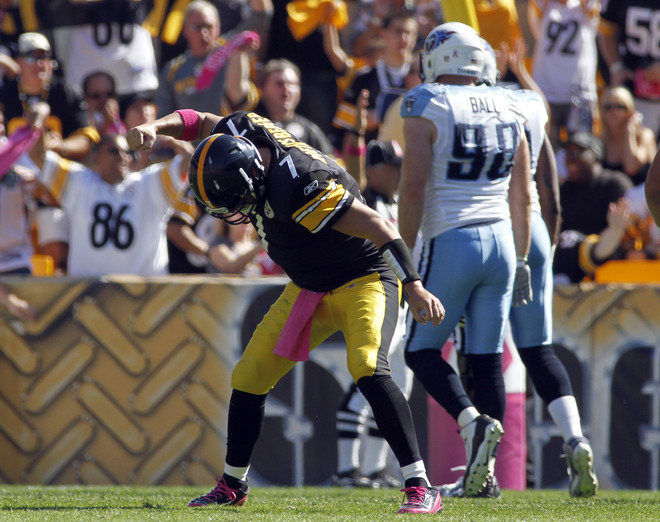
PITTSBURGH, PA - OCTOBER 9: Ben Roethlisberger(notes) #7 of the Pittsburgh Steelers celebrates his touchdown pass against the Tennessee Titans during the game on October 9, 2011 at Heinz Field in Pittsburgh, Pennsylvania. (Photo by Justin K. Aller/Getty Images)
Steelers quarterback Ben Roethlisberger went to see offensive coordinator Bruce Arians last Monday, the day after the team took a 17-10 licking in Houston. He didn't like some of the things that happened with the offense. He wasn't comfortable with being sacked five times and hurried eight other times, not because of the significant physical toll the hits took, but because he felt like he was hurting the offense by holding the ball too long.
"We had a very candid conversation," Roethlisberger said.
Later that day, Arians sought out Roethlisberger to make sure the quarterback didn't misunderstand his message. He recalled this second talk Sunday: "Don't change. You're the best there is as young as you are. Why should you change because everyone is saying you're getting sacked too much?"
Turns out even the great ones need reminded occasionally of just how great they really are.
"It meant a lot coming from him," Roethlisberger said.
Maybe the quarterback and the coordinator should talk more often.
Roethlisberger played one of the best games of his career, throwing five touchdown passes in the Steelers' 38-17 win against the Tennessee Titans at Heinz Field. It was hard to believe he was the same guy who limped out of Houston's Reliant Stadium on crutches, wearing a walking boot on his sprained left foot.
"I'm not the only guy playing with an injury. I'm not going to complain about it," Roethlisberger told a media throng. Later, though, in a quiet moment, he acknowledged the pain was pretty bad. "But I can deal with pain. Once I found out there was no structural damage, I knew I would play. I don't want to let my guys down. I'll be out there until they take me off in a cart ... "
Said Arians, "I wouldn't trade him for anyone for that reason. He's always going to show up and give everything he has."
That was especially important in this game. It wasn't just that the Steelers were coming off the Houston loss and were 2-2. They were playing without injured linebacker James Harrison and defensive linemen Casey Hampton and Aaron Smith, three players who have combined for one NFL Defensive Player of the Year award, 10 Pro Bowls and three team MVP awards. Roethlisberger and the offense needed to be on. They were.
Injured offensive tackle Willie Colon might be Roethlisberger's closest friend on the team. He and defensive end Brett Keisel were in Roethlisberger's wedding this summer. He has seen Roethlisberger play hurt in many games.
"He knows the whole team is on his shoulders," Colon said. "It's going to take a lot to sit him down. He's just so tough. Physically, everyone knows he's an animal. But it's his mental toughness that separates him from other guys."
It helped that Roethlisberger was barely touched by the Titans. By my unofficial count, he was hit as he unloaded a shovel pass to running back Ike Redman in the second quarter and when he was sacked in the third quarter when defensive tackle Jurrell Casey beat right guard Ramon Foster. That's it.
The Steelers offensive line -- ridiculed after the Houston game and all season, really -- bounced back nicely. Left tackle Max Starks, who, as teammate Hines Ward put so eloquently, "was sitting on the couch last week," started and played 62 of 64 snaps. He had to go the distance because backup Jonathan Scott had to take over at right tackle in the second quarter for injured Marcus Gilbert (shoulder). There was more shuffling in the third quarter when center Maurkice Pouncey missed six plays with a minor knee injury. Left guard Doug Legursky jumped in at center with Trai Essex filling in at his guard spot.
"Ben always believes in our unit despite how we're playing," Colon said. "I can't tell you how much that means. He knows every guy in our room would take a bullet for him."
Roethlisberger acknowledged getting rid of the ball quickly, saying he didn't look for the "home run every play." He said he simply took what the Titans defense gave him. "They did a lot of soft zone stuff and that left Heath [Miller] and Hines open underneath. I was able to get them the ball and let them run with it."
Don't be fooled into thinking Roethlisberger has changed. He's still going to go for the home run when he thinks it's there. His final touchdown pass was a 40-yarder to wide receiver Mike Wallace.
"He was very sharp with all his reads," Ward said.
Roethlisberger did throw an interception late in the first half because of a miscommunication with Arians. The original play-call was for Roethlisberger to spike the ball to stop the clock. At the last second, he tried to change to a quick pass to wide receiver Emmanuel Sanders, who was lined up right with Ward and Wallace. None of the receivers heard that call and cornerback Cortland Finnegan wound up with an easy interception.
"Too bad because that play was open and would have gone a long way," Arians said.
You know it was a good day when that was all Arians had to complain about.
"We ran the ball a lot better and we blocked a lot better," he said. "It was a nice outing for everybody."
Especially for the tough-as-they-come quarterback.
PITTSBURGH, PA - OCTOBER 09: Ben Roethlisberger(notes) #7 of the Pittsburgh Steelers calls out signals at the line of scrimmage against the Tennessee Titans during the game on October 9, 2011 at Heinz Field in Pittsburgh, Pennsylvania. (Photo by Jared Wickerham/Getty Images)
Through four games, I'd begun to think the Steelers' only viable option to preserve Ben Roethlisberger was to freeze him. You know, cryogenics. Store him away and save him for some other day, when he wouldn't be limping for his life on a sprained foot.
But for this one day, this 38-17 bounce-back body slam of the Tennessee Titans on a pristine Sunday at Heinz Field, a few other less creative options were unearthed.
Like, oh, blocking.
And executing plays quickly.
And having receivers work their routes correctly.
And establishing an honest-to-Franco running game.
And trying just about every reverse, play-action pass and fake punt in offensive coordinator Bruce Arians' playbook.
Funny how this works, but that sudden burst of competence helped Roethlisberger complete 24 of 34 passes for 228 yards and five touchdowns — second time in his career, one more than Terry Bradshaw — despite mobility that ranged somewhere between Kent Graham and the Mister Rogers monument. The sprained left foot had Roethlisberger limping before, during and after the game, but he held the pocket and, to borrow wide receiver Hines Ward's description, "played his tail off for us out there."
No one should dispute it or downplay it. But the hard truth is, neither the Steelers nor Roethlisberger had a choice. Someone needed to erase the stink of Houston, to avoid the amplifying doubts that would follow a 2-3 start. Someone needed to breathe life back into a franchise that surely was asking questions of itself that a lot of us had been asking for weeks.
Only one player on this roster has the singular ability to change that. Roethlisberger needed to step up, even if it was just on one foot.
"I just don't want to let my guys down," he said afterward. "I want to give them my best. I'll be there until they take me off on a cart, which has happened before. I want to put this team and this offense in the best position to win football games."
The best position, as Roethlisberger saw it, was to play without limitation.
I asked Arians if he had adjusted his playcalling in any way to compensate for the foot injury, and Arians swore that "not one thing" was changed. Earlier in the week, Arians went over play after play with his quarterback to check if he could run it, and Roethlisberger nodded with each. Before the game yesterday, recognizing a brick wall when he saw one, Arians told Roethlisberger: "Play football the way you know how. Don't change who you are just because people think you'll get sacked."
So it was that Roethlisberger shrugged off two game-opening incompletions by nailing his next four passes. The last was an 8-yard touchdown to tight end Heath Miller that pierced right between the 8 and the 3.
He was 3 of 4 on the next drive, capped by a 7-yard touchdown to Ward.
On the third drive, he handed off to Isaac Redman and Jonathan Dwyer repeatedly to get to the Tennessee 1. Once there, he and Arians turned to one of those plays that had been a concern to Arians, a rollout to the right. Roethlisberger ran across to fire a touchdown to tight end David Johnson, then slowly limped to the Steelers' sideline, which conveniently was in the same direction. He hunched over in clear agony.
"Ben said he could do it," Arians said. "You saw that he could."
Anyone still think Roethlisberger is faking or milking these things?
The man was sacked 14 times through four games, hit 21 other times, crushed from the blind side at least four times, had his right knee bent sideways by a cheap shot, and still suited up Sunday.
What more does the irrational faction of his critics want?
There was credit to go around: Redman and Dwyer battled far harder for their yards than Rashard Mendenhall had been doing. LaMarr Woodley finally showed up. Nose tackle Chris Hoke was receiving raves for his work as Casey Hampton's substitute. Troy Polamalu was ablaze. And the offensive line, led by Maurkice Pouncey back in Pro Bowl form and Max Starks back in the fold, was stunningly solid. Roethlisberger was sacked once.
Was it all real?
Let's wait and see. For this one day, linebacker Lawrence Timmons summed it up best when asked about all of the injuries: "We are the Pittsburgh Steelers. We're a tough team."
Let me take that to a different level: Ben Roethlisberger is the Pittsburgh Steelers, and he's never been tougher.