Friday, April 12, 2013

A Football Widow's Traumatic Journey


The New York Times


April 8, 2013

ANNAPOLIS, Md. — The end of Ralph Wenzel as his wife knew him began in January 2007. They were descending a flight of stairs at San Francisco International Airport, on their way to the baggage claim, after a two-week trip to Hawaii.
Symptoms of his dementia had been troubling during their vacation. Wenzel acted as if he had awoken in a strange place, surrounded by strangers. He did not recognize his wife, Eleanor Perfetto, or her parents. He braced himself and shook his big fists when they approached. He tried to run away. It had not been much of a vacation, she thought.
Wenzel started down the stairs, and Perfetto walked next to him, holding his hand. Six steps from the bottom, he stumbled. He fell hard and landed in a heap on the floor, blood spewing from a gash on his forehead.
He stayed at a hospital in California for 10 days. Doctors would not let him board a plane because he was too volatile. They increased his medication, and he drifted further out of touch.
Perfetto decided that her husband, who was 63 and had played seven seasons in the N.F.L. as a guard, needed to live in an assisted-living facility. She began to wonder: what is the rest of my life going to be like?
She did not have an answer. But she would sell their house in the countryside, she decided.
At first she had found it to be an odd, little house. It was gray, with big windows, beautiful trees and a deck, set on 20 acres on Kent Island, near Annapolis. Most of the backyard was grassy marshland. A creek snaked through it and spilled into a pond. Their closest neighbor lived on the other side of the pond, about a half-mile away. Across the marsh, they could see the Eastern Bay.
She would remember this as the last place her husband was healthy. Back then, he tended a vegetable garden in the yard. He would wake up at the same time each day and putter around in his garden. Life in their odd, little house was pleasant. But Perfetto had noticed something was off. Wenzel kept losing his wallet and his checkbook. He seemed easily confused.
She kept this to herself until one day in 1999, when they were discussing what to do about a patch of strawberries.
He had first planted the strawberries outside the garden, only for them to be ravaged by rabbits and deer, so he moved them inside the fence. Now, months later, the strawberries had regrown wildly and needed to be moved again.
He suggested they be moved outside the fence: he pointed to where they had been planted before, clearly not remembering that he had once planted them there. She was alarmed. She scheduled a doctor’s appointment.
The doctor asked, when did he first notice something was wrong?
It was in 1994, he said. He was coaching high school football at Sidwell Friends School in Washington. One day while instructing his players, they told him he had taught them the same thing the day before.
“Well, then, tell me what I taught you,” Wenzel said, and the players repeated verbatim what he was about to say.
Perfetto had never heard that story. Then the rest came pouring out: the confusion, he noticed it, too. It depressed him. It felt as if there were a door shut in his brain that he could not open. Wenzel was 56, and the doctor diagnosed “mild cognitive impairment,” which typically progresses into dementia.
Knowing what was to come made him more depressed, Perfetto sensed. At home, she made sure he kept a routine — managing that vegetable garden — so he felt as if nothing had changed. But it would.
She eventually hired several cleaning women, who were in fact caregivers, to take turns watching Wenzel while she was at work. They made sure he ate his lunch and took his pills. At first it was for a few hours. Then he needed to be watched all day. He still weighed about 225 pounds and he was eating well, but his mind was slowly escaping him.
At night, lying in bed, while Perfetto read, Wenzel hallucinated. Many nights he turned to her, so mad, shouting about children playing in the guest bedroom: “I don’t know what they’re doing in there!” She took him, showed him the empty guest room and said, “Look, there’s no one there.”
His face would go blank, his eyes would droop, disappointed and sad, and he would say, “Well, they left.”
He was paranoid. Often he told the caregivers that Perfetto put him to bed early some nights to throw wild parties without him. The notion made her chuckle. When she wasn’t working as a senior director at Pfizer, she was watching him.
About once a month, she indulged herself and drove to Annapolis, to meet her friends in a book club. They drank wine, gossiped and shared recipes and vacation spots. She and her husband loved to travel. They had been to the Caribbean, Italy and France. But how much longer could that last?
He could no longer communicate in complete sentences, only in words or phrases or mumbled jargon that his wife had to strain to decipher.
Life went on like this until he fell.
Moving Apart
Four months after Wenzel fell at the airport in 2007, Perfetto attended a local fund-raiser with her book club friends. They introduced her to John McCloud. They told her she and McCloud had a lot in common. His wife had died about six weeks earlier from brain cancer. She had fought it longer than expected, but the end had been horrible. He was coping.
Perfetto and McCloud hit it off. They started seeing each other every now and then.
She tried to visit her husband every day. He had been moved to a facility in Annapolis, and Perfetto had moved in with a book club friend who lived nearby. Wenzel could walk, gingerly, on his own, but his mumblings were mostly indecipherable.
On weekends, she took him out for drives, put on his favorite oldies CDs, and for a few minutes he would bob his head, then fall fast asleep. Some days, they went on walks at a nearby park or got ice cream. They often went for seafood, and he would eat a basket of fried fish, oysters and shrimp.
She stayed until the staff showered him, then tucked him into bed and put on an old movie, maybe a musical like “My Fair Lady,” and the music put him to sleep.
Wenzel stayed at that facility for about nine months. Then Perfetto moved him, because she was not happy with the care, to another local facility where he would stay for about three and a half years.
McCloud did not go with her to visit. But sometimes he helped get Wenzel to the doctor’s office. They were growing closer, Perfetto and McCloud. He understood loss. They moved into a new house together in Annapolis, in a neighborhood near her book club friends, in November 2008.
Deterioration and Death
Wenzel fell hard again in December 2010, breaking his collarbone. He went back to the hospital. When he left, it was decided that he needed to be restrained. Perfetto moved him again, to a third, smaller facility called La Casa.
There, when he tried to get up, a buzzer would go off. He flailed. He pushed his back against the chair, he kicked, waved, sometimes all at once. He broke several chairs. The attendants were wet and soapy after his showers.
Perfetto still tried to visit every day. She often found him slouching in a chair, his head drooping onto his chest, his brow furrowed as if he were mad, his mouth drooling. Perfetto had to lift his head to feed him.
On Saturdays she brought doughnuts — apple cinnamon, his favorite. He would eat two or three, but they had to be mashed first.
At the communal table, she chatted with the other residents. She learned about their grandchildren and former lives.
No matter how much Wenzel ate, he lost weight. He dropped to 140 pounds. Crumpled in his chair, the formerly burly football player looked like a skeleton with skin, Perfetto thought. Some days he would be rolled outside, his chair set in the sun. He was not well enough to walk anymore. He was unresponsive. He seemed gone.
In January 2012, five years after the fall at the airport, Wenzel came down with the flu. He was put in hospice care. Perfetto began making arrangements for his death.
One afternoon in June, while she was in London for a business conference, Wenzel did not wake up from a nap. There were no signs of trauma, no signs of pain. He was 69.
A small service was held a week later. Wenzel was cremated, but his brain was harvested and sent to Dr. Ann McKee, a neuropathologist who is the director of the brain bank at Boston University’s Center for the Study of Traumatic Encephalopathy. She examines brains for signs of chronic traumatic encephalopathy, commonly known as C.T.E., believed to be caused by repeated blows to the head. It can be diagnosed only posthumously.
That summer, after his death, Perfetto found herself occasionally sitting in traffic and still thinking of when she would visit Wenzel next. It had become routine.
In September, Perfetto had a funeral for Wenzel in the countryside on Kent Island, at their former neighbor’s house across the pond. It was a beautiful, sunny day. About 100 family members and friends attended.
They poured his ashes into the creek. In the distance she could see her old house. It looked as it had, except for a swimming pool where the vegetable garden used to be.
A 1-Year-Old’s Brain
At the time of his death, Wenzel’s brain was scarred and unsightly, its hills were not plump, its valleys were deep and thin, but most noticeably, the entire brain had shrunk to half its size. It could fit in the palm of a hand. It weighed 910 grams, about the size of a 1-year-old’s brain.
Six months later, McKee had assessed the damage, the result of 69 years of life, 7 seasons as an offensive lineman in the N.F.L. and several concussions. She called Perfetto to deliver the news.
McKee had examined at least 90 cases of C.T.E. She described Wenzel’s as one of the worst she had seen. She said it was “as bad as guys who played 16 seasons and lived into their 80s.”
McKee determined that Wenzel also had Alzheimer’s disease, which meant it was as if his brain had been lighted on fire at both ends. The findings did not seem to surprise Perfetto. In recent years, she has been one of the most outspoken voices in the debate over head injuries in football, and their possible long-term effect on players’ cognitive abilities.
On Tuesday, in United States District Court in Philadelphia, oral arguments will be held in the case between the N.F.L. and thousands of retirees who accused the league of hiding information about the dangers of head trauma. The players are seeking damages for their injuries. Perfetto, 54, will address reporters after the arguments are heard.
She might be asked: what was it like, those last five and a half years?

Thursday, April 11, 2013

Pens' injuries don't curb Cup expectations


By Chris Mueller 
Special to The Beaver County Times | Posted: Wednesday, April 10, 2013 12:16 am
http://www.timesonline.com

Jarome Iginla. Brenden Morrow. Douglas Murray. Jussi Jokinen.
Nice collection of names right there.
The Penguins essentially ruined the trade deadline for the rest of the NHL by making several moves to bolster an already strong roster, giving up no members of the current NHL team in doing so. Ray Shero’s work is clearly done for the rest of the season. It became clear that the expectation level of Cup or bust was an appropriate one.
At least, it was appropriate 10 days ago. Since then, Sidney Crosby has taken a puck to the face, Paul Martin’s hand has been broken, James Neal has been concussed by a spinning back elbow from Michael Del Zotto and the Pens have seen what looked like an incredibly deep roster of forwards become a MASH unit.
When I look at the Penguins, I see a team beset by uncertainty, and the frustrating reality of mystery recovery timetables. That’s really the worst part of this whole exercise. At least with Martin’s injury, there is a prognosis, a definite fix and a reliable return timetable. With Crosby and Neal, there is no such certainty. Neal is reported to be feeling better, but we all know that the Penguins and concussions can be an unpredictable mix. Crosby isn’t eating solid foods, and though he seems in good spirits, the team has not set a date or timetable for his return to working out, let alone playing hockey.
These injuries and their nebulous recovery periods come at the worst possible time. With only a few weeks to go until the playoffs, the Penguins figured to spend their time assimilating new pieces, developing much needed chemistry and figuring out ideal line combinations that would maximize everyone’s talents. Instead, they’re playing with a host of different pairings, developing exactly zero continuity relative to what they’ll be trying to do come playoff time and hoping all the while to hold off Montreal.
Doesn’t sound like the rosiest of pictures, and yet the expectations remain: Cup or bust.
Even in the NHL, where last year’s Stanley Cup finals matched a six and eight seed, it is widely acknowledged that the playoffs are often a hot goalie-based crapshoot, it’s still Cup or bust.
Admittedly, even as I write this, it’s tough to shake that notion from my mind. The assemblage of talent on this team — when healthy — is enough to make other players around the league blush. No one denies that when the Penguins are healthy and playing their style, they project as an incredibly tough out in a seven-game series.
Still, I can’t shake a feeling of uneasiness. They aren’t healthy. The league, while respecting the Pens’ talent, doesn’t fear them. Their 15-game winning streak was built largely on one-goal victories and featured several comeback wins. They are by no means invincible, even if it looks like they are on paper. Because of Martin’s injury, it’s doubtful the team will be at full strength until some time in the first round of the playoffs. You know, the same first round that has been their nemesis the last few seasons. Despite all their additions, they are still vulnerable to a goalie meltdown, a breakdown in their lately rigid adherence to Dan Bylsma’s preferred style of play and, of course, injuries.
However, the refrain is the same. Cup or bust.
Maybe it stems from the nice collection of names they acquired. Maybe it’s because they have the best player in the world, and he’ll almost certainly be back before the playoffs start, even if it’s only for the last game of the season. Maybe it’s because when “on,” they look unbeatable. Whatever the case, the expectation level is sky-high, despite all the tribulations that come with every deep playoff run.
The snap judgment after all the trade deadline dust settled was that only a championship would suffice. I’m not sure it was a fair thought then, even though I embraced it. In the last 10 days, things have gone as far off script as possible. The Pens have seen several chinks, even if temporary, appear in their armor. By no means are they invincible, unbeatable or even necessarily the odds-on favorite as things currently stand.
None of that matters, though. It is quite clear that three words will follow this wounded, vulnerable team, for better or worse.
Cup or bust.

Wednesday, April 10, 2013

Pens clinch Atlantic and #2 seed by dropping Hurricanes


Penguins clinch Atlantic by beating 'Canes 5-3

SERIES AT A GLANCE

  1. Game 1: Canceled
    Carolina0
    @ Pittsburgh0
  2. Game 2: Canceled
    Carolina0
    @ Pittsburgh0
  3. Game 3: Final
    Pittsburgh1
    Carolina4
    Final
  4. Game 4: Final
    Pittsburgh5
    @ Carolina3
    Final
  5. Game 5: Sat, Apr 27 7:00 PM ET
    Carolina
    @ Pittsburgh
RALEIGH, N.C. (AP) -- The Pittsburgh Penguins work pretty fast these days - when they are turning a deficit into a lead, and when they are wrapping up a division.
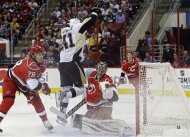
Beau Bennett and Evgeni Malkin scored 13 seconds apart in the third period, and the Penguins clinched the Atlantic Division title by beating the free-falling Carolina Hurricanes 5-3 on Tuesday night.
Brenden Morrow scored his first goal with Pittsburgh, the first team in the NHL to claim a division crown in this shortened season.
''It's been a priority for us to look at being tops in the division for the seeding in the playoffs,'' coach Dan Bylsma said. ''To be able to do that with eight games left in the season, I think that's a pretty big accomplishment for this team.''
Robert Bortuzzo added a goal, and Pascal Dupuis had an empty-netter and two assists. Marc-Andre Fleury made 25 saves for the Penguins, the division winner for the first time since 2008.
They were without a handful of regulars - including captain Sidney Crosby, James Neal and Kris Letang - but still had plenty of timely firepower to hand Carolina its club-record eighth straight home loss.
''I just thought the response after the score was really good,'' Penguins defenseman Brooks Orpik said. ''Sometimes when things aren't going your way, you get a bit deflated. It wasn't that way on the bench at all.''
Joe Corvo and Bobby Sanguinetti scored early goals for the Hurricanes, and Riley Nash put them up 3-2 exactly 2 minutes into the third.
''Any time you get the lead in the third, you want to clamp down and really do the little things right,'' Nash said. ''It just didn't seem like we did that. It's another learning experience.''
Bennett tied it with 10:11 left by slipping a backhand past Justin Peters, and Malkin scored with 9:58 left by poking the rebound of Jarome Iginla's shot past Peters.
''I had a good-look shot. It was sitting there and with (Malkin's) long reaching on the net, it was good to see him poke that one in,'' Iginla said.
Dupuis scored into an empty net with 1.9 seconds left.
Peters finished with 28 saves for Carolina, which lost its sixth straight and for the 13th time in 14 games.
These teams have gone in opposite directions since their last meeting - a 4-1 Carolina win at home over the listless-at-the-time Penguins on Feb. 28.
Pittsburgh responded by winning 17 of 19, including a 15-game winning streak that ended last week, to take control of the Eastern Conference.
The Hurricanes, meanwhile, descended into one of the worst slumps in club history - one that has enveloped nearly one-third of the compressed 48-game schedule.
Since taking a 2-0, first-period lead against Washington on March 14 - a game they went on to lose 3-2 - the Hurricanes have been outscored 56-21. Carolina has gone from the top of the Southeast Division to near the bottom of the conference.
''It's playoff mentality. (These are) all learning experiences right now. ... We played hard with them. If anything, we said, 'We can play with these guys.''' Carolina coach Kirk Muller said. ''But you have to be mentally tough to play these games.
''Put all that effort in as much as you want, but if you make a couple mistakes, the games get tighter and more important, you'll pay for it.''
At least some injured players began to trickle back into the lineup: defenseman Justin Faulk was activated from the injured list, and Alexander Semin returned after missing two games with an upper body injury. Muller said Faulk was closer to 100 percent than Semin.
Two Carolina defensemen scored off first-period faceoffs, with Sanguinetti's slap shot tying it at 2 with 4:27 left. Corvo struck first4:06 in.
Bortuzzo tied it at 1 just 92 seconds after Corvo's goal when he went backdoor and scored off a pretty cross-ice pass from Dupuis. Morrow briefly put the Penguins up 2-1 with 6:11 left with his first goal with the Penguins, coming on an impressive effort in the slot.
When Nash scored with 18 minutes left, backhanding a rebound high past Fleury, it was his first goal since he had two against Washington on March 12.
But Bennett and Malkin scored in bang-bang fashion to keep the Penguins surging and the Hurricanes reeling.
''They came out hard and strong. They're an aggressive team and put a lot of pressure on you,'' Bylsma said. ''We had to respond, and did in the first but, especially, in the third.''
NOTES: Muller said Peters made a surprise start because G Dan Ellis, the scheduled starter, sustained an unspecified injury during warmups. LW Drayson Bowman was out because of an upper body injury and C Tim Brent was sidelined by a lower body injury. ... The Penguins have now beaten every team in the East this season. ... Carolina made room for Faulk by sending D Brett Bellemore to Charlotte of the AHL. ... LW Jussi Jokinen, traded by the Hurricanes to Pittsburgh at the deadline, assisted on Morrow's goal. Another former Carolina player, RW Craig Adams, had two assists.
---
Follow Joedy McCreary on Twitter at (at)JoedyAP.

Monday, April 08, 2013

Emboldened by Pittsburgh's confidence in him, Jason Grilli ready to thrive in closer role

By Tim Brown
Yahoo! Sports
April 6, 2013


LOS ANGELES – They don't play entrance songs for journeymen middle relievers, for set-up men whose job is to be neither seen nor heard.Jason Grilli celebrates his first save of the season. (AP)
So when Jason Grilli stood Wednesday night at the bullpen gate at PNC Park, the ninth inning –his ninth inning – calling, he heard the familiar guitar licks, the heavy drum beat, the lyrics even before they burst into the nighttime air. He'd played them before, so many times, in his head.
"Don't need a helmet, got a hard, hard head.
Don't need a raincoat, I'm already wet.
Don't need a bandage, there's too much blood.
After a while, seems to roll right off."
It's Pearl Jam, a song called "Whipping," released in 1994, a few years before Grilli was the fourth overall pick in the draft. Now it had been released again, out of his imagination and into a ballpark, announcing 36-year-old Jason Grilli and his dream job, that as closer for the Pittsburgh Pirates.
The longer his career went, from one job to the next, one city to the next, the louder the music got. Maybe others heard it. But probably not. This was becoming the sound track of his professional life, him pushing, the game pushing back, neither budging.
"It says I'm still here," he said. "Alive and kicking."
Jason's father, Steve, was in the ballpark that night, like he'd been in so many ballparks on so many nights. He'd been a big leaguer, too; 70 precious appearances over parts of four seasons more than three decades ago, all but one of those appearances for the Detroit Tigers.
"Sometimes I look back at that and think, "Did I?" Steve said. "It seems like a wonderful dream."
He'd since become a scout for the St. Louis Cardinals, and an insurance broker, and run a tavern on Grant Avenue in Syracuse called Change of Pace ("Everybody used to say if I had a better changeup I'd be in the big leagues," he said.), and been a television analyst for the Syracuse Chiefs. Mostly, much as he could, he'd been Jason's dad.
The ninth inning came, and it was Jason's. It had been since the Pirates traded Joel Hanrahan the day after Christmas, that coming two weeks after they'd signed Grilli to a two-year, $6.75-million contract, the first multi-year contract of Jason's career. Along came a three-run lead against the Chicago Cubs, three outs from a win, Grilli's to have and to hold.
He chuckled to himself. Eight organizations. The elbow surgery, the knee surgery, the trades, the cuts, the demotions. Being a first-rounder, then living it down. Danielle, his wife. Their two boys. Dad in the box seats, mom beside him. The manager who believed in him. All the others who did, and some who didn't. The sacrifices. The rewards. The people, right here right now, who relied on him, just him, because this is Pittsburgh, these are the Pirates, and after two decades, wins are more important here than maybe any other place in the game.
"Don't need a helmet, got a hard, hard head…"
Jason Grilli celebrates with Russell Martin after a 3-0 win. (Getty)His song. Aloud, so everyone else could hear it too.
Steve smiled. Without knowing the words, he called it "head-banging music," which fit the song and, of course, fit his boy.
Steve?
"I'm more a Tony Bennett guy."
Forever ago now, Jason Grilli was going to be a starter, somewhere at or near the top of somebody's rotation. Maybe the San Francisco Giants', who drafted him. Maybe the Florida Marlins', who traded Livan Hernandez for him. Maybe the Chicago White Sox's, who picked him up in a Rule 5 draft. Maybe the Tigers', who signed him after the White Sox gave up on him. In 2006, it seemed like it might actually happen, but the Tigers went with a kid, Justin Verlander, instead.
So maybe he wouldn't be a starter, but he could be a big-leaguer, a reliable pitcher, maybe a closer. He had the fastball. He had the breaking ball. Right? He kept taking the ball, in places such as Colorado and Texas and then Pittsburgh. He blew out body parts and took the ball. Recovered, and took the ball. Flew through his prime, turned 34, then 35, then 36, and just kept taking the ball.
"On the gravel roads," Jason Grilli called it.
Why?
"The shortcomings of what he envisioned of himself," Steve said. "The golden carrot is still out in front of him. He hasn't accomplished what he wanted to accomplish. That's to make it big."
Jason stood Friday afternoon in the visitor's locker room at Dodger Stadium, two days after that one-two-three ninth inning against the Chicago Cubs, the sixth save of his career, the first as an honest-to-goodness, somebody-believes-in-me closer. He'd grown his hair long. Raised the stubble on his chin. Big, strong, dark, he was, by God, going to look the part.
He was not going to be J.D. Drew, Troy Glaus or Vernon Wells, taken second, third and fifth in that '97 draft. He was not going to be somebody's ace.
"And I won't ever catch Mariano Rivera in saves," he said.
But, if this was going to be his moment, stretched over a single night or another five years, then he was going to make it his, and play it for all the bad news along the way, and all the good news. He was going to play it for his dad, and his mom, and his wife, and his boys, and all the people in this locker room. He'd watch three hours of baseball, watch the other 24 guys strain to put the ball in his hand, and then he'd play his song.
"My career certainly is not a snapshot of what I thought it would be," he said. "It's more like a Polaroid, still developing.
"I came through all this and I was a pretty good major-league player who sticks with it. That to me is all the justification. Was he a bona fide big leaguer?"
When the last out against the Cubs came and the Pirates had won and he was the one who finished it, Grilli accepted the game ball. Then he handed it to his dad, who'd needed a hard, hard head himself over a dozen professional seasons, who'd put Jason on a mound and told him he could do it, who'd only a few years ago carried an injured Jason back and forth to the shower, hell, who'd traveled some of those same gravel roads.
"He's always been my jockey," Jason said.
Little changes, really. He takes the ball, he gets an out, then two, then another. He'd watched other guys do it seemingly forever. Now it's him.
The difference? Now everybody can hear the music.
Memorable Moments on Yahoo! Sports:

Blame injuries for Penguins' sour notes


By Mark Madden
Special to The Beaver County Times | Posted: Sunday, April 7, 2013 11:47 pm
http://www.timesonline.com
After 12 home games in 33 days, the Penguins are on the road until April 17. How best to sustain the buzz? Refreshing Penguins notes! Getting everyone healthy wouldn’t hurt, either.
-- When the Penguins acquired Jarome Iginla, Brenden Morrow and Douglas Murray, they became Stanley Cup favorites. But now Sidney Crosby and Paul Martin are out indefinitely, and Kris Letang has played just once since March 17. The best-laid plans, etc.
-- Jussi Jokinen was brought in for playoff depth at forward, and to replace Matt Cooke on next season’s third line. Cooke will be a free agent. Jokinen’s contract has one more year left at $2.1 million and he often skated on a line with Brandon Sutter in Carolina. Players of that ilk will always be interchangeable under a salary-cap system.
-- The NHL’s compacted schedule is denying the Penguins practice time, thus preventing their recent acquisitions from meshing with their system. Coach Dan Bylsma’s decision to give his players yesterday and Saturday off was nonetheless wise. The Penguins have the best part of a month to blend. But as the season winds down, you can’t catch up on rest.
-- Defenseman Matt Niskanen is being force-fed a bigger role and more ice time in the absence of Letang and Martin, and the result is a crummy stretch of play for Niskanen. With Niskanen, less is more. With rookie Simon Despres, more could be more. He’s got pedigree and potential. Yet Despres was a healthy scratch in this past Friday’s 2-1 home win over the Rangers. The very marginal Robert Bortuzzo and Deryk Engelland played instead. Can’t figure it.
-- That said, Bortuzzo has a touch of Hal Gill about him. He’s 6-foot-4, just physical enough, and that long stick is everywhere.
-- Minus Letang and Martin, the breakout has slowed to a crawl. Most of the defensemen just whack the puck up the boards, or freeze a forward with a pass. Very rarely can a forward generate speed while receiving the puck.
-- Fans who criticize the play of Morrow because he has just one point in six games don’t understand what Morrow provides. He’s a leader, he’s physical, he’s gritty, he goes to the blue paint and he generates a body count. Morrow is the type of player that breaks the opposition defensemen down over a seven-game series. Murray provides the same element on defense. This is the NHL, not a fantasy league.
-- Statistically, this season is in line with Marc-Andre Fleury’s best ever. Beyond that, he’s making big saves at big times, which is the primary job of a goaltender on a good team. Fleury beat the Rangers nearly single-handedly. He should have received all three stars.
-- Odd stat: Chris Kunitz leads the Penguins with 20 goals. But he has had goal droughts of eight games, six games, four games and four games.
-- It seems inevitable, if everyone gets healthy, that Crosby centers Pascal Dupuis and Iginla, and Evgeni Malkin centers Kunitz and James Neal. Everyone would be in his comfort zone. Bylsma should approximate those combinations as much as possible as soon as possible. The Malkin-Iginla-Neal line isn’t scoring, and doesn’t pass the eye test. Iginla and Neal both need to play right wing.
-- Geno Nation is loyal but misguided and occasionally downright stupid. If you think Malkin’s play is worth $8.7 million, you’re putting hero worship and fanboy gibberish ahead of your powers of observation. Or maybe you just don’t know hockey. If Malkin’s hurt, he shouldn’t play.
-- Michael Del Zotto’s elbow to the head of Neal during this past Friday’s game was damaging and reckless, but I didn’t detect malice. It should have drawn a penalty. But the Rangers defenseman was not suspended, and rightly so.
-- The NCAA Division I men’s hockey championships take place Thursday and Saturday at Consol Energy Center. The Frozen Four is sports’ last truly great neutral-site event. The tickets belong to fans, not corporations. You see dozens of people wearing jerseys of schools that aren’t participating. The passion is tangible every minute of every game. It’s electric.

Sunday, April 07, 2013

Pens going distance in building 'winning atmosphere'


Winger James Neal talks with Jarome Iginla during his Penguins debut on Saturday, March 30, 2013, at Consol Energy Center.
About Rob Rossi
Pittsburgh Tribune-Review NHL/Penguins Reporter Rob Rossi can be reached via e-mail or at 412-380-5635

By Rob Rossi 
Pittsburgh Tribune-Review

Published: Sunday, April 7, 2013, 12:01 a.m.
Updated 8 hours ago 

Jarome Iginla could not believe his eyes.
While showing his family the inside of Consol Energy Center for the first time on Thursday afternoon, Iginla walked his kids down a hallway lined by large photographs of Penguins players, ranging from captain Sidney Crosby to fourth-line center Joe Vitale.
“We were just looking at the pictures on the way, and I'm, like, ‘Oh, my gosh, we're already up there,' ” Iginla said, referring to the framed photograph of him in a black Penguins home jersey. “I thought that was a pretty neat touch, to already be a part of it.”
Iginla had been in Pittsburgh less than a week.
The Penguins wasted no time trying to make Iginla's surroundings feel like home.
“They got my kids jerseys with my number (12) and name on the back, and stuffed animals — and my kids were so pumped,” Iginla said. “They were wearing those jerseys around everywhere, and they had hats. Now we're full Penguins fans.”
Iginla did not leave his only previous NHL home — Calgary, where he played for 16 seasons, including the last nine as Flames captain — so his children could get new gear and toys.
He agreed to waive a no-movement clause in his contract because he believes the Penguins, specifically because of Crosby and Evgeni Malkin, the MVP last season, give him a chance to finally win the Stanley Cup.
“Players want to win,” Iginla said. “But those small things go a long way.”
LEMIEUX, SHERO AND LUCK
Penguins CEO David Morehouse could not have drawn up Iginla's Thursday any better.
The mandate of majority co-owners Mario Lemieux and Ron Burkle is to “build the kind of franchise that people want to come and play for,” Morehouse said.
“We want to treat our players better than anybody else treats their players,” Morehouse said, recalling the two years team officials spent touring dressing rooms of NHL, NBA and MLB teams so that the Penguins could make good on Burkle's request to “build the best dressing room in sports.”
“When players are traded here or sign here, we want them to know right away that they're going to be treated the best,” Morehouse said.
So far, so good — at least so it seems.
Twice over a span of five days this season the Penguins traded for a player who was another team's captain, a player who possessed a contractual clause that allowed him to block any move.
Winger Brenden Morrow waived that clause March 24, agreeing to leave his only NHL home, Dallas, to join the Penguins. Iginla followed March 28.
Morehouse said the lure of the Penguins for those players was obvious.
“It starts with Crosby and Malkin. Guys want to play with our two great players,” Morehouse said. “But it's not just the great players we have, the great facilities we have, the fact that Pittsburgh's a great hockey town. It's all those things combined. And I think mostly it's that our owners are committed to winning.”
That is it, defenseman Mark Eaton said.
“People want to win, and winning begets winning, and people want to be a part of that,” Eaton said. “But word travels, too.”
Eaton rejoined the Penguins early this season — he initially signed a tryout contract and worked through a conditioning stint at AHL affiliate Wilkes-Barre/Scranton — after leaving as a free agent in July 2010.
He was the first free agent that general manager Ray Shero signed upon taking over the Penguins in May 2006.
After signing Eaton, Shero instructed a member of his then-smallish hockey operations staff to send flowers and a welcome package to Eaton's wife, a gesture that has become tradition.
“Ray's a first-class GM, and what he's done with this team has been first class,” Eaton said. “And this ownership, with Mario being around, everybody knows about him. You add all of that in with the winning and the world-class players, Crosby and Malkin, and it's just something people want to be part of.”
Shero said that if the Penguins are “a destination, it's because the table has been set by Ron and Mario and those franchise players for guys like Iginla to play with.”
“You have to look back beyond my seven years, back to when Mario and Ron made the commitment to keep the team here after they got the ping-pong ball to fall a certain way,” Shero said, referring to the 2005 NHL Entry Draft lottery that won the Penguins the opportunity to select Crosby first overall.
“The year before that (2004), a player like Malkin was available with the second pick, so you're talking about franchise-changing moments for the Penguins. Mario and Ron took advantage of it. They realized it was an amazing opportunity to build something special.”
SID, GENO AND MORE
Crosby said there is a reason he never craved the opportunity to test his worth on the free-agent market. A year away from becoming the likely most-coveted free agent in NHL history, Crosby signed a 12-year extension last July.
“There's a lot of pressure that comes with committing to a team for so long,” Crosby said. “But when it comes to the guys here, we have a pretty good idea of what is expected of us, and we know what to expect.
“I think we all like that. I know it's something that I never take for granted and is something I wanted to be a part of for a long time.”
Malkin, like Crosby a former MVP and scoring champion, said he wants to make a similar commitment to the Penguins this summer when he can sign an extension.
Penguins ownership first signed off on spending to the salary cap in 2008, back when the skeletal frame of Consol Energy Center did not yet exist. The Penguins have been a cap team since, and ownership has authorized Shero to spend as needed to keep Crosby and Malkin in Pittsburgh through the duration of their careers.
Those players are the best advertisements for those interested in Pittsburgh.
The Penguins are “about more than just Sid and Geno,” though, said Iginla, who can become a free agent July 5.
Shero will make a push to keep Iginla — a player he has long admired — and though negotiations will not begin until after the Stanley Cup playoffs, an impression clearly has been made.
“Calgary was a good organization, and it's a smaller city, and (the Flames) create that family feel,” Iginla said. “But you get that family feel here, too. And the facilities here are amazing. (Consol Energy Center) has been well thought out.
“Just look at the shooting room. That's great. When you're a player, you grow up shooting in your backyard or basement. Here, there is a room for us to just shoot. And the breakfast area is built so that guys can eat and hang out together. I could keep going on, but there are things that make it conducive to helping you get ready to play.
“I was here less than a week and I could tell why they have this winning tradition with the Penguins. It's a winning atmosphere.”
Rob Rossi is a staff writer for Trib Total Media. Reach him at rrossi@tribweb.com or via Twitter @RobRossi_Trib.

Copyright © 2013 — Trib Total Media