Friday, May 06, 2016

No matter how well Matt Murray plays, Penguins still have goalie conundrum


By Mark Madden
May 6, 2016
I think I’m always right. It’s my biggest charm, some say.
But when it comes to the Penguins’ goaltending situation, I can’t be right, because I honestly don’t know what they should do.
Marc-Andre Fleury has been cleared to play after missing all of April with a concussion. Statistically, he had the best regular season of his career: 2.29 goals-against average, .921 save percentage, 35 wins, five shutouts.
Fleury kept the Penguins within reach of the playoffs. That situation was shaky before they won 14 of their last 16.
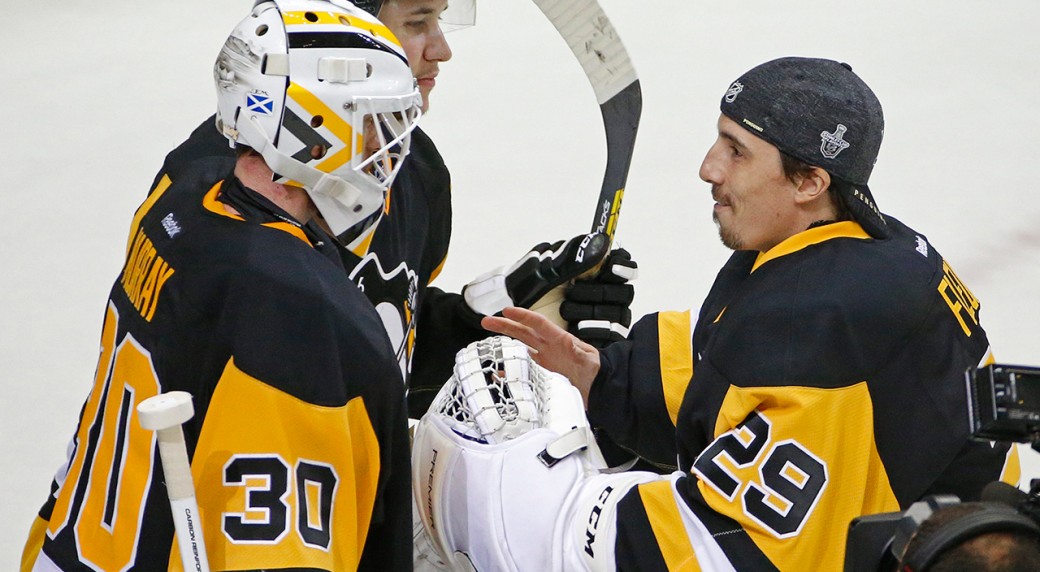
Murray has manned the blue paint through the last seven playoff games. He has six wins, a 1.81 goals-against and a .944 save percentage. His 47-save performance in the Penguins’ Game 3 win over Washington Monday was miraculous.
Fleury, 31, is a 12-season vet with a Stanley Cup ring, another Finals appearance and, yes, some playoff disappointments.
But Fleury was the Penguins’ best performer in each of the last two postseasons with a 2.32 goals-against and a .919 save percentage in 18 games.
Murray, 21, is in his second pro campaign. He was the American Hockey League’s top goaltender and top rookie last season.
Murray has massive potential, and we’re seeing some of it realized right now.
“Right now” is the primary consideration.
I believe Fleury is superior. Even if the Penguins ride the hot goalie and Murray wins the Stanley Cup, Fleury is my starter at the beginning of next season. That’s one thing I’m absolutely certain about.
Fleury is a proven commodity in his prime. The performance of young goalies can be mercurial.
Witness ex-Capital Jim Carey, who went from Vezina Trophy winner at age 21 in 1996 to out of hockey by 1999. From NHL first-team all-star to net defective, and it happened within three years. Other examples abound.
Ideally, the Penguins would like to keep Fleury and Murray for 2-3 years, the probable 2017 expansion draft permitting. You need two quality goalies.
Long-term, I’ve got it figured. Short-term, I keep vacillating.
Originally, I thought Fleury should play as soon as health permitted. Then the doctors cleared him, and I thought, “Give Murray one more game.” Murray made all those stops Monday, so he had to start Wednesday. I thought, “Fleury plays Game 5 no matter what.” But Murray won again.
If coach Mike Sullivan wants to reinstate Fleury as the Penguins’ No. 1 goaltender without Murray faltering, he should do it at the start of the Eastern Conference final (provided the Penguins eliminate Washington). Otherwise, Fleury only regains the job if Murray is injured or flounders.
Sullivan has lots of faith in Murray. He coached him earlier this season with the Penguins’ Wilkes-Barre/Scranton affiliate. Sullivan might see Murray as his best choice. That notion can’t be discounted.
Stylistically, I prefer Fleury. Murray sets up so deep in the crease, he’s practically inside the net. You’d think a 6-foot-4 goalie would come out and challenge. Cut down the angles. Murray has given up four soft goals in the Capitals series.
But Murray makes big saves, and keeps winning.
Some say that it’s impossible for Sullivan to make a bad decision. That’s wrong. It’s possible.
In 1996, starter Tom Barrasso played the first three games of the Penguins’ opening-round series with Washington, losing twice. Barrasso got hurt. Backup Ken Wregget won the next three games. In the second round, the Penguins beat the New York Rangers in five games. Wregget played all of them. He was brilliant.
But Barrasso got healthy. Wregget lost the first game of the Eastern Conference final at home to Florida, 5-1. Coach Eddie Johnston started Barrasso in the series’ remaining games. Barrasso didn’t stink, but he leaked in Tom Fitzgerald’s shot from just inside the blue line in Game 7 and the Penguins lost 3-1.
Johnston lifted the hot goalie. Barrasso didn’t lose the series. But perhaps Wregget could have won it.
For Sullivan, the safe decision is to keep using Murray. The hot goalie.
This situation won’t become toxic. The Penguins are lucky in that regard. Fleury and Murray are good teammates.
So is Jeff Zatkoff. Don’t forget Zatkoff’s role in the Penguins’ run. He got a split in the first two games of the first-round series against the Rangers after not starting in almost two months. That contribution can’t be minimized.
Mark Madden hosts a radio show 3-6 p.m. weekdays on WXDX-FM (105.9).

Resiliency, desperation traits Capitals seemingly lack in playoffs

 - The Washington Times - Thursday, May 5, 2016
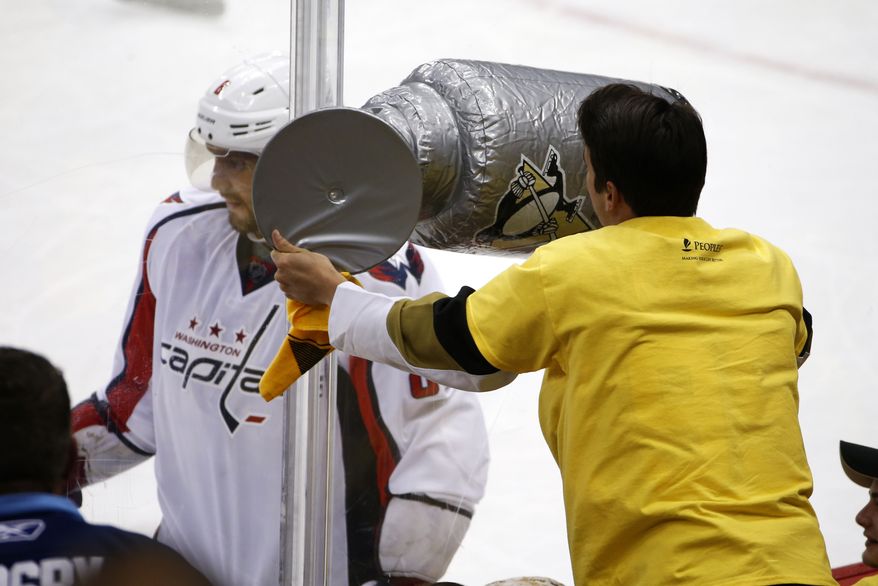
A Pittsburgh Penguins fan waves an inflatable Stanley Cup at Washington Capitals' Alex Ovechkin, left, during the third period of Game 4 in an NHL hockey Stanley Cup Eastern Conference semifinals in Pittsburgh, Wednesday, May 4, 2016. (AP Photo/Gene J. Puskar)
“That’s why it’s sudden death. That’s what it feels like.”
— Barry Trotz, Washington Capitals coach
No, Coach. That’s not what it feels like. It’s a slow death — one that starts with the opening of every Capitals season and then ends in Stanley Cup Playoffs failure.
Worse, Coach, it is like Groundhog Day, because it happens every year.
Sudden death? Hardly.
The Capitals, in a game in which Redskins coach Jay Gruden might have called a “Code Red,” continued their “code blue” lifeless play in a 3-2 overtime loss to the Pittsburgh Penguins in Game 4 of the Eastern Conference semifinals on Wednesday night.
The victory gives the Penguins a 3-1 lead, with Game 5 on Saturday night at Verizon Center.
Who knows? Maybe the Capitals will be desperate enough to play their best game of the playoffs before the home crowd and force a Game 6 back in Pittsburgh.
We keep hearing from Trotz that his team hasn’t played its best game in these playoffs. What are they saving it for — next season’s Russian Heritage Night and another Alex Ovechkin milestone celebration?
Here you have a team that, by its coach’s own admission, has not played its best. A team with players who, by their own admission, have played with a lack of desperation. A team that was handed an opportunity, with the one-game suspension of Pittsburgh’s valuable defenseman Kris Letang, to take advantage of a weakened Penguins team and even the series at 2-2, giving it home-ice advantage again in a two-out-of-three series finale.
And yet there were large stretches of Wednesday night’s game when theCapitals played with that disturbing lack of urgency that has become this franchise’s postseason identity during the Ovechkin era.
I can’t stop thinking about something the great New York Rangers goaltender Henrik Lundqvist once said about what it takes for playoff success — something that I referred to in my column on Wednesday about the pattern of offensive woes in the Capitals‘ playoff history.
“A lot of these games, it comes down to will,” Lundqvist said last year. “How badly do you want it? Teams are so even that it comes down to a battle in the corner, in front of the net, all over the ice. It’s one-on-one battles against your opponent. If you want it bad enough, I think you’re going to have a good chance.”
He said this after the Rangers came back from a 3-1 series deficit to defeat the Capitals in seven games.
There’s been little evidence of that “will” from the Capitals this postseason. In fact, if you go back to previous playoffs since 2009 — Ovechkin’s first postseason — you would be hard pressed to find many performances that meet that standard.
The closest the Capitals have come to doing “battle in the corner, in front of the net, all over the ice?” The team coached in 2012 by Dale Hunter — the time when Ovechkin’s greatest skills were marginalized.
That group failed to get any farther than any of the other Capitals playoff teams since 2009, exiting in seven games in the second round to the Rangers. But no one ever used the words “lack of urgency” or “lack of desperation” to describe that unit.
The National Post, one of Canada’s largest newspapers, wrote then of Hunter’s coaching style — and its results:
“He reduced the ice time of the team’s stars, created less puck possession for his team, and produced more time in Washington’s defensive end. He has carved out increased roles for of a posse of grinding pros like Jay Beagle, Joel Ward, Jason Chimera, Troy Brouwer, Mike Knuble, and especially in Game 6 in Washington, Matt Hendricks. Hendricks, a guy who bounced around for years, is a perfect Capital, just now.
“‘Cause he’s a — I don’t know if I can say it — he’s a prick on the ice,’ Brooks Laich says of Hendricks. ‘You don’t want to play against a guy like that. You have to go through a lot to get the best of Matt Hendricks. He’s going to compete, and he’s going to do everything in his power to not let you do it.’”
This team?
“We’ve just got to make sure we’re in full desperation mode from the drop of the puck next game,” defenseman Taylor Chorney said after Wednesday’s overtime loss.
Or they could just save it for Russian Heritage Night.

Thursday, May 05, 2016

Hornqvist scores in OT, Penguins beat Capitals 3-2


By Will Graves
https://sports.yahoo.com/nhl/teams/pit/
May 5, 2016

Hornqvist scores in OT, Penguins beat Capitals 3-2
Pittsburgh Penguins Matt Cullen (7) scores a goal against Washington Capitals goalie Braden Holtby (70) during the second period of Game 4 in an NHL hockey Stanley Cup Eastern Conference semifinals in Pittsburgh, Wednesday, May 4, 2016. (AP Photo/Gene J. Puskar)


PITTSBURGH (AP) -- Patric Hornqvist makes a living by working in tight spaces. Given a rare moment of freedom from his usual spot parked in front of the opponent's net, the Pittsburgh Penguins forward pushed the Washington Capitals to the brink of elimination.

Three Stars

  1. Patric Hornqvist
    #72, Pittsburgh
    G:1
    A:1
    Pts:2
    +/-:1
    PPP:0
    SOG:3
  2. Matt Cullen
    G:1
    Pts:1
    +/-:0
    PPP:0
    SOG:2
  3. John Carlson
    #74, Washington
    G:1
    Pts:1
    +/-:1
    PPP:0
    SOG:2
Hornqvist fired a loose puck between Braden Holtby's legs 2:34 into overtime to give the Penguins a 3-2 victory Wednesday night in Game 4 of the tightly contested second-round series.
Washington's Mike Weber tried to steer the puck out of harm's way in front of the net, but it went right to Hornqvist charging in from the right circle. The burly forward buried it for his fifth goal of the postseason to give the Penguins a 3-1 lead in the best-of-seven Eastern Conference semifinals.
''That's a big win,'' Hornqvist said. ''Now we have to stick with it. We haven't done anything yet.''
Maybe, but the Penguins can advance to the conference final with a victory in Game 5 in Washington on Saturday after sending the Capitals to a third straight loss. Washington dropped three consecutive games just once while capturing the Presidents' Trophy for posting the league's best record. Now the Capitals are three periods away from an eighth playoff series loss to the Penguins in nine all-time postseason meetings.
''We have to have the mentality shift by shift, period by period, try to turn it around,'' said Washington captain Alex Ovechkin, who had seven of his team's 36 shots but was held without a point.
The Penguins survived despite missing defenseman Kris Letang, serving a one-game suspension for an illegal hit on Marcus Johansson in Game 3. The makeshift group at the blue line that included Brian Dumoulin and Justin Schultz played just fine in the absence of perhaps Pittsburgh's most indispensable player. The Penguins blocked 14 shots and clogged the area in front of the net to protect rookie goaltender Matt Murray.
''It wasn't a perfect game by any stretch but we're playing against a pretty good opponent and Tanger's a tough guy to replace,'' Pittsburgh coach Mike Sullivan said. ''Guys had to play more minutes, more significant roles. I thought the group of them did a tremendous job.''
Matt Cullen and Trevor Daley also scored for Pittsburgh and Murray stopped 34 shots to improve to 13-1 in his last 14 starts, including a 6-1 mark in the postseason. Penguins captain Crosby left briefly in the third period after getting slashed by Ovechkin but his presence early in overtime helped set up the winner.
Pittsburgh had been on the wrong end of sudden death overtime eight straight times since beating the New York Islanders in Game 6 of the first round in 2013. The drought ended when a Conor Sheary shot from the point was stopped by Weber before it got to Holtby. Weber then nudged it across the slot to an awaiting Hornqvist. Holtby, who was focusing on Crosby standing right in front of him, couldn't get his legs closed fast enough.
''I have to get over there quicker than I did,'' Holtby said.
Jay Beagle and John Carlson scored for Washington, and Holtby made 29 saves.
The Capitals now have to rally from a 3-1 deficit, something they've only done twice in the franchise's 41 seasons. Washington had the league's best record in one-goal games during the regular season but is just 2-4 in one-goal contests in the playoffs.
''We have the experience, the composure,'' Holtby said. ''It's just a matter of putting it to use now and keep pushing forward. Hopefully the bounces will go our way sooner or later.''
The Capitals dominated Game 3 everywhere but the scoreboard, falling 3-2 behind a spectacular 47-save performance by Murray. Washington coach Barry Trotz insisted there was ''a good vibe'' coming from his club, pointing to the way his team tilted the ice as proof the results would come if the Capitals kept at it.
The Penguins realized they were lucky to escape Game 3 with the series lead and responded with a far better performance even with Letang missing.
Still, Washington needed just 2:58 to take its first lead since Game 1 as Beagle flipped a backhander Murray's way despite being nearly parallel to the goal line. The shot sailed over Murray's shoulders and into the far top corner.
Daley's first playoff goal in nearly two years tied it later in the period, as his shot from the top of the right circle deflected off Washington's Karl Alzner and by Holtby. The 39-year-old Cullen, playing between a pair of forwards - Tom Kuhnhackl and Oskar Sundqvist - who were born when Cullen was well into his teens, put Pittsburgh in front by taking a stretch pass off the boards from Dumoulin and beating Holtby low.
Justin Williams stripped Derrick Pouliot deep in the Pittsburgh zone and slipped it across the ice to Carlson, who had little trouble firing it over Murray's extended glove set the stage for the latest dramatic moment in a series that is living up to its considerable hype.
''A lot of us have been on both sides of the 3-1 series,'' Crosby said. ''I think you understand that when you have a team in that position you have to take advantage of it and take advantage of that opportunity.''
NOTES: Pittsburgh went 0 for 4 on the power play and is 0 for 14 with the man advantage during the series. ... The Capitals scratched D Nate Schmidt, who struggled in Game 3. ... Pittsburgh Pirates pitcher Gerrit Cole watched from the front row next to the Washington bench and was caught on camera good-naturedly yelling at the Capitals before being chastised by an usher.

Crosby provides intangibles for Penguins


May 5, 2016
(AP Photo/Gene J. Puskar). Pittsburgh Penguins' Sidney Crosby prepares to take a face-off during the second period of Game 4 in an NHL hockey Stanley Cup Eastern Conference semifinals against the Washington Capitals in Pittsburgh, Wednesday, May 4, 2016.
Pittsburgh Penguins' Sidney Crosby prepares to take a face-off during the second period of Game 4 in an NHL hockey Stanley Cup Eastern Conference semifinals against the Washington Capitals in Pittsburgh, Wednesday, May 4, 2016. (Gene Puskar/AP)

Sidney Crosby knows where to go to get the best of the Washington Capitals.
On Wednesday night, he went there and helped push his generational rival to the edge of elimination.
Front of the net.
Front of the goalie.
That is where Crosby was on the Penguins' first and last goals in a 3-2 overtime victory atConsol Energy Center. He wasn't setting a screen, just occupying the attention of Capitals skaters and drawing a look from goalie Braden Holtby.
A split second is a lifetime in the NHL.
For the Penguins, the couple of split seconds Crosby distracted Holtby were all defenseman Trevor Daley and winger Patric Hornqvist needed to score the biggest goals of the showcase series in these Stanley Cup playoffs.
Daley's answered the Capitals' fluky first goal early in the opening period. Hornqvist's ended Game 4 early in overtime.
“Sudden death, that's what it feels like,” Capitals coach Barry Trotz said.
He wasn't alluding to a bigger picture, but the Penguins can make it seem that way. With a win in Game 5 at Verizon Center on Saturday night, the Penguins would bring to a shocking, sudden end the season of the best club in the NHL's regular season.
If that is how it goes, Capitals captain Alex Ovechkin will have gone 0 for 2 against Crosby in postseason showdowns. He'll also have failed to reach the Eastern Conference final.
To lay another potential postseason failure at the skates of Ovechkin would not be fair. But hockey is cruelest for the superstars who haven't won the Cup.
Heck, it can be brutal for the superstars who have won it.
Crosby claimed Lord Stanley's silver chalice in 2009, and all he's done since (when healthy) is win or contend for MVPs and scoring titles. Still, even critics in the one NHL city where he is truly revered have wondered when he would deliver a playoff moment like the ones he has produced for Canada's Olympic teams.
On Wednesday morning, Penguins coach Mike Sullivan fielded questions about Crosby's alleged struggles in Round 2.
Crosby had not recorded a point against the Capitals. He had not scored a goal since Game 4 against the Rangers in Round 1.
What was wrong with Sid?
Nothing.
Not one darn thing was wrong, and to assess his performance only by points was to miss his brilliance. As he had in the 2009 Cup Final against the Detroit Red Wings, Crosby was doing all of the hard work against the Capitals' best offensive and top defensive pairing.
Trotz, a reputable defensive coach, acknowledged the Capitals had a plan to limit Crosby offensively. It involved gaining “inside position, making him play defense and limiting his time and space.”
However, a concession that Trotz offered Wednesday morning proved prophetic.
“Make him play in tight areas,” Trotz said of Crosby. “But he's really good in the tight areas.”
Usually in the playoffs, the tightest area is the contested ice near a goalie's crease. In this physical, bruising and contentious series, any area of ice has been tough for players on either club to occupy.
Crosby, though, knew that one area above all was where he had to go in what figured to be a series-shaping Game 4.
He went there whenever he could, including a few minutes after leaving the game in the third period. Ovechkin had slashed his right hand. Crosby was visibly frustrated as he walked from the Penguins bench to the medical room.
Upon returning, he skated even more purposefully than he had earlier in Game 4. With the score tied 2-2 late in regulation, he skated to the slot and battled near the Capitals net before taking a stick to the face from defenseman Karl Alzner.
A Penguins power-play goal could have been considered a form of justice.
But the perfect ending for the biggest win in years — and most impressive because the Penguins played without their top defensive pairing and a top-six winger — was a goal Crosby neither scored nor set up.
Instead, he was where a captain goes. It was where Crosby went while scoring eight goals and recording 13 points seven years ago against the Capitals.
Crosby was near the net.
And as a result, the Penguins are close to eliminating the Capitals.
Rob Rossi is a Tribune-Review staff writer. Reach him at rrossi@tribweb.com or via Twitter@RobRossi_Trib.

Penguins come out firing in overtime, put Capitals on the brink of elimination


By Brian Metzer
http://www.timesonline.com/sports/
May 5, 2016


NHL Playoffs: Penguins vs. Washington Capitals, Game 4

Patric Hornqvist celebrates his game-winning goal. (Kevin Lorenzi/The Times)

A look back at the first three games of the series between the Penguins and Capitals would reveal different moments in which each team held the upper hand. That changed during the first three periods of Game 4, where they played to a tie in almost every way.
Each team seemed to have a number of prime scoring chances, but their shot totals remained nearly identical, with the Penguins rolling up 31 and the Capitals 34. The Penguins outhit the Capitals for the first time in this series, but by only five, and the game, tied at 2-2, had the feel of one that might rival the epic four-overtime affair between the two rivals back in 1996.
Then came overtime.
The Penguins must have slurped down a bit more water, or had a few protein bars, because the teeter-totter that looked like a level piece of wood all night tipped in their direction.
“They're going to get their time in our offensive zone and we're going to get our time, too,” Penguins coach Mike Sullivan said. “What I liked about our game tonight was we got a real solid effort throughout our lineup, from the forward position on back.”
Whereas the Penguins played it a bit safe at times during the third period, they started to put the pedal to the floor and spent most of the overtime period in the Capitals' zone. As a result, the period lasted only 2 minutes, 36 seconds.
Unlike Game 1 at the Verizon Center,  when the Capitals controlled overtime and won 4-3, the Penguins ramped up their attack and kept pucks heading toward goaltender Braden Holtby.
“I think obviously our last game wasn’t good at all,” forward Patric Hornqvist said. “We have to be better in that area, and I think we improved a lot. Our defense played a lot of hard minutes and they have a good forecheck, so we have to make sure we get the puck out quick and take it to the net as quick as we can, and then play below the circles. That’s when we’re at our best.”
Holtby might have faced only two shots, but quick puck movement left him struggling to get from his right to his left, and he had no chance to stop Hornqvist’s game-winning shot.
It was the kind of game that the Penguins have played since Mike Sullivan arrived. They bent at times but they never broke, and they showed the resolve of a team that is just getting started in these playoffs.
That resolve has the Capitals, the regular-season champions, at the brink of elimination -- something the Penguins can accomplish Saturday night.
“That’s a big win,” Hornqvist said. “Now we have to stick with it. We haven’t done anything yet. We have to play better if we’re going to win next game, and obviously the next game is going to be the hardest to win. We have to make sure we do the right things out there and play even better that we did tonight.”

Capitals can’t establish championship bona fides in Game 4 loss


May 4, 2016
Pittsburgh Penguins goalie Matt Murray (30) makes a save against Washington Capitals Justin Williams (14) during the first period of Game 4 in an NHL hockey Stanley Cup Eastern Conference semifinals in Pittsburgh, Wednesday, May 4, 2016. Photo: Gene J. Puskar, AP / Copyright 2016 The Associated Press. All rights reserved. This material may not be published, broadcast, rewritten or redistribu
Pittsburgh Penguins goalie Matt Murray (30) makes a save against Washington Capitals Justin Williams (14) during the first period of Game 4 in an NHL hockey Stanley Cup Eastern Conference semifinals in Pittsburgh, Wednesday, May 4, 2016. (Gene Puskar/AP)

PITTSBURGH – A team with Stanley Cup aspirations should have won this game. Let’s start there. The next 900 words are just filler.
The Capitals did not, of course, win this game. The Penguins claimed a 3-2 overtime victory Wednesday night, in the most essential contest Washington has played this season, at least until Saturday rolls around.
The Penguins were without perhaps their least replaceable player in suspended defenseman Kris Letang. The Capitals had supposedly found their game in Monday night’s loss, and pledged to “play Game 4 exactly the way we played Game 3,” as one player put it. They were on the road, but with Letang out, the Caps were actually a betting favorite.
ADVERTISING
And whether they admitted it or not, they knew this showdown was likely critical to their playoff survival. The surging Penguins haven’t lost three straight games since mid-December. NHL teams with 3-1 series leads win 90 percent of the time. The best team in franchise history wasn’t supposed to be reduced to a Hail Mary before Mother’s Day.
So how was it that the Capitals went more than eight minutes without a shot to start the second period, a near-replay of Game 2’s second-period silence? How was it that they again struggled with discipline, with T.J. Oshie taking a penalty miles from the puck and Karl Alzner getting dinged with a late call? How was it that Washington’s power play continued to look as dangerous as a soggy off-brand paper towel? How was it that the dominance from Monday was gone, and the Capitals were left hoping to win an overtime coin flip?
“We got our fair share of chances toward the end of the game and overtime and we just didn’t cash in at the big moments,” defenseman John Carlson said. “It’s something we’re going to have to do. At this point, you lay it on the line, and that’s not good enough. And now we’ve got to reach back and dig deeper, work harder and lay it on the line a little bit more.”
This, though, was the time to cash in on the big moments. The Penguins had been just 2-8-1 without Letang, who was averaging more ice time than anyone in this series. Washington had lost three straight games itself just once during its record-setting regular season. The Capitals thought they had found a way to impose their style on the Penguins, to control the puck and unleash their combination of strength and skill. That made this night feel like the pivotal moment of the series.
“We didn’t take advantage of it,” Coach Barry Trotz said.
This was a mostly entertaining game between the Eastern Conference’s best two teams, and each had stretches when they controlled the pace. Washington looked out of sorts for much of the early going; the Penguins were on their heels early in the third. The Capitals had no shortage of chances, although it was the Penguins who rung shots off both the crossbar and post.
But the mission wasn’t to create chances, not after Game 3’s flurry of them still led to a loss. The mission was to regain home-ice advantage, to capture a split and to back up all those assurances that things now were finally different.
Indeed, this was a club brimming with confidence in the lead-up to this game, secure that its regular-season resilience, combined with momentum from a strong showing in Game 3, would carry the day. There’s a balance between faith in your abilities and desperation as your opportunities begin running out; this team veered toward faith.
“I think what this group has learned is that you stay to the plan, you execute and do your job well,” Trotz said before the game. “And if you do that, it will turn your way.”
That’s why it was surprising to see the coach make a lineup change before Game 4, turning to gritty veteran defenseman Mike Weber over the younger and swifter Nate Schmidt. Weber was on the ice during Pittsburgh’s game-winning goal, and Washington’s defense was erratic throughout the night, with the Penguins zooming into Washington’s zone with space. Trotz said the game-winner came on “an unlucky play,” but whether Weber was to blame or not, his insertion into the lineup won’t soon be forgotten.
Washington’s season-long “stick to the script” mantra gets more complicated now, because the script has been covered with graffiti and red scribbles. Letang will be back Saturday night. Washington’s power play has been one of its bedrocks, but that unit now is 1 for 12 in this series. And it gets ever more difficult to argue that Vezina Trophy front-runner Braden Holtby gives Washington a significant advantage in net, not when Pittsburgh’s Matt Murray has looked so unshakable. For the second straight game, he stoned breakaway wizard Oshie alone in front of the net, and he out-dueled the more heralded Holtby.
Washington’s comfort with adversity was supposed to be another edge. The Capitals were 27-6-8 in one-goal games during the regular season, the league’s best mark. In the playoffs? They’re now 2-4.  They showed backbone, sure, tying the score after Justin Williams won a puck in the corner, and surviving that Alzner penalty despite the absence of two of their top penalty killers. I promise you that those moments will not be fondly recalled if the Caps lose this series.
“We’ve been in some tough spots before,” Alzner said. “It just comes with the job. You find a way to get over it as fast as you can.”
Of course, it isn’t over quite yet. Washingtonians are plenty familiar with blown 3-1 series leads, and the Capitals will get at least one more chance to back up their Presidents’ Trophy. But it’s hard to imagine they won’t look back with regret on this game – against a shorthanded team, and with desperation supposedly on their side.
It’s the kind of game that would have looked great in a Road to the Stanley Cup commemorative book. Because it’s the kind of game a champion might have won.