Friday, January 02, 2015

The hidden history of Roberto Clemente

Looking back at the Hall of Famer's stay in Fort Myers, 42 years after his death

David Dorsey, ddorsey@news-press.com
December 31, 2014

The photograph shows Roberto Clemente jumping for a fly ball at Terry Park, an act he completed countless times between 1955, his rookie season, and 1968, the Pittsburgh Pirates' final spring training in Fort Myers.
Clouds shaped like wings of an angel appear in the background behind Clemente. The negative of the photo, taken circa 1960 at Terry Park by Jim Klingensmith of the Pittsburgh Post-Gazette, was recovered from a trash container in 1991, stored in a box for seven years and then bought and displayed at the Clemente Museum in Pittsburgh.
Like that photograph, Clemente's stay in Fort Myers has remained hidden but preserved.
Forty years have passed since the Hall of Fame right fielder died at the age of 38 on Dec. 31, 1972. His plane crashed while delivering supplies to earthquake victims in Nicaragua.
Clemente's native Team Puerto Rico arrives in Fort Myers today for four days of practices and games in preparation for the World Baseball Classic. Despite the 45 years that have passed since Clemente played off Palm Beach Boulevard, signs and stories of his time in Fort Myers remain. So do those of Clemente as an international icon.
"There's one thing that strikes me," said David Maraniss, who wrote the best-selling biography "Clemente: The Passion and Grace of Baseball's Last Hero," published in 2006. "It's 40 years since he died and 60 years since he made it to the United States. Yesterday can seem like a million years ago. Everything has become so immediate. But somehow, Clemente is revered and remembered. It's quite unusual."
ESPN will broadcast "The Clemente Effect," a 90-minute documentary with the vision of capturing Clemente's legacy, at 4:30 p.m. Sunday, March 10.
Director Mario Diaz, 42, a Puerto Rico native, traveled to Fort Myers in October for filming.
"Our visit to Fort Myers was twofold," Diaz said. "We wanted to document his years there. It was the first time he experienced the Jim Crow laws. And we wanted to see what the city has done afterward. It was an important part of our story."
LIFE ON LIME STREET
Clemente arrived in Fort Myers with no fame and no right to stay with the rest of his teammates because of his dark complexion. While the white players lived in the Bradford Hotel downtown, Clemente began his career by living with Etta and Charlie Powell at 2764 Lime St. They lived in a Dunbar neighborhood known as "The Bottom."
The address no longer exists. The house has been razed and replaced. Etta Powell died at age 84 in 1987. Charlie Powell died years earlier. The Powells had no children. Their best mutual friend, Fort Myers native Pat McCutcheon, died last year at the age of 90.
"Etta Powell had one of the nicest homes there," said her goddaughter, Evelyn Jones, 71.
Jones, a retired Lee County teacher, used to accompany Clemente to and from a corner grocery store. She did that a handful of times, and she said Clemente always acted with courtesy and appreciation toward her.
She was 14 in 1955 and Clemente was 20. He was, by many accounts, shy, still learning English and still learning to understand why the dark color of his skin prevented him from staying with the rest of his Pirates teammates.
"There wasn't that type of segregation in Puerto Rico," Maraniss said. "When he got to Fort Myers, it was a different situation. He had to deal with it on his own, basically."
The Pirates had just one other black player in 1955, the first spring the team held its practices in Fort Myers. Native Cuban Ramon Mejias, now 82, is living in California but could not be reached by The News-Press or the Pittsburgh Pirates.
In 1957, Clemente and a growing number of black players moved to the late Dr. Ella Piper's home at Mango and Evans streets, said Marshall Williams, now a 70-year-old Cape Coral resident who grew up across the street from that house. In the mid-1960s, the black Pittsburgh Pirates were allowed to live with their white teammates at the hotel downtown.
On some evenings, Williams said he would see Clemente at Club 82, a bar on Anderson Avenue, later renamed Dr. Martin Luther King Jr. Boulevard.
"He would sit in the corner and just sip on his beer until it was time to go home," Williams said. "He was just a quiet dude. He didn't have much to say. He was cool."
TERRIFIC AT TERRY PARK
Woody Hanson, a Fort Myers property appraiser, has numerous photographs of Clemente hanging in his office.
In 1965-68, at ages 11-14, Hanson landed a prime spot for any child that age. He worked at Terry Park as a batboy.
"It was the most magical place I have ever experienced," Hanson said. "It was the greatest collection of characters and wonderful people. It was a moment I treasure.
"Roberto Clemente was one of those great people and ballplayers that cared about kids — and about clubhouse boys. I will never, ever forget him. Most of the players would talk like this:
'Hey, you.'
'Hey, kid.'
'Hey, do this.'
"But with Clemente, he would call you by your first name. He was like that with everybody. What do you expect? Clemente was the first one in the clubhouse every morning. Clemente was quiet. He liked to operate under the radar. He was very humble. And with the way he treated me, I knew this was a good man."
Fort Myers resident Frank Pigott also had a good vantage point of Clemente. Pigott's father, the late Park T. Pigott, helped lure the Pirates to Fort Myers for spring training.
"You want to play catch?" Clemente would ask Frank Pigott.
"I'd play catch with Roberto Clemente and a lot of them," said Frank Pigott, now 70. "At the time, I was in awe. I wouldn't say he was shy, but he wasn't an in-your-face type guy. He was a genuine, nice guy. He always spoke to you by your name. He'd shake your hand. He was always glad to help people. If there were 1,000 kids there to get his autograph, he would sign every one of them."
Former Fort Myers mayor Wilbur Smith, 67, was 11 years old in 1957. Smith, who in 1993 would help land the Boston Red Sox at City of Palms Park in Fort Myers for spring training, became mesmerized by Clemente's dominance in right field.
"I saw him pick a ball off the top of the right-field wall that was hit by Stan Musial," Smith said. "Clemente caught it, turned and fired all the way to home plate, to hold the runner at third. It is to this day the most amazing baseball play I've ever seen. I've never seen an arm that could compare to his."
CLAIMING CLEMENTE
Clemente belongs to Puerto Rico, where a 12,500-seat stadium opened in 2000 in his hometown of Carolina. He belongs to Pittsburgh, where Roberto Clemente Bridge leads to a 12-foot, 1-ton, bronze statue of him, just outside PNC Park.
Clemente belongs to Fort Myers, too.
The 10-acre Clemente Park, on the corner of Dr. Martin Luther King Jr. Boulevard and Henderson Avenue, has two signs rededicating it on April 30, 2011.
To the north, a faded and scratched plaque commemorating Roberto Clemente Field at Terry Park sits not far behind home plate. Shady Oaks Park can be seen across the street. Less than a mile to the east, one can drive by Lime and Mango streets, where Clemente once lived.
Pittsburgh Pirates manager Clint Hurdle had no idea back in 1977-81 that he practiced on the same fields Clemente once roamed. As a young outfielder, catcher and first baseman, Hurdle trained at Terry Park for the Kansas City Royals.
Since becoming manager of the Pirates in 2011, Hurdle's appreciation for Clemente has grown.
"Since I've gotten here, he has obviously taken on a different meaning and in deeper ways," Hurdle said. "The legacy. The family. I know his wife. I know his sons. I know them all. Anybody who comes to town, we take them to the museum. It's the No. 21 that Clemente wore."
Asked if he could imagine being separated from his teammates in living accommodations because of the color of his skin, Hurdle said he could not.
"No," Hurdle said. "I mean, we have this conversation about Jackie Robinson all the time, and rightfully so. But there are so many other similar stories like that with guys like Roberto Clemente. There was no such thing as equality back in those days. That was just wrong. There were haves and have nots, cans and cannots. No, I can't imagine. I still have no understanding about the challenges and the perseverance it took to overcome all of that — and play the sport better than almost everyone."
In 1997, Major League Baseball retired Robinson's No. 42 for all teams, recognizing Robinson for breaking the color barrier as the first black player in the majors.
Efforts to retire Clemente's No. 21 across Major League Baseball have stalled under Commissioner Bud Selig. Roberto Clemente Jr. vowed to renew the cause when Selig retires.
The sport named its annual humanitarian award after Clemente in 1973. Whether No. 21 gets universally retired or not, Clemente's legacy seems secure, Maraniss said.
"You talk to most athletes today, and they don't even know the history of their own sport," Maraniss said. "But you talk to any Latino player, and he'll know Roberto Clemente."
Kennys Vargas knows Clemente. The 22-year-old Minnesota Twins minor league first baseman from Canovanas, Puerto Rico, had this to say about a man who died 18 years before Vargas was born.
"Roberto Clemente, in Puerto Rico, is the best," Vargas said. "He's the king of kings."
Connect with this reporter: David Dorsey (Facebook), @DavidADorsey (Twitter)
CLEMENTE'S ACCOLADES
Won four National League batting titles
Achieved 3,000th career hit Oct. 3, 1972, his final game
Finished career with .317 batting average
Won 1966 National League Most Valuable Player Award
Won 1971 World Series MVP Award
Earned 12 Gold Gloves
Selected to 12 All-Star games

Thursday, January 01, 2015

Remembering The Greatness Of Roberto Clemente

By Steve Kallas
December 31, 2014
Roberto Clemente, Pittsburgh Pirates, approaches the plate at Wrigley Field in Chicago, August 21, 1963 - BL-4369-2000 (Don Sparks/National Baseball Hall of Fame Library)

(Editor’s note: Wednesday marks the 42nd anniversary of Roberto Clemente’s tragic death.)
We live in a world where many people never saw players like Roberto Clemente or Sandy Koufax or Mickey Mantle actually play baseball. So, now, Koufax was “overrated,” as one “expert” said (preposterous, of course). Or Mickey Mantle “only” hit .298 lifetime so, how good could he really have been? (One of the greatest players ever, that’s how good.) Or, in the case of Roberto Clemente, he didn’t have power, so he can’t be an all-time great. One needs to look at the facts to (maybe) understand the greatness of Clemente. Surviving film clips should be reviewed as well. This is about Clemente, considered by a few contemporaries to be one of the greatest, if not the greatest, players of all-time. Yet considered by many modern day “experts” to be not worthy of a mention.
As many of you know, the anniversary of the death of the great Roberto Clemente is on December 31. In 1972, Clemente was flying a rescue mission to help the victims of an earthquake in Nicaragua when his plane went down and his body was never found.
Whenever people talk about the great talents of Hall of Famer Roberto Clemente, they always come to what was viewed to be his major weakness, that thing that kept him from being considered in the same class with the all-time greats. Clemente really didn’t have power, they say, he only hit 240 home runs, how can he be considered one of the all-time greats if he didn’t hit a lot of homers?, etc. Well, a review of what some of his contemporaries thought, plus a review of the field (Forbes Field) he played in for most of his career, will show that Clemente really did have excellent power and should not be left out of the all-time greats conversation.

“HE PLAYED IN AN AIRPORT”


This all started a few years ago when Hall of Famer Duke Snider was on a New York radio station talking about, among others, the great Clemente. Clemente has always been considered an all-time great player, EXCEPT for that one fact — he didn’t have power. When the interviewer said what everybody has repeated through the years – that Clemente didn’t have power, that he only hit 240 home runs – Snider interrupted and said, with surprise in his voice, “Clemente had power. HE PLAYED IN AN AIRPORT.”
This statement sounded surprising to those who knew that Hall of Famer Ralph Kiner, a Pittsburgh Pirate great (1946-53) right before Clemente (1955-72), had led the National League in home runs for seven consecutive seasons. How could Kiner, a prolific home run hitter, have done so well in Forbes Field while Clemente only managed to hit 240 home runs in his career?

GREENBERG GARDENS


Well, here’s the answer to that question: In 1947, the Pirates talked legendary player Hank Greenberg into coming to Pittsburgh to play for the Pirates. According to various reports, in order to sweeten the pot for Greenberg, the Pirates decided to move their bullpens to left-field. Forbes Field, a massive ballpark first used by the Pirates in 1909, was 365 feet down the left-field line, 406 in left-center going out to 457 in deep left-center.
Prior to the 1947 season at Forbes Field, according to baseball-statistics.com, a “double-bullpen, 30 feet wide by 200 feet long, was placed behind the left field wall – it significantly cut the distances in left field, reducing the left field line from 365 to 335 feet and the left-center power alley from 406 to 355 feet.” In Green Cathedrals by Philip Lowry, the dimensions of Forbes Field are listed as “Left Field, 365 (1930), 335 (1947), 365 (1954), Left Center, 406 (1942), 355 (1947), 406 (1954).”
The New York Times, in its April 19, 1947 edition, described the new “Greenberg Gardens” as a “tailor-made home-run area in left field. The “Gardens” are an enclosed bullpen which shortens the 365-foot distance to the left-field wall by 30 feet.”
Well, that answers a few questions.
The Gardens, re-named by some as Kiner’s Korner since Greenberg retired after the 1947 season, stood at Forbes Field until Kiner, in a dispute with Branch Rickey, was traded during the 1953 season. According to the New York Times, Rickey tried to immediately take down the bullpen and shorter fence, but the National League ordered Rickey to leave it up until the end of the 1953 season, when it was removed. The old, absurd pre-1947 dimensions of Forbes Field were restored for the 1954 season (to have an understanding of how massive Forbes Field was, they stored the batting cage in left-center field ON the field DURING the games).
Of course, Roberto Clemente was a rookie for the Pittsburgh Pirates one year later in 1955.

CLEMENTE’S “MINOR-LEAGUE” CAREER


Some of you know the crazy rule that existed in baseball in the 1950s. If you signed a player for more than $5,000, if that player was not put on the major-league roster for that season, he could then be drafted after a year in the minors in the “Rule 5” draft. According to the excellent Clemente biography by David Maraniss, this is what happened to Roberto Clemente.
After a glowing report from Dodger superscout Al Campanis (interestingly, he gave Clemente an A+ for power), Clemente was originally signed by the Brooklyn Dodgers (to keep him away from the New York Giants so they wouldn’t have Willie Mays and Clemente in the same outfield) and his bonus and contract made him someone who would have to be in the majors or subject to a draft at the end of the year. The Dodgers did the same thing a year later with a pitcher named Sandy Koufax – but the Dodgers kept him on the major league team in 1955.
They tried to “hide” Clemente in the minors in 1954 but many knew of his great talents. So, while Koufax was “protected,” Clemente had a bizarre one-year minor-league career – only 87 games, only 147 at-bats, only a .257 average.
The hiding didn’t work and the Pirates took Clemente with the first pick of the Rule 5 draft.

CLEMENTE’S MAJOR LEAGUE CAREER


So Roberto Clemente showed up at the airport (Forbes Fields) in 1955 as a very young (20), very inexperienced (147 minor league at-bats), very out of place (in Pittsburgh) player. Below is a discussion of some of the power he showed and what some of his contemporaries thought of him from a power perspective:
ROGERS HORNSBY – A coach for the Chicago Cubs in 1959, the Hall of Famer witnessed Clemente hitting a home run out of Wrigley Field on May 17, 1959 that landed on Waveland Avenue, well over 500 feet. It went out to the left of the scoreboard in center field. Hornsby said it was one of the longest home runs he had ever seen in his 45 years in baseball.
SANDY KOUFAX — Two Koufax stories: 1) In the excellent Clemente biography by Kal Wagenheim, Koufax said that the longest ball ever hit off him to the opposite field was “hit off me by Clemente at the Los Angeles Coliseum in 1961. It was a fastball on the outside corner, and he drove it out of the park; not over the fence, but he knocked it way out.” Koufax went on to say that Clemente “could hit a PITCHOUT for a home run”; 2) On May 31, 1964 at Forbes Field, Clemente hit a home run off Koufax 30 feet high off the light tower in center field. Koufax said he couldn’t recall anyone hitting one longer off him (from “Tales of the Tape”).
JOHNNY PESKY – Many don’t know that the face of the Boston Red Sox was a coach for manager Harry Walker of the Pirates when Clemente played in Pittsburgh. Two Pesky stories: 1) The Wagenhem bio talks of the day (May 15, 1967) when Clemente hit three home runs and a double against Cincinnati, driving in all seven runs for the Pirates in an 8-7 loss. Pesky, who played with the great Ted Williams, said he had never seen such a fearful display of power in one game; 2) According to the Maraniss bio, Pesky told writer Les Biederman of the Pittsburgh Press that the only hitter he had ever seen get solid wood on the ball time after time as much as Clemente was his (Pesky’s) friend Ted Williams.
HARRY WALKER – Walker was the manager of the Pirates in 1966. Before the season started, he went to Clemente and told him (according to the Wagenheim bio) “Roberto, I wish this year you would go for power, hit 25 homers and get 115 runs batted in. We will need it for the pennant.” Clemente went out and, in his MVP season of 1966, hit 29 home runs and drove in 119 runs (and scored 105). This was staggering because it was (and remains today) the third highest home run total for a right-handed batter in the history of Forbes Field (excluding, of course, the Greenberg Gardens years of 1947-1953).
CLEMENTE v. STARGELL v. KINER – It’s obviously hard to compare, but understand a few things about this trio. Clemente only averaged about 5-6 home runs a year at Forbes Field, a place he played in for fifteen-and-a-half seasons. Stargell only averaged about 10 home runs a year at Forbes Field in the seven-and-a-half seasons he played there. Yes, Stargell was lefty and it was just about equally hard to hit home runs for lefties (although the deepest part of the park was 457 to left center).
The Kiner comparisons are fascinating. Kiner played one year, his first, at Forbes Field when it was an airport (the year before Hank Greenberg came to Pittsburgh). In that first year (old dimensions), Kiner hit 23 home runs. Then, with the advent of Greenberg Gardens, Kiner hit 51, 40, 54, 47, 42 and 37 in his next six seasons (Kiner often credited his mentor, Hank Greenberg, with teaching him (Kiner) how to pull the ball, making him especially deadly with Greenberg Gardens in left to left center field at Forbes Field).
This is not to detract from Ralph Kiner in any way. In fact, his 23 home runs in 1946 led the National League. But Kiner, according to The Baseball Biography Project, only hit eight home runs (of his 23) at Forbes Field in 1946. In 1947, with the advent of Greenberg Gardens, he hit 28 (of his 51) at Forbes Field. In his one season playing his home games in the old Forbes Field, Kiner hit 23 home runs for the season. In the next six seasons playing his home games in the “new” Forbes Field, Kiner AVERAGED over 45 home runs per year.
Give that a little thought when you think about Roberto Clemente.
ALL-TIME LEADING HOME RUN HITTERS AT FORBES FIELD – Without question, this is a misleading stat. But it’s presented to show the futility of trying to hit home runs at Forbes Field. The all-time list at Forbes Field, according to baseball-statistics.com, is 1) Ralph Kiner, 175, 2) Roberto Clemente, 85, 3) Willie Stargell, 74, 4) Frank Thomas (obviously of the old Pirates and, later, Mets, not the modern day slugger), 64, 5) Wally Westlake, 62.
Obviously, Clemente is high on the list because he played there for many years but the point here is that NOBODY could hit a lot of home runs in Forbes Field (except, again, during the Greenberg Gardens years).
PIE TRAYNOR AND TRIPLES – While this quote from legendary Pirate Pie Traynor wasn’t about Clemente, it makes a further point. Dave Anderson wrote a column in the New York Times on July 11, 1970 (just before the closing of Forbes Fields), discussing the fascinating point that, in the 61-year history of Forbes Field, a no-hitter was never pitched there. Anderson quoted Traynor as saying: “The reason for that is that it’s a ‘triple’ ball park, not a ‘homer’ ball park. Hitters shorten their swings.”
Fascinating stuff. On more than one occasion, Clemente told sportswriters about the absurdity of trying to hit home runs in Forbes Field. In 1964, for example, Clemente told a sportswriter that “As long as I’m in Forbes Field I can’t go for home runs; line drives, yes.” Indeed, Clemente hit 166 triples in his career, playing home games for fifteen-and-a-half seasons in a “triple” park. Who knows how many of them would have been home runs in a “normal” park or in Greenberg Gardens?
Interestingly, to almost prove Traynor’s point, two no-hitters (by Bob Gibson in 1971 and John Candelaria in 1976) were thrown in the Pirates new stadium, Three Rivers Stadium, in the first seven seasons there. It seems that Traynor had a point.
1967 – With information at baseball-reference.com, a review was made of virtually every Clemente home at-bat in the 1967 season. The goal was to try to get a feel for how many additional home runs Clemente might have hit in Greenberg Gardens or a more “reasonable” ballpark. Not scientific, but the results are interesting. In 1967 home games, Clemente hit approximately 18-20 balls that were fly outs to left or center (including sac flies) or extra base hits to the outfield (mainly triples). There were eight home games for which actual at-bats were not available.
An exercise in futility? Not really, because it’s just to make the additional point that Clemente had power that didn’t show up in his home run totals because of where he played in the 1950s and 60s.
SANDY KOUFAX AND FERGUSON JENKINS – Clemente didn’t hit more than six home runs against any individual pitcher. But the two that he did hit six home runs off, Sandy Koufax and Ferguson Jenkins, are two Hall of Fame pitchers. Interestingly, he hit six off Koufax in only 107 at-bats. He hit six off Jenkins in only 94 at-bats. Both work out to 30+ homer seasons with about 500 or so at-bats.
THE 1971 WORLD SERIES – The Baltimore Orioles, big favorites to beat the Pirates, didn’t really know how to pitch to Clemente (not that anyone else did). Clemente stood far away from home plate and he would often be pitched away under the theory that he couldn’t reach the outside pitch. Of course, he had excellent power the other way and many of his blasts were to right and right-center field. But National Leaguers knew it was a waste of time to pitch him inside. Clemente once said “pitch me inside and I’ll hit the ball to (expletive deleted) McKeesport.”
In the ’71 World Series, Clemente’s (finally) national recognition MVP World Series, according to the Maraniss bio, the Orioles had decided to pitch Clemente inside (contrary to Gene Mauch’s (Phillies manager) Clemente Rule – “Don’t pitch him inside. He’ll kill you.”). This led to his .414 Series average. In Game 6, Hall of Fame pitcher Jim Palmer came inside to Clemente in the first inning. He hit a triple down the left field line. In the third inning, Palmer went outside to Clemente. He hit a home run to right field. With the game tied at 2 in the tenth inning, Dave Cash singled but then stole second for the Pirates. Unfortunately, that allowed the Orioles to intentionally walk Clemente. The Orioles would win, 3-2, setting up Game 7.
Oriole ace Mike Cuellar started Game 7 for the Orioles. Long-time rivals, Clemente turned on an inside pitch and hit it 390 feet over the left field wall after Cuellar had retired the first 11 Pirates he had faced in the pivotal game. The run turned out to be the difference as the Pirates won Game 7, 2-1, and the World Series. Clemente had at least one hit in every game and had two doubles, a triple and two home runs in the seven-game Series.
OTHER CLEMENTE MOON SHOTS – By no means all-inclusive, here is a list of other Clemente notable smashes:
1. In 1955, according to the Wagenheim bio, Clemente hit a Warren Spahn pitch OVER the scoreboard in left field at Forbes Field. The New York Times, on February 11, 1954, explained what a shot this would have to be when, discussing the tear down of Greenberg Gardens, the Times wrote “More important, however, is that instead of clearing a twelve-foot screen to land in homer territory, the hitter will now have to power his drive over the left-field scoreboard, which rises 25 feet 6 inches.” A few days later, Clemente hit a 430- foot triple off Johnny Antonelli.
2. On September 8, 1958, Clemente tied a National League record by hitting three triples in one game.
3. Early in the 1960 season, Clemente went three for three against Cincinnati, with two doubles, a single and, according to the Maraniss bio, “a long sacrifice fly that would have been a home run in any other park but was hauled in by Vada Pinson near where the batting cage was stored at the 457-foot sign in deepest left center.”
4. On May 6, 1960, at San Francisco’s Candlestick Park, Clemente hit a ball pitched by Sam Jones into a terrific wind. According to the Wagenheim bio, “the shocked fans and players saw the home run ball land 450 feet away as Roberto calmly trotted around the bases.” According to Tales of the Tape, “Despite the wind, the ball carried into the remote bleacher area beyond the left field fence. Clemente and Ernie Banks are the only two visiting players to reach that remote area of the park (along with two Giant players).”
5. In June of 1966, according to the Wagenheim bio, during an 11-game home stand, Clemente hit .444 with 28 hits and six home runs. Two of the home runs were to deep right center in Forbes Field, landing “between the Barney Dreyfuss monument and a light tower close to the 436-foot marker.” During that home stand, according to “Tales of the Tape,” one of those home runs, hit off the Cardinal’s Al Jackson, was hit so far that Cardinal’s outfielder Curt Flood said, “I just didn’t think anyone could hit a ball that far.”
6. On September 2, 1966, Clemente got his 2,000th hit off Hall of Famer Ferguson Jenkins, a mammoth blast into the upper deck in right field at Forbes Field.

SO, WHAT DOES THIS ALL MEAN?


This is in no way meant to say that Clemente had the power of a Mantle or a Mays or an Aaron (even Clemente admitted that wasn’t true). But it is to say that Roberto Clemente certainly had excellent power and, if he had played somewhere else (or during the time of Greenberg Gardens), his home run totals would have been much higher. As Kal Wagenheim astutely noted in his Clemente bio, “Many a home run in San Francisco, Los Angeles, Chicago, Cincinnati, or Philadelphia would have fallen innocuously into the leftfielder’s glove at Forbes Field.”
Nor could you compare Clemente’s power to that of the great Joe DiMaggio, who hit 361 home runs playing in his own airport at the old Yankee Stadium.
But Clemente had his moments (and many of them) where he showed what he could do. He understood early on that it was pure folly to try and hit home runs at Forbes Field. He stood far away from the plate, so most people would pitch him away. He had stunning opposite field power for his time or any time. He played mostly in the pre-1969, high mound “pitchers” era. He came to the majors before he was ready, was thrown into the deep water and survived and then thrived. The Maraniss bio lays out well the many injuries that Clemente had and played with throughout his career. Despite those, he wound up passing the great Honus Wagner for most games played by a Pittsburgh Pirate.
To sum up, any conversation about the greatest baseball players ever is simply incomplete (and misguided) without the great Roberto Clemente’s name in the conversation. He may not be a top five player of all-time, but once you go to the bottom of the top 10, and certainly to the top 15 or top 20, Roberto Clemente’s name is in the mix and on the list.
Remember, HE PLAYED IN AN AIRPORT (thank you, Duke Snider).

Sutter's goal lifts Penguins over Hurricanes 2-1


By Dan Scifo
http://sports.yahoo.com/nhl/teams/pit/
January 1, 2015

NHL: Carolina Hurricanes at Pittsburgh Penguins
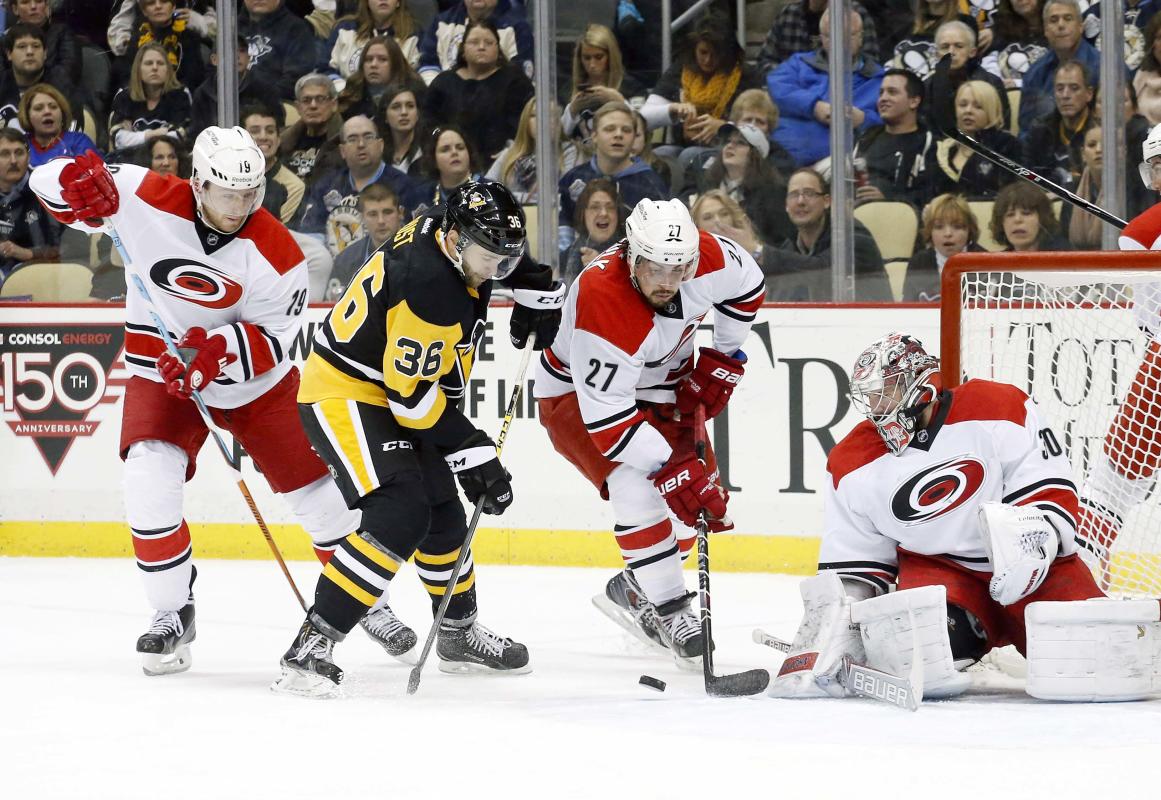
Dec 31, 2014; Pittsburgh, PA, USA; Pittsburgh Penguins right wing Bryan Rust (36) shoots the puck as Carolina Hurricanes left wing Jiri Tlusty (19) and defenseman Justin Faulk (27) and goalie Cam Ward (30) defend the net during the third period at the CONSOL Energy Center. The Penguins won 2-1. (Charles LeClaire-USA TODAY Sports)

PITTSBURGH (AP) -- Brandon Sutter picked the best time to score his first goal against his former team.

Three Stars

  1. Marc-Andre Fleury
    #29, Pittsburgh
    W:1
    GAA:1.01
    SV:24
    SV%:.960
  2. Brandon Sutter
    #16, Pittsburgh
    G:1
    Pts:1
    +/-:0
    PPP:0
    SOG:3
  3. Cam Ward
    #30, Carolina
    L:1
    GAA:2.03
    SV:37
    SV%:.949
Sutter scored the game-winning goal in the final two minutes to lead the struggling Pittsburgh Penguinsover the Carolina Hurricanes 2-1 on Wednesday.
Sutter, acquired from the Hurricanes in a 2012 trade that sent Jordan Staal to Carolina, scored his eighth of the year, while Beau Bennett, playing for the first time in 16 games, set up both Penguins' goals. Chris Kunitz also scored his 11th for the Penguins, who snapped a four-game losing streak and avoided dropping back-to-back home games for the first time this season.
''It's always fun playing against your old team, especially when you can beat them,'' Sutter said. ''It's a good way to end the year.''
Eric Staal scored his ninth of the year and his second goal in as many games. The Hurricanes, who lost for the 11th time in their last 13 games, managed just 16 goals during that span. Carolina, which suffered its 12th one-goal loss of the season, nearly won in Pittsburgh for the second time in a little more than a month despite having one of the worst road records in the league.
''We play hard, we play right, but we have to generate more,'' Staal said. ''We have to get more offense out of everybody, and it's obviously a broken record and beaten to death, but it is what it is.''
Marc-Andre Fleury, making a season-high eighth straight start, stopped 24 shots. Cam Ward made 37 saves for Carolina.
The Hurricanes pushed hard early in the third, trying to break a 1-1 tie.
Defenseman Justin Faulk hit the post during a power-play in the first two minutes of the period, and, moments later, Fleury denied Jay McClement with a sliding save during a two-on-one. He later stopped Elias Lindholm with a glove save on a partial breakaway during another Hurricanes' power play.
''We had three turnovers and those were the big saves that (Fleury) made,'' Penguins' coach Mike Johnston said. ''When we had a breakdown, which we had three big ones, (Fleury) was there for all of those.''
It also allowed Sutter to score the game-winner against his former team with 1:42 remaining. Bennett set up Sutter in the slot, who sent a wrist shot over Ward's shoulder on the blocker side.
''Those ones always feel good,'' said Sutter, who missed a couple games earlier this month while experiencing mumps symptoms. ''Fortunately, it went my way tonight.''
Not much has gone Pittsburgh's way lately.
The Penguins have experienced a depleted lineup the last several weeks while battling injury and a league-wide mumps outbreak, leading to their worst losing streak in three years. They had help on Wednesday after the return of Bennett and Craig Adams along with defenseman Christian Ehrhoff. Bennett, who has missed 90 of the Penguins' last 118 games, was out the past 16 with mumps and a lower body injury, but his impact was felt on Wednesday.
''He looked good for a guy that's missed quite a bit of time,'' Sutter said. ''First game back you're usually a little jittery, but once he got playing he looked like he belonged right where he was.''
Pittsburgh outshot Carolina, 17-7 in the second period, but couldn't get the go-ahead goal, missing out on a pair of power-play opportunities. Carolina's best chance to break the deadlock came in the final minute when Fleury denied Jiri Tlusty with a glove save from in front.
''We gave up a lot of breakaways and chances, but I thought (Fleury) held us in there,'' Sutter said.
NOTES: Pittsburgh won seven of the last nine against Carolina at home and 10 of 13 overall. . Hurricanes' D Michal Jordan left midway through the second period after dislocating his finger, but later returned. . Tlusty played in his 300th game with the Hurricanes. . Both teams play at home on Friday, Pittsburgh hosting Tampa Bay, while Carolina welcomes Philadelphia. . Carolina scratched Alexander Semin (upper body) and Tim Gleason, while Pittsburgh sat forwards Rob Klinkhammer and Steve Downie and D Scott Harrington.

Wednesday, December 31, 2014

Roberto Clemente: The day the game died


By  · December 8, 2014
Don McLean’s “American Pie” is a musical classic that tells the tale of the day music died when singer Buddy Holly was killed in a plane crash. For me, December 31, 1972 is the day baseball died because this is the day my favorite player, Roberto Clemente, died, also from a plane crash.
Roberto Clemente (Wikipedia)
Roberto Clemente
(Wikipedia)
Today, we are all too frequently reminded of what is wrong in professional athletics. Stories abound of player wrong doings and arrests making it difficult to look up to athletes as role models. As a kid growing up in the 60’s and 70’s, this was not the case and I came to admire Roberto Clemente, the right fielder for the Pittsburgh Pirates.
As I think back, I am not exactly sure why I liked him more than the other greats of the game at the time. I grew up outside of San Francisco, but was never a big fan of Willie Mays or others on the Giants. I suppose I liked Clemente because of his somewhat awkward style of play, not unlike the way I played ball as a kid. He always ran hard, but never gracefully. He swung at pitches outside the strike zone and could hit to all fields rather than wait for the perfect pitch. He played the less glamorous position of right field while possessing a howitzer for an arm. And he quietly went about his business while earning one MVP award, 15 All Star Game appearances, four batting titles, and 12 Gold Gloves for fielding excellence. He was a complete player who played every game like it might be his last and in his final at bat, he hit his three thousandth hit.
In December of 1972, Nicaragua was devastated by an earthquake just three weeks after Roberto had visited the country. After the quake, he led the effort to collect much needed aid for the victims only to become frustrated when the first three plane loads were stolen by rebels. Clemente decided to escort the fourth plane hoping he could convince rebels to allow the aid to reach victims. He never made it. The plane crashed into the Atlantic Ocean shortly after take off and Roberto’s body was never found.
I was watching the Rose Bowl game the following day when just before half time, one of the announcers told viewers of Roberto’s death. When I then read about it at the bottom of the television screen, it conformed what I did not want to believe at first. I quietly got up and walked back to my bedroom and began to cry. I didn’t know what else to do.
Following his death, I found it difficult to really admire athletes and have a favorite. I still loved sports but I did not place players on a pedestal like I used to, even though I would not graduate from high school until 1977. By the early 1980’s, I pretty much quit following baseball. Players had gone on strike and I now thought they cared more about their bank account than anything else. A few years later, drug problems would begin to dominate sports and I now see professional sports as nothing more than entertainment that seems to thrive in a constant state of controversy.
Jason Brown (YouTube)
Jason Brown
(YouTube)
It’s too bad because there are still good guys out there in athletics who do not get the attention they deserve. Nowadays, athletes are more apt to write a check to a cause and then show up for a well choreographed photo op than to actually give back to the less fortunate.
Someone worthy of praise today is Jason Brown, the 29-year old former center for the St. Louis Rams. While his former teammates have grabbed headlines for their Michael Brown Jr. “Hand Up, Don’t Shoot” pose, Jason decided to retire even though he was leaving $12.5 million dollars in money if he played through the remainder of his contract. He did so in order to become a farmer who grows food with the sole intent to donate his crops to food pantries for the homeless. Even though he still had another five to seven years of playing days ahead of him, and probably another $50 million dollars in earnings, Jason made a choice that deserves far more attention than what we give to screw ups like Adrian Peterson or Ray Rice.
This New Year’s Eve will mark 42 years since the tragic death of Roberto Clemente. If he were still alive, he would not be one of those former athletes living off the memory of what he accomplished on the field of play. Instead, he would judge himself by what he accomplished off it. He would also be proud of Jason Brown, and others like him. We should all honor the memory of Roberto Clemente by going out of our way to recognize the work of the Jason Browns of professional sports. Doing so will go a long ways to make being a fan of athletes worth it again.
- See more at: http://lapostexaminer.com/roberto-clemente-day-game-died/2014/12/08#sthash.aQqL2gHZ.dpuf