Monday, November 13, 2017

For the Colts, it’s the same old, same old; mistakes, a blown lead and another loss

By Bob Kravitz
November 12, 2017
Indianapolis Colts quarterback Jacoby Brissett (7)
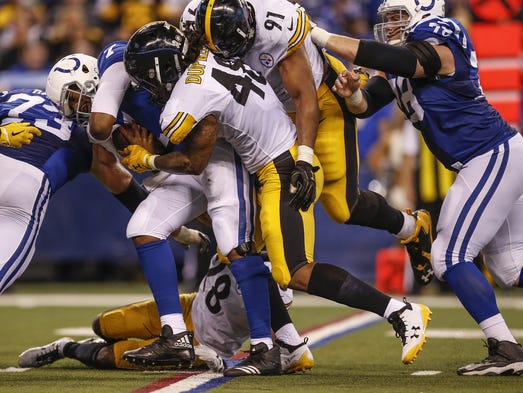
Jacoby Brissett is sacked by Bud Dupree and Stephon Tuitt in Sunday's game at Lucas Oil Stadium. (Mykal McEldowney/Indy Star)
INDIANAPOLIS (WTHR) - Let’s play Colts’ Mad Libs, shall we?
The Indianapolis Colts had a terrific chance to beat ___ Sunday at _____. In fact, they held a __-__ lead until there was ____ left in the fourth quarter. But then came the implosion. Then came the killing errors by ­­­­___ and ___, not to mention more game-altering mistakes by ___ and ___, all of which conspired to leave the 3-7 Indianapolis Colts as ___-___ losers to the _____. Indy played well enough to win, but just poorly enough to lose, just as they have in four other games when they’ve enjoyed a second-half leads. All of this has left the Colts utterly ____. “We can’t beat ourselves,’’ ___ said. “But they’re all correctible errors, so we’ll go back, look at the tape and ___.’’
How many times have I written this column this season? How many times have you read this column this season? As strangely compelling as the Colts are off the field – T.Y., Vontae Davis, Andrew Luck in Europe -- they’re painfully dull and predictable on Sundays. And Mondays. And Thursdays.
Even on a day when the Pittsburgh Steelers looked utterly disinterested, like they were going through the motions on their way to a 17-3 deficit, the Colts could not find a way to win a football game. Even with a couple of breaks – the Frank Gore non-fumble, the missed field goal, a blocked PAT and a rare quiet game from Pittsburgh’s offensive players, Le’Veon Bell and Antonio Brown -- the Colts could not get out of their own way long enough to avoid their usual fate.
Here’s what makes this game so challenging for a columnist, besides the fact I’ve written the same basic piece five times now this season: They really played pretty well. I mean, they played well enough to beat a Pittsburgh team who came in here with a 6-2 record and three straight victories. They slowed down Bell (3.1 yards per carry). They put the clamps on Brown (three receptions on seven targets). Defensively, they did almost everything they needed to do, a huge upset given the fact that Ben Roethlisberger has owned the Colts (13 touchdowns, no interceptions, no sacks) the last three times these teams have met.
For heaven’s sake, in the first quarter, the Colts (Pierre Desir, in particular) intercepted Roethlisberger and Hassan Ridgeway sacked him, two things they haven’t done in years. And in the process, they ran out to a 17-3 early-third-quarter lead. They were running it with Frank Gore. They were getting touchdown catches from Donte Moncrief and Chester Rogers. They were as good as they’ve been all season, punching a good team in the mouth.
When they lose by a thousand, it’s easy to get out the journalistic machete and hack away with impunity. But they played well. They played passionately. They played physically.
And they still lost,

If you want to know what kinds of silly mistakes turn a victory into a loss, I give you the immortal T.J. Green, who really should know better by now – but, for some inexplicable reason, does not and probably never will. The Colts had the Steelers backed up at the 1-yard line after Rigoberto Sanchez’ odd-looking, line drive kick was downed in the shadow of the goal line. One play later, Bell ran up the middle and was tackled, only to have Green, a master of the mindless personal foul, dive into the pile like David Boudia off the 10-meter board well after the whistle. Next thing the Steelers knew, they had the ball at the 21.
Now granted, they eventually punted, so no harm, no foul, right?
Wrong.

On the punt, Green was flagged once again, and the Colts were moved back to the 8-yard line. What’s that – about 90 yards of field position? And again, the Colts were not directly hurt by those mistakes, but now the field had been flipped, and after another exchange of punts, the Colts were forced to start another drive at their own 11-yard line. That’s when Jacoby Brissett threw a check-down to Jack Doyle, only to have the ball ricochet off his hands and into the mitts of Pittsburgh linebacker Ryan Shazier.
Three plays later, Pittsburgh scored a touchdown to pull within 17-9 with 11:52 left in the game.
“We got them at the 1-yard line,’’ Pagano said. “You can’t do it. It kills you. Next thing you know, they’re at the (21-) yard line. You’ve got an opportunity there in a tight game field position wise. You’ve got to keep your head and you’ve got to keep your cool…’’
Even the good things the Colts did turned bad. Margus Hunt, a very tall man, blocked the PAT attempt, which was picked up by safety Matthias Farley. Down the field he ran, the end zone and two points beckoning, but at the last second, he cut inside and was chopped down by the Pittsburgh holder at the 3-yard line.
Somewhere, Nick Harper was cringing.
“Dumb, just dumb,’’ Farley said later. “I didn’t know anybody was closing in, and then I shouldn’t have cut it inside.’’
Still, the Colts had a shot to pull off the upset. After Chris Boswell missed a field-goal try from 37 yards, the Colts took possession with 6:17 to go in a tie game, and actually – miracle of miracles – managed their only first down of the fourth quarter (and just four the entire second half and just 19 net yards after the Rogers touchdown). But then, on a second-and-5 at the 42, guard Kyle Kalis, who committed three penalties Sunday, got popped for holding. The drive expectedly stalled, setting up Pittsburgh for the game-winning drive.
You knew it was going to happen, didn’t you? Seriously, if you didn’t, you haven’t been watching this team all season.
Meanwhile, poor Brissett was getting thrown around like a rag doll, taking hit after hit as Pittsburgh ratcheted up the pressure. He appeared to hurt his right arm, or – gasp! – shoulder. He limped off another time with a leg injury. Then he took a shot to the back of the head from Pittsburgh’s Stephon Tuitt, which sent him to the medical tent for tests.
Actually, he was there twice. First, he was checked and cleared by team trainers, then moved the bench, then returned to the medical tent, where he was cleared by an independent neurologist. Brissett finished the game, but afterwards, the team announced Brissett would not be meeting with the media because he was symptomatic once again and had been put into the concussion protocol.
There will certainly be questions as to why and how Brissett was cleared to return, only to suffer from symptoms later, but this wasn’t even close to the Russell Wilson situation. In the Seattle game, referee Walt Anderson sent Wilson off the field due to concerns about a hit to the head, at which point, Wilson momentarily ducked into the medical tent, then returned to the field seconds later. Brissett was in the tent long enough to be properly assessed.
I lack the medical credentials to determine whether Brissett was wrongly re-inserted into the game. If the NFL is so inclined, the league has the prerogative to investigate.
All we know is what we’ve known nearly from the beginning of this doomed season: The Colts don’t know how to win, even when they play well, as they did against Cincinnati and then Sunday against the Steelers. We’re at the fill-in-the-blank portion of the season. At least it will be two full weeks before we have to write the exact same column again. For that, we are all eternally grateful.
Want more Kravitz? Subscribe to The Bob Kravitz Podcast oniTunesGoogle PlayStitcher or TuneIn. If you have a good story idea that's worth writing, feel free to send it to bkravitz@wthr.com.


    Ugly win over Indy could be turning point for Steelers

    By Mark Madden
    November 12, 2017
    Martavis Bryant catches a 2-point conversion to tie the score at 17-17 in Sunday's 20-17 win in Indianapolis. (http://www.steelers.com/photos/)
    A win is a win is a win, even if the Steelers’ 20-17 victory at Indianapolis was mostly notable for how awful the Steelers were before regrouping. The only time they led was when the clock hit three zeroes.
    But perhaps the game provided an odd, yet positive, turning point of sorts.
    Prior to Sunday, the Steelers were 7-14 in the last 21 games they were a road favorite. Adding to that ignominy would have been a huge mental blow and a PR disaster. It would have also fueled the idea that Mike Tomlin is transitioning from elite coach to BS artist, a notion that is not without merit.
    The second half also saw quarterback Ben Roethlisberger finally play like the Steelers need him to. Not a moment too soon, either.
    In the first half, Roethlisberger was seven-of-15 for 72 yards. He threw one interception and zero touchdowns. That performance was not a hit on Twitter.
    The Steelers posted just 100 yards of total offense in the first half. This against an Indianapolis defense that ranked worst in points per game and second-worst in yards per game before yesterday, and which doesn’t have a single starter remaining from the Colts’ opening game in 2016.
    But if Roethlisberger was a primary reason the Steelers found themselves in a hole, he showed up with the biggest shovel when it came time to dig out.
    In the second half, Roethlisberger was 12-for-16 for 164 yards and two touchdowns. He hiked his QB rating from 33.2 at the half to 93.9 for the game. Roethlisberger made throws in traffic. His touch and accuracy resurfaced.
    The Steelers are 7-2 and on course to earn home field for the playoffs’ AFC bracket, which is sorely needed.
    But for the Steelers to have a realistic shot at the Super Bowl — which likely means eliminating New England — Roethlisberger must keep playing like that.
    The late pyrotechnics aside, it wasn’t a banner day for the Steelers’ offense.
    It was supposed to score 30 points every game. It has yet to do so even once.
    Running back Le’Veon Bell has had games of 134, 144 and 179 yards but also games of 32, 47 and 61 yards. Bell was flat mediocre Sunday: He gained 80 yards on 26 carries, barely averaging three yards per.
    Bell is likely still shaking off the last effects of missing training camp. But he also seems to lack his usual burst, or is a half-step late delivering that burst.
    The Steelers dodged a veritable hail of bullets.
    Too many penalties: Nine for 70 yards. Lousy third-down efficiency: Three-for-11 until going two-for-two on the game-ending drive that produced Chris Boswell’s game-winning 33-yard field goal. Chaos reared its head: The Steelers took a time out before their game-tying two-point conversion in the fourth quarter, but still incurred a delay-of-game penalty before the attempt. Offensive coordinator Todd Haley was visibly raging on the sideline.
    It was quite the circuitous route to victory.
    It wasn’t without cost, either: Cornerback Joe Haden, the secondary’s glue, broke his leg. Safety Mike Mitchell, the secondary’s hammer, was carted off.
    A win is a win is a win.
    But the poor first half can’t be overlooked, especially from a preparation standpoint. The Steelers came out woefully unready and apparently unmotivated following a bye week.
    Focus and discipline win championships. It’s difficult to scramble your way to a Super Bowl like the Steelers scrambled to a narrow triumph at Indianapolis.
    Even at 7-2, the Steelers need to show a lot more. New England looms, first on Dec. 17 and almost certainly again in the playoffs.
    Mark Madden hosts a radio show 3-6 p.m. weekdays on WXDX-FM (105.9).

    Friday, November 10, 2017

    Rutherford not done tweaking Pens’ lineup


    By Mark Madden
    http://www.timesonline.com/sports
    November 9, 2017

    Pittsburgh Penguins v Edmonton Oilers
    Kris Russell #4 of the Edmonton Oilers defends against Riley Sheahan #15 of the Pittsburgh Penguins at Rogers Place on November 1, 2017 in Edmonton, Canada (Codie McLachlan/Getty Images North America) 


    Penguins GM shouldn’t hesitate to trade some future for a better shot at winning now
    Riley Sheahan, then with Detroit, didn’t score in his first 79 games last season.
    That’s bad for a center getting a regular shift and a bit of power-play time.
    Sheahan has not scored in his first 16 games this season, either: Eight games with the Red Wings and eight since being traded to the Penguins Oct. 21.
    I see a trend, and it’s an alarming one.
    Also disturbing: Sheahan has just one assist this season. He personifies the Penguins’ secondary scoring dilemma.
    Sheahan might start scoring. He netted 14 times in 2015-16.
    He might start dishing out apples. If not, linemates Carl Hagelin and Bryan Rust might want to get used to having just one goal each.
    Mostly, Sheahan is playing OK. He competes hard all over the rink. He’s averaging 15 minutes of ice time. He’s part of a penalty-killing unit that ranks 14th in the NHL (up from 20th last season). He wins 54 percent of his draws.
    Combine that description with Sheahan’s meager numbers, and you’ve got a decent fourth-line center. (But not near as good as Matt Cullen.)
    That’s what Sheahan will ultimately be: The Penguins’ fourth-line center.
    It didn’t feel like GM Jim Rutherford was done reconstructing his team’s bottom six when he acquired Sheahan, and it still doesn’t.
    The Penguins’ roster will look much different after the Feb. 26 trade deadline. Moves will be made, perhaps more major than expected.
    The Penguins will get a third-line center of some repute and expense, moving Sheahan to the fourth-line and Greg McKegg to the list of healthy scratches (or to Wilkes-Barre/Scranton).
    This likely won’t happen until just before the deadline, though Rutherford would act if the right deal avails itself prior.
    The intent will be to acquire a center good enough to skate with Phil Kessel, thus putting Kessel, Sidney Crosby and Evgeni Malkin on separate lines.

    The Penguins have won two straight Stanley Cups, but it’s a safe bet that Rutherford and Coach Mike Sullivan prefer the 2016 incarnation because of scoring balance made possible by the Hagelin-Nick Bonino-Kessel (third) line.
    That balance isn’t there now. Forwards currently skating in the Penguins’ bottom six have totaled just five goals in 17 games.
    It’s too early to speculate about who Rutherford might want, but Toronto’s Tyler Bozak is an ideal fit.
    He’d be a rental. He has a $4.2 million cap hit. Bozak and Kessel were linemates (and roommates) in Toronto. Toronto has depth at center. Getting Bozak would undoubtedly please Kessel.
    But Toronto is a playoff-caliber team. To part with Bozak, the Maple Leafs would likely want defense, where the Penguins have quality but lack depth. The Leafs certainly won’t just dump Bozak to save a few paychecks.
    The trade deadline is a long way off. But that’s what the Penguins want, balanced scoring with their top three threats distributed among three lines.
    Kessel and Sheahan are not a good fit. When a center scores in just one of his last 101 games, wingers won’t be lining up to skate with him.
    Besides bottom-six help, the Penguins need a defenseman.
    When their best six are healthy, things are fine. But Matt Hunwick has missed the last 11 games with a concussion. Justin Schultz (also concussed) just returned from a six-game spell on the sideline.
    The Penguins’ defense wasn’t in shambles when Hunwick and Schultz were absent at the same time.
    But less is more with Chad Ruhwedel, and Frank Corrado and Zach Trotman played like the marginal talents they are.
    Ruhwedel shooting right-handed fills a need. But the Penguins need a more solid No. 8 defenseman.
    Where’s Derrick Pouliot when you need him? Just kidding.
    Rutherford shouldn’t hesitate to trade some future for a better shot at winning now. How often do teams get a chance to hoist the Stanley Cup for a third straight time?
    Mark Madden hosts a radio show 3-6 p.m. weekdays on WXDX.com (105.9).

    Tuesday, November 07, 2017

    Penguins’ best option is to play through struggles


    By Mark Madden
    http://www.timesonline.com/sports
    November 6, 2017
    Brock Boeser #6 of the Vancouver Canucks scores his first goal against Matthew Murray #30 of the Pittsburgh Penguins during their NHL game at Rogers Arena November 4, 2017 in Vancouver, British Columbia, Canada. Vancouver won 4-2. (Photo by Jeff Vinnick/NHLI via Getty Images)

    While the team’s play leaves something to be desired, things are far from desperate.
    If you’re truly upset about the Penguins’ start, you just like to be mad.
    That’s not ignoring what’s wrong with the Penguins. Their problems are great, and they are many (lack of five-on-five production being the worst).
    But what solutions do you suggest? What options are available?
    Consider defenseman Kris Letang. He’s minus-16 and was minus-3 in Saturday’s 4-2 loss at Vancouver.
    Letang has had a few rough games. Despite missing last year’s playoff run after surgery to repair a herniated disc, Letang doesn’t appear to be physically lacking. He’s just playing bad and trying too hard.
    GM Jim Rutherford won’t trade Letang. Even if Rutherford tried, Letang’s market value would be low because of his play, health issues and $7.25 million salary.
    Coach Mike Sullivan won’t scratch Letang or decrease his ice time. Matt Hunwick and Justin Schultz look set to return from concussions. But even if Hunwick and Schultz play, who replaces Letang? Frank Corrado? Not much upside.
    Letang has pedigree, bountiful physical attributes and a dazzling skill set. He’s accomplished a lot. When he plays to his talent level, Letang is one of hockey’s top five defensemen. He’s only 30. He’s hardly washed up.
    The best solution is to let Letang play through his bad patch. Have faith.
    The same applies to Sidney Crosby at minus-11. To Bryan Rust, with one goal in 16 games despite a top-six role. To Jake Guentzel, who looks in a funk.
    The same applies to the entire team. Have faith. Just go play hockey.
    That might not placate younger fans who don’t remember the Penguins losing, or the bandwagon jerks. It certainly doesn’t satisfy the mob mentality.
    But it’s the logical option. It’s really the only option.
    But selected Twitter simpletons, talk-show callers and low-rent bloggers would blow up a team that’s won the last two Stanley Cups based on playing lousy for 16 games.
    Results-wise, those 16 games haven’t even been that terrible. The Penguins are 8-6-2 and, before last night’s NHL action, were just one point out of first place in the Metropolitan Division and had the fourth-most points in the Eastern Conference despite a difficult schedule to date.
    The Penguins have had bad stretches before. Bad seasons, too. Some entire decades were mostly putrid.
    But the Penguins have Crosby, Evgeni Malkin, Letang, Matthew Murray, Phil Kessel and 13 other players from last year’s champs. Despite a mediocre record, being optimistic doesn’t require being a hopeless romantic.
    Kessel, by the way, is the exception to the Penguins’ lackluster start.
    Kessel’s play will always have its quirks, but he leads the team in points, assists, shots and power-play points. The man-advantage unit has carried the Penguins by converting 28.8 percent of its chances, and Kessel has excelled on the left half-wall. He also has two overtime goals.
    The biggest question is finding more offense five-on-five.
    The answer is not Daniel Sprong.
    Sprong, a second-round pick in 2015, is off to a torrid beginning in his first full season of pro hockey. The Dutch right winger has eight goals in 10 games with the Penguins’ Wilkes-Barre/Scranton farm team.
    Fans see that and want Sprong, 20, called up.
    ut production at the minor-league level doesn’t necessarily translate to success in the NHL. It’s not a fantasy league.
    By all accounts, Sprong’s defensive acumen is improving. But the organization doesn’t feel he’s ready for the NHL. While the Penguins’ play leaves something to be desired, things are far from desperate.
    Sprong’s style is also similar to Kessel’s. In today’s era of grinding and shot-blocking, do the Penguins need two of that ilk? When Sprong arrives in Pittsburgh with any degree of permanence, Kessel may be on his way out.
    Mark Madden hosts a radio show 3-6 p.m. weekdays on WXDX-FM (105.9).

    Sunday, November 05, 2017

    Steady David DeCastro 'spoils' Steelers, continues to get better


    By Joe Rutter
    November 4, 2017

    The most grounded member of the Steelers offensive line loves to travel.
    David DeCastro, whose family roots are centered in South Africa, has made several trips to his parents' homeland, and he took his wife on a safari there three years ago.
    Earlier this year, it was a trip to New Zealand and Australia for David and Bonnie DeCastro, one final excursion before the birth of their daughter, Brooke, in October.
    As much as DeCastro likes to spend his offseasons traveling the world, he can be found in the same spot every Sunday during the fall and winter: anchoring the right guard position for the Steelers.
    When the 6-foot-5, 315-pound veteran suited up Sunday against the Detroit Lions, DeCastro made his 64th consecutive NFL start, the equivalent of four seasons. Among active players at the position, DeCastro owns the second-longest streak of consecutive games played.
    It's not just the number of games that is noteworthy. It's the snaps. Since his streak started in Week 10 of the 2013 season, DeCastro has missed just two. Heading into the Steelers' game next Sunday in Indianapolis, DeCastro has played 4,345 of a possible 4,347 offensive snaps.
    DeCastro also brings quality along with his quantity. Pro Football Focus recently ranked DeCastro as the best run-blocking guard in the NFL, and he's likely on his way to a third consecutive appearance on the Pro Bowl and All-Pro lists.
    “He's getting better every year,” offensive line coach Mike Munchak said. “He enjoys what he does. He enjoys the game, and he's very consistent in everything he does. There's nothing he can't do. He's good at everything.”
    Especially staying healthy. Among a team full of Steelers, DeCastro is an ironman.
    Only left tackle Alejandro Villanueva has anything resembling a modest run of consecutive starts among the other Steelers linemen. He has started 34 games in a row since moving into the lineup two years ago.
    Center Maurkice Pouncey has missed all of one season and virtually every snap of another. Right tackle Marcus Gilbert missed seven games over the previous three seasons and has sat out five more in 2017. Ramon Foster has started a full 16-game slate just twice in nine NFL seasons.
    “I love playing with Dave,” Foster said. “I know he's going to be consistent. I know I don't have to worry about him mentally or physically. I know he's going to do his job. I know he's not going to be late. He's going to be where you want him to be. You know he's going to block who you want him to block, and you know he's going to go a little bit extra.
    “That's what you expect from David DeCastro. That's one of the biggest compliments a guy can ever get: You don't have to worry about him.”
    It wasn't always that way for DeCastro. There was a time when, if the Steelers weren't worried about his dependability, he sure was. After starting all 39 game in three seasons at Stanford, DeCastro was selected by the Steelers with the No. 24 overall draft pick in 2012.
    In his third preseason game, DeCastro's right knee was bent while pass-blocking. It resulted in a dislocated knee cap and a torn medial collateral ligament. He didn't return until four games remained in his rookie season.
    “It was a tough start,” DeCastro said. “I had never been hurt before. I rarely missed a practice in college, never missed a game. You go out in the third game, and you blow out your knee. It was a whirlwind.”
    Another freak injury involving DeCastro occurred in the 2013 opener, although he wasn't the player hurt. DeCastro missed a cut block and collided with the Pouncey's right leg. The hit tore Pouncey's ACL and ended his season after just eight plays.
    “We started 0-4 that year, and Pouncey goes down with me falling into his leg,” DeCastro said. “I'm like, ‘Really, can we just not have this?' You work so hard in the offseason, and then that happens. It was some tough times.
    “You give credit to the coaches and players to help keep you up and moving forward. It has worked out well the last couple of years.”
    Has it ever. DeCastro was named to the Pro Bowl after the 2015 and '16 seasons, and he was selected first-team All-Pro in '15 and a second-teamer in '16. He also was rewarded before the 2016 season with a six-year contract that will keep him with the Steelers through 2021.
    “He gives me a sense of comfort,” Pouncey said. “I know he's going to do his job. I know he's going to help out, and I know he's going to make us look really, really good. I just appreciate everything he does.”
    Since accidentally ending Pouncey's season in the 2013 opener, DeCastro has missed just one game. That was midway through that season when he sat out a game at New England with an ankle injury.
    Those trying to find a secret to DeCastro's durability likely will come away without a sexy answer.
    “I attribute some of it to taking care of your body,” DeCastro said. “I never saw a chiropractor, and I never got a massage in college. That was stupid. You're young, and you think you can get away with anything. Nowadays, it's complete different. You get the massage, you see the chiropractors, you do the stuff necessary to take care of your body.
    “Like anything in life, when it's new, it's hard at first, but then you get a handle on it. I don't even think about what I do now. You just know what is expected. There's some luck involved to it, but for the most part it's about taking care of yourself.”
    DeCastro has started every game since Munchak arrived as offensive line coach in 2014.
    “The more he started doing things, the better he got,” Munchak said. “Whether it's running on screens, pulling on plays or trapping, whether it's pass blocking or just learning the game within the game, he's grown in every area.
    “He understands the game. He's here every day. He practices every day. He likes the routine. It's important to him. He's a true pro. You wish you had a bunch of him.”
    The Steelers do have another DeCastro of sorts in the making. When Villanueva signed with the Steelers before the 2014 season, he was converted from the defensive line. While spending that season on the practice squad, Villanueva gravitated toward DeCastro. With his Army background, Villanueva embraced DeCastro's cerebral, methodical nature.
    “I didn't know what the NFL was supposed to be like. I didn't know what an NFL player was supposed to look like,” Villanueva said. “I didn't know what the standard was. So when I walked into the offensive line room for the first time, I met the standard.”
    DeCastro's play on the line has helped the Steelers advance one round further in the postseason since 2014. He has earned recognition from his peers, and he has been rewarded financially by the Steelers.
    Most importantly to DeCastro, he has accomplished everything by showing up to work every day and doing his job. No exceptions.
    “As a coach, you kind of get spoiled having a player like him,” Munchak said. “In this league, it's hard to keep guys on the field. He's been the one steady guy who, since I've been here, has kept that going.”
    Joe Rutter is a Tribune-Review staff writer. Reach him at jrutter@tribweb.com or via Twitter@tribjoerutter.

    Saturday, November 04, 2017

    Pens still searching for best line combinations


    By Mark Madden
    November 2, 2017
    Phil Kessel #81 of the Pittsburg Penguins keeps his eye on the puck against the Calgary Flames at Scotiabank Saddledome on November 2, 2017 in Calgary, Alberta, Canada. (Photo by Gerry Thomas/NHLI via Getty Images)

    Forward lines used to have colorful nicknames.
    “The Production Line” – Gordie Howe, Ted Lindsay and Sid Abel, Detroit circa 1947-52; “The Punch Line” – Rocket Richard, Elmer Lach and Toe Blake, Montreal circa 1943-48; “The French Connection” – Gilbert Perreault, Richard Martin and Rene Robert, Buffalo circa 1972-79; “The Legion of Doom” – Eric Lindros, John LeClair and Mikael Renberg, Philadelphia circa 1995-97.
    But in today’s NHL, lines don’t stay together long enough to get a nickname.
    Some coaches use two-man combinations on a relatively steady basis, rotating the line’s third member. On most teams, that’s the extent of continuity.
    The Penguins haven’t even had that lately. The preferred two-man combos have been Sidney Crosby-Jake Guentzel and Evgeni Malkin-Phil Kessel.
    But even those have been torn asunder as coach Mike Sullivan tries to finagle his team into playing as well as its record, and preferably better.
    It’s not hard to realize what Sullivan is endeavoring.
    Sullivan likes to equally divide up whatever physical presence the Penguins have among the lines.
    The departure of Chris Kunitz to Tampa Bay via free agency is a significant loss in that department. But Patric Hornqvist goes here, Tom Kuhnhackl goes there, Ryan Reaves goes somewhere else.
    Kuhnhackl certainly figured it out. He had eight hits while skating on Malkin’s left wing Wednesday at Edmonton.
    Sullivan also uses certain players to trigger linemates to adjust their play.
    Crosby doesn’t like playing with Hornqvist. Nothing personal. Crosby just prefers faster wings.
    But when Hornqvist is on Crosby’s line, Crosby’s game turns simpler and he plays down low more.
    When Malkin skates with Kessel, each defers to the other too much. But when each perceives himself as his line’s best player, their shots go up.
    Or at least they should. Kessel played right wing on a line with Riley Sheahan and Guentzel Wednesday and didn’t get one shot on target.
    Kessel is a curious study. He has just four goals in 14 games after netting only 23 in 82 games last season. Kessel is hardly the sharpshooting, goal-scoring machine that GM Jim Rutherford had to figure the Penguins were getting when he acquired Kessel from Toronto on July 1, 2015.
    Kessel is instead a playmaker, and a good one.
    Before last night’s game at Calgary, Kessel led the Penguins with 11 assists, tying him for seventh in the NHL. His 15 points topped the Penguins and tied him for sixth in the league.
    Kessel had eight power-play assists, making him the de facto quarterback of the NHL’s No. 2 man-advantage unit (29.6 percent conversion rate). The power play flows through Kessel at the left half-wall.
    Those aren’t the statistics expected from Kessel. But his contributions are big.
    Kessel does lead the Penguins with 56 shots on goal. So he’s not missing that part of his game.
    No Penguin is exactly torching the stat sheet. Malkin ranked 14th among NHL scorers before Thursday night’s games, Crosby 32nd.
    But if any forward is in a bit of a funk, it’s Guentzel.
    After scoring 50 goals over the entirety of his rookie pro campaign last season, Guentzel had three goals and four assists in his first 14 games.
    Before facing Calgary, Guentzel had one goal and one assist in his previous nine games. Guentzel had zero shots and three minor penalties at Edmonton.
    No need to panic. Guentzel, 23, may well be worn down by the rigors of having played 98 games in 2016-17. When he gets a second wind and is reunited on a line with Crosby – which will inevitably happen – Guentzel will be fine.
    Conor Sheary, meanwhile, is tied for the team lead in goals with six.
    The Penguins’ glut of skilled forwards – with Daniel Sprong and Zach Aston-Reese lurking at the team’s minor-league affiliate in Wilkes-Barre/Scranton – has Sheary the subject of trade speculation.
    But Sheary can score. He had 23 goals in 61 games last season. He’s a comfortable fit with Crosby. That latter fact may keep Sheary around.
    Mark Madden hosts a radio show 3-6 p.m. weekdays on WXDX-FM (105.9).

    Friday, November 03, 2017

    Steelers rookie T.J. Watt's career off to bright start

    By Joe Rutter
    November 2, 2017

    T.J. Watt
    The measuring stick for T.J. Watt stands an inch taller and is about 40 pounds heavier, but it might as well have the dimensions of the U.S. Steel Tower.
    When you're the younger brother of three-time defensive player of the year J.J. Watt and play on the same side of the ball, expectations are on a grander scale than for most NFL rookies. Living up to them can be more taxing than the IRS code.
    “He feels like he can't do anything right,” Steelers outside linebacker coach Joey Porter said about his first-year pupil. “I try to tell him you're playing good, don't worry about it.”
    No worries necessary.
    Halfway through his rookie season, T.J. Watt is entrenched as a starter at right outside linebacker for the Steelers. He is tied for second on the team in sacks and ranks second among all NFL rookies in that category. He has also shown an ability to stop the run and drop into pass coverage, requirements of an outside linebacker in the Steelers' 3-4 scheme.
    It's a promising start to an NFL career to be sure, but perhaps not when you grew up in the shadow of big brother J.J., the 6-foot-5, 290-pound wrecking ball for the Houston Texans who is out for the season with a leg injury.
    T.J also came through the Pewaukee (Wisc.) High School pipeline after yet another brother, Derek, a fullback with the Los Angeles Chargers.
    “From his background and where the family comes from, I'm pretty sure he's getting criticism from home,” Porter said, “so he's always going to do a little more.”
    His older brothers may be in his ear, but T.J. said that is not what is driving him to excel in his rookie season.
    “I'm my biggest critic,” he said. “If I'm not, then something is wrong. I always want to play better.”
    Watt's four sacks are the most among Steelers outside linebackers and trail team leader Cam Heyward by one. Only Heyward has more quarterback pressures. Watt's 28 tackles are sixth on the team, and he has one of the Steelers' five interceptions.
    “He's done good,” said left outside linebacker Bud Dupree, who has three sacks. “Everyone wants to do better. With circumstances and the way the defense is designed, he's doing everything we've asked him to do.”
    Like most rookies, Watt has experienced some pains — growing and injury-related. After opening the season with two sacks against Cleveland, Watt had just one over his next four starts. He also missed the third game of the season with a groin injury that continues to be bothersome.
    “I tell him the plays are going to come. Some days it just happens like that,” Porter said. “As far as his progression, he's on track to play good football and he's been playing good football.”
    Watt plans to take it easy during the Steelers' bye. He will spend the off week resting.
    “I've been going pretty much since rookie minicamp and (even before) when I was training for the combine and the draft,” Watt said. “It's good to get a week where I can get my body back and not have to focus on an opponent.”
    Watt has impressed Porter with the way he has played through his injury.
    “He's a tough guy,” Porter said. “If (injuries) are holding him back, he'd never use it as an excuse. That's what I love about him. He knows if he's going to be out there, he's going to be judged by how he's doing on the field.
    “If he was injured or did have a knick-knack, I won't use it because he won't use it. As long as he goes out there on the football field, it doesn't matter what you've got going on (with injuries). It doesn't count anyway. Nobody wants to hear about that once you take the field.”
    Watt has played perhaps more than anticipated. When the Steelers selected him with their first-round draft pick, they were filling the spot vacated when they let underachieving outside linebacker Jarvis Jones walk in free agency. With 39-year-old James Harrison under contract, the Steelers didn't need to rush Watt into the lineup.
    Yet Watt was anointed the starter midway through training camp, and he has started every game when healthy.
    “We drafted him to come and play,” Porter said. “It's not like he's not playing good football. He's done everything we've asked him to do.”
    And he has already done more than J.J. this season. J.J. Watt didn't have any sacks in five games prior to his season-ending leg fracture. T.J. Watt needs just two sacks to surpass his brother's total of 5 12 sacks from his rookie season with the Texans.
    “It's amazing to watch that guy grow,” Porter said about T.J. “There's still a lot left that he hasn't shown yet. I'm looking forward to the second half of the season to show everybody what he can do.”
    Joe Rutter is a Tribune-Review staff writer. Reach him at jrutter@tribweb.com or via Twitter@tribjoerutter.

    Wednesday, November 01, 2017

    Steelers’ decision to keep Martavis Bryant a smart one


    By Chris Mueller
    http://www.timesonline.com/sports
    October 31, 2017

    Image result for martavis bryant 2017 october
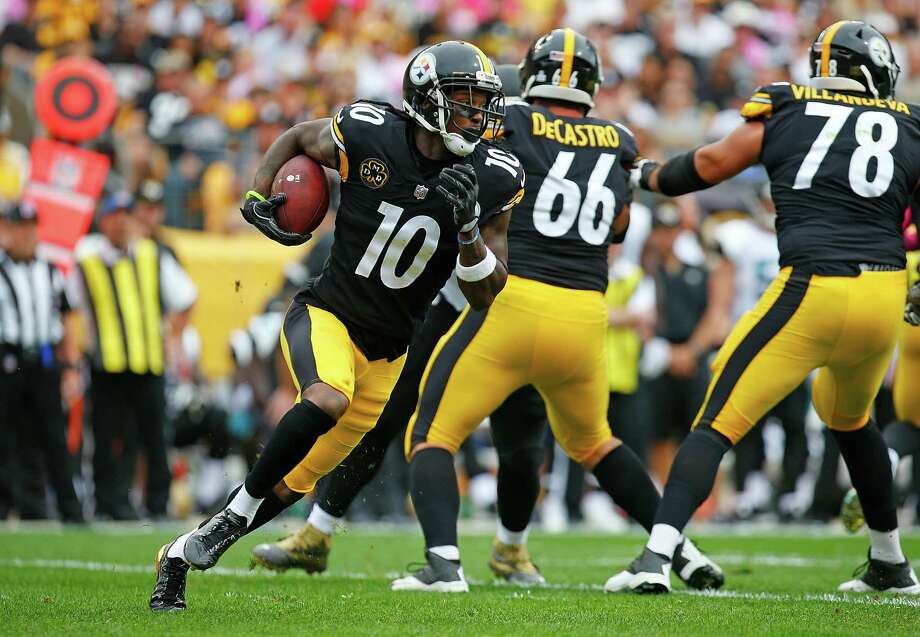
    Martavis Bryant #10 of the Pittsburgh Steelers runs upfield after a catch in the first quarter during the game against the Jacksonville Jaguars at Heinz Field on October 8, 2017 in Pittsburgh, Pennsylvania. (Photo by Justin K. Aller/Getty Images)

    Kelvin Benjamin was traded, but he’s no Bryant. Mike Tomlin, Kevin Colbert and company know what they have in their gifted receiver
    A third and a seventh rounder. That’s what it took for the Buffalo Bills to pry Kelvin Benjamin from the Carolina Panthers. Benjamin is no ordinary wide receiver, either. At 6′5 and 235 pounds, he’s a big, physical target. He has 18 touchdowns in two and a half seasons in the NFL. Kelvin Benjamin is a difference-maker.
    That said, he isn’t Martavis Bryant. Not close. Benjamin is a physical specimen, a man with first-round pedigree, but he has appeared in 40 games and has 18 touchdowns to his credit. Bryant, with an NFL career that has been sidetracked by a full season suspension and a tumultuous 2017, has 15 touchdowns in 28 games, only 12 of which have been starts. Those numbers don’t lie.
    Benjamin might have the pedigree, but Bryant is a different sort of talent altogether. Kelvin Benjamin commands attention from opposing defenses. Martavis Bryant commands fear and respect. That fear and that respect, the threat of what Martavis Bryant can do if not paid proper respect, is why the Steelers were so wise to keep him through Tuesday’s 4 p.m. trade deadline.
    Not that there weren’t interested parties, of course. The Bills inquired. So did the Patriots.
    Whenever New England expresses interest in acquiring a player, it is reason enough for those around the league to take notice. The Steelers, clearly, know what they have in Bryant, despite his public unhappiness and relative lack of production this season.
    Mike Tomlin and Kevin Colbert know what Bryant provides. They know the threat conveyed by his mere presence. If there is one thing defensive coordinators hate, it is being torched for big plays. It’s why so many teams still risk losses by playing the prevent defense when they have a late lead. No one likes getting beat deep. No one likes getting humiliated. Every time Martavis Bryant steps on the field, he represents the grave threat of embarrassment.
    You don’t just give up a guy like that because he’s unhappy. You don’t give up on a guy like that because the going gets bumpy for a little bit.
    The Kansas City Chiefs knew. Frequently, they assigned Marcus Peters, their best cover corner, to Bryant. They did this even though Antonio Brown was on the other side of the field. They did this even though Brown, not Bryant, is just about universally recognized as the best wide receiver on the planet. Brown delivers death by a thousand cuts. The destruction Brown wreaks, while all-encompassing in sum, is surgical, and at times gradual.
    Brown’s dominance, though it will someday land him in the Hall of Fame as one of the absolute best to play his position regardless of era, is the kind that can be admired one piece at a time. His big plays seem to spring forth from the void. They are as sudden and unexpected as they are amazing. Bryant, by comparison, looms every time he splits out wide. Everyone, from the team managers to the fan in the last row, knows who he is and what he represents.
    Teams know that while Brown is the best in the business, Bryant is just as devastating, if not more, when left unchecked, or in the hands of mere mortals. Even the best the other team has to offer often isn’t enough.
    Though his social media tantrums have been frustrating, though his agent seems incapable of providing good advice, Bryant is the kind of player that can turn wins into losses. He’s the kind of player that can keep even a venerable mind like Bill Belichick up at night. After all, how does one go about stopping someone that has no physical equal? Put Bryant one on one against every corner in the league, and if the ball is thrown properly, he wins 95 out of 100 times.
    Put simply, Martavis Bryant is the kind of player that makes the ultimate difference. His teammates have said he’s been a consummate professional behind the scenes, his missteps only coming in the public eye. They have praised his work ethic, his enthusiasm. That’s enough for me.
    The Steelers were right to keep Martavis Bryant. The guess here is that their gamble, if it even qualifies as one, will be handsomely rewarded — maybe even in early February.