Showing posts with label Pirates 2006. Show all posts

Sunday, January 14, 2007

Ron Cook: Sanchez Best Choice for Dapper Dan Award


Pirates' Sanchez is the best man in a strong field as the Dapper Dan Sportsman of the Year

Sunday, January 14, 2007

Pittsburgh Post-Gazette


You know it's been a pretty good year when you can't put a check next to Willie Parker's name or Sidney Crosby's name for the 2007 Dapper Dan Sportsman of the Year award. All Parker did for the Steelers was run 75 fabulous yards into Super Bowl history and follow it up with a team MVP season. Crosby hasn't won a Stanley Cup for the Penguins yet -- give him time, it's coming -- but, at 19, he's become the best player in the NHL and shown he has a chance to be -- sorry, Mario -- the greatest player in Pittsburgh hockey history, assuming that history lasts longer than June.

You know the competition for the Dapper Dan award is stiff when you can't bring yourself to vote for Pitt's Jamie Dixon or Penn State's Paul Posluszny. Pitt and Penn State people don't seem to agree on much, but they'd have to admit Dixon is a phenomenal basketball coach who has built Pitt into a national power, and Posluszny could play linebacker for any college team in America.

You know the Dapper Dan field is ridiculously strong when West Virginia's Rich Rodriguez and John Beilein should finish down in the voting. They're central figures in what maybe is the hottest college athletic program this side of Gainesville, Fla. Rodriguez as the football coach who delivered the Big East Conference's greatest victory in the 2006 Sugar Bowl and Beilein as the basketball coach who plugs in new players and keeps winning because of his estimable system.

Any one of those six sports figures would be a deserving winner of the prestigious Dapper Dan award in any other year.

But not this year.

You ultimately will help to decide the honoree with your votes, but it says here the award should go to the guy who overcame a club foot as a child, a serious ankle injury that cost him most of two years in the minor leagues, and the short-sightedness of his Pirates general manager and manager to win the 2006 National League batting title.

Freddy Sanchez.

The batting championship alone is enough to win Sanchez the Dapper Dan award. He put together six incredibly consistent months, hitting .333, .360, .380, .301, .355 and .320 on his way to a final average of .344, the highest by a Pirates player since Roberto Clemente hit .345 in 1969. He led the league with 53 doubles and was remarkable in the clutch as evidenced by his .386 average with runners in scoring position. He also was a versatile and steady fielder, making just 10 errors in his 92 starts at third base, 27 at shortstop and 18 at second base.

Sanchez's success was no surprise. He always seemed to hit well above .300 as a minor leaguer in the Boston Red Sox's system. He also has a long history of working toward his goals, no matter the adversity. Doctors wondered when he was young if he would walk normally because of that club foot. Baseball executives wondered if he would make it in the big leagues because of that ankle problem that required surgery and cost him most of 2003 and 2004.

Sanchez answered all of the doubters, including Pirates general manager Dave Littlefield and manager Jim Tracy.

Sanchez didn't figure in their plans as a starter going into last season even though he finished the 2005 season by hitting .306 after the All-Star break. Littlefield signed Joe Randa as a free agent to play third base, a decision he soon would regret. Tracy didn't turn to Sanchez as his starter at third until after Randa went on the disabled list with a foot injury in early May.

Less than 21/2 months later, Sanchez played in the All-Star game at PNC Park, having been swept in as a National League reserve on the groundswell of fans' write-in voting.

Perseverance should get Sanchez the Dapper Dan award.

But there's so much more to Sanchez's magical season.

The man did the impossible by keeping people interested in the woeful Pirates in the franchise's 14th consecutive losing season. More than 1.86 million fans went to PNC Park, at least in part, to see Sanchez. They loved his effort. They loved his humility; hits weren't important to him because of the batting title, he often said, they were important because they helped the team. Most of all, they loved his production.

Certainly, Sanchez was the reason a crowd of 25,004 came to PNC Park for the season's otherwise meaningless final game Oct. 1 against the Cincinnati Reds. Fans, waving their "Go Freddy!" placards, wanted to see if Sanchez could hold off Florida's Miguel Cabrera for the batting title. He did it in extraordinary style, getting singles in his first two at-bats to finish the year with an even 200 hits.

If you listen closely, you still might be able to hear the echoes of the "Fred-dy! Fred-dy!" chants.

It's nice to think we'll hear them again in three months at the David L. Lawrence Convention Center.

On the night of April 15, when they officially make Sanchez a Pittsburgh sports legend by giving him the Dapper Dan award.


--------------------------------------------------------------------------------

(Ron Cook can be reached at rcook@post-gazette.com or 412-263-1525. )

Sunday, December 03, 2006

Gene Collier- Here's the pitch: Pirates should sign Jeff Suppan

Landing him as a free agent would show ownership is interested in winning
Sunday, December 03, 2006
Pittsburgh Post-Gazette

Nothin' but blue skies for the Pirates ever since they stopped, you know, playing ballgames.

The offseason has been another predictable financial success with revenue-sharing payments coming due from capitalists on the other end of the baseball universe -- the Yankees and Red Sox -- and for a change, there was even some good news in free agency.

The gleeful agent for free agent pitcher Kip Wells announced last week that the former Bucco bust would not entertain a return to Pittsburgh, instead taking a $4 million, one-year deal from the St. Louis Cardinals.

Whew! That was close.

Wells won two games last year, cashing in at $2 million per win with the world champion Redbirds, who are clearly still drunk. Not only did Wells go 2-5 last year with an earned run average north of 6, he finished the year in Texas where he began it with the Pirates -- on the disabled list. He's 57-74 lifetime.

Yeah, sounds like $4 million.

Walk Jocketty, resident front office genius in St. Louis, recently called the free agent market "silly." Gee Walt, I can't imagine why. Meanwhile, Walt's apparently willing to let Jeff Suppan exit his own clubhouse after helping pitch the Cardinals into the World Series and on to their first championship in 24 years, earning -- whoops -- $4 million.

Shrewd.

Suppan, a far more successful former Pirate, won six times as many games as Wells and it's said can be had for $9 million a summer for the next three or four years. The Pirates are pretending to be interested, mostly because their serious fans are aware that Suppan is exactly what their callow left-handed pitching rotation needs, a 32-year-old hard-throwing right-hander. Kevin McClatchy's club can afford to pretend because there's plenty of cash laying around and because even he and the Nutting-ventured-Nutting-gained Nuttings know that there are enough other interested teams -- reportedly more than a dozen -- to ensure that the winning bid will be considerably higher and likely from a much more competitive club.

Why would Suppan, after all, pitch in Pittsburgh, where it'll be all he can do just to get the club from one bobblehead night to the next, when he can pitch somewhere where a pennant might be at stake?

As it happens though, Suppan is one of the better litmus tests of ownership interest to come along in years. If the Pirates were to somehow sign him, even as part of lifting their payroll out of the McClatchy flatlands, they could create the impression that they're actually interested in competing in this industry.

Which is, of course, why they won't.

The Pirates got $25 million last year from revenue sharing alone.

That particular windfall is expected to be greater this time, so it wouldn't surprise anyone if the Pirates got enough money to cover their payroll before they even sell a ticket, especially if they're planning on keeping payroll at something, to use general manager Dave Littlefield's term, "fiftyish." It was 47(million)ish last year.

The Pirates insist their Bud Selig-endorsed welfare checks are plowed into player development, which could explain why the money hasn't helped the product -- the Pirates are terrible at player development.

They'd be better advised to plunge into free agency on the reasonable chance of landing a player someone else has developed into a legitimate competitive force, perhaps like Jeff Suppan.

The actual retail price won't likely be known until the stratospherically salaried pitchers begin to get slotted, particularly Barry Zito, currently being held hostage by the game's uber agent, Scott Boras.

Jason Schmidt won't take a lot less than Zito, Greg Maddux won't take a lot less than Tom Glavine, if any. Roger Clemens is still out there waiting to be begged and handed some kind of one-year, eight-figure contract with a lot of 2s in it because his uniform number is 22.

I live for this?

(Gene Collier can be reached at gcollier@post-gazette.com or 412-263-1283. )

Monday, November 20, 2006

Bob Smizik: Pirates' fans find offseason depressing

Sunday, November 19, 2006
Pittsburgh Post-Gazette

There are bits and pieces of baseball in the newspaper every day, and almost all are nothing but downright discouraging and disheartening to the ever-shrinking band of black-and-gold bleeders who believe the Pirates' day will come.

The Chicago Cubs sign Aramis Ramirez to a five-year, $73 million contract. Wouldn't Rammy, who grew up in the Pirates' organization, look sweet hitting behind Jason Bay? But, of course, that's impossible. As recently as 2003, the Pirates couldn't afford the $6 million Ramirez was due the next season. Although the giveaway of Ramirez was the most spirit-crushing event of the McClatchy-Nutting ownership era, in retrospect, it only jump-started the inevitable. The Pirates cannot afford players the stature of Ramirez.

Those same Cubs, the only team in the National League with a worse record than the Pirates, sign backup catcher Henry Blanco to a two-year, $5.25 million contract. That's chump change for the Cubs, but a major expenditure for the Pirates.

The Central Division champion St. Louis Cardinals sign clearly declining outfielder Jim Edmonds to two-year $19 million contract, vastly more money than the Pirates couldn't afford to pay to keep Ramirez.

On the Pirates' Web site the other day, readers wanted to know about the chances of the club signing veteran pitchers Greg Maddux or Jeff Suppan. Ed Eagle of MLB.com let these bug-eyed optimists down easily, gently informing them there is not even a miniscule chance of the Pirates paying those kinds of salaries or those kinds of players wanting to play for the Pirates.

The Boston Red Sox pay $51.1 million, more than the Pirates' entire payroll, for the rights to negotiate with Japanese pitcher Daisuke Matsuzaka. No truth to the rumor the Pirates bid was $850,000.

We could go on and on, and it's enough to pose this question:

Which is the most depressing time of the baseball year in Pittsburgh: The season or the offseason?

Our vote is for the offseason. During the season, the Pirates won 41 percent of their games. That stinks, but at least it meant you almost had a 50-50 chance of them winning if you showed up at PNC Park or tuned them in. Beyond that, it was pleasant to see the development of players such as Freddy Sanchez, Mike Gonzalez, Zach Duke and Chris Duffy.

There are no such plusses in the offseason. Not only are we reminded daily by the news that the Pirates can't compete, when they do sign a player, invariably, it's the wrong signing which raises false hope and costs the team money that could better be spent elsewhere.

This column always has been of the belief there was a small window of opportunity some day for the Pirates. We don't believe that anymore.

One of the reasons is because of the message the ticket-buying public sent to the Pirates last season when 1.86 million purchased tickets to give the team its fifth-highest attendance in history. By their willingness to spend money to watch a 14th consecutive losing season and by showing up in astonishing numbers late in the season, these people told Pirates ownership exactly what it wants to hear:

We don't care how many games you win, just keep the fireworks and the bobbleheads coming.
Those are words Bob Nutting, the team's bottom-lined devoted chairman of the board, loves to hear. It's a message that tells the Pirates they don't have to increase their payroll significantly, just continue with those snazzy promotions.

What this means is there's not only no chance the Pirates will sign a high-profile free agent, but they are not likely to go after such a player in trade. Why should they? They sell tickets without the inconvenience of carrying high-salaried players.

General manager Dave Littlefield will be active in the trade market this offseason, but he's not likely to be dangling some of his best players: Bay, Duke, Sanchez, Gonzalez.

An historical note for Littlefield. What might be the three most important Pirates trades in the past 50 years involved the team trading one of its best players.

After the 1958 season, the Pirates traded right-handed slugger Frank Thomas, coming off a 35-home run, 109-RBI season, for Harvey Haddix, Don Hoak and Smoky Burgess. These three veterans helped turn a contender into a world champion two years later.

In November 1986, the Pirates traded Rick Rhoden, who had won 15 games, and in return got a package that included young Doug Drabek. The Pirates had a top-of-the-rotation ace and future Cy Young winner who would power their three division titles.

In April 1987, the Pirates traded Tony Pena, generally regarded as their best player, for three unproven players, Andy Van Slyke, Mike LaValliere and Mike Dunne. A weak club was on its way to becoming a division champion.

The point is this: You want to get quality players, you have to trade quality players. Jose Castillo and Paul Maholm will not fetch players who can significantly upgrade the Pirates. Jason Bay and Zach Duke, like Frank Thomas, Tony Pena and Rick Rhoden before them, can.

But it's not going to happen. There simply is no pressing need from within the organization for the Pirates to get better. It's all about fireworks and bobbleheads.

(Bob Smizik can be reached at bsmizik@post-gazette.com.)

Sunday, October 08, 2006

Bob Smizik: Pirates' McClatchy needs help

Sunday, October 08, 2006
Pittsburgh Post-Gazette

In a self-congratulatory news release last week, the Pirates applauded their attendance success during the past season when they sold 1,861,549 tickets, the fifth-highest total in team history. What the Pirates didn't announce was people bought all those tickets to see a team that had the franchise's fourth-worst record in the past 50 years. Think about that for a second. Considering the Pirates history, achieving the fourth-worst record in the past half-century is not easily done.
In view of such a season -- and despite some of the recent spin it was a hugely disappointing one -- you might think changes were afoot. Ha!
The Pirates don't work that way and that was never more obvious than with the other announcement made last week.

Kevin McClatchy, the man who sits in the chair where the buck is supposed to stop, was given not just an extension but what amounts to the title of CEO For Life. Only with the Pirates are people rewarded in such a grand fashion for leading the team to 11 consecutive losing seasons.
Chairman of the board Bob Nutting, the man who controls the club's financial decisions, didn't have the guts to make a public appearance to hail his latest decision. He sent a press release instead.

It said, in part: "We have great confidence in this group and are especially pleased to have Kevin as our Managing General Partner and CEO. He will continue in that position as long as he desires.''

Wonder how managers Gene Lamont, who led the Pirates to their two best seasons in the past 14 years, and Lloyd McClendon and general manager Cam Bonifay feel about that? All three were fired after significantly shorter losing tenures.

The difference: Those three honorable gentlemen were not partners and friends with the Nutting family.

A word about McClatchy. He is a frequent target of the media, including this column, and fans because he is the public face of the Pirates and has been since he bought the team in 1996. He is the one constant in all those losing years where there have been four managers and two general managers. The Nuttings, Bob and his father, G. Ogden, own the largest share of the team. They use McClatchy to stand between themselves and the public and to take all the criticism.

I like Kevin McClatchy and take no joy in frequently criticizing him, which is why I have attempted to point out recently that the Nuttings are the real owners of the Pirates and the people with whom the buck should stop. McClatchy is a great guy and a first-class gentleman. He wants to win as badly as anyone and if he had the money, he'd pour it into the team. He doesn't.

But to give him such an all-encompassing vote of confidence when he has overseen 11 consecutive losing seasons tells us all that is wrong with this franchise.

It's true, the team was successful off the field this year, but a large part of that is due to the fact Major League Baseball threw the Pirates a life preserver called the All-Star Game. Without the additional 2,500 season tickets that were sold almost totally because of the All-Star Game, attendance would have declined, as it should have. But Nutting looked right past that fact to take the easy way out and reward his pal.

Judging from discussions with people who work under McClatchy on the business side of the Pirates operation, he is held in high regard. He is considered a good boss who challenges his employees. But he's over his head on the baseball side, where the Nuttings allow him something close to total autonomy. Even after 11 years with the Pirates, he is not nearly steeped enough in the details of playing the game and winning at it to be the man in charge.

Where was McClatchy when general manager Dave Littlefield was throwing money -- about $17 million -- at free agents who almost any knowledgeable observer knew were not the answer?
The Pirates got nothing out of Sean Casey, Jeromy Burnitz and Joe Randa that they couldn't have received from players already on the team that would have cost considerably less.
The money could have been so much better spent on player development either within their own system or in Latin America or Asia. But it was showered on unworthy free agents by a baseball operations staff that clearly lacks the necessary evaluating skills.

Since McClatchy is CEO and managing general partner for the foreseeable future, he needs help on the baseball side. It's time for the Pirates to divide his duties. It's time to bring in someone over Littlefield who actually knows baseball.

The San Diego Padres, for example, have a first-class general manager in Kevin Towers. But that wasn't enough for San Diego ownership. Last year they hired Sandy Alderson as their CEO. Alderson had previously worked as the highly successful general manager of the Oakland A's. If Towers is threatened by Alderson, it hasn't shown. The Padres have made the playoffs the past two seasons.

Such a person would not come cheap, a real turnoff to the Nuttings. But if the Pirates want to end this 14 years of failure, they need bold new initiatives. If Littlefield is their man, and they claim he is, they need someone with more baseball savvy than McClatchy overseeing him.

(Bob Smizik can be reached at bsmizik@post-gazette.com. )

Wednesday, October 04, 2006

Analysis: Creativity, confidence keys for Pirates heading into 2007

Wednesday, October 04, 2006
By Dejan Kovacevic, Pittsburgh Post-Gazette

On the penultimate day of spring training, in the visitors' clubhouse at Fort Myers, Fla., shortstop Jack Wilson put forth the most accurate prediction of the year regarding the Pirates: "We are the last team that can afford to get off to a bad start."
How right he was. And for exactly the right reason.

Because, as the team would show by losing its first six games, the moment that happened, all the changes in the roster and staff, all the fuzzy feeling about the talented youngsters and everything else, disintegrated to a simple matter of the seven letters spread across the players' chests.

They were the Pirates again.

What can they do to avoid such a pitfall in 2007?

It starts with the organizational meetings later this month, continuing with key decisions to be made right through the day the team flies from Florida to Houston to open the season.

Offseason

There might be less debate than usual at those meetings, if only because, as the Pirates point out, there are fewer holes to fill at the major-league level. The breakout of Freddy Sanchez, the emergence of Ronny Paulino, the promise of Jose Bautista and the maturity of the pitching staff has seen to that.

That leaves two primary items on general manager Dave Littlefield's offseason shopping list: One is for a left-handed power bat to play first base or right field. The other is for a right-handed starter to complement Ian Snell and offset the three left-handers.
The first question, of course: How much is there to spend?

The Pirates finished 2006 with an active payroll -- the sum of full-year salaries on the 25-man roster -- of $33.2 million. (They actually paid out $45 million when counting prorated salaries for players who were traded.) Now, erase from that group Jeromy Burnitz, Joe Randa and Shawn Chacon, and another $13.6 million is subtracted.

With ownership keeping its payroll limit in the range of $45 million, and factoring in roughly $10 million in raises for existing players, there should be about $15 million in leftover cash.

That does not bring in two megastar free agents, especially not to Pittsburgh. And, in the cases of the top-shelf talent -- Alfonso Soriano, Carlos Lee, Jason Schmidt, Mike Mussina -- it probably does not bring one. Schmidt, for example, would be a wonderful fit if he returned, but he is coming off a season in which he made $10.5 million in San Francisco and could be the No. 1 target on the pitching market.

Moreover, some in upper management are wary of committing too many dollars to any one player because the Pirates were burned by paying Burnitz $6.7 million.

So who does that leave as a possibility?

The free-agent market for left-handed power bats at the Pirates' desired positions will be slim, perhaps limited to Houston's Aubrey Huff.

Huff, 29, made $7.5 million this past season while producing 21 home runs and 66 RBIs in 454 at-bats, the latter half spent with the Astros at hitter-friendly Minute Maid Park. But he also topped 20 home runs each of the previous four seasons with Tampa Bay.

The market for that right-handed starter is more expansive.

Among those fitting the stated criteria are Seattle's durable Gil Meche, 28. He had the best year of his career at 11-8 with a 4.48 ERA while making $3.7 million. Texas' Vicente Padilla, 29, is another. He went 15-10 with a 4.50 ERA and 156 strikeouts while making $4.4 million.

But the name that stands out is St. Louis' Jeff Suppan, 31. He pitched well in a half-season with the Pirates in 2003 and is cited frequently around the front office as the "type of guy" they would love to add. He went 12-7 with a 4.12 ERA while making $4 million.

If the Pirates choose the trade route, which they are likely to do for the bat, that raises another issue: What would they give up? The most obvious candidate to be on the block is enigmatic second baseman Jose Castillo, but he will not be a sufficient lure after a dismal second half.

The most attractive bait the Pirates can offer is pitching, but there will be strong resistance from some in the organization to part with starters. And there is logic to that: One starter gone means yet another must be replaced, and the team cannot yet count on Sean Burnett to take the spot of a left-hander who gets dealt.

That leaves the bullpen, the organization's deepest area. Relievers tend not to get dealt for power hitters, but some general managers value closers more than others, and the Pirates saw this past season that they have two potentially good ones in Mike Gonzalez and Salomon Torres.
That is, perhaps, a luxury they will decide they cannot afford.

Then again, what if Littlefield stepped off the beaten path? What if he abandoned the worn concept of filling holes at the major-league level and used his bait to bolster his prospects, as more successful low-spending teams have done?

Take, for example, Joe Koshansky in the Colorado system.

His is a strange story, in that he converted two years ago from pitcher to power-hitting first baseman. Still, he is 24 years old, left-handed, a hulk of a man at 6 feet 4, 225 pounds, and he sends the ball out of the park. In 132 games for Class AA Tulsa this past season, he hit 31 home runs in 500 at-bats, along with a .284 average and 109 RBIs.

On top of that, because the Rockies have Todd Helton signed through 2011, they have no place to play any first baseman for the foreseeable future.

Colorado covets pitching. The Pirates have no prospect close to Koshansky's profile. Why not place a call?

Spring training

Regardless of who comes in from the outside, internal decisions will remain when the Pirates reach Bradenton.

Most pitching positions are set, with one rotation spot open and two, maybe three in the bullpen.
Paulino is behind the plate, Wilson at short, Jason Bay in left, indications were strong Chris Duffy will be in center, and Xavier Nady will play whichever of first base or right field Littlefield does not fill.

This might be the main issue of the spring: Sanchez is a virtual lock to move to second base. That could send Bautista back to his natural position at third, although it is unlikely he showed enough in 2006 to sew that up. Or, Castillo could go there. Management made clear late this past season its feeling that Castillo's growing frame was not suited to second.

Other elements of intrigue should be in play, too.

The Pirates are sure to retain outfielder Jody Gerut, even though he missed all the past season because of knee surgery. He is left-handed and hit 22 home runs as a rookie for Cleveland in 2003. He might push Nady for starting duty or, at the least, push Nate McLouth off the bench.
What will become of the nomadic Ryan Doumit? He is sure to get chances because of his switch-hitting power potential, but will they be as a catcher or first base, where he spent September? The early line is that he will back up Paulino.

The bullpen? It will be Josh Sharpless, Jonah Bayliss and Marty McLeary, among others, looking for work from the right side. And, if management does not pick up Damaso Marte's $3 million option, Shane Youman and Juan Perez will be among those trying out from the left side.

Opening day

By the time Roy Oswalt throws that first pitch to Duffy, one other piece will have to be in place: The players will have to, somehow, over the span of several months, carry over the confidence that was on display for much of the second half of 2006.

Perhaps that confidence -- and inspiration -- will come from management by finally setting for the players a firm goal beyond the vague concept of general improvement: Would there really be any shame associated with shooting for 82 victories? Not only would that end the string of losing seasons a year short of Major League Baseball's record, but it also would represent a 15-game improvement.

We will ... win?

Then again, a slogan like that might just recreate Wilson's worst fear from this season.

"We can't go into next year worried about breaking the streak," he said last week. "We can't worry about our record, either. We can't come in with this whole we're-going-to-change-this-thing-around attitude. That's just pressure. We just need to worry about going out and playing the game the right way. That's what we did here in the second half, and we need to keep that going."

(Dejan Kovacevic can be reached at dkovacevic@post-gazette.com. )

Tuesday, October 03, 2006

Analysis: Lack of long view, innovation sunk Pirates from the start

Tuesday, October 03, 2006
By Dejan Kovacevic
Pittsburgh Post-Gazette

It was a psycho summer for these 2006 Pirates, one that ranged from historic lows to heady highs. From being the butt of Jay Leno jokes to beating some of the National League's finest. From the booing of 22-year-old Zach Duke at the home opener to the thunderous chants for Freddy Sanchez at the season finale.

More Coverage:
Lowlights, highlights of 2006
Players' report cards, salary status
Stats Geek: It's time Pirates get some direction

And, somehow, it all pivoted on a game in which they did not participate.

It had been known for years that Pittsburgh would play host to Major League Baseball's 77th All-Star Game, and the Pirates' brass made the appropriate fuss in the buildup. As a result, ticket sales increased. As did payroll. As did management's understated but undeniable desire to win immediately to avoid national embarrassment.

It all backfired.

Big-time.

The baseball world descended on the city at the lowest point imaginable, with the Pirates owning the worst record in the sport at 30-60 and the local citizenry as angry as it had been during any of these 14 consecutive losing seasons.

Then, just after that break, a remarkable transformation began.

The chins picked up, the starting pitching improved, the key hits finally came and the Pirates would go 37-35 the rest of the way for their first winning second half since 1992.

What happened?

A top-to-bottom breakdown of the 120th season for the Pittsburgh Baseball Club:

Ownership

The ball began rolling downhill Oct. 1, 2005, the day Kevin McClatchy and the ownership group bought newspaper ads to trumpet a 25 percent boost in payroll, to $47 million.

Most anywhere else, that would blossom into a positive. In Pittsburgh, it would bring more of the same.

Rather than insist on general manager Dave Littlefield increasing investment in the team's developmental departments -- precisely how low-revenue franchises succeed in baseball's imbalanced economics that the Pirates so often decry -- McClatchy issued a "challenge" to Littlefield to address needs at the major-league level.

The idea, as the team acknowledged, was to capitalize on the All-Star effect on attendance. Satisfied customers this year, the thinking went, would come back in 2007.

But, as so often happens with quick fixes in sports, the one-year rentals that were acquired -- Sean Casey, Jeromy Burnitz, Joe Randa and Roberto Hernandez -- contributed little, muddied the team's direction by their mere presence and were traded or benched by midseason.
Ownership also continued to feel heat for its failure to discuss finances.

The Pirates received a revenue-sharing check for $25 million from other teams which, when added to other national money, meant they could cover their payroll without selling a single ticket at PNC Park. Still, despite widespread skepticism about whether the team was spending all it could, neither McClatchy nor the two men with greatest control of the Pirates' finances -- chairman Bob Nutting and his father, Ogden -- addressed the matter with any detail.

The reclusive Nuttings were nowhere to be seen, but McClatchy made his voice heard. He was the only person -- other than players -- at any level of the organization to speak candidly or passionately about the team's dismal start, when he said in late June that he was "extremely disappointed."

General manager

The bottom line for Littlefield this year was ... well, the bottom line.

When counting prorated salaries paid out to players who never had a realistic chance to figure in the Pirates' future -- Casey, Burnitz, Randa and Hernandez -- the final bill was $16.4 million. Or more than a third of the total $45 million that eventually was paid out.

That is money that, with a firmer long-range plan, could have been set aside to ensure that Sanchez, Mike Gonzalez and other core players heading toward arbitration can remain in Pittsburgh for a long time.

Or it could have been poured into a minor-league system bankrupt of prospects at the top two levels, perhaps by luring power-hitting types who failed to catch on elsewhere in a desperate attempt to address the organization's most glaring deficiency.

Or it could have gone into new frontiers in the Far East, Australia and even Europe, where more teams are testing the waters while the Pirates have yet to make a first foray.

Or, on a much more beaten path, the money could have gone to Latin America, a hotbed of talent where no team has been less aggressive over the past decade than the Pirates.

Put it this way: Randa was signed solely because management incorrectly pegged Sanchez as a utility player. If Randa's $4 million salary had been applied to Latin America, it might have tripled the amount that the team's highly experienced set of scouts could have spent there. As it is, the Pirates still are not a player for the most prominent prospects.

In general, Littlefield's risk-taking remained negligible. Innovation is a must when operating a low-spending team, but the Pirates continued to be content to play a game they cannot win by simply scanning free-agent lists and filling holes.

Littlefield's trades were more of the same -- salary dumps for middling prospects -- except for one potentially decent deal in getting Xavier Nady from the New York Mets for Hernandez and Oliver Perez. But there, too, another player was traded at his lowest possible value in Perez. Successful, low-spending teams are built by dealing players at peak value, even if it is unpopular.

Three areas where Littlefield merits credit: One is for acknowledging his mistakes by not forcing manager Jim Tracy to play Burnitz or Randa. Two is for again assembling a fine bullpen. The third, and most important, is for his yearlong commitment to the young rotation of Duke, Ian Snell and Paul Maholm. Nothing will benefit the Pirates more next year.

Manager

When Tracy gathered players into a Bradenton cafeteria in mid-February for his first speech as the Pirates' manager, he promised a change in the losing culture.

He also predicted, more tangibly, that he and his staff could help reverse the team's 13-28 record in one-run games the previous year.

Well ...

The Pirates would go 9-27 in that category in the first half, their 25 one-run losses by the Fourth of July the most in baseball history.

And that was only one element of all that beset Tracy.

He was blamed, fairly or not, for allowing pitching coach Jim Colborn to tinker with his young starters' mechanics, for defending Burnitz when fans noticed him dogging it on a grounder, for failing to support shortstop Jack Wilson in an argument with umpires in Houston, for turning Chris Duffy into a .194 hitter and essentially chasing him out of baseball, for sticking with the same lineup no matter how poorly it clicked, and for much more.

Most grating to the players and public, it seemed, was Tracy's pattern of crediting himself or his staff when things went well, but blaming the players when they went poorly. The most striking example was a May 23 loss in Phoenix, when he faulted Ryan Doumit -- playing first base for the second time in his life -- for failing to come up with a sharp grounder that decided the outcome.

Still, Tracy kept his cool. He never had a postgame tirade, he found a way to bring a fresh smile on days after difficult losses and, maybe most critical, stuck to a firm and impressively detailed vision for team-building.

And, through it all, he would cling to that awful one-run record like a life preserver, citing it repeatedly as evidence that they were on the cusp of some wild reversal of fortune.

He would be proven right.

In more ways than one.

From an individual standpoint, his fingerprints on the progress of young players were easy to detect: The starting pitchers became effective, partly by heeding Tracy and Colborn. Ronny Paulino was identified early on as the catcher of the future by Tracy and bench coach Jim Lett, even though upper management had him slotted as third-string. Jose Bautista, embraced by Tracy in the spring, showed promising power. Even Duffy would return to become exactly the type of leadoff hitter Tracy had sought.

From the team standpoint, the victories started becoming routine, even against elite opponents. And that record in one-run games: 15-4 after the break, best in baseball.

Tracy won over the clubhouse, too, by all accounts.

His crediting coaches and blaming players virtually vanished. When a reporter in San Diego asked Tracy last week about a trend that reflected well on the staff, Tracy's terse reply was: "It's about the players."

He also set the tone for a palpable team-first sentiment. Using an approach not practiced at any other level of management -- setting numerical goals for the players -- he kept them from drowning in the standings by isolating homestands, road trips and other small samples.

One veteran described the relationship between Tracy and the players as one of gradually finding common ground.

"Maybe he was used to having certain types of players from his time in Los Angeles, and he expected that right away here," the player said. "And we, on the other hand, were used to another manager and his ways. But I think he did a good job learning how to push our buttons, and we learned to appreciate the things he teaches."

The players

The first-half losing was tolerated about as well as it could be in the Pirates' clubhouse.
Probably too well.

One early July afternoon at New York's Shea Stadium, in a visitors' quarters barely focused on the event at hand, one older player groused, "There's some nice talent here. Nice people, too. But, sometimes, you know, it just doesn't work. ... Bad collection of dudes, man."

Funny thing is, it was essentially that same collection of dudes that turned it around at the break.

And this without the benefit of a single players-only meeting all year.

"I think we just got sick of it," Bay said. "When you've gotten beaten down so badly, you start to press, you start to take it almost personally. You know you're supposed to be better, and you've actually gotten worse. It's tough to take."

Reliever Matt Capps found inspiration when he went home to Atlanta over the break and was teased.

"People are telling me how the Pirates stink," he said. "I don't want to hear that. I knew better. And I made up my mind, for myself, to help change that."

The only way change would come is if the starting pitching were to dramatically improve, and it did. The rotation was 21-44 with a 5.53 ERA before the break, then 24-26 with a 4.07 ERA afterward. Snell became a 14-game winner. Duke and Maholm rediscovered peak form. Tom Gorzelanny's midseason addition helped, too.

The starters' surge, in turn, boosted an overtaxed bullpen. Gonzalez, wobbly early in his first year as a closer, wound up 24 for 24 in saves. Salomon Torres might have been baseball's best reliever in the second half. Capps extended an exemplary rookie season. John Grabow matured into a trustworthy late-innings contributor.

Young and able, the relief corps shaped into a long-term strength.

Some positional spots took substantive form, too.

Sanchez became a fixture and the Pirates' 25th batting champion despite wasting his April on the bench. Paulino was the surprise of the summer, handling the pitching staff well and batting .310. Duffy reached base at a Rickey Henderson clip, stole bases at will and sparkled in center field. Nady showed promise. Wilson performed roughly to expectations in the first year of a long contract extension. And Bay, of course, continued his ascent into the game's elite.

Only enigmatic second baseman Jose Castillo took a step backward, with a sluggish finish that left his future in doubt.

How did so many move in the same direction at the same time?

Some players tip their caps to Tracy -- "He's our leader, no question," one rookie said -- but the majority point to the mirror.

"I think we all kind of paused and said, 'Whoa, what were we doing in the first half?' " Duke said. "We knew we were better players than that, and we were right. And you'll see: What we went through this year, good and bad, is going to pay off."

TOMORROW: How the Pirates plan to approach 2007.

(Dejan Kovacevic can be reached at dkovacevic@post-gazette.com. )

Monday, October 02, 2006

Batting crown is Freddy-made


By Rob Rossi
PITTSBURGH TRIBUNE-REVIEW
Monday, October 2, 2006

A game of pingpong helped Freddy Sanchez win the National League batting championship Sunday.

After going 0 for 4 the previous night, due in large part to uncommon nervousness, Sanchez was intent on relaxing prior to the Pirates' season finale against the Cincinnati Reds yesterday.

As has often proven the case inside the home clubhouse at PNC Park this season, Sanchez engaged in a spirited game of pingpong before he took the field for the final time in 2006.

"(I played pingpong) to calm myself down," said Sanchez, whose final average of .344 was five points better than that of Florida's Miguel Cabrera, who went 0 for 2 against the Phillies yesterday.

With a pingpong paddle, Sanchez dispatched Ian Snell.

Sanchez thrilled nearly 25,000 adoring fans by going 2 for 4, winning the batting title and securing a spot in the record book.

"I wasn't thinking about it all season," said Sanchez of the batting title. "Then it came down to the final days and, whether I wanted to or not, I started thinking about it a lot."

As a result, Sanchez was not himself -- especially Saturday, when he quickly bolted from the clubhouse to avoid speaking with the media following a Pirates' victory that snapped an eight-game losing streak.

"There was so much pressure," Sanchez said. "It was definitely the most I've felt in a long time."
Jack Wilson could see that his best friend since high school was nearing a breaking point. Wilson knew that if Sanchez did not cool himself, the batting crown might slip through his hands.

"He wasn't being himself all day on Saturday, and I told him that after the game," Wilson said. "When he walked in (yesterday), he was different. He was Freddy again. I knew he was going to get a couple of hits and wrap this thing up."

Sanchez avoided talking about the batting race before the game, if at all possible. When wished good luck by a reporter, he offered a polite "thank you" and then asked if the discussion could take a different direction.

"I had to take my mind off it," Sanchez said. "I was so surprised to feel nervous. But I guess you really can't control your feelings.

"I had to do something, though. I didn't go onto the field early. When nobody had the (pingpong) table, I decided to have a game just to relax."

Wilson laughed when told of Sanchez's relaxation strategy.

"Would you expect anything else from Freddy?" Wilson said. "That totally makes sense for the way he thinks. The batting title is on the line ... so let's play pingpong right before the game starts."

There is little doubt that Sanchez wanted to win the batting title, but perhaps not as much as Pittsburghers wanted it for him.

Rhythmic chants of "Go Freddy Go!" followed him into and out of the batter's box over the weekend -- none louder than before his first plate appearance yesterday.

"I wanted to do this so bad for the city of Pittsburgh," said Sanchez, whose popularity among Pirates fans is unrivaled, even by Wilson and Jason Bay.

"I got the sense (the fans) wanted this for me so bad. I had to give it to them."

A Pittsburgh player hadn't won a batting title since 1983, when Bill Madlock won the second of his two titles while playing for the Pirates.

Sanchez's batting title is the record 25th in the 120-year history of Pittsburgh's baseball club. He joins the ranks of such legends as Honus Wagner, Paul Waner, Roberto Clemente and Dave Parker as Pirates who have paced the National League in hitting.

Sanchez is the 11th different Pirate to win the championship. His final average was the highest by a Pirates player since Roberto Clemente hit .345 in 1969.

Sanchez became just the third Pirate to collect at least 200 hits in a season. Parker had 215 in 1977, and Wilson recorded 201 hits during his All-Star campaign in 2004.

"That was a great year for me, obviously," Wilson said. "Honestly though, I'm more ecstatic for what Freddy did this season. To come from where we've come from -- this is really special.
"He wasn't supposed to be here. I mean, I knew that he had the talent, but Freddy was on the bench at the beginning of the season. Now he is the batting champ."

As Sanchez was hounded by photographers inside the Pirates' clubhouse, Wilson caught a glimpse of the excitement, paused and then flashed a smile wider than had been seen all season.
"Awesome," Wilson said.

From the bench to the All-Star Game to winning the batting title on the season's final day, Sanchez was exactly that in 2006.

Rob Rossi can be reached at rrossi@tribweb.com or (412) 380-5635.

Sanchez hits his way to National League crown


Two hits bring .344 average, too much for Cabrera
Monday, October 02, 2006
By Paul Meyer, Pittsburgh Post-Gazette

More coverage:
Slideshow: Freddy Sanchez, 2006 National League Batting Champion
Bright sides come up at the end for Pirates

The Pirates yesterday stood and applauded a player after a game for the second consecutive Sunday.

Last week it was San Diego's Trevor Hoffman who broke the record for saves. This time, though, the player was one of their own.

The object of their affection yesterday was Freddy Sanchez, who with two hits not only reached the 200-hit mark for the season but who also won the National League batting championship, becoming the first Pirates player to do that since Bill Madlock in 1983.

"It's just been a great day for him," said Jack Wilson, who had 201 hits two seasons ago. "The last couple of months watching him do what he does. ... I enjoyed watching him more than the year I had my 200 hits. He's the epitome of consistency for a major-league hitter."

Sanchez, who didn't become a Pirates regular until early May, finished with a .344 batting average, beating Florida Marlins third baseman Miguel Cabrera by five percentage points.

Cabrera, who began the day three points behind Sanchez, batted leadoff yesterday rather than in his customary third spot in an attempt by the Marlins to get him as many at-bats as possible.
But after striking out in his first two at-bats, Cabrera left the game against the Philadelphia Phillies.

The Pirates were aware Cabrera was done, but there was no thought of removing Sanchez from their game even though -- by getting hits in his first two at-bats -- he had virtually clinched the title.

"I didn't talk to [manager Jim] Tracy, and Tracy didn't talk to me," Sanchez said of leaving early in what became a 1-0 Pirates victory against the Cincinnati Reds. "It felt great to finish the game."

Against the background of black-and-gold placards urging him to "Go Freddy Go" and in front of a highly supportive crowd, Sanchez began his historic day by lining a single into left field on an 0-2 pitch from Matt Belisle in the first inning.

"That first hit took a load off," Sanchez said. "There was a lot of relief."

He singled again in the fourth inning on an 0-1 pitch from Belisle.

This time he hit a hard ground ball to the left of second baseman Brendan Harris, who made a diving attempt but couldn't field the ball cleanly. Official scorer Bob Webb immediately ruled the play a hit.

That was the 200th hit for Sanchez, who received a hug from Wilson when the two took the field for the fifth inning.

"I'm proud of you," Wilson told Sanchez. "We're in the history books with the 200 hits. Pretty cool from where we've come."

Wilson, then a second baseman, and Sanchez, then a shortstop, played together on a summer league team in California just before they became seniors at different high schools.
Sanchez lined to second in the sixth inning and popped to short center field in the eighth.

Sanchez, who started only seven of the Pirates' first 27 games, assumed the batting lead July 3 and held it for all but one day the rest of the season.

"Freddy Sanchez really embodies what we as an organization want this franchise to be," Tracy said. "He has all the attributes of a winning player -- personality, hard work and a very competitive nature.

"He's a tremendous over-achiever -- a very talented over-achiever. He can really hit."

Sanchez is the 11th Pirates player to win a league batting title. His is the 25th batting title won by a Pirates player -- the most of any major-league team -- and the organization gave him a watch in honor of the achievement.

His .344 average is the highest for a Pirates player since 1969 when Roberto Clemente hit .345.

"To be up there with all those names -- not just the Pirates but all the names [of batting champions] -- it feels good," Sanchez said. "Who'd have thought at the beginning of the year I'd be in this situation?"

Indeed.

Sanchez, who batted .291 last season, was relegated to utility-player status when the season began because the Pirates had signed free-agent third baseman Joe Randa in the winter.
But when Randa went down with an injured foot in early May, Sanchez became the man.

"For him to be patient and allow things to take their course is a tribute to him as a player and [Sanchez] believing in what he's able to do," Randa said. "I'm sure he was frustrated when they signed me.

"Then we became friends. He understood the process. When I got hurt, there was a door open for him and he walked in. He took advantage of it.

"From that day on, he showed what it takes to go through the ups and downs and learning what scouting reports are doing to him and making the adjustments. Any guy who has success has to make adjustments, and he's done that -- at a fast pace.

"It's been a real pleasure to watch him do what he's done and to be part of it."

Sanchez tried to deflect talk of the batting title in the preceding days and also tried not to think about it.

But he admitted he felt pressure Saturday night on Freddy Sanchez All-Star Bobblehead Night. He went 0 for 4 against Cincinnati's Bronson Arroyo.

"Saturday night was the worst," Sanchez said. "The fans were awesome, but I felt the most nervous, the most pressure. I got out of my game plan. I was trying to force a hit. I wanted so bad to do it for the fans and for the city."

Yesterday, Sanchez tried to relax.

Just before he left the clubhouse for the dugout, he played pingpong in the clubhouse.
"I hadn't played pingpong in I don't know how long," Sanchez said.

Sanchez, a Fantasy Football League fanatic, also paid some attention to his fantasy players during the game yesterday.

"I had somebody keeping me posted," he said, grinning. "I was still focused on the pitcher, but things like that help take your mind off [the batting race]."

Now, Sanchez can think about the batting race -- and his batting championship -- all he wants.

"It really hasn't sunk in yet," he said. "I'll go home and relax for a couple days and have a chance to think back on it. And I'll be like, 'Wow! This is something special.' "

Ron Cook: Facts Obscure Pirates' Hopes


Monday, October 02, 2006
Pittsburgh Post-Gazette

The spectacular scene that was PNC Park for the 2006 All-Star Game obscured the fact the Pirates had a 30-60 record at the break.

The wonderful scene yesterday of incredibly loyal Pirates fans showing a little love to their 2006 National League batting champion and 200-hit man Freddy Sanchez obscured the fact the team finished 67-95.

What will take our minds off all the work the Pirates must do in the offseason to prevent a 15th consecutive losing season in 2007? Kevin McClatchy's resignation this week?

We couldn't be that lucky.

It appears McClatchy will be back as at least the titular boss, which doesn't exactly generate confidence considering all the Pirates have achieved during his 11-year watch. General manager Dave Littlefield and manager Jim Tracy also will be back. All they did this season, in a year McClatchy said the team absolutely, positively had to have a winning record, was deliver the same-as-last-season 95 losses. Lloyd McClendon must be laughing all the way to the playoffs in Detroit.

Of course, everyone at Pirates headquarters wants you to believe the team is, at long last, on the verge of something big. "It's a lot closer than people want to think," Tracy said, pointing to the 37-35 record since the break. That's so predictable, but also a bit disingenuous. Tracy is the same man, who, after the Pirates' 1-7 start in April, pleaded with everyone to judge the team on its six-month body of work. Well, that body flat-out stunk. Not to be critical.

But let's assume, just for kicks, that the Pirates will be a real threat in the National League Central Division. Let's assume the St. Louis Cardinals, Houston Astros and Chicago Cubs, all of whom have more resources than the Pirates, will do nothing in the offseason to get better. Let's assume each of the Pirates' core young pitchers -- Ian Snell, Zach Duke, Paul Maholm and Tom Gorzelanny -- stay healthy and take a huge step forward next season even if that hardly every happens to an entire starting staff. Can you say Oliver Perez? And let's assume a team that ranked last in the league in runs and home runs, had the third-most strikeouts and second-fewest walks really is just one big, preferably left-handed, bopper away.

Do you think Littlefield can find that player?

It's not as if Littlefield is in a fair fight in free agency even if he'll probably have about $15 million to spend. The top hitters -- Alfonso Soriano, Carlos Lee and Jermaine Dye will be among the free agents -- are going to have options. Do you really think they would be interested in Dead Franchise Walking? Lee turned down $14 million a year from Milwaukee before he was traded to Texas. He's probably not headed here.

Now Daryle Ward is available ...

You laugh? Ward hit seven home runs in 130 at-bats for Atlanta this season. That's four more than Sean Casey had for the Pirates in 213 at-bats before they traded him to Detroit in July. Littlefield brought in Casey and his $7.5 million price tag in an offseason trade.
That initial Casey deal and others like it are why it's hard to get excited about the Pirates' chances of finding that slugger in a trade. Littlefield's history has not been to make bold deals. His personnel judgment also has been shabby.

Littlefield had about $12 million to spend before this season and wasted most of it on Jeromy Burnitz and Joe Randa. The Pirates gave Randa $4 million to play third base, which meant Sanchez started the season on the bench. It's one thing for all of us to overlook Sanchez's potential. It's unconscionable for Littlefield and Tracy to do it.

Actually, the Pirates are lucky to even have Sanchez. In 2003, Littlefield traded young left-hander Mike Gonzalez to Boston for pitcher Brandon Lyon. That Lyon showed up as damaged goods is the only reason the Pirates were able to get Gonzalez back and Sanchez from Boston in a subsequent trade for Lyon and pitcher Jeff Suppan. Gonzalez had 24 saves in 24 chances this season and Sanchez, you might have heard, hit .344.

The Dave Williams-for-Casey trade is fairly typical of Littlefield's work. He generally gives up little and gets the same in return. He has moved soon-to-be free agents at the trade deadline -- Jason Schmidt, Kris Benson, Kip Wells -- but those hardly qualify as daring deals. Even his best trade -- Brian Giles for Jason Bay and Perez in 2003 -- had a lot to do with dumping Giles' $8.3 million salary. To get that bopper, Littlefield probably will have to give up one of his starters and maybe a John Grabow or even a Jack Wilson. Believe it when you see it.

Ah, what the heck?

Maybe Littlefield will get that big bat and the Pirates will win 95 games next season instead of losing 95. Maybe they'll pull a Detroit, which went from 91 losses to 95 wins and the playoffs under first-year manager Jim Leyland, who wasn't good enough to get a sniff for the Pirates' job.
Or maybe they'll pull a Los Angeles Dodgers, who went from 91 losses under Tracy last season to the playoffs this year under Grady Little.

Who knows?

Maybe McClatchy and the Nuttings will give the Pirates their best chance at success by putting the team up for sale.

We can hope, can't we?

Saturday, September 30, 2006

Gene Collier: Sanchez Summer was the lone interesting sign


Sunday, October 01, 2006
Pittsburgh Post-Gazette

You've got to be awfully consistent to win a batting title in the major leagues, so I suppose it was not surprising that Frederick Philip Sanchez, who has consistently denied any particular interest in winning one, spent a good portion of his fateful 2006 baseball weekend demonstrating that same consistent disinterest.

When the Pirates' clubhouse opened yesterday afternoon, he was watching Purdue wrestle with Notre Dame on the big screen that is the room's focal point, even though several smaller monitors including the one closest to his locker had the Phillies-Marlins game on. The Marlins' Miguel Cabrera, Sanchez's only remaining competition for the National League batting championship, was at that moment getting punched out on three pitches by former Pirates pitcher Rick White on a Florida afternoon that would see his average dip to .339721, which is .340 in topical conversation.

That's the number he'll have to build on today, the final day of the season, if he's to keep the .343-hitting Sanchez from winning the 25th batting championship in Pirates history, more than any other franchise.

"Freddy needs a hit or two over the next two games," manager Jim Tracy guessed before the game last night.

Freddy doesn't have 'em yet.

Sanchez's 0-4 last night kept Cabrera within striking distance.

Sanchez dressed quickly and bolted without comment after the game, but Tracy said he planned to write his name on the lineup card today. To sit Sanchez would be an accepted strategy on the final day of a batting title issue, but it can backfire as well, as when the Reds' Sparky Anderson sat Ken Griffey on the final day of the 1976 season, only to absorb the 4 for 4 turned in by Chicago's Bill Madlock, who won the batting title, .339 to Griffey's .336.

It might seem an exercise in statistical trivia, a small matter of numerological housekeeping for earnest readers of baseball's record book, but batting titles are often the launching points of distinguished careers. Sanchez had an undistinguished one to this point, but a rich sampling of the company he can join today indicates essentially that excellence will ensue -- Bonds, Gwynn, Madlock, Parker, Rose, Clemente, Aaron.

The past 50 National League batting titles have been won by only 27 people, 27 people whose typical career batting average wound up at .302. They've varied wildly in style, with more of them hitting only two homers in their batting title years (Dick Groat 1960, Richie Ashburn 1958, Matty Alou 1966) than belting 45 or more (Derek Lee 2005, and Barry Bonds 2004 and 2002). None of them could have been said to have had undistinguished career.

Even a player such as Ralph Garr (1974), a defensive liability on some terrible Atlanta Braves teams, wound up with a career batting average of .306 across 13 seasons. Terry Pendleton (1991), with the lowest career batting average (.270) of anyone who won the league title in the past 50 years, won an MVP award and three Gold Gloves in a career that spanned 15 seasons. Bill Buckner (1980), whose career was poisoned by a single World Series ground ball, was a .300 hitter or better five times.

"There's no such thing as a fluky batting champion," Tracy said. "There's nothing fluky about a player just continuing to go the plate and taking superior at-bats. Freddy Sanchez not only knows how to take a critical at-bat with a runner in scoring position, he's capable of making productive outs."

That is, of course, the raw fabric of the Sanchez story, that despite some rather persistent evidence that he always knew what he was doing at the plate, he never played his way into an everyday lineup until a year ago. Even this spring, the offseason acquisition of Joe Randa figured to put him back in the dugout and pretty much keep him there. It was Randa's foot injury in early May that brought him back.

"I think he would have wound up with something like the same number of at-bats anyway," Tracy said. "You could just tell very early by the kind of at-bats he was having in pinch-hit situations that there was no way you could not play this guy. If it hadn't been Randa, someone else would have gotten nicked up just enough for it to happen.

"He's not the first player in this game who's done that and then gone on to have a very special year."

No matter what happens at PNC Park and in Florida this afternoon, this has been our Sanchez Summer. The very sound of summer on these mostly quiet North Side nights has been the regular vocal eruptions sparked by another line drive off the bat of steady Freddy, who has very simply hit the ball hard in every direction in every month and in every situation.

The .392 he hit at PNC Park was the best batting average by any player at any Major League Baseball Park in America. No wonder it will end with thousands holding up their "Go Freddy Go" signs. That's what will have to sustain them through the long offseason that starts again within hours.

Tuesday, September 26, 2006

Freddy or not, here comes final stretch of batting race


Six points separate Sanchez, Cabrera with six games to go

Tuesday, September 26, 2006
By Dejan Kovacevic, Pittsburgh Post-Gazette

If the National League batting race were boiled down to a simple matter of desire, the duel between the Pirates' Freddy Sanchez and the Florida Marlins' Miguel Cabrera probably would wind up in a dead heat.

With neither man going off at the gun.

"It's not what I'm shooting for," Sanchez continued to insist on the just-completed West Coast trip. "My goal is to help this team win some more games, so we can continue this good baseball we've been playing."

And Cabrera?

"I'm not thinking about that," he said over the weekend in Philadelphia.

OK, then, just for fun: What if the determining factor were which hitter admires the other more?
"He's unbelievable," Sanchez said of Cabrera. "He's the type of hitter where you feel he can get a hit at any time. And not just that, but hit it out of the ballpark, very far and to any field."

"I've always thought he was a great hitter," Cabrera said of Sanchez. "Everybody said he was a good hitter. He just never got the chance. He was in Boston and didn't get the chance. And early on with Pittsburgh, he didn't get the chance because there were other players in front of him. But now that he's gotten the chance, look what he's done. He's been consistent the whole year."

Sounds like a tie there, too.

Well, believe them or not, ready or not, here comes the home stretch of Sanchez vs. Cabrera, with Sanchez holding a .342 to .336 edge. The Colorado Rockies' Matt Holliday is lurking, too, at .332. But his chance at leapfrogging from the third spot is a long shot this late in the game, so he can remain out of the discussion for now.

That leaves two players who, for how close their averages are, have little in common.

The advantage

Start with their service time in Major League Baseball.

Sanchez is a late bloomer, a 28-year-old just now on the verge of finishing his second full year.
Cabrera is much younger at 23, but already has 3 1/2 seasons, including his wunderkind contribution to the Marlins' 2003 World Series champion.

Their styles differ, too.

Cabrera's swing is more methodical and much more powerful. He has 25 home runs to Sanchez's six, and his 50 doubles are a match for Sanchez's total that is second only to Paul Waner in Pirates history. Sanchez's swing is as flexible as any, making for an uncanny -- and often unorthodox -- approach to getting the head of the bat on the ball.

Sure, some similarities can be found: Each bats right-handed, plays a fine third base and works out of the No. 3 spot in the order with a left fielder batting cleanup behind him.
But, as Sanchez will attest, those are few.

"Miguel's really a powerful guy. I mean, he can do all kinds of things with the bat, including hit out of the park to all fields. He's amazing."

And yet, power numbers are immaterial in determining the batting champion. What will matter, obviously, is who gets the most hits in the final week. And there are variables aplenty there.
The biggest could be Sanchez's health.

He felt what he called a "tweak" in his left wrist Friday in San Diego, and he would go 0 for 9 in that series while hitting only three balls out of the infield. But the injury apparently is not serious, as the Pirates' medical staff did not perform any scans on the wrist. Sanchez expressed optimism that the team's day off yesterday would be enough for it to feel better.

Cabrera, too, has been bugged by injury. A strained left shoulder caused him to sit out two games late last week, and he indicated it might nag him the rest of the way.

What would be the next-largest factor is pitching.

Sanchez unquestionably has to face the tougher set of starters, beginning tonight with the Houston Astros' Andy Pettitte, Jason Hirsh and Roy Oswalt. Then, he gets the Cincinnati Reds' two best in Aaron Harang and Bronson Arroyo, followed by Matt Belisle.

Cabrera's Marlins take on the Reds for three beginning tonight, but he misses Harang and Arroyo. Instead, he gets Belisle, Chris Michalak and Kyle Lohse. After that, he should see the Philadelphia Phillies' Jamie Moyer, Randy Wolf and Brett Myers.

A closer look, though, shows that Cabrera's advantage might be slight.

His cumulative career average against the six starters he will face is .333 -- 20 for 60 -- but almost half of that is the result of being 9 for 18 against Wolf. He never has faced Michalak or Lohse, and first-time matchups tend to benefit the pitcher.

Sanchez's career average against his six starters is .302 -- 19 for 63 -- and he has at least three at-bats against each. Perhaps most promising, his best numbers -- 6 for 15 -- have come against Oswalt, the most formidable pitcher of the group.

Each hitter will play the rest of the way on his home field, and that looks like a wash. Sanchez bats .388 at PNC Park, the best home average in the majors, and Cabrera bats .350 at Dolphin Stadium.

The general math is favorable for Sanchez, as well. So late in the season, with so many at-bats in the equation, an 0-for-4 game usually results in a loss of no more than two percentage points. Even one hit per night can keep his mark from sliding, especially if he finds other ways to avoid piling up empty at-bats, such as walks, bunts or sacrifice flies.

History? Now, that one swings heavily in Sanchez's favor. No Florida player has won a batting title, while the Pirates' 24 is the most of any team. The most recent was Bill Madlock in 1983.

The mind-set

Ask Sanchez if he might alter any aspect of his approach in the final days, and he responds with a laugh.

"I'm not changing a thing. If Jack Wilson's on second base, I'm giving myself up to move him over," he said. "That's the mentality I've had all year, so why would I change it now?"
Might he have allowed himself to imagine the feeling of winning the batting title?

"I'm really not doing that. It's just not there yet for me. I'm the type of person who doesn't really think about stuff unless it's there. I'm just not worried about it. And I'm sure Miguel's not, either. I'm sure he's more worried about the playoffs. Florida's having a phenomenal year, and I'm sure that's what's important to him. For me, too."

And how might Sanchez feel, then, if manager Jim Tracy benches him Sunday to preserve a sizable lead in the race.

"There's nothing I can do about that, but it won't be me asking. I want to win. I'm not one that wants to sit on the bench. I want to play."

So, he has absolutely no thoughts, no talks on the matter?

"Look, I'd be lying if I said my parents, family, friends weren't all really into it. And, you know, my teammates are, too. I appreciate that. I know they care. But I sometimes think that they want it for me more than I do."

The most persistent is his father, Fred Sanchez Sr., for who he recently purchased the MLB Extra Innings television package to watch all of the Pirates' games. He phones almost daily from California, and he apparently does not stray much from the topic at hand.

"I listen for a while. Then, I'm, like, 'OK, Dad, enough. I'm done talking about it.' "

Sunday, September 24, 2006

Bob Smizik: Pirates Improved Play Should Not Be Dismissed


Sunday, September 24, 2006
Pittsburgh Post-Gazette

The Pirates' surprisingly improved play hasn't created much more than a tiny ripple of interest in this Steelers-obsessed town, but it's worthy of examination, even on a day when the Bengals are at Heinz Field.

For starters, let's dismiss the notion held by many that this success is nothing more than another Pirates late-season run with the pressure off that won't translate into any kind of success next year. Since 2001 the Pirates have historically played better before Aug. 1 than after. Only once since PNC Park opened, in 2003, has the team done better in the final two months than in the first four. Over the past six years, the Pirates have a winning percentage of .442 in the first four months of the season and .410 in the final two.

So this is something new and, yes, is something worthy of attention -- with this caveat. The pressure is off. The Pirates began to play well when their season was over. That doesn't make their accomplishments meaningless, but it must be taken into account.

All the important players will be back next season barring, of course, trades. A nucleus is in place. But that's all it is. Much more needs to be done.

For example, the last time the Pirates were good, in the early 1990s, the nucleus of that team -- Barry Bonds, Bobby Bonilla, Andy Van Slyke, Doug Drabek and John Smiley -- was in place by 1987. But that team had only one winning season over the next three and reached championship-caliber status only after significant other parts were added.

Obviously, the Pirates don't have that kind of talent to build around. But for the first time in a long time they have decent talent returning, and of greater significance, that talent is under their control for several more years.

The most heartening turn of events for the Pirates is the general decline of the National League Central. For the Pirates to reach .500 or better, it's not just a matter of how good they are, it's a matter of how good the rest of the division is. Since 1998, the first year the Central became a six-team division, no team has finished fourth and been at or above .500. Which means for the Pirates to have any hope of reaching .500, they have to be better than three other Central Division teams.

It's too early to make any kind of prediction for 2007 but the division is coming back to the Pirates. Perennial powers St. Louis and Houston, are in decline. Cincinnati made a run this year, but there's a lot not to like about that team. Milwaukee went backward after reaching .500 in 2005 and the Cubs came apart this season and will finish last.
Which means third place is within reach.

Here's why the Pirates have a chance next season to reach .500:

Not enough can be said about the fact their young starters, Ian Snell, Zach Duke and Paul Maholm, have pitched the entire season and gained valuable experience. Snell has been a major surprise. It's more impressive that he was 8-6 when the team was 30 games under .500 than it is that he's 14-10 and with a chance to be the team's first 15-game winner since Todd Ritchie in 1999. After a poor start, Duke looks like a long-term fixture at the top of the rotation. Maholm has been adequate, at best. But those three, along with rookie Tom Gorzelanny, have the makings of a strong rotation in the future. A veteran right-hander must be added.

The earned run average of the bullpen is fifth best in the National League. Mike Gonzalez had a good year as closer, and Salomon Torres and Matt Capps are capable setup men on the right side, as is John Grabow on the left.

Freddy Sanchez opened the season as a utility player and probably will finish it as the National League batting champion. Jason Bay has the look of a perennial All-Star, a 30-home run, 100-RBI player. Jack Wilson needs to lose some weight so he can become the shortstop he once was but that is more than likely to happen. Catcher Ronny Paulino will hit over .300. It's too early to call him the catcher for the next five years, but he could be.

Here's why they might not reach .500:

Jose Castillo has been a major disappointment. He has slowed in the field and his bat is erratic. In late May he hit six home runs in five games. He hit only five in his next 226 at bats. He's batting .226 since the end of May. Worse, he had four hits in his first 51 at-bats (.078) in September. He is definitely available on the trading market, but who would want him and what could the Pirates get in return?

Jose Bautista looked like a definite building block for the future either at third base or in the outfield when he smacked 10 home runs in 145 at bats after being recalled from the minors in May. In his next 226 at bats, he hit only five home runs. Of greater concern is his August-September batting average of .197 (26 for 132) going into the weekend.

Chris Duffy is having a spectacular September, batting .347 after a .229 August. The Pirates must make a major decision on him. Is he the guy or do they have to go out and get someone like Juan Pierre.

Xavier Nady is batting .311 as a Pirate but with only three home runs and 19 RBIs in 167 at bats going into the weekend. The Pirates need more than that from a first baseman/right fielder.
The chance for .500 is there. Much will depend on the rest of the division and much will depend on what improvements general manager Dave Littlefield can make.

Friday, September 22, 2006

Brown, Frattare Become Co-No. 1s


On the air with Bob Smizik
Friday, September 22, 2006
Pittsburgh Post-Gazette

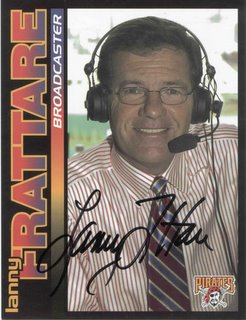
In a move that might not mean much for the present, but which speaks significantly to the future, the Pirates have elevated announcer Greg Brown to a role equal with Lanny Frattare, long known as the Voice of the Pirates.

The announcers will be co-No. 1s and co-Voices of the Pirates for the 2007 season and beyond.
The only on-air change listeners will experience is during radio broadcasts. In the past, Frattare has done the first three innings and the last three. In the future, the two men will more equally share the broadcast. Additionally, some of the ceremonial duties which mostly fell to Frattare will be more evenly divided.

To the surprise of many, the move was initiated by Frattare, who has been with the team since 1976.

"I didn't want to see Greg leave," said Frattare. "Greg is a talented guy, and I know that good broadcasters leave for better opportunities. I didn't want to see that happen with Greg."

The Pirates were only too happy to accommodate.

Tim Schuldt, the team's director of marketing, sales and broadcasting, said: "This is about giving Greg Brown the knowledge that when the club and Lanny agree it's time for Lanny to go off into the sunset, Greg is the guy. We feel Greg is as good as any No. 1 guy and we wanted him to know that."

Frattare and Brown, along with analyst Bob Walk, have agreed to three-year contracts through 2009, although the deals have not been finalized. Their existing contracts expire at the end of the season. The club had one-year options on analysts Steve Blass and John Wehner, and those deals have been extended through '07.

"I'm thrilled, absolutely thrilled," said Brown, who had expressed an interest in the Chicago Cubs' job after the 2005 season. "What's great about it is that Lanny went out and lobbied for this. I think that is unprecedented."

It is something Frattare would not have considered in the past.

"I'm really an insecure guy," he said. "But over these last two years, which have been extremely enjoyable for me, I've got myself mentally where I need to be. It meant a lot to me years ago to be the No. 1 guy. It's not as important to me now."

Frattare soon will finish his 31st season as a Pirates broadcaster, a span in which he has done more than 4,700 games. He has announced longer and done more games than any broadcaster in team history.

He joined the Pirates in 1975, after the controversial firings by KDKA of Bob Prince and Nellie King, as a junior partner to veteran Milo Hamilton. Frattare had been broadcasting for the Pirates' Class AAA minor-league affiliate in Charleston, W.Va. In the early years, Hamilton dominated the broadcasts, allowing Frattare to do only the second and seventh innings.

When Hamilton left after the 1979 season to go to work for the Chicago Cubs, he was replaced by Dave Martin. Martin left after one season, and Frattare became the principal voice of the Pirates from that day on. He has been criticized over the years, once a stunning public rebuke by Bill Craig who ran KBL (the forerunners to FSN Pittsburgh), which was the television station that carried Pirates games. Over the years, Frattare has come to realize criticism is part of the business and never really stops.

When it was announced last week that Frattare would be back for three seasons, reader Dave Rider, an XM Radio subscriber from Bloomsburg, Pa., wrote:

"I wish the Pirates had changed announcers. I have heard many of the other team's announcers, who I believe do a much better job than Lanny and Bob [Walk]. I'm so tired of hearing their personal discussions. I would rather hear about players, managers, strategy, etc., as opposed to their current snacking preferences or their plans for dinner."

It's a legitimate complaint, something to which Frattare will listen, but it won't cause him to change his style.

Brown, who grew up a Pirates fan in Harrisburg and whose parents were from Western Pennsylvania, started with the team in 1994 and seems set for the long haul. "I'd like nothing more than to retire as the Pirates announcers," he said.

By all accounts, some day he'll be No. 1. And Frattare won't stand in his path.

Junker gets weekend job

After going more than three months with a one-man on-air sports staff, WTAE has hired Guy Junker as weekend anchor and promoted Jon Burton to the No. 1 role, where he replaces Andrew Stockey, who moved to morning news anchor in June.

Junker will continue to do the Junker and Crow show from 10 a.m. to 1 p.m. on ESPN Radio 1250. He worked at WTAE in a weekend role from 1984-90. He is a native of Baldwin, steeped in Pittsburgh sports expertise and best known for playing host to Sports Beat on FSN Pittsburgh with Stan Savran.

(Bob Smizik can be reached at bsmizik@post-gazette.com. )

Wednesday, September 20, 2006

Q & A With Lanny Frattare: Part I & II


09/14/2006 2:36 PM ET
Frattare a familiar voice for Pirates fans
Bucs broadcaster recalls stories from early stages of career
By Ed Eagle / MLB.com

Broadcaster Lanny Frattare has been the voice of the Pirates for 31 years. In Part 1 of an interview with Bucs beat reporter Ed Eagle, Frattare discusses the early stages of his career, replacing Bob Prince and the recent switch in radio affiliates.

In his 31 years as a Bucs broadcaster, Frattare has covered two no-hitters, four division champions and the 1979 World Series championship team. He's been on hand for some of the finest moments in the careers of Pirates superstars such as Willie Stargell, Dave Parker, Barry Bonds, Brian Giles and Jason Bay.

Recently, Frattare sat down with MLB.com to discuss his views on the team's recent change in affiliate stations, the challenge of having to take over for Hall of Fame broadcaster Bob Prince, and the highlights and lowlights of a career spent calling the games of the team that he loves.

MLB.com: What is your take on the team's decision to move the flagship station from KDKA to WPGB?

Lanny Frattare: I have tremendous faith in the Pirates organization to do what's in the best interest of the ballclub, and yet, I'm positive that everybody associated with the team and with the radio stations knows how much I appreciate what KDKA did for me.

KDKA had the rights when I was chosen as a Pirates broadcaster 31 years ago. The executives there had a lot to do with the decision to hire me. I'm deeply indebted to a lot of people over there and I've developed a lot of strong friendships. I know a lot of those friendships are still going to be there because of the substance of those friendships.

I'm also quite confident that I'll be developing a lot of other great friendships with the Clear Channel family.

MLB.com: Your voice has become the soundtrack of summer for so many Bucs fans over the years. What does it mean for you to be the official voice of the Pirates?

Frattare: One of the things I realized when I took over for Prince -- and I learned a great deal from talking to Pirates fans about how much Prince meant to them -- is that whatever you get as a baseball broadcaster is given to you by the fans. If you are doing a great job and they can feel some affinity towards you, and you develop those "air friendships," they're the ones that basically make you the voice of the team.

I have had hundreds of people say to me that my voice is the voice of summer to them, and I'm extremely pleased about that.

I learned early on in Pittsburgh in the late '70s that Pirates fans loved Prince and they developed some tremendous memories through him. I thought that I would love to create a whole new generation of baseball fans. I've been afforded that opportunity. As I go out and make a lot of appearances for the ballclub, I have people that come up to me and say they remember listening to me when they were six years old, and now they're 37. It means a great deal to me.

MLB.com: How difficult was it to emerge from Prince's shadow early on in your career with the Pirates?

Frattare: It was probably more difficult a few years down the road.

When I first got the job, I was elated about having realized my goal. My goal was to be a Major League announcer. I told myself, "If this is only a one-year deal for me, I can still say I reached my goal -- my dream."

Fortunately for me, Prince was my biggest supporter. He pulled me aside on regular occasions and told me what I was doing right and what I was doing wrong. Here I am, one of the guys that replaced him and Nellie King, and he cares enough to share his advice with me. That was very important to my progress as a Pirates broadcaster. He pointed out that I had a ways to go. I was a raw broadcaster with a lot to learn.

MLB.com: So it was just a matter of time before you felt comfortable in the role?

Frattare: There have been two or three bumps in the road for me in my career.

After you've had a job for a little while, I did become somewhat paranoid about losing the job. That can become a negative, because you start worrying about how you are doing things. You second guess yourself as a broadcaster.

Finally, there came a point in my career -- probably later than it should have come -- where I said, "I can only be Lanny Frattare. I can't be Bob Prince. I can't wave green weenies. I can't wear loud sport coats. I can't be Vin Scully. I have to be Lanny and I have to hope that is good enough." Once I got that into my head, I was fine.

Then, the second bump in the road was the Bill Craig episode, where Bill lashed out at me publicly. [Craig was a general manager at KBL during the time when that network held the rights to the Pirates TV broadcasts.] I had lunch with him a week before he lashed out at me publicly, and he and I had a chance to go through this process of him telling me what he didn't like about my style, etc. And I was just disturbed that he wouldn't have given me an opportunity to take what advice I thought was valuable from him and blend it into my broadcaster. He didn't give me any time to do that.

There was a strong part of me that wanted to lash back at him publicly, and I didn't do that. It was probably wise that I didn't, but there was still a part of me that wanted to stand up for myself.

It was also very painful for my family. My daughter was going to school and being exposed to comments from her classmates. After I had gone to Spring Training, my daughter wrote a letter to the newspaper defending me. It was a wonderful letter, and at the time, my daughter might have been 16 or 17 years old. I knew nothing about it, but there were people in town that maintained that I put her up to it. That was difficult in that regard.

When the Craig article came out, I have to tell you that I had a ton of friends who came over to my house that night. It was like somebody had died. They all rushed to my side to defend me and support me.

MLB.com: What do you think fans would be surprised to find out about you?

Frattare: They probably would be surprised to know that through much of my career I have been a real insecure person.

A couple of years ago, I took 10 days off from the broadcast because I was battling some bouts with depression. The club, my wife, my friends, Kevin McClatchy and the Pirates organization were outstanding. They were very supportive of me.

I can talk about it now because I have gotten to the other side of this issue. I have been able to put a good bit of that insecurity behind me. Now, I can bask in the glow of my successes in the time I have spent here as a Pirates broadcaster.

Before, I was one of those guys that, if I had nine people tell me wonderful things and one person told me something negative, I used to dwell on that one person's comment. I've been able to get past that.

At times, people might think about broadcasters and egos, and at times, may even think that guys who are on the air, because of the way they carry themselves, are arrogant. But my issue was never ego or arrogance. It was insecurity and paranoia. I've gotten past that.


09/18/2006 12:51 PM ET
Frattare recalls ups and downs of career
Pirates announcer sits down for Part II of Q&A session
By Ed Eagle / MLB.com

MLB.com: Which Pirates have you most enjoyed covering?

Frattare: I have developed some favorites based on performances on the field or friendships. Kent Tekulve and I were together [in the Minor Leagues] in Charleston, W.Va., when I was a broadcaster in Triple-A and Teke was first coming up. In fact, Teke's wife, Linda, is godmother for my daughter, Megan. There was always a strong bond between the Tekulves and the Frattares.

My friendship with Jimmy Leyland is front and center. Jimmy gave me the opportunity to be with him a lot off the field. He trusted me with a great deal of information. It was very common for me to go after games to his suite, where he would be talking to his coaches about players.
I'm a big fan of Phil Garner. Ed Ott was another player who came up with me through the Minor Leagues. I was a huge fan of Art Howe. I think Art's a wonderful individual and I'm glad to see he had success as a big-league manager.

Most recently, I've spent a good bit of time trumpeting Freddy Sanchez. Freddy was on the Caravan with us this winter and enjoyed the experience immensely. I wasn't bashful when I introduced Freddy at a chamber lunch as my favorite Pirate.

In my 31 years covering baseball, this current crew of Pirates players is the best group of guys that I have ever been with. That's not to say that there weren't good guys from the '79 team -- Willie Stargell, Garner, Chuck Tanner -- or from Jimmy's teams, but from 1-to-25 or 1-to-32, [this group is the best]. There have been times this year where it was hard to see them not be successful. I really wanted to see these good people be successful, because I really have respect for the people that they are.

MLB.com: You have covered thousands of games since 1976. Which one has been the most memorable?

Frattare: There are number of games that stand out for different reasons.

First of all, there was the clincher in 1990 in St. Louis, with Doug Drabek pitching a masterful game against Joe Magrane, and the celebration [that followed]. I had developed a strong friendship with Jimmy Leyland, Gene Lamont and Kent Biggestaff, and I was so thrilled to watch Jimmy Leyland and his people put together this ballclub, and here they were celebrating.
Interestingly enough, after we clinched in 1990, I didn't go down to the clubhouse for maybe an hour after the game because I didn't want to impose on the celebration. But I was afforded the opportunity after we got on the airplane and then got back to Pittsburgh and went to the Clark Bar to watch them celebrate. I got great satisfaction from that.

The other game that stands out for me is in that 1990 season. Doug Drabek almost pitched a no-hitter against the Phillies. Sil Capusano broke it up. The reason that's been such a big deal to me is because I went through a period of my career where I was trying to do perfect broadcasts, and realized at some point that that was next to impossible. But that game, I thought I had come as close as I possibly could to doing a perfect broadcast, in terms of setting the stage, in terms of bringing in the history notes and the drama of the whole game. I was extremely proud of that, and that's why it's always stood out for me. I was extremely proud of that broadcast.

MLB.com: You've seen your share of stinkers, too. Which one stands out the most?

Frattare: I can vividly remember when the Cubs clinched the division title, it might have been 1984. It was at Three Rivers, and it was a painful game to do, because there were a lot of Cubs fans in the ballpark. So much of the excitement level that was in the park, it was just very frustrating to announce a game with that backdrop.

The most painful game, obviously, was Game 7 of the '92 playoffs, because I knew it was painful for Jimmy and his troops. I also wanted to make sure that I called the game with the professionalism that it deserved, and I'm pleased that I did that.

When I closed down the broadcast, because of my relationship with Jimmy, I was anxious to run down there and see if he was doing OK. I learned in the process what a true champion he was, dealing with the adversity of that painful loss.

MLB.com: You've seen the highs and lows with this organization. Obviously, with 14 consecutive losing seasons, this hasn't been the best of times. What signs do you see that lead you to believe that the team is ready to turn the corner?

Frattare: I see a lot of good signs. But one of the things that I strongly believe is that ... I'm to the point in my career, not only with the Pirates organization but with life itself and other sports teams, where I am turned off by disingenuous, phony platitudes.

I understand that spin is a part of baseball. Nevertheless, I'm quite confident of the fact that when a team is successful, that speaks a great deal more to fans than do discussions about who is in the Minor Leagues coming up or who has promise. I try to focus more on the fact that this is one game that I am doing, and I am going to zero in on it and talk about the things that happen. But in terms of what it means in the long term, I really don't know.

I want to help sell tickets. I want to get people excited about the team. But I also want to do it with some credibility. And the team understands that, as well. Consequently, that's probably the toughest thin line in which to walk, as a broadcaster. You want to be credible. You want to get people excited about the team. But you also know that if a team is right, if the team is good enough, that does a lot more for the organization than all of the talk about where we are, how close we are, etc.

MLB.com: How much longer to do you plan to call games for the Pirates?

Frattare: There a couple of issues here.

First of all, I want to tell you that I am ecstatic that I just signed a new deal with the ballclub.
In years past, there was so much made of being the voice of a team that consequently, talented "No. 2 guys" moved on to other teams. I've long believed that Greg [Brown] is an outstanding broadcaster, and this organization must make sure that Greg is happy here. What we're going to do next year is split the broadcast down the middle. I'm excited about that, because I don't want to see Greg go anywhere.

It's important that baseball teams have two strong play-by-play announcers and two color analysts, or in our case three, so that the broadcast doesn't miss a beat whether I'm on or Greg's on. I'm proud that that's where we are, in that regard. I'm excited that for the next three years, Greg and I are going to share more of the responsibilities.

I must admit that something about doing 40 years would be a nice, round number. I would be 67 at that point, so that might be the time for me to say, "Thank you, and goodbye." But the other big issue is I've seen a lot of broadcasters that have stayed longer than they should have stayed. And, if at any point in the next nine years I get the sense, or my wife tells me or my bosses tell me that I am slipping too much, I don't want to stay longer than I should stay.

Ed Eagle is a reporter for MLB.com. This story was not subject to the approval of Major League Baseball or its clubs.