Showing posts with label Pirates History. Show all posts
Showing posts with label Pirates History. Show all posts
Monday, August 12, 2019


Friday, August 09, 2019
Tuesday, July 23, 2019
'79 Pirates reminder of difficulty current small-market teams have
By John Steigerwald
https://triblive.com/sports/john-steigerwald-79-pirates-reminder-of-difficulty-current-small-market-teams-have/
July 21, 2019

Tim Foli and Phil Garner (Christopher Horner/Tribune-Review)
What will happen first: An American walking on Mars or the Pirates going to another World Series?
Right now, I’d put my money on a Mars walk.
The Pirates celebrated the 40th anniversary of their most recent World Series win Saturday night — the same night America was celebrating the 50th anniversary of Apollo 11 landing on the moon. It was a nice reminder of just how hard it is for a major league team in a small market to win a World Series.
Kind of like landing on the moon, which was a lot harder than it looked.
There were lots of stories over the last few days about just how dangerous the trip to the moon was and how everything had to go exactly as planned to avoid disaster.
The Pirates have been a disaster for most of the time since they beat the Orioles in 1979, and seeing the players gathered on the field and shown on the PNC Park scoreboard Saturday night should have given every baseball fan an appreciation for the job general manager Pete Peterson did in putting that team together.
It’s also a stark reminder of just how unlikely it is the Pirates will play in another World Series.
That 1979 team was made up of a brilliant mix of homegrown players, free agents and trades.
Willie Stargell, Dave Parker, Omar Moreno, Steve Nicosia, Ed Ott, Manny Sanguillen, Kent Tekulve, John Candelaria, Bruce Kison and Don Robinson were products of the Pirates farm system, which was overseen by Peterson before he became General Manager in 1977.
No team in baseball was better at finding good players.

Jim Rooker, Manny Sanguillen and Rennie Stennett (Christopher Horner/Tribune-Review)
Jim Bibby, who won 12 games in 17 starts, was signed as a free agent before the 1978 season. Lee Lacy, a valuable utility man, was signed before the 1979 season.
Bill Robinson, Phil Garner, Bill Madlock, Mike Easter Tim Foli, Bert Blyleven, Enrique Romo and Grant Jackson were brought in via trades. Peterson also made a trade to bring in Chuck Tanner as manager.
If it hadn’t been so well orchestrated, you might call it catching lightning in a bottle. Under MLB’s current economics, that’s the only way the Pirates are going to get back to the World Series.
Stargell, Parker and Tekulve, probably the three most important players on the team, would have priced themselves out of Pittsburgh long before 1979 under the current system. They would have left as free agents or been traded for prospects.
Madlock won four batting titles before being traded to the Pirates by the San Francisco Giants for pitching prospect Ed Whitson in June 1979. Guys who win four batting titles don’t come to Pittsburgh in 2019. Too expensive.
Players like Bibby and Lacy would have had Pittsburgh way down on the list of places they’d like to play if Stargell, Parker and Tekulve had left to play for big-market teams.
It’s a shame only old fans have a real appreciation for what it’s like to experience the Pirates making a World Series run.
Seeing the reaction from the fans Saturday at PNC Park and the feeling that still exists among the remaining members of that team should tell fans who have no memory of it just how special it is.
And there’s a good chance that it won’t happen again in their lifetime.
• My favorite memory of covering the 1979 World Series is from my trip to Baltimore for Game 6. The Pirates had been given almost no chance to win before the series started, and everybody outside of Pittsburgh said it was over after the Orioles went up three games to one.
But the Pirates won Game 5.
I was working for WTAE-TV, and in Baltimore, we were doing our production at our sister station, WBAL.
When I walked into the WBAL newsroom on the day between Games 5 and 6, I noticed every person was wearing an Orioles cap and a T-shirt. These words were written on both: Baltimore Orioles 1979 World Champions.
Oops.
John Steigerwald is a Tribune-Review contributing writer.
Categories: Sports | Pirates | John Steigerwald Columns
MORE PIRATES/MLB STORIES
Monday, July 22, 2019
Once baseball’s best, Dave Parker belongs in Hall of Fame
By Kevin Gorman
https://triblive.com/sports/kevin-gorman-once-baseballs-best-dave-parker-belongs-in-hall-of-fame/
July 21, 2019

When the Pittsburgh Pirates celebrated their 1979 World Series champions on Saturday at PNC Park, there was only one other place in the world Dave Parker would have rather been.
That’s Cooperstown, N.Y.
Parker was regarded as the best player in baseball from the mid-1970s until the early ‘80s, a five-tool player who was a two-time NL batting champion and a three-time Gold Glove winner.
That Parker was being honored in Pittsburgh but not in Cooperstown is disappointing, especially with the timing of the 40th anniversary of his All-Star Game heroics and the World Series victory. And it has left Parker disillusioned.
That he’s not in the Baseball Hall of Fame is as much of a black eye for the game as Parker was front and center of the cocaine scandal of the infamous Pittsburgh drug trials in 1985.
Baseball deemed him the game’s best player in his prime.
It shouldn’t blackball him.
“General managers had a poll, and they were asked who would be the first guy they would begin a franchise with, and it was me,” Parker said. “I did everything that you can do. I journeyed some things twice. They said I was the best player in the game, so live up to it and do what’s right: Make me the Hall of Famer that I should be.”
Parker fell short of the milestone markers that can clinch a Hall of Fame candidacy, with 2,712 hits, 339 home runs, 1,493 RBIs and a career .290 batting average.
But he was a seven-time All-Star, an NL MVP and a two-time World Series champion.
Just like Willie Stargell.
Where Stargell had superior power numbers, with 475 homers and 1,540 RBIs, he also had 480 fewer hits than Parker in 106 fewer games. That’s not to suggest Parker was as good as Pops, just that he resided in the same stratosphere and should have a bronze bust in Cooperstown.
“I think I should be there,” Parker said. “Most people that know me and played against me, they look at me as a Hall of Famer anyway. I don’t think that there was anybody from 1975 to ’81 that was a better player than me.”
Over that seven-year span, Parker compiled 1,157 hits, 140 home runs, 617 RBIs and slashed .313/.364/.517. Problem is, he didn’t sustain that momentum. Parker batted below .300 and hit fewer than 20 homers every season from 1980-84, despite becoming one of baseball’s highest-paid players.
Yet in 15 years on the Baseball Writers’ Association of America ballot, he never received more than 24.5 percent of the vote. A candidate who receives 75 percent of votes is elected.
Parker is hardly alone in his belief he belongs in Cooperstown, a sentiment shared by his teammates from the ’79 World Series champions for which he was a catalyst.
“I can’t disagree with that statement,” former Pirates pitcher John Candelaria said. “Should he be in the Hall of Fame? Absolutely, with some of the people they’re letting in today. No offense to some of them. They’ve got the votes, but I believe Dave was better than some who have gotten in.”
In 2017, Parker was one of nine former players on the ballot for the Modern Era vote. Only pitcher Jack Morris and shortstop Alan Trammell were elected. Trammell was a six-time All-Star, four-time Gold Glove winner and 1984 World Series MVP who had a career .285 batting average, 2,365 hits and 185 homers.
What’s more, the 2019 class includes a pair of borderline candidates in Harold Baines and Edgar Martinez. Both spent a good portion of their careers as designated hitters, and neither ever was considered the best player in the game like Parker.
Martinez had 2,247 hits, a career .312 batting average and 309 home runs over 18 seasons with the Seattle Mariners. A seven-time All-Star, he benefited by being a designated hitter but had only one 30-homer campaign and never won a World Series.
Baines, voted in by the Veterans Committee, was a six-time All-Star who had 2,866 hits and 384 home runs over 22 seasons but never had 30 homers and only topped 100 RBIs three times.
“He ain’t no Dave Parker,” Parker said pointedly.
Neither was Dale Murphy, despite similar statistics and an eight-year stretch where the former Atlanta Braves outfielder was regarded as one of baseball’s best players. A seven-time All-Star, five-time Gold Glove winner and a two-time MVP, Murphy had 2,111 hits, 398 homers but a career .265 average.
If Murphy is left out because of his hitting, Parker could be punished for his power numbers. He had only two 30-homer seasons and three with 100-plus RBIs.
But there’s no room for discounting his defense. Parker possessed one of the most dangerous arms in the game, as evidenced by his throwing out Jim Rice at third and Brian Downing at home plate in the 1979 All-Star Game, for which Parker was named MVP. But Parker’s arm also prevented many runners from taking an extra base, just by the sheer threat. And he had 154 career stolen bases and batted .345 in the 1979 World Series.

Parker played hard and he played through pain, wearing first a football facemask and then a hockey goalie mask upon returning from a broken jaw after a collision with Mets catcher John Stearns in 1978. That was his NL MVP season.
“I felt like a bad dude because of the way I played the game,” Parker said. “I never ran a ball halfway to first base. I hit the ball to second base and guys would barely throw me out. I had outstanding speed, above-average throwing arm. I did everything. No more you can do. You just sit back and wait.
“It’d be great to be there, but I’m in the Reds Hall of Fame, the Negro (Leagues Baseball Museum) Hall of Fame. It would be nice to get into the regular Hall of Fame, but you just sit and wait, just sit and wait.”
Parker has waited long enough. There was a time when he was baseball’s best. The black eye has healed. It’s time the game honors him for it by putting Parker where he has long belonged.
Kevin Gorman is a Tribune-Review staff writer. You can contact Kevin by email atkgorman@tribweb.com or via Twitter .
Categories: Sports | Pirates | Kevin Gorman Columns
MORE PIRATES/MLB STORIES
Sunday, July 21, 2019
Fam-a-lee forever for Pirates as they celebrate 1979 World Series champions
By Kevin Gorman
https://triblive.com/sports/fam-a-lee-forever-for-pirates-as-they-celebrate-1979-world-series-champions/
July 20, 2019

Dave Parker waves to the crowd before the Pirates' 5-1 win over the Phillies on Saturday night. (Christopher Horner/Tribune-Review)
Dressed in black jerseys with gold trim and gold pillbox baseball caps with black stripes, the 1979 “We Are Family” Pirates stood triumphantly one more time to cheers in Pittsburgh.
The Pirates celebrated the 40th anniversary of their World Series championship by honoring the players in what manager Clint Hurdle called “a proper and professional way” before they played the Philadelphia Phillies on Saturday night before a sellout crowd at PNC Park.
If you heard any noise, it was just the boys boppin.
“We’re looking to go out and take 3-1 from somebody,” said right fielder Dave Parker, who popularized that saying on his T-shirt, was introduced last and received a roaring ovation. “You never know how these guys’ heart is. These guys have big hearts. That was reflected 40 years ago. If we had to toe it up right now, it would be reflected right now.”
That was a friendly reminder by Parker the Pirates overcame a 3-1 World Series deficit to beat the Baltimore Orioles in October ’79, staving off elimination to rally and win the next three games and clinch the world championship.
The Pirates haven’t been back to the World Series since, a four-decade drought that was something Parker said he could have never imagined when the charismatic club captured the hearts of the city while disco-dancing to the tune of the Sister Sledge hit.
“It was great. We had fun. Other teams would come in and didn’t know if we were getting ready for a game or a barbecue,” Parker said. “We were a team that had fun, and we threw everything on the field that we could to win.”
Missing were many of the characters who provided the backbone for that bunch, starting with Hall of Fame captain Willie Stargell. The seven-time All-Star first baseman hit 32 of his 475 career home runs to capture NL MVP honors in ’79, and Parker believes the lefty hitters could have had a blast at PNC Park.
“We would’ve capsized some boats,” Parker said. “It’s a great hitters’ park. It’s got a high wall, a lot of doubles, a lot of home runs. We would have loved playing here.”
Outfielder Lee Lacy credited general manager Harding Peterson, who died April 16, as the architect of that team and suggested a statue should be built in his honor.
“He was a great general manager,” Lacy said. “No one has won it here since.”
Pitcher Don Robinson credited Chuck Tanner for fighting to bring him to the big leagues by threatening the Pirates that they could find a new manager if they didn’t. Robinson was 22 when he won Game 2 of the ’79 World Series. Showing the Fam-a-lee spirit they are forever Pirates, Margaret Stargell represented her husband, as did the late pitcher Bruce Kison’s wife, Ann Marie, with his son, Robbie, and daughter, Jennifer.
“A lot of characters and lot of fun — it was an honor and privilege to play with them,” said pitcher John Candelaria, who won Game 6 of the World Series. “It hurts. You remember the guys. They stay in your mind and your heart.”
The Pirates shed some tears but mostly were smiles during their 40th reunion, enjoying every moment of reliving their championship season and being celebrated by the city’s baseball fans once again.
“It’s still a family. It doesn’t matter what ball field or city or country we’re in,” catcher Ed Ott said. “To be around the closest-knit 25 players is a thrill. The camaraderie and friendship we’ve had, we would’ve went to war for each other.”
Kevin Gorman is a Tribune-Review staff writer. You can contact Kevin by email atkgorman@tribweb.com or via Twitter .
MORE PIRATES/MLB STORIES
Strong spirit still defines ‘We-Are-Fam-a-lee’ Pirates
By Joe Starkey
https://www.post-gazette.com/sports/joe-starkey/2019/07/19/Strong-spirit-defines-We-Are-Fam-a-lee-Pirates-Stargell-Tanner-Tekulve-Easler/stories/201907190054
July 19, 2019
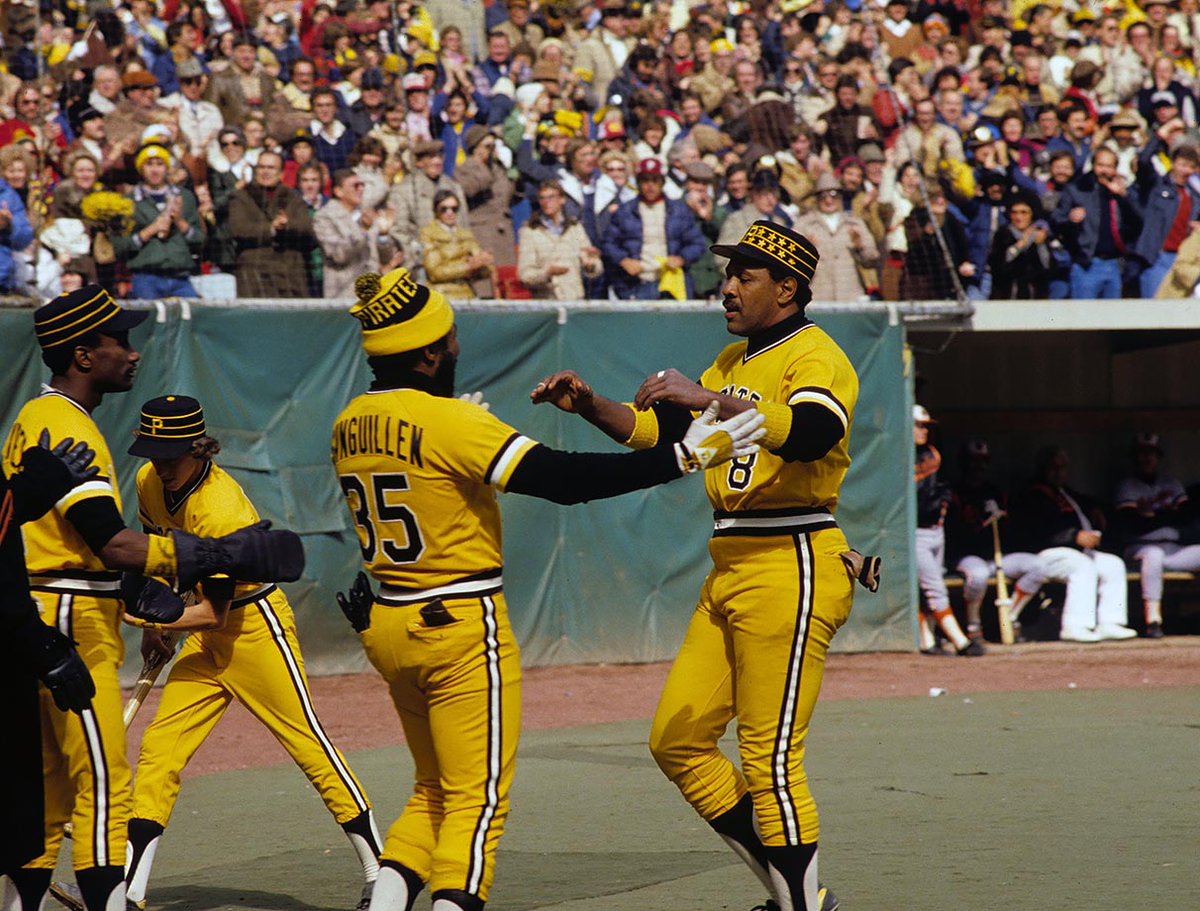
If life were a ballgame, most of the 1979 Pirates would be nearing the seventh-inning stretch. Some have been lost along the way, including the patriarch, Willie Stargell. Others have endured major struggles.
Dave Parker, the larger-than-life right fielder, was diagnosed with Parkinson’s disease in 2012. He is 68. Kent Tekulve, the leaner-than-life closer, had a heart transplant in 2014. He is 72.
Which makes you and I how old?
Hard to believe,” Tekulve says, “that it was 40 years ago we were freezing our asses off in Baltimore.”
Father Time has proven to be a tougher foe than those Orioles, but believe me when I tell you this: The ’79 Pirates never, ever go down without a fight. A fair number of them will congregate this weekend at PNC Park for a 40-year reunion, and they remain a feisty, fun-loving crew.
Ten years ago, before the 30-year reunion, I asked manager Chuck Tanner how he was able to keep so many talented players content and engaged.
"I'd tell them, 'We're going to win the pennant, and if you don't want that, get the hell out of here,’” Tanner said. “I managed for the team.”
That’s the other thing about those Pirates — they defined team as well as any champion in baseball history. They truly were a family, personifying the Sister Sledge hit (“We Are Family”) that became their anthem, and they were the only team of the 20th century to win a World Series without either a pitcher who won 15 games or a hitter who knocked in 100 runs.
They were ahead of their time, too. The term “super-utility player” hadn’t been invented, but the Pirates had multiple players who could fit that description. And like today’s managers, Tanner would often go to his bullpen early.
“Look at it this way,” Tekulve says. “We went to the last day (to win the division), so anybody that had anything to do with any oddball win was important. It took every single person.”
Click on the link below to read the rest of the article:
https://www.post-gazette.com/sports/joe-starkey/2019/07/19/Strong-spirit-defines-We-Are-Fam-a-lee-Pirates-Stargell-Tanner-Tekulve-Easler/stories/201907190054
Saturday, July 20, 2019
Celebrating the 1979 Pirates, not the generational gap
By Kevin Gorman
https://triblive.com/sports/kevin-gorman-celebrating-the-1979-pirates-not-the-generational-gap/
July 19, 2019
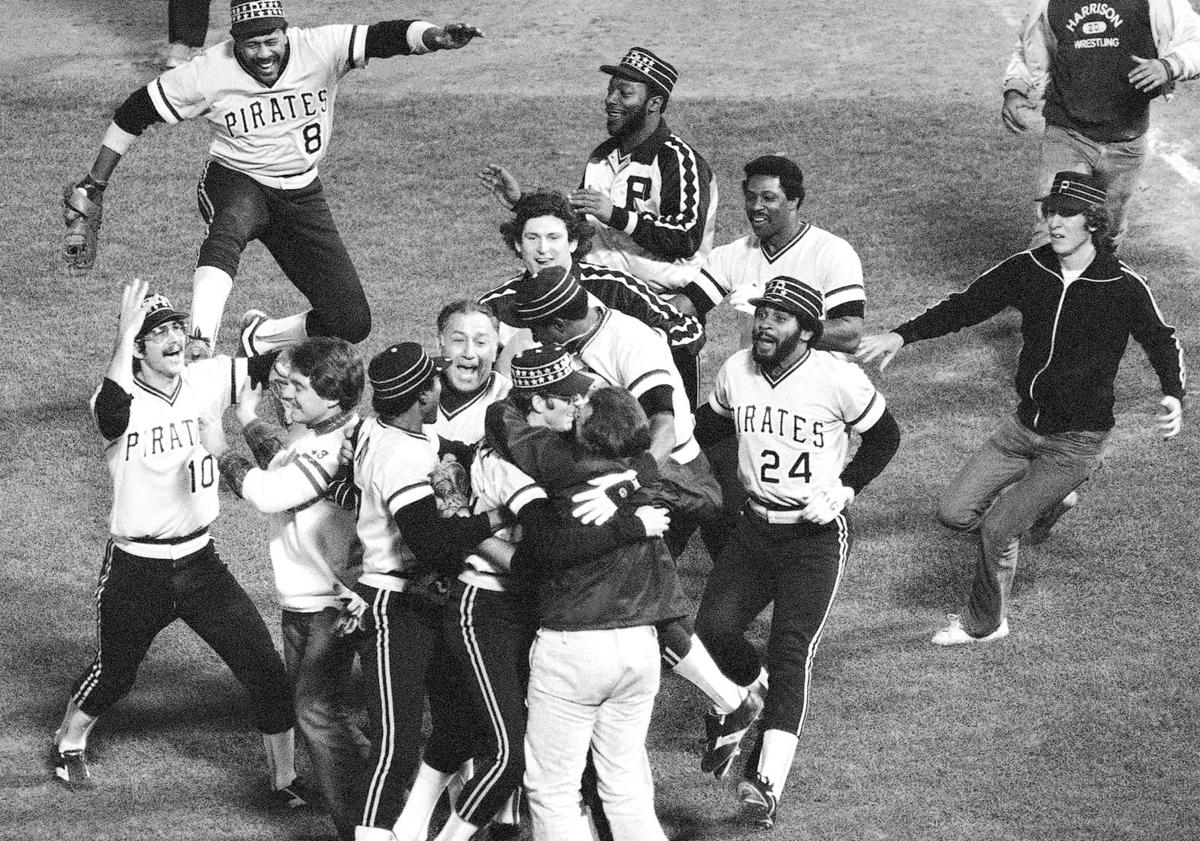
For a 6-year-old Pittsburgh kid who needed nothing more than a ball and a glove to spend a summer day happily, the 1979 Pirates were my glorious introduction to baseball.
With the Pirates winning the World Series and the Steelers on their way to a fourth Super Bowl, Pittsburgh branded itself the City of the Champions. That’s a tag this city still owns, even if Boston has tried to lay claim to the title.
It was an amazing time to be introduced to the sports world, an escape for a steel town that suffered as its mills closed and families had to figure out their future. We could live in the present, enjoying the success of our sports teams and their superstars.
When we played pickup baseball games, using your imagination to create ghost runners, you didn’t just play a position. You became that player. You were Willie Stargell at first base or Dave Parker in right field. You were Phil Garner at second base and Bill Madlock at third. You were John Candelaria starting games and Kent Tekulve closing out a victory in his submarine style.
Actually, that’s not altogether true. You were Pops and Cobra, Scrap-Iron and Mad Dog, Candy Man and Teke. It seemed like everyone had a nickname, so they felt familiar. No wonder we sang along and danced to Sister Sledge’s “We Are Family.” That’s what Pirates games felt like: a family reunion.
When the Pirates honor their 1979 World Series champions Saturday at PNC Park, it promises to be a celebration of when they were baseball’s best. But it also will serve as a sad reminder that the Pirates long have lived off their past and that nostalgia only can carry a town and its team for so long.
The Pirates haven’t won a World Series in four decades, a 39-year drought that ranks as the seventh-longest in Major League Baseball. That has caused a generational gap in the city, where almost anyone younger than me has grown up with no memories of the Pirates winning a World Series.
That’s four decades of frustration for Pirates fans, save a pair of three-year stretches from 1990-92 and 2013-15 when they made the postseason. In between, this city endured two decades of losing seasons, a drought of despair in a city of champions.
We’re spoiled like that.
Only the Washington Nationals, founded in 1969 as the Montreal Expos, and the Seattle Mariners, founded in ’77, have gone longer without making a World Series appearance. Everyone else in MLB has at least reached the Fall Classic.
No wonder Pittsburghers have turned their attention — and entertainment dollars — toward supporting the Steelers and Penguins. Since the Pirates last won a World Series, the Steelers have won the Lombardi Trophy three times and the Penguins the Stanley Cup championship five times.
A once-great baseball town has become a football town and a hockey town, even though it has a rich baseball history and one of the best ballparks in America. You could say the same about Boston and Chicago, home to Fenway and Wrigley. The Red Sox went 85 years between winning World Series titles, from 1918 until 2004. The Cubs endured a century-long streak, 107 years from 1908 until 2016.
Yet their fans remained fervent, hopeful even. They celebrated the game, cherished their ballparks and kept their fingers crossed that each year would be the year. Those waits are an eternity compared to the Pirates’ four-decade stretch, but imagine the outcry if this is only halfway to waiting for their next World Series title.
On July 19, the 1979 Pirates were four games out of first place. By the 95-game mark, they were 46-39. These Pirates were 45-50 going into Friday’s game against the Philadelphia Phillies, 6½ games out of first, 4½ out of the wild card.
Those ’79 Pirates traded in mid-April for shortstop Tim Foli and in late June for Madlock, a two-time NL batting champion who would win two more in ’81 and ’83. These Pirates only addressed their issues internally, promoting minor leaguers and trading for pitchers Chris Stratton and Yefry Ramirez, both of whom had been designated for assignment. They have done this despite one of baseball’s lowest payrolls.
That the Pirates have neglected to help this team is a shame, especially given that they were in first place in late April. There is more talk of the Pirates being sellers than buyers at the July 31 trade deadline, especially after losing five of six on the road in Chicago and St. Louis after the All-Star break.
This is a fun team to watch and to cover, and the Pirates can only hope that kids today are trying to ring that bell like Josh Bell or become the Nightmare who closes out a game like left-handed flamethrower Felipe Vazquez.
For all of the Pirates’ ownership and front office talk about wanting to win a World Series, they have done little to provide this team the players to be a contender.
That shouldn’t stop fans from celebrating the ’79 Pirates, reveling in the return of the World Series winners.
But we only can dream about what it would be like for the Pirates to celebrate their ’79 champions with another World Series run, for these Pirates to capture the hearts of Pittsburgh kids forever the way their predecessors did 40 years ago. Instead, like ghost runners, the Pirates have left that to our imaginations.
Kevin Gorman is a Tribune-Review staff writer. You can contact Kevin by email atkgorman@tribweb.com or via Twitter .
Categories: Sports | Pirates | Kevin Gorman Columns
Thursday, July 11, 2019
40 years after historic All-Star Game, Dave Parker battles Parkinson’s, helps at Reds Youth Academy

CINCINNATI, Ohio - The line was drawn three months prior, and Dave Parker responded when Jim Rice sought an advantage in the Major League All Star Game played in Seattle’s Kingdom 40 years ago.
Earlier in 1979, Parker and Rice — standing back to back — graced the cover of Sports Illustrated with the headline “Who’s Best?” They were considered the top two players in the game.
Rice, the Boston left fielder, is pictured looking over his shoulder and up at the much taller Parker, the Pittsburgh right fielder who was grinning at the camera.
“In the photo, I held up my [index] finger to let him know he didn’t stand a chance,'' Parker, smiling at the memory, said in a recent interview with The Plain Dealer.
But the competition began before the cover photo shoot. Rice started things off at the introduction.
“He wore some playoff and all-star rings and squeezed my hand really hard,” said Parker. “I told him, ‘I’m going to punch you in the head if you shake my hand like that again.'"
Not only did Parker avenge Rice’s vice grip, but his defensive display in 1979 earned him the All-Star Game’s Most Valuable Player Award and helped establish him as one of the best players of that era. It was the first time an outfielder had two assists in an All-Star game, and it wouldn’t happen again until Tony Gwynn did it in 1992.
Parker also is the only position player to win the award mainly because of his defense. He also wasn’t too shabby at the plate that day. He singled, was intentionally walked and drove in a run on a sacrifice fly.
‘Cobra’ still on the prowl
Parker, 68, doesn’t move as swift as he once did in right field. "The Cobra,'' as he was known in his playing days, had two knee surgeries and was diagnosed in 2012 with Parkinson’s Disease, which attacks the brain nerve cells and affects movement. Parker fights the disease daily with exercise and medication.
Some days are good and some days are a challenge for Parker who remains busy as a volunteer at the Cincinnati Reds Urban Youth Academy. It’s across the street from his residence.
Parker, who grew up in Cincinnati and played four years with the Reds, teaches young baseball players the fundamentals of the game.
Parker and his wife, Kellye, are also devoted to theDaveParker39Foundation, which raises money to assist Parkinson’s awareness and programs.
“I’d like to find a cure,” Parker said. “My foundation was created to bring attention to the disease and help fund research.”
Generating attention has been routine for Parker. He’s well equipped to stir awareness for Parkinson’s. His history of memorable performances, particularly the 1979 All-Star Game, is a prime example of Parker rising to the occasion.
“I went into that All-Star game with the attitude of playing hard and the chance to show my talent,” Parker said. “I wanted to be the guy that no one wanted to run against and I wanted to be the guy that would hit . . . I wanted to be number one.”
The Game
All-Star play during those days was more than a midsummer exhibition game. Competition between the two leagues did not have to be manufactured like the rule where the winner of the game (from 2003-2016) determined which league had home field advantage in the World Series.
The competition was so intense that the National League defeated the American League in 1970 when Pete Rose collided into Indians catcher Ray Fosse for the winning run in the 12th inning.
“In the pregame meeting in those days, National League president Warren Giles’ veins would pop out in his head as he told us this game was our chance to show the world the National League was superior,” Rose told The Plain Dealer.
Parker felt it, too.
“We went into those games with the attitude that we were going to kick their butts,” said Parker, who played in six All-Star Games and hit a home run in the 1981 game in Cleveland.
The National League came into 1979 game with seven straight wins and 15 out of the last 16.
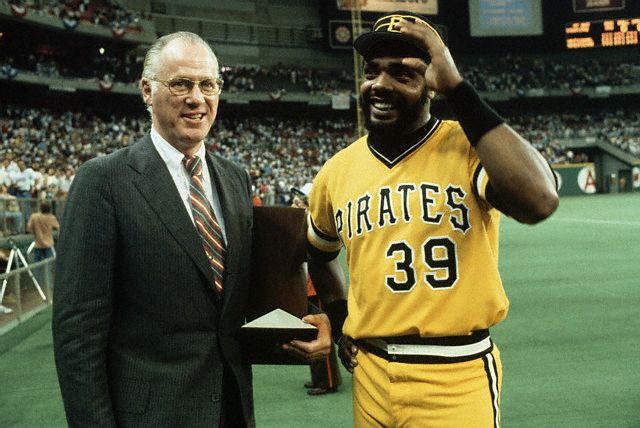
Dave Parker accepting the All-Star Game MVP award from Bowie Kuhn
The laser from foul territory
In the seventh inning, with the AL ahead, 6-5, Rice hit a ball to shallow right field. Parker charged and overran the ball. Rice, already at second, went for third.
Wrong move.
Parker recovered, retrieved the ball after a high bounce in and threw a one-hop laser from foul territory to Los Angeles Dodgers third baseman Ron Cey, who easily tagged Rice out.
“Parker made a great throw and I wasn’t surprised because I knew he had a terrific arm,” Cey said.
Speed was never Rice’s strength. He had a career-high 10 stolen bases in 1975, but his attempt at third did not surprise Parker.
“I knew Jimmy was going to run because he’s a competitive guy,” Parker said. “But I got a lot of satisfaction nailing him at third. Jimmy and I go way back.”
Nailing Rice at third
Lee Mazzilli’s solo homer tied the score in the eighth. The AL threatened in its half of the inning behind Brian Downing’s leadoff single. He moved to second on a sacrifice bunt and an intentional walk put two runners on with one out.
Enter left-handed batter Graig Nettles .
“I said ‘Oh [expletive],’ because Parker’s in shallow right field and I knew Nettles would hit the ball to right field, and that wasn’t good,” Downing said.
Right on cue, Nettles popped a one-hop single to right field. Parker charged, caught the ball on a short hop and fired a rope to catcher Gary Carter.
“Parker wasn’t playing that deep and I figured the play home was going to be ugly,” Downing said. “I planned to slide way inside and reach that front tip of the plate."
Carter took the throw on the third base side of the plate. Downing made his slide but Carter’s block and tag completed the incredible play.
“If the throw was just several inches higher or to the other side, I would’ve been safe,” Downing said.
Rose, who watched the play from first base, pointed out the short dimensions [316 feet] in right field.
“Dave had a great arm and his arm looked even better in Seattle because right field isn’t that deep,” Rose said. “But he would’ve thrown those guys out no matter which stadium we were in.”
Joe Morgan scored on a bases-loaded walk in the top of the ninth and the NL won the All-Star Game, 7-6.
This wasn’t the first time Parker’s arm was on display in an All-Star Game, well, sort of. In the 1977 Game at Yankee Stadium, Parker and a collection of golden arms - Ellis Valentine, Dave Winfield and Reggie Smith - put on a show during pregame.
“That was the best contest I’ve been in as far as arms,” said Parker, who won the 1985 Home Run Derby. “Reggie Smith had the strongest arm. He threw balls that exploded. I was probably the most accurate. I had a quick release - scoop it up, take it to may hand and get it off.”
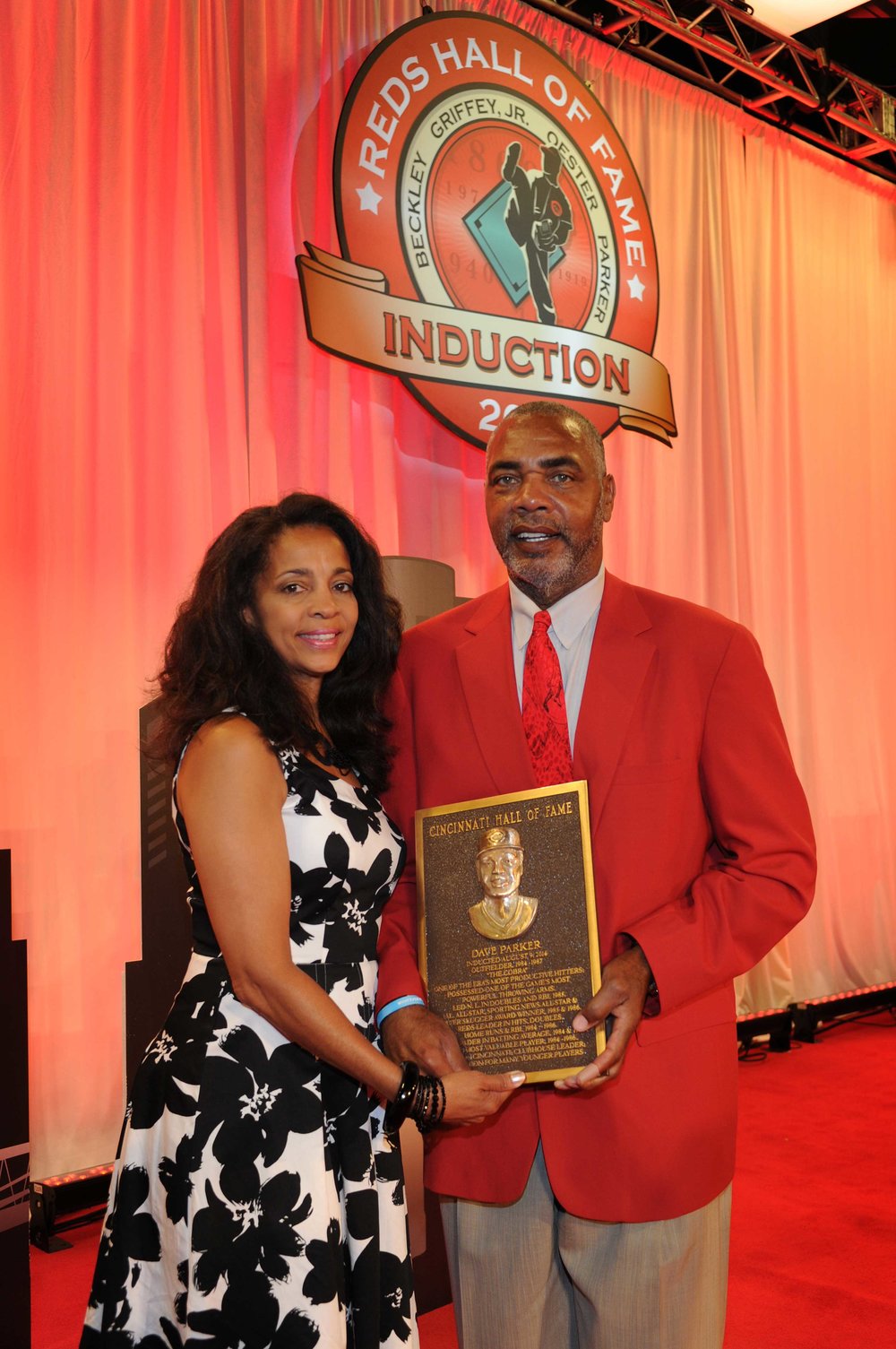
Dave Parker with wife, Kellye, at Reds Hall of Fame Gala, 2014
Hall of Famer?
Winning the All-Star Game MVP was just the start of Parker’s accomplishments that season. He won a Gold Glove and contributed to the “We Are Family” Pirates’ World Series triumph, beating the Baltimore Orioles in seven games.
Parker ended his 19-year career with a .290 batting average, 2,712 hits, 339 home runs and 1,493 RBI. He was a seven-time All-Star, three-time Gold Glove winner and a three-time Silver Slugger Award winner and two-time NL batting champion. He was the National League MVP in 1978.
His 26 assists in 1977 are still the most by any outfielder in a season since Roberto Clemente’s 27 in ’61.
He also was the first professional athlete to average $1 million a year when he signed a five-year, $5 million contract with the Pirates in January 1979.
Those numbers have not been enough for induction into the Baseball Hall of Fame. His most votes was in 1998, his second year on the ballot, when he received 116 votes, well short of the 355 needed for election. He was considered by the Modern Baseball Era Committee in 2017, but was not elected.
Parker has been inducted into the Cincinnati Reds Hall of Fame and the Negro Leagues Baseball Museum’s “Hall of Game,” which honors former baseball greats who competed with the same passion, determination, skill and flair exhibited by the heroes of the Negro Leagues.
Subscribe to:
Posts (Atom)

