Showing posts with label Steelers 2012-13. Show all posts

Monday, April 15, 2013

ESPN: Bengals try to sign James Harrison


The Cincinnati Bengals and former Pittsburgh Steelers linebacker James Harrison will try to complete a deal this week, a source familiar with situation told ESPN NFL Insider Adam Schefter.
[+] EnlargeJames Harrison
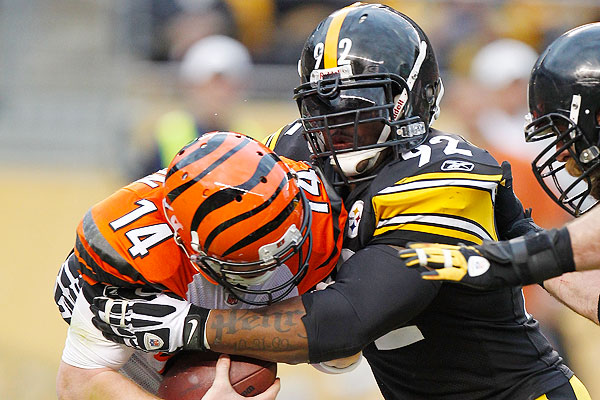
Gregory Shamus/Getty ImagesJames Harrison has long been a thorn in the side of AFC North quarterbacks, such as the Bengals' Andy Dalton, pictured. He might soon be a player Ben Roethlisberger has to worry about as well.
Harrison and former Miami Dolphinslinebacker Karlos Dansby each visited Cincinnati last week, and while the Bengals are interested in Dansby, a deal with Harrison seems more attainable and realistic at this time. 
The Bengals have a need at outside linebacker, as 2012 starter Manny Lawson signed with the Buffalo Bills this offseason.
The 34-year-old Harrison, who was set to make $6.57 million in 2013, was released by the Steelers last month after refusing to take a pay cut. His agent said his client would be open to a return to the Steelers, but the Pittsburgh Post-Gazette reported that the team is not interested in a reunion.
Harrison was meeting with the Baltimore Ravens on the same day Baltimore reached agreement with linebacker Elvis Dumervil, which ended the team's interest in signing Harrison. Otherwise he has received little interest from teams looking for a linebacker.
Harrison missed the first three games of the 2012 season with a minor knee injury but was one of Pittsburgh's steadiest performers over the second half of the year. He finished with six sacks, tied for the team lead, and a pair of forced fumbles as the Steelers finished No. 1 in total defense for the fourth time since Harrison became a starter.
He has 64 career sacks and was named The Associated Press' Defensive Player of the Year in 2008 after finishing with a career-best 16 sacks.
Information from ESPN NFL Insider Adam Schefter and The Associated Press was used in this report.

Friday, April 12, 2013

A Football Widow's Traumatic Journey


The New York Times


April 8, 2013

ANNAPOLIS, Md. — The end of Ralph Wenzel as his wife knew him began in January 2007. They were descending a flight of stairs at San Francisco International Airport, on their way to the baggage claim, after a two-week trip to Hawaii.
Symptoms of his dementia had been troubling during their vacation. Wenzel acted as if he had awoken in a strange place, surrounded by strangers. He did not recognize his wife, Eleanor Perfetto, or her parents. He braced himself and shook his big fists when they approached. He tried to run away. It had not been much of a vacation, she thought.
Wenzel started down the stairs, and Perfetto walked next to him, holding his hand. Six steps from the bottom, he stumbled. He fell hard and landed in a heap on the floor, blood spewing from a gash on his forehead.
He stayed at a hospital in California for 10 days. Doctors would not let him board a plane because he was too volatile. They increased his medication, and he drifted further out of touch.
Perfetto decided that her husband, who was 63 and had played seven seasons in the N.F.L. as a guard, needed to live in an assisted-living facility. She began to wonder: what is the rest of my life going to be like?
She did not have an answer. But she would sell their house in the countryside, she decided.
At first she had found it to be an odd, little house. It was gray, with big windows, beautiful trees and a deck, set on 20 acres on Kent Island, near Annapolis. Most of the backyard was grassy marshland. A creek snaked through it and spilled into a pond. Their closest neighbor lived on the other side of the pond, about a half-mile away. Across the marsh, they could see the Eastern Bay.
She would remember this as the last place her husband was healthy. Back then, he tended a vegetable garden in the yard. He would wake up at the same time each day and putter around in his garden. Life in their odd, little house was pleasant. But Perfetto had noticed something was off. Wenzel kept losing his wallet and his checkbook. He seemed easily confused.
She kept this to herself until one day in 1999, when they were discussing what to do about a patch of strawberries.
He had first planted the strawberries outside the garden, only for them to be ravaged by rabbits and deer, so he moved them inside the fence. Now, months later, the strawberries had regrown wildly and needed to be moved again.
He suggested they be moved outside the fence: he pointed to where they had been planted before, clearly not remembering that he had once planted them there. She was alarmed. She scheduled a doctor’s appointment.
The doctor asked, when did he first notice something was wrong?
It was in 1994, he said. He was coaching high school football at Sidwell Friends School in Washington. One day while instructing his players, they told him he had taught them the same thing the day before.
“Well, then, tell me what I taught you,” Wenzel said, and the players repeated verbatim what he was about to say.
Perfetto had never heard that story. Then the rest came pouring out: the confusion, he noticed it, too. It depressed him. It felt as if there were a door shut in his brain that he could not open. Wenzel was 56, and the doctor diagnosed “mild cognitive impairment,” which typically progresses into dementia.
Knowing what was to come made him more depressed, Perfetto sensed. At home, she made sure he kept a routine — managing that vegetable garden — so he felt as if nothing had changed. But it would.
She eventually hired several cleaning women, who were in fact caregivers, to take turns watching Wenzel while she was at work. They made sure he ate his lunch and took his pills. At first it was for a few hours. Then he needed to be watched all day. He still weighed about 225 pounds and he was eating well, but his mind was slowly escaping him.
At night, lying in bed, while Perfetto read, Wenzel hallucinated. Many nights he turned to her, so mad, shouting about children playing in the guest bedroom: “I don’t know what they’re doing in there!” She took him, showed him the empty guest room and said, “Look, there’s no one there.”
His face would go blank, his eyes would droop, disappointed and sad, and he would say, “Well, they left.”
He was paranoid. Often he told the caregivers that Perfetto put him to bed early some nights to throw wild parties without him. The notion made her chuckle. When she wasn’t working as a senior director at Pfizer, she was watching him.
About once a month, she indulged herself and drove to Annapolis, to meet her friends in a book club. They drank wine, gossiped and shared recipes and vacation spots. She and her husband loved to travel. They had been to the Caribbean, Italy and France. But how much longer could that last?
He could no longer communicate in complete sentences, only in words or phrases or mumbled jargon that his wife had to strain to decipher.
Life went on like this until he fell.
Moving Apart
Four months after Wenzel fell at the airport in 2007, Perfetto attended a local fund-raiser with her book club friends. They introduced her to John McCloud. They told her she and McCloud had a lot in common. His wife had died about six weeks earlier from brain cancer. She had fought it longer than expected, but the end had been horrible. He was coping.
Perfetto and McCloud hit it off. They started seeing each other every now and then.
She tried to visit her husband every day. He had been moved to a facility in Annapolis, and Perfetto had moved in with a book club friend who lived nearby. Wenzel could walk, gingerly, on his own, but his mumblings were mostly indecipherable.
On weekends, she took him out for drives, put on his favorite oldies CDs, and for a few minutes he would bob his head, then fall fast asleep. Some days, they went on walks at a nearby park or got ice cream. They often went for seafood, and he would eat a basket of fried fish, oysters and shrimp.
She stayed until the staff showered him, then tucked him into bed and put on an old movie, maybe a musical like “My Fair Lady,” and the music put him to sleep.
Wenzel stayed at that facility for about nine months. Then Perfetto moved him, because she was not happy with the care, to another local facility where he would stay for about three and a half years.
McCloud did not go with her to visit. But sometimes he helped get Wenzel to the doctor’s office. They were growing closer, Perfetto and McCloud. He understood loss. They moved into a new house together in Annapolis, in a neighborhood near her book club friends, in November 2008.
Deterioration and Death
Wenzel fell hard again in December 2010, breaking his collarbone. He went back to the hospital. When he left, it was decided that he needed to be restrained. Perfetto moved him again, to a third, smaller facility called La Casa.
There, when he tried to get up, a buzzer would go off. He flailed. He pushed his back against the chair, he kicked, waved, sometimes all at once. He broke several chairs. The attendants were wet and soapy after his showers.
Perfetto still tried to visit every day. She often found him slouching in a chair, his head drooping onto his chest, his brow furrowed as if he were mad, his mouth drooling. Perfetto had to lift his head to feed him.
On Saturdays she brought doughnuts — apple cinnamon, his favorite. He would eat two or three, but they had to be mashed first.
At the communal table, she chatted with the other residents. She learned about their grandchildren and former lives.
No matter how much Wenzel ate, he lost weight. He dropped to 140 pounds. Crumpled in his chair, the formerly burly football player looked like a skeleton with skin, Perfetto thought. Some days he would be rolled outside, his chair set in the sun. He was not well enough to walk anymore. He was unresponsive. He seemed gone.
In January 2012, five years after the fall at the airport, Wenzel came down with the flu. He was put in hospice care. Perfetto began making arrangements for his death.
One afternoon in June, while she was in London for a business conference, Wenzel did not wake up from a nap. There were no signs of trauma, no signs of pain. He was 69.
A small service was held a week later. Wenzel was cremated, but his brain was harvested and sent to Dr. Ann McKee, a neuropathologist who is the director of the brain bank at Boston University’s Center for the Study of Traumatic Encephalopathy. She examines brains for signs of chronic traumatic encephalopathy, commonly known as C.T.E., believed to be caused by repeated blows to the head. It can be diagnosed only posthumously.
That summer, after his death, Perfetto found herself occasionally sitting in traffic and still thinking of when she would visit Wenzel next. It had become routine.
In September, Perfetto had a funeral for Wenzel in the countryside on Kent Island, at their former neighbor’s house across the pond. It was a beautiful, sunny day. About 100 family members and friends attended.
They poured his ashes into the creek. In the distance she could see her old house. It looked as it had, except for a swimming pool where the vegetable garden used to be.
A 1-Year-Old’s Brain
At the time of his death, Wenzel’s brain was scarred and unsightly, its hills were not plump, its valleys were deep and thin, but most noticeably, the entire brain had shrunk to half its size. It could fit in the palm of a hand. It weighed 910 grams, about the size of a 1-year-old’s brain.
Six months later, McKee had assessed the damage, the result of 69 years of life, 7 seasons as an offensive lineman in the N.F.L. and several concussions. She called Perfetto to deliver the news.
McKee had examined at least 90 cases of C.T.E. She described Wenzel’s as one of the worst she had seen. She said it was “as bad as guys who played 16 seasons and lived into their 80s.”
McKee determined that Wenzel also had Alzheimer’s disease, which meant it was as if his brain had been lighted on fire at both ends. The findings did not seem to surprise Perfetto. In recent years, she has been one of the most outspoken voices in the debate over head injuries in football, and their possible long-term effect on players’ cognitive abilities.
On Tuesday, in United States District Court in Philadelphia, oral arguments will be held in the case between the N.F.L. and thousands of retirees who accused the league of hiding information about the dangers of head trauma. The players are seeking damages for their injuries. Perfetto, 54, will address reporters after the arguments are heard.
She might be asked: what was it like, those last five and a half years?

Thursday, March 14, 2013

Absorbing loss of Wallace depends on this


Losing a wide receiver is familiar territory for the Steelers. They've parted ways with Santonio Holmes and Hines Ward in recent years. The reason Pittsburgh has been able to move forward without them goes back to its backup plan. 
The Steelers traded Holmes because they hadMike Wallace. They released Ward because they had Antonio Brown. Now, with Mike Wallace signing a five-year deal that averages $13 million per season, the next receiver who needs to step up is Emmanuel Sanders. In his three seasons, Sanders is known more for his injuries (especially his fake one) than his big plays.

How much the Steelers miss Wallace depends on Sanders' ability to raise his game. Sanders has outstanding speed. He just doesn't have the numbers.

It's a big void for Sanders to fill. No player in the NFL has more 40-yard receptions since 2009 than Wallace (27), and his 16 touchdown catches of 40 yards or longer are also an NFL high during that span. In three seasons, Sanders has 21 catches over 20 yards and none over 40 yards.

Wallace may have been a one-trick pony, as coach Mike Tomlin once called him, but ability to run the deep route always proved valuable. Sanders' best trick so far has been faking a leg cramp to save the Steelers an injury.
There will be more pressure on the Steelers' passing game this year because Wallace isn't the only loss. The status of tight end Heath Miller is uncertain after he tore his ACL in the second-to-last regular-season game.

Yes, there was no way the cap-strapped Steelers had a chance to keep Wallace, even if he agreed to take half of what he got from the Dolphins. And yes, Wallace isn't a great fit for the Steelers' offense if coordinator Todd Haley sticks with the short passing game.

Still, what the Steelers will miss the most about Wallace is the threat of him going deep. Teams couldn't drop a safety down on his side of the field because the Steelers were one deep Ben Roethlisberger pass from a Wallace touchdown.

This is what Pittsburgh loses in going from Wallace to Sanders. They were both third-round picks. They both have speed. But defenses don't fear Sanders like they do Wallace. If defenses don't respect Sanders by the end of the season, the Steelers' passing game will struggle.

Monday, March 11, 2013

Steelers won't replace Harrison's toughness

By Jamison Hensley
ESPN AFC North Blog
March 9, 2013


When the Steelers announced the release of linebacker James Harrison on Saturday, finding a pass-rusher became as much of a priority as nabbing a running back.

As of today, the Steelers would have to rely on Jason Worilds or Chris Carter to step into Harrison's spot, and there's no confidence that either can handle the job. The Steelers can look to the draft and hope someone like Georgia's Jarvis Jones falls to them at No. 17 next month.

But let's be honest: No one is going to replace Harrison's toughness, mean streak and steely-eyed stare that struck fear into anyone lining up across from him. Harrison was more than a pass-rusher. He was a quarterback crusher. Every team in the AFC North knew it had better find some pass-blocking tackles or Harrison would be hitting the quarterback all game.

Remember last season when Peyton Manning talked about returning to football and half-jokingly begged Harrison not to blindside him?
[+] Enlarge
James Harrison
Charles LeClaire/USA TODAY SportsMore than his jarring hits, the Steelers will miss the intensity and passion that James Harrison brought to the team.
Harrison was as fierce a tackler as he was a competitor. Teams would double-team him, and he would find a way to drop a running back for a loss. Teams would cut block him, and he kept coming back. He played with so much tenacity that you would forget he was only 6 feet tall. He always loomed larger.

For some, Harrison will always carry the label of a dirty player. He became the first player suspended under the NFL's enhanced enforcement of player safety violations after a vicious hit on Colt McCoy. He had so much money taken away for illegal hits -- more than $100,000 -- that the NFL should have named its fining system The James Harrison Fund.

That shouldn't get in the way of what Harrison represented on the field. He has the gritty mindset of an old-school player and was the backbone of the top Steelers defenses over the years.

"James has been an integral part of our success during his years in Pittsburgh and has helped us win two Lombardi trophies during that time," Steelers general manager Kevin Colbert said. "We appreciate all of his efforts and wish him the best.”

So, was this a bad move for the Steelers? It's a bad move for both sides. The Steelers don't have an immediate replacement for Harrison, and Harrison probably won't make as much elsewhere as what the Steelers offered.

The Steelers believe Harrison can still play. If they didn't, they would have cut him instead of trying to negotiate a pay cut. In the end, the Steelers couldn't pay him $6.57 million in 2013. He was too much of a liability in terms of age (turns 35 in May) and injuries (missed a total of eight games the past two seasons).

Another team will sign Harrison because he can still get to the quarterback. Even though his sacks have decreased the past two seasons, he has at least six sacks in six straight seasons. And there's no doubt a team will get a determined Harrison who wants to show the Steelers that he can play at a high level.

This is nothing new with the Steelers, who are always trying to get under the salary cap. They got nose tackle Casey Hampton to take a pay cut last year and did the same with running backJerome Bettis twice. Still, this won't go over well in the Steelers' locker room, which already has had its problems this offseason. Harrison was one of the most respected players within the organization, and his departure puts more pressure on LaMarr Woodley to rebound from last year's disappointing effort.

The news of Harrison's release makes it a good day for Joe FlaccoAndy Dalton and whoever is starting for the Browns. But for the Steelers, this was more than parting ways with one of their best defenders over the past decade. They said goodbye to one of the toughest players ever to wear the Black and Gold.

Harrison had to go


By Mike Bires mbires@timesonline.com | Posted: Sunday, March 10, 2013 12:11 am
Beaver County Times
http://www.timesonline.com

When news broke that James Harrison had been cut, shockwaves reverberated throughout the area. Fans are furious that the ferocious linebacker who wore No. 92 will no longer play for Pittsburgh.
But really, cutting Harrison was the smart thing to do. Football is a business, as Hines Ward found out last year.
The Steelers had no trouble parting ways with their all-time leading receiver and one of the most popular players in franchise history. So it comes as no surprise that they would release Harrison.
Harrison had a terrific run with the Steelers. He was a five-time Pro Bowler who helped them get to two Super Bowls.His performance in 2008, when he earned the Defensive Player of the Year, was one of the greatest by any Steeler defender, and that includes the likes of Hall of Famers Joe Greene, Jack Lambert or Mel Blount. His team-record 16 sacks that season and the 100-yard interception return he had in the Super Bowl are the stuff legends are made of.
But at Harrison’s age – he turns 35 on May 4 – it was time for the Steelers to turn the page. With back and knee injuries in recent years, he’s obviously in decline.
In 13 games last year, Harrison had just six sacks. Granted, he missed the first three games with a knee injury. But six sacks in 13 games is certainly a red flag the Steelers couldn’t ignore.
Of course, money was an issue, too.
Harrison was due to make $6.57 million this year. It’s believed that the Steelers offered him half that, and Harrison refused the pay cut. He believes some team out there will take a gamble on him and offer him the kind of money he wants.
Harrison wouldn’t mind playing for a team with legitimate Super Bowl hopes. He also wouldn’t mind playing in a warm-climate city.
But what if he winds up in Cleveland?
The Browns are reportedly $47 million under the salary cap. They have the money. They also have a new defensive coordinator in Ray Horton, who’s very familiar with Harrison and a 3-4 base defense.
Horton coached the Steelers’ secondary for seven years (2004-10) before becoming the as D-coordinator in Arizona, where he also used a 3-4. The Browns played a 4-3 defense in recent years, but that could change now that Horton is calling the shots.
It’s been reported that the Browns are interested in signing Baltimore outside linebacker Paul Kruger. Might their thinking change now that Harrison is available? Harrison is from Akron.
As for the Steelers, it appears that Jason Worilds is the man who will replace Harrison.
At first glance, that’s not a very promising thought. But Worilds is only 25 and he had five sacks last year in limited action.
Remember, the Steelers gambled on Harrison when they cut Joey Porter in 2007.
The Steelers never regretted cutting Porter. They won’t regret cutting Harrison.

Tuesday, February 26, 2013

Pittsburgh Steelers 2013 Offseason Preview

By Tom Mantzouranis
Sports Illustrated
February 21, 2013


Despite big-money deals, LaMarr Woodley and James Harrison were both ineffective in 2012.
Charles LeClaire/US Presswire

SI.com is laying out offseason road maps for all 32 teams as they start their journey for the Lombardi Trophy -- two teams per day, from the teams that need the most work to contend in 2013 to the ones that are in pretty good shape. See them all.

2012 Record: 8-8 
Key Pending Free Agents: Larry Foote, LB; Casey Hampton, DT; Keenan Lewis, CB; Rashard Mendenhall, RB; Max Starks, T; Mike Wallace, WR; Jonathan Dwyer, RB (RFA); Steve McClendon, DT (RFA); Isaac Redman, RB (RFA); Emmanuel Sanders, WR (RFA) 
List of Draft Picks (pending compensatory picks): 1 (17), 2 (48), 3 (80), 4 (113), 5 (144), 6 (176), 7 (207) 
Available Cap Space: About $14 million over the projected limit 
GM/Coaching Moves: None


2012 Season Recap


You could tell last summer that success in 2012 just wasn't in the cards for the Steelers.
Despite coming off of a 12-4, playoff-qualifying season in 2011, bad omens hovered over Pittsburgh. Three longtime stars and fan favorites -- Hines Ward, James Farrior and Aaron Smith -- bid adieu. Mike Wallace decided to try to leverage his breakout season into a new deal with a contract holdout. The running backs, including presumed started Rashard Mendenhall, dealt with injuries. The sordid and sloppy move from Ben Roethlisberger-favored Bruce Arians to Todd Haley at OC unsurprisingly led to drama between the quarterback and his new coach. And then the rookie first- and third-rounders OL David DeCastro and LB Sean Spence, both of whom were being counted on to infuse youth and talent into units thirsty for it, went down in the preseason with serious injuries. DeCastro would wind up missing 12 games, Spence the season.
All of that dissonance bled into the 2012 season, and manifested in mistakes at costly times. Roethlisberger and the Steelers, so typically clutch when the game is on the line, suffered from bad interceptions, fumbles, drops and mental breakdowns. It's fitting, then, that they were officially eliminated from playoff contention when Big Ben overthrew Mike Wallace for a Bengals interception with 14 seconds left and the game tied 10-10 in Week 16, allowing an easy path for Cincinnati to kick the game-winning field goal.
But less tangible influences impacted the Steelers record too. Haley's arrival brought with it a departure from Bruce Arians' vertical-heavy passing game, a scheme built around the Steelers', and Big Ben's, strengths. The emphasis on short passing was supposed to keep Roethlisberger healthy, but he still missed three games with a shoulder and serious rib injury, and the offense took to Haley's plan awkwardly. And despite boasting a defense that was ranked first overall, Pittsburgh was short on game-changing plays; their 20 takeaways ranked 24th in the league, and their 37 sacks were middle of the pack. The offense started fast and slumped late; the defense was troubled early but came on stronger as the season wore on. The Steelers just never were a cohesive unit last year.

Stat To Feel Good About

75.8. The passer rating for all attempts against Steelers starting cornerbacks Keenan Lewis and Cortez Allen, according to Pro Football Focus. Allen, in particular, shone in this area. His 68.5 rating against was 10th in the league in 2012.

If It Ain't Broke ...

The Steelers' No. 1 ranked defense was anchored by a secondary that led the league with just 185.2 yards against through the air. Part of that can be explained by the fact that the team faced just 523 attempts against last year -- only five teams faced fewer. Still, there's a lot to like about the unit, especially given the absence of a pass rush threat to help out (more on that below). On a defense that needs to get younger, the emergence of Keenan Lewis (26) and Cortez Allen (24) proved to be a blessing. The Steelers' secondary didn't make a ton of big plays, but it didn't allow many, either. Its 19 touchdowns allowed ranked seventh last year, but its 31 plays of 20-plus yards and two of 40-plus led the league. If the Steelers can retain Lewis' services this offseason (more on that below, too), those two will pair with the still serviceable Ike Taylor to give the Steelers a very stingy trio atop the cornerback depth chart.

Troubling Stat

10.2 percent. Combined plays on which pressure was achieved by OLBs James Harrison and LaMarr Woodley, down from 14.3 percent in 2011 and 15.8 percent in 2010.

Must Fix It

There are your prime culprits for the Steelers' lack of heat on opposing quarterbacks. Woodley had an abysmal season made all the worse by recent criticism from an anonymous teammate, who said, "He was awful. He tells us he works out, but we didn't see it. He wasn't in shape. That has to be a reason why he was always hurt." Entering the third year of his six-year, $61.5 million deal at just 28, Woodley is going nowhere, but he has to silence questions about his conditioning and motivation.
Harrison, meanwhile, is due to make $6.57 million in 2012, and has said he's open to restructuring his contract but not taking a pay cut. There's a simple solution there: let him walk. The former Defensive Player of the Year just isn't worth the money or hassle his outspoken nature brings at this point in his career. Talented backup Jason Worilds has flashed ability and is ready to step up as a starter. There should be a ton of options available in the first round for the Steelers to address the deficiency, too, including Ezekiel Ansah, Barkevious Mingo and Dion Jordan.

More On The To-Do List

1. Get younger everywhere on defense. The Steelers boast the league's oldest defense adjusted for snap count (29.2 years old), according to Football Outsiders. Cutting Harrison would be a start, and giving Cameron Heyward more snaps at end over Brett Keisel would help too.
2. Don't let the secondary slip. Re-signing Lewis is key if the Steelers could possibly afford it, and it's long past due for the team to find a good insurance plan and sooner-than-later successor for Troy Polamalu. Texas' Kenny Vaccaro could be a good option there in the first round, but it's more likely the team addresses safety with one of the many prospects pegged for Round 2.
3. Give Big Ben help at receiver. What a difference a year makes. Thought to be one of the team's biggest strengths entering 2012, Wallace and Antonio Brown both had disappointing years, and Wallace is as good as gone. Emmanuel Sanders will be given more responsibility once he is signed to a tender or new deal, but the team has to bring in another No. 2/3 option.

What We'll Be Saying In July

The Steelers' disappointing 2012 began with a roster bloodbath, and 2013 looks likely to start the same way. The Steelers are well over the cap, with eight players slated to make at least $5 million in 2013. Roethlisberger could be extended to help relieve some of that, but the stark reality is that the Steelers are probably going to lose all of their unrestricted free agents (except, possibly, Lewis if they do enough tinkering with their cap space) and will likely have to ax veterans on top of it.
Though the Tomlin-Roethlisberger tandem keeps the Steelers in the playoff contention conversation, this is a team that appears to have its short-term window closing, and the draft likely won't bring enough help to get the Steelers back in the 10-win range. We're going to be looking at the Steelers and wondering if they can do more with less to get back into the playoffs.


Monday, February 25, 2013

Steelers' problems might be too big


By Mark Madden 
Special to the Beaver County Times | Posted: Sunday, February 24, 2013 11:51 pm
http://www.timesonline.com

Turmoil didn't cause 8-8; 8-8 caused turmoil.
But the fact remains that the Steelers locker room appears lousy with malcontents, laggards and tattletales. Which is worst? That's in the eye of the beholder
Such malaise is common with most NFL teams. Localization thereof is just another reminder that the Steelers are no longer a "special" franchise - if they ever were.
So, who's at fault?
Coach Mike Tomlin is hardly blameless. He seems to cede a bit more control and lose a bit more discipline every year.
Linebacker LaMarr Woodley is the founder of the latest tempest. Critics like Ryan Clark may characterize the unnamed Steeler source as a rat, but no one is calling that unnamed source a liar.
It's common knowledge that Woodley was out of shape, overweight and lacked dedication. The proof was in his season: Just four sacks and a level of invisibility the Steelers can't afford from an edge rusher.
Clark and Antonio Brown are right when they say the matter should have been kept in-house. But, given that, why did they keep discussing it publicly?
Oh, right: Got to get on TV.
What's a bigger sin: Tanking a season due to lard and laziness, like Woodley? Or calling Woodley out anonymously after the fact? Stinking, or snitching?
Going 8-8 suggests the former. Gangsta culture dictates the latter.
Hines Ward knows where things went wrong: He retired. Humility lives.
"When you lose so much leadership in the locker room, that is where things present itself like that," Ward told the NFL Network.
The Steelers don't lack leadership. They lack followers. The Young Money Crew and the Florida Gators posse (known collectively as the No-Ring Mafia) seem to believe they got NFL life figured out. So shut up, Troy.
The Steelers also lack self-awareness. The Steelers, as an organization and as individuals, are rarely made to experience an unpleasant moment. As a result, they seem to believe they shouldn't. They run this town, and they know it.
But when you go 8-8 and miss the playoffs, you don't get treated like immortals coated in Teflon. Punks, loafers and lousy performances get called out.
Humiliation isn't always bad. It can motivate. Woodley's problems weren't sorted out internally, or privately. So tell the outside world and see what happens.
Some feel Mike Wallace's impending departure (via Rolls-Royce
Phantom) will restore order. But there is a lot more than one bad apple.
The idea of a player currently without a contract or team purchasing a car that costs $500K is dumbfounding, isn't it? Wallace is in a temporary profession making temporary money. But someday he'll be a TV star: Wallace will be the primary protagonist on ESPN 30 for 30's "Broke 2."
So, how will the Steelers straighten out their locker room?
Winning is generally a cure-all. It's also easier said than done.
The Steelers' biggest problem has traditionally been when they don't recognize there's a problem. But perhaps the Steelers' current problems are too big. Perhaps too many bad actors populate their roster. Perhaps there are insufficient replacements for the broken parts that need to be replaced.
Only one thing seems certain: The Steelers are a lot closer to a losing season than they are a Super Bowl.
On the field, the Steelers' best bet is turning their hopes over to Ben Roethlisberger, one of football's top five quarterbacks. But tradition dictates the Steelers strive for balance on offense and hard-hitting defense. Don't let Roethlisberger win the game in the first quarter. Ask him to bail you out in the last.
Didn't work in 2012. Won't work in 2013. Between inferior weaponry and outdated philosophy, the Steelers are wasting their $102 million quarterback.
You think 8-8 caused turmoil? We might see what 6-10 produces.
Mark Madden hosts a radio show 3-6 p.m. weekdays on WXDX-FM (105.9).