Showing posts with label Troy Polamalu. Show all posts

Friday, August 02, 2019

POLAMALU, COPE SNUBBED BY STEELERS’ HALL


By Mark Madden
https://1059thex.iheart.com/featured/mark-madden/content/2019-07-29-polamalu-cope-snubbed-by-steelers-hall/
July 29, 2019

Related image

When the Steelers started a hall of fame (technically, a "Hall of Honor") in 2017, it made little sense.
The Steelers already had a hall of fame. It's located in Canton, Ohio. Yeah, it's the Pro Football Hall of Fame, but 23 Steelers are enshrined. They've taken over.
But the Steelers forged ahead in the spirit of self-congratulation, immediately diluting the "honor" in the Hall of Honor by including 27 in the inaugural class. (They included all Steelers inducted into Canton.)
This year's class includes:
*Coach Bill Cowher. No argument. #OneRing
*TE Elbie Nickel. How would he fare against today's nickel defense? (Sorry.) Nickel is also on the Steelers’ All-Time Team (they have that, too). He made three Pro Bowls and finished in the top 10 for receiving yards three times in his 11 seasons. Nickel's last season was 1957, so there's barely anybody alive that remembers him, and he's dead.
*WR Hines Ward. No argument. But this is impressive because nobody ever gave Ward a chance. He is definitely the leader of this year's Hall of Honor class. Also on the Steelers’ All-Time Team. #TwoRings
*TE/T Larry Brown. Brown was excellent. He, too, is on the Steelers’ All-Time Team. Brown made one Pro Bowl. He caught a touchdown in Super Bowl IX, the Steelers' first Super Bowl victory. Brown is deserving, but enough already with the Steelers of the '70s. #FourRings
The bigger story might be a couple potential honorees that didn't make it: Broadcaster Myron Cope and S Troy Polamalu.
Cope is one of the most beloved figures in team history. I expected Cope to be part of the inaugural group. The omnipresence of the Terrible Towel speaks for itself.
Cope is dead, so there's no hurry. But - this is putting it delicately - he wasn't universally loved throughout the Steelers organization.
Play-by-play man Bill Hillgrove is. Perhaps he gets in before Cope.
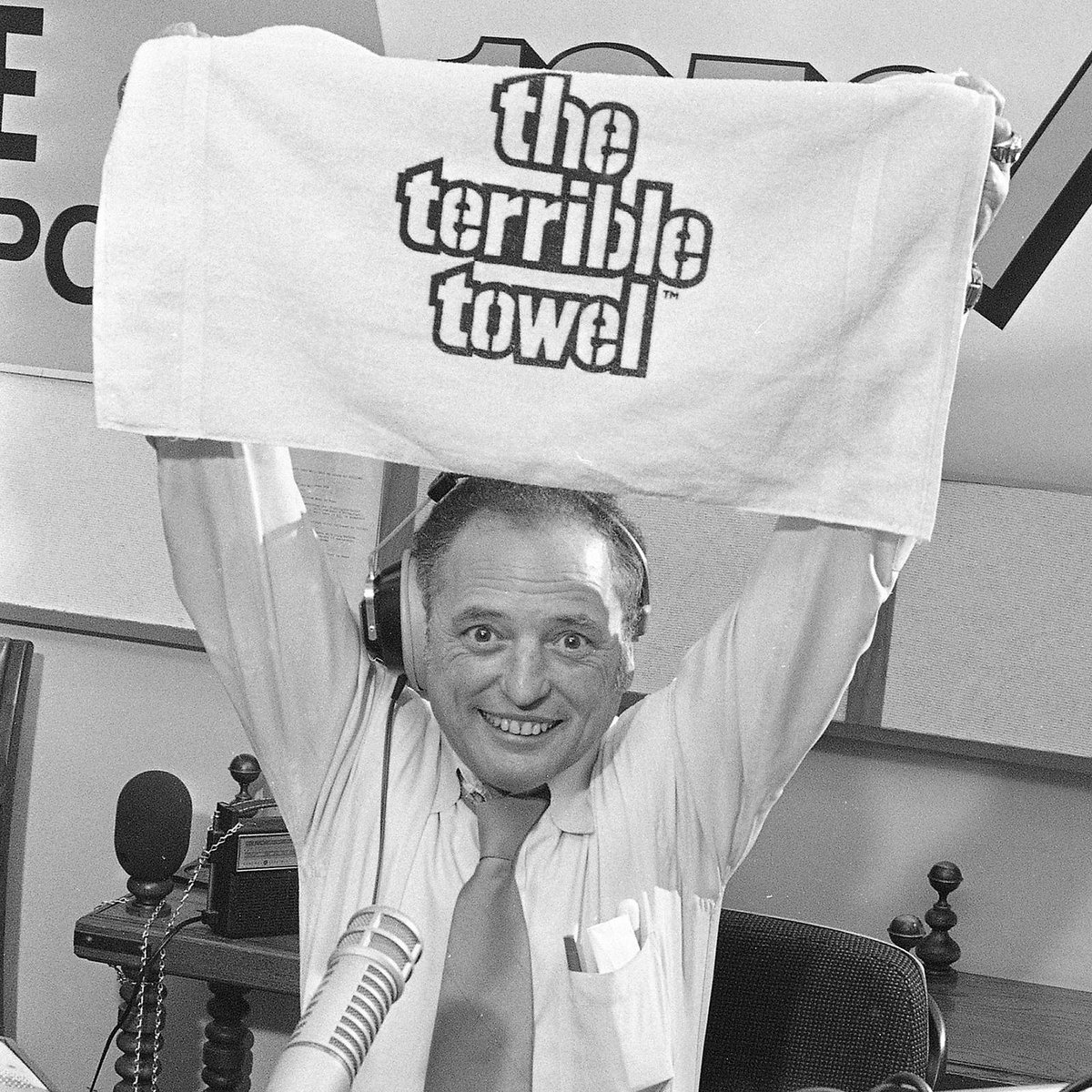
Image result for myron cope
Polamalu not making it in his first year of eligibility is dumbfounding. He can get into Canton starting next year. He's not a lock for that, but is a good bet.
Polamalu is one of football's greatest safeties ever, and easily the Steelers' best at the position. He's on the Steelers' All-Time Team, and on the NFL's All-Decade Team for the 2000s. #TwoRings
Polamalu is more accomplished than any of this year's four inductees. His popularity is overwhelming. Why didn't he make it?
Maybe the Hall is trying to space out prominent honorees for the sake of yearly impact. That didn't seem to be a concern in 2017, but delaying entry of those already in Canton would have been anticlimactic.
But football-wise, there seems no good reason.
Polamalu retired after the 2014 season. He wanted to play in 2015, but the Steelers said no.
Polamalu and the Steelers have had an icy relationship since. Giving a lesser player in James Harrison the benefit of every doubt to continue his career past its usefulness provides drastic contrast, especially when Harrison disrespected the Steelers on many levels before finagling his way to arch-enemy New England in 2017.
Polamalu no-showed the reunion of the Steelers' Super Bowl XLIII-winning team this past December. Perhaps the Steelers were afraid he wouldn't come to the Hall of Honor ceremony.
At any rate, the connection seems fractured. It's a shame, because Polamalu's excellence as a player is matched (perhaps bettered) by his class as a human being. If Polamalu is mad at you, you did something wrong.
The breach needs repaired. Making Polamalu wait to make the Hall of Honor won't help.

Wednesday, August 05, 2015

Steelers still knockin' on Canton's door


Tuesday, Aug. 4, 2015, 10:33 p.m.

Troy Polamalu in Super Bowl XLIII


Once “The Bus” makes his final stop, at the Pro Football Hall of Fame on Saturday, the Steelers officially can boast of 21 busts in Canton.

There is no shortage of candidates for No. 22.

The top five among retired players — Alan Faneca, Hines Ward, Troy Polamalu, Donnie Shell and the late L.C. Greenwood — have compelling cases. Shell and Greenwood are the contenders left from the dynastic 1970s teams. Faneca becomes eligible next year, Ward in 2017, Polamalu in 2020.

The question here is not who's next — logjams at certain positions, internal politics, etc., make that impossible to predict — but rather who is most deserving?

Think of it this way: If you could vote for just one of the five, who would it be?

My choice is Polamalu.

Like Ward (my second choice), Polamalu wasn't just great but uniquely great. To confine him to a positional label such as “strong safety” would do him a terrible disservice. He played in a land far beyond such descriptors.

This is what I always say about Polamalu, particularly when he is compared to the great Ed Reed (who played free safety): Nobody potentially affected more plays in the offensive coordinator's playbook — from a quarterback sneak to a power sweep to a screen pass to a bomb — than No. 43.

As Dick LeBeau told me shortly after Polamalu's retirement: “He could go from point A to point B like no one I've seen. … The best safety I've ever seen.”

At Steelers camp last week, I asked two longtime Hall voters — Sports Illustrated's Peter King and USA Today's Jarrett Bell — who they'd choose first among Faneca, Ward and Polamalu. Both immediately answered Polamalu.

“In the 32 years I've covered the NFL, I can't think of six or eight guys who are as precedent-setting as Troy Polamalu,” King said. “He's almost the Barry Sanders of safeties. He really is a symbol for what I think of as an automatic Hall of Famer.”

Not that the other four don't belong.

Let's start with Greenwood. Like a lot of borderline Hall of Famers on great teams, his candidacy comes with a riddle: Would he have been as good without all that talent around him, or would he have stood out even more on a less-talented team?

Greenwood saved some of his best work for the biggest games (unofficially credited with five sacks in four Super Bowls) and was a member of the 1970s All-Decade Team. He clearly belongs.

“I do think there was Steelers fatigue (among voters) in late '80s and '90s,” King said. “His best shot now is with the Seniors Committee. I think he has a slightly better shot than Donnie Shell.”

The likes of Tony Dungy and veteran Hall voter Rick Gosselin have vociferously backed Shell, who retired with more interceptions (51) than any strong safety to that point and delivered hits that could fell an elephant.
Shell belongs, too, as does Faneca, the most decorated of the five in question in terms of First-Team All-Pro nominations (six).

In regards to Faneca, I'm probably guilty of underrating a nonglamour position. As Bell put it, “Faneca definitely has the resume, but it can be tough for guys in the interior of the offensive line to get their recognition.”

Ward was a one-of-a-kind player: a money receiver and devastating blocker. Why shouldn't his blocking acumen help his cause, considering the Steelers rushed for more yards than any team during his career?
Ward wasn't just bumping into cornerbacks, either. He was cracking down on defensive ends and breaking linebackers' jaws.

“I'm very bullish on Hines Ward for a simple reason: He was the best blocking receiver in football in the last 30 or 40 years,” King said. “When you add that he caught a thousand balls, he absolutely, unequivocally would get my vote.”

Bell pointed out a potential pitfall.

“What will hurt Hines — I think — is you'll have receivers with bigger numbers,” he said. “Randy Moss and Terrell Owens are in the pipeline. You'll see more.”

Bettis, on NFL Network, said Ward was the best player he played with or against.

I hear that. I just happen to believe that another teammate of his — the guy wearing No. 43 — was slightly better.

Joe Starkey co-hosts a show 2 to 6 p.m. weekdays on 93.7 FM. Reach him at jraystarkey@gmail.com.


Read more: http://triblive.com/sports/joestarkey/8833092-74/polamalu-ward-faneca#ixzz3hwUUZkSI 
Follow us: @triblive on Twitter | triblive on Facebook

Sunday, April 12, 2015

Steelers' Polamalu's legacy is greater off the field

The story of Troy Polamalu, who retired this week after 12 superlative seasons with the Steelers, can be told in a plethora of ways.
It can be told using large, spectacular moments, like when Polamalu sealed a trip to Super Bowl XLIII for the Steelers by intercepting Joe Flacco and weaving through the Baltimore Ravens for a late touchdown.
It can be told using smaller, everyday football plays: Polamalu blowing up a stretch play, deflecting a pass or delivering a solid hit to prevent further yardage. His pre-snap movement could be a highlight reel all its own, a wild-haired man running around, wreaking havoc before the ball was snapped.
Polamalu was the ultimate competitor between the lines, a ferocious, reckless, unpredictable force of nature who destroyed game plans, quarterbacks, running backs, wide receivers, tight ends and anything else that got in his way. He played the safety position in a way few could even comprehend, much less emulate.
Dick LeBeau, a Hall of Famer and Polamalu’s defensive coordinator for all but one season, called him the greatest safety he has ever seen.
That said, recounting his career in Pittsburgh strictly through the lens of football smacks of shortsightedness. It's missing much of what the man is about.
Polamalu’s greatest achievement was transcending football. For every on-field highlight there exists a story of random charity, such as picking up a restaurant tab for a complete stranger. His ferocious hitting and vicious playing style has a counterweight, too, in the form of his near-constant presence at Children’s Hospital. Polamalu is such a fixture there that he has his own parking space.
He didn’t and doesn't visit sick kids because that is what athletes are expected to do, popping in for an hour or two, then leaving. He formed real, tangible bonds. No one really heard about it, though, because Polamalu never sought recognition for it, probably thinking that it wasn’t something that deserved public adulation.
Given the microscope that the modern-day athlete, especially the star athlete, is under, it is surprising when there isn’t some sort of incident to look back on. Polamalu has a clean sheet. No dust-ups with media, no incidents with fans, not even the slightest hint of something untoward on his docket. He was perhaps the only true personification — and then some — of the much talked-about, never really seen “Steeler Way.”
Polamalu represented a fascinating contrast — an incredibly introspective, thoughtful athlete, unflappably calm bordering on serene away from the field, and a terror on it. When he spoke about changes to the game, ones designed ostensibly to protect players, he was blunt about the nature of football, and the risks associated with it.
It was a relief that he stepped away from football when he did, retiring instead of trying to squeeze one more season out of a body on a clear decline. His concussion history dates back to high school, and the way in which he discusses concussions leaves open a very real fear that he could suffer debilitating effects later in life.
No player deserves the fate that the game so often brings them later in life, but Polamalu’s light, the goodness the he so obviously spreads to everyone around him, makes it logical to hope for all the world that he dodges that fate.
My favorite aspect of Polamalu’s career is that for all his brilliance on the field, and according to former safety partner Chris Hope, he was an extremely intelligent, analytical player, he had little interest in watching the sport on television. His passion instead was and is soccer.
How fitting that he loves soccer, known as “The Beautiful Game.” For 12 Hall of Fame seasons, he imparted a kinetic, manic beauty onto a violent position in a brutal sport. No one else played football like he did, and no one else ever will.
Polamalu is a Pittsburgh sports legend. He is arguably the most beloved local athlete of his generation. His impact will be felt and spoken of for decades after his retirement. He is one of the greatest football players of all-time. And yet, he is a better person than he was a player.
Watching him play was a privilege. Knowing that a guy wearing the hometown uniform was as good as advertised away from the field was a source of civic pride. May he enjoy a long, fruitful life after football. Few, if any, did it better.
Chris Mueller is the co-host of "The Starkey & Mueller Show" 2-6 p.m. weekdays on 93.7 The Fan.
Get All Digital Access to the website, apps, e-edition, plus local delivery of the Sunday paper.Subscribe now.

More about 

More about 

More about 

Saturday, April 11, 2015

Steelers safety Troy Polamalu retires


By Will Graves
http://sports.yahoo.com/nfl/teams/pit/
April 10, 2015

Troy Polamalu Safety Troy Polamalu #43 of the Pittsburgh Steelers returns an interception 40 yards for a touchdown against the Baltimore Ravens during the fourth quarter of the AFC championship game on January 18, 2009 at Heinz Field in Pittsburgh, Pennsylvania.  (Photo by Gregory Shamus/Getty Images) *** Local Caption *** Troy Polamalu;Tyrone Carter
Safety Troy Polamalu #43 of the Pittsburgh Steelers returns an interception 40 yards for a touchdown against the Baltimore Ravens during the fourth quarter of the AFC championship game on January 18, 2009 at Heinz Field in Pittsburgh, Pennsylvania. (Photo by Gregory Shamus/Getty Images) 
(Gregory Shamus/Getty Images North America)

PITTSBURGH (AP) -- His flowing locks bouncing off the top of his No. 43 jersey, Troy Polamalu spent more than a decade flying across football fields as the heady but humble backbone of a defense that fueled the Pittsburgh Steelers' return to the NFL's elite.
Now, his singular career is a part of franchise lore. Move over Joe Greene, Jack Lambert and Mel Blount. You've got company.
Polamalu, an eight-time Pro Bowler and 2010 NFL Defensive Player of the Year, is retiring after 12 seasons, telling the only team he's ever played for that it's time for the next phase of his life. Polamalu's retirement was first reported by the Uniontown (Pa.) Herald-Standard.
''Troy is a shining example of a football man in the way he loved the game, the way he respected the game and the way he played the game,'' Steelers coach Mike Tomlin said in a statement. ''It's a shining example of the window into who he is. He is a legendary Steeler and a legendary man.''
Taken with the 16th overall pick in the 2003 NFL draft out of USC, Polamalu's frenetic style and preternatural instincts allowed him to thrive in Hall of Fame defensive coordinator Dick LeBeau's 3-4 defense. At his peak, Polamalu was arguably the most disruptive player in the league. His ability to anticipate what was coming became highlight fodder that will live on for generations, whether he was leaping over the line of scrimmage while trying to stuff a quarterback sneak or feathering his fingertips under the ball to pluck a pass before it struck the ground.
Still, beneath the hair that earned him a lucrative endorsement deal and the splash plays that changed the course of seasons - including a pick-six against Baltimore in the 2008 playoffs that paved the way for the team's sixth Super Bowl title - was a man who defined himself as more than just a football player. He was open about his deep Christian faith and made the sign of the cross gesture following tackles.
Soft-spoken and thoughtful, Polamalu's quiet nature away from the game played in stark contrast to the hell-bent way he went about his job. He embraced the role of mentor late in his career, taking expected successor Shamarko Thomas under his wing two years ago, even inviting Thomas to train with him on the west coast last spring, a regimen that Thomas joked was akin to learning how to be a ninja.
''His actions as a human being were just as impressive as any of the many inhuman plays he made on the football field,'' Steelers general manager Kevin Colbert said. ''We were very fortunate to have him be a part of our organization for the past 12 years.''
Polamalu finishes with 32 career interceptions, a dozen sacks, seven fumble recoveries and five touchdowns. The numbers, however, hardly do justice to the way Polamalu could wreak havoc on opposing game plans. LeBeau loved to say simply ''Troy will be Troy'' when asked how the Steelers might use Polamalu on a given Sunday.
While LeBeau's system relied heavily on discipline and disguise, Polamalu was given expansive freedom to go where he felt the ball was headed. He was right more often than he was wrong. Yet his relentless play took a toll on his sturdy but hardly chiseled 5-foot-10, 213-pound frame. He played a full 16-game schedule just twice in his final six seasons, missing more than half of 2012 with calf problems and four games in 2014 following a fluky knee injury. Polamalu returned in time for Pittsburgh's loss to Baltimore in the wild-card round of the playoffs, registering five tackles in what turned out to be his final game.
Polamalu, who had two years remaining on his contract with the Steelers, said in the aftermath of the loss he would have to wait and see what the future held.
Polamalu told the Herald-Standard he never considered playing for another team and decided it was time to move on when he wondered if he could make the commitment necessary to play another season.
His departure marks the third significant shake-up for a defense in transition during a busy offseason. LeBeau left in January after not having his contract renewed and free agent linebacker Jason Worilds abruptly retired in March at age 27.
LeBeau landed a job with Tennessee and Worilds is young enough that a comeback isn't out of the question. Not so with Polamalu, who could become the first member of the core group that led the Steelers to two Super Bowl wins and three appearances in six seasons to be enshrined in the Pro Football Hall of Fame.
Tributes came pouring in through social media in the aftermath of Polamalu's announcement, with opponents who spent long Sunday afternoons dreading dealing with Polamalu tipping their caps in reverence to an iconic career.
Tim Tebow tweeted Polamalu was one of the ''toughest, smartest and kindest players I played against'' while San Francisco wide receiver Torrey Smith - who tangled regularly with Polamalu while playing for the Ravens - tweeted ''Polamalu would do some crazy things on the football field....loved watching him play and competing against him.''
It's a feeling echoed by nearly all that witnessed Polamalu's freakish talent in person.
''We've been fortunate to have great players throughout the years, but he of course would be one of the top players,'' Steelers chairman Dan Rooney said. ''He did everything with dignity and responsibility, and it was special to have Troy be a Steeler his entire career.''
---
AP NFL website: www.pro32.ap.org and www.twitter.com/AP-NFL

Respect for a great Browns opponent: Troy Polamalu


Pat McManamon, ESPN Cleveland Browns reporter
http://espn.go.com/blog/pittsburgh-steelers/
April 10, 2015

Pittsburgh Steelers v Cleveland Browns
Safety Troy Polamalu #43 of the Pittsburgh Steelers catches an interception in front of tight end Evan Moore #89 of the Cleveland Browns at Cleveland Browns Stadium on January 1, 2012 in Cleveland, Ohio.

(Matt Sullivan/Getty Images North America)


Cleveland guys aren’t supposed to admire or respect a Pittsburgh Steeler. It’s part of the code.
But it’s impossible not to admire or respect Troy Polamalu. He shattered that code with his unique style of play and his pursuit of spiritual peace and understanding.
Polamalu announced Thursday he would retire after 12 seasons in Pittsburgh, where his continued excellence was constant torment to the Browns. The praise and warmth for him began immediately after the announcement.
Polamalu played hard, he played fast and he played clean. He was a Hall of Fame player and a great teammate.
Off the field, his life revolved around family and spirituality rooted in a belief that a person could never truly know God except through humility.
He chased excellence in the humblest of ways.

There are a lot of people who know Polamalu a lot better than I did and spent a lot more time with him. But with a guy like Polamalu, any time spent with him left an indelible impression. You left feeling you learned something, that somehow his inner security -- he smiled and said the internal waters were turbulent -- had left a mark. He was that kind, that humble, that unique.
Browns fans know well how he made big play after big play when he saw the orange helmets. When Pittsburgh needed an interception, a sack, a fumble, it often seemed Polamalu provided it. Eight of his interceptions came against Cleveland, and he lost just three times to the Browns in 12 seasons.
But he was best defined in a couple of other moments.
The last time the Steelers were in the Super Bowl, Aaron Rodgers took advantage of the Steelers' secondary. Polamalu sat at a podium after the game and took responsibility, blaming himself because the coverage calls he made allowed the Packers to complete big passes.
After three or four minutes, the PR rep next to him said he could go. Polamalu said no, he was fine, and kept talking and taking responsibility. The PR rep again said he could go. Polamalu shook his head no. This happened two or three more times, until finally Polamalu had answered every question.
What he never said was he was playing with an Achilles tendon injury that meant any step he took could cause it to snap. Because of the injury, he played cautiously.
Polamalu missed two games with that Achilles injury, returned against the Browns in a game the Steelers needed to win and intercepted Colt McCoy on the second play of the game. Later in the game, he did his patented leap over the line to tackle McCoy as he took the snap from center. He reinjured the Achilles in that game as well, but he never once mentioned it after the Super Bowl loss.
The other moment came on a bench at St. Vincent College in Latrobe, Pennsylvania, the Steelers' idyllic training camp home. There Polamalu sat for 45 minutes and explained his spiritual journey.
How he decided he had to find a way to know his God the best way he could.
How he spent offseasons reading every book he could find about every religion in the world, from Catholicism to Buddhism to Islam.
How that led him to Orthodox Christianity, a religion he found pure because he saw it as unchanged for 1,500 years.
How that led him to make a pilgrimage to Mount Athos in Greece, an ancient home of monasteries accessible only by boat, a place National Geographic called “the essence of isolation” with ancient monasteries carved into the mountains.
Polamalu didn’t want to know about Mount Athos; he wanted to feel it. That visit and consultation with one of the Orthodox Church’s spiritual leaders led him to believe that only in humility can one be complete.
Polamalu is a pacifist who played a violent sport because it involved surrender for the greater good of the team. He saw the same surrender for the greater good in the monastic lifestyle.
He is intensely spiritual but never forces his beliefs on others, saying that causes resentment.
His random acts of kindness for people are well-known in Pittsburgh but were never publicized.
In a sense, Polamalu embodied what the Browns have lacked -- the great player intrinsically part of the community where he played.
He’ll be missed. Yes, even in Cleveland.

Polamalu waged the good fight


Friday, April 10, 2015, 11:09 p.m.


It won't be the absurd acts of athleticism I'll remember most about Troy Polamalu, although I will say this: If I'd pay to watch one defensive player in his prime play a single snap on the chance he'd perform some superhuman feat, it'd be a toss-up between Polamalu and Lawrence Taylor.

It won't be the hair, either, although I still recall his Aunt Shelley telling me, “When he came home one summer (from college), he told me he couldn't afford any more haircuts. He said, ‘I don't have time for them, anyway.' ”

I asked Troy about that on April 26, 2003, the day the Steelers, in one of the more inspired moves in franchise history, traded up 11 spots to draft him. He'd been late to his own party, caught in Santa Ana traffic on the way to his uncle's house. He was by himself in his car when he learned he'd be wearing black and gold.

He came to the phone during the party, just after performing a traditional Samoan dance called a siva. Much like Troy's playing style, the dance was described as a “fantastic mix of grace and power.”

He told a story of earning extra cash in college by boogying at luaus with his Polynesian dance group. He laughed when I asked about the hair.

“I guess I don't really care too much about my physical presence,” he said. “I'll do anything to cover my face.”

It won't be Polamalu's monastic dedication to his craft or his penchant for timely plays that I'll remember most, either, although I can still hear Heinz Field exploding as he intercepted Joe Flacco and returned it for an AFC title-clinching touchdown. I can still see him raising the ball with two hands like an offering to the football gods as he crossed the goal line.

But there was something else. Something much deeper.

Polamalu was the rare athlete who acknowledged the inner strife that accompanies any rise to superstardom.
Money. Fame. Ego. Privilege. Temptation. Many of us envy it, willfully ignoring the fact that those things do not feed the soul. They cannot sustain a person.

They are much more likely to damage him.

I can't tell you how many athletes I encounter who are unable or unwilling to navigate the simple, “Hello, how are you?” interaction. It has either become lost through years of living in a distorted sports world or seems somehow beneath them.

Troy knows he's not important.

With Troy, the conversation usually started like this:

Me: “Troy, how are you?”

Troy: “Fine, thank God. How are you?”

Look at all the broken lives of retired athletes. Stories of ruin emerge daily, in many forms. Polamalu studied the personal struggles of transcendent sports figures such as Michael Jordan, Walter Payton, Jim Brown and Muhammad Ali. Much as he admired them, he desperately wanted a normal family life with his wife, Theodora, and later their two children.

“It takes a tremendous struggle to try to stay together (as a family) in this sort of environment, especially when you want to be at the peak of it,” he once told me. “Obviously, it's a struggle on my family. But my wife is so amazing in how she helps me and just leads our family. I'm so blessed to have that.”

Polamalu truly appreciated his gifts. His actions revealed as much. His actions were a tangible testament to his gratitude. He visits Children's Hospital so often that he has his own parking space. He does not merely visit sick children. He builds relationships with them. He wants no publicity for it.

I asked him once, as we were sitting outside the locker room at minicamp, “How does a man maintain his spiritual life amid the trappings of NFL fame and fortune?”

“I don't know if I'm successful at that,” he said. “But to me, there is no greater arena to culture that. You face so many passions. You're fighting ego, pride, avarice. Obviously this business is filled with a lot of temptations. But it's the best place, I feel, to overcome them.”

Near as I can tell, he overcame them.

That's what I'll remember most.

Joe Starkey co-hosts a show 2 to 6 p.m. weekdays on 93.7 FM. Reach him at jraystarkey@gmail.com.


Read more: http://triblive.com/sports/joestarkey/8145453-74/polamalu-troy-family#ixzz3WzXOKay6 
Follow us: @triblive on Twitter | triblive on Facebook

Friday, April 10, 2015

Ten things to know about Troy Polamalu


Scott Brown, ESPN Pittsburgh Steelers reporter
April 9,2015
Troy Polamalu’s unforgettable 12-season run with the Pittsburgh Steelers ended on Thursday night when he informed the team that he is retiring.
Polamalu, who turns 34 on April 19, started 142 regular-season games for the Steelers, emerged as one of the faces of the franchise and won a pair of Super Bowls during his time in Pittsburgh.
The 2003 first-round draft pick will go down as one of the greatest -- and most memorable -- players in franchise history.
Polamalu made eight Pro Bowls -- two fewer than Mel Blount and Donnie Shell combined -- and earned All-Pro honors six times, including first-team recognition in 2005, 2008, 2010 and 2011.
Polamalu won the NFL Defensive Player of the Year award in 2010 after he tied his career high with seven interceptions and also recorded 82 tackles and a sack.
Here are 10 things to know about Polamalu from his time with the Steelers.
1. One of the mysteries of Polamalu is how someone who is so soft-spoken and unfailingly polite off the field was able to morph into a human missile during games. Defensive end Brett Keisel and cornerback Ike Taylor are the only players who were teammates with Polamalu for all 12 of his seasons. Keisel isn't sure when the transformation would take place, but he knows Polamalu gave himself plenty of time before games. “He’s always the first guy at the stadium. Always,” Keisel said last season. “I don’t know exactly what he does because he’s there hours and hours before everybody else. I’m assuming he transforms into this psychopath that comes out and plays. I don’t know if it takes six hours before game day to make the transformation complete, but for some reason he’s there way before everyone else.”
2. There may have never been a louder roar at Heinz Field than after Polamalu read the eyes of Joe Flaccoin the fourth quarter of the 2008 AFC Championship Game and picked off the rookie quarterback. Polamalu weaved his way 40 yards before diving into the end zone to all but clinch the win that sent the Steelers to Super Bowl XLIII. Believe it or not, that is Polamalu’s only career interception against the Ravens but not the last time he made a big play in a crucial game against the Steelers’ archrival. Two seasons later, Polamalu blitzed from Flacco’s blind side with the Steelers trailing 10-6 with less than four minutes left in the fourth quarter at M&T Bank Stadium. He pounced on Flacco as the Ravens quarterback was cocking his arm, forcing a fumble that LaMarr Woodley returned to the Ravens’ 9-yard line. The Steelers don’t make the Super Bowl if they don’t win that game. And they don’t win the game without Polamalu’s strip-sack giving them the short field they needed to score the decisive touchdown in a 13-10 win.
3. Polamalu intercepted 32 passes, tied for seventh in Steelers history, and added three more in the postseason. He intercepted passes against 17 different teams, but forgive the Cleveland Browns if they feel like Polamalu, well, picked on them. Eight of his career interceptions came against the Browns, which is one reason why Pittsburgh lost just three times to Cleveland in Polamalu’s 12 seasons. The Browns weren’t the only team Polamalu tormented in the AFC North. He intercepted five passes against the Cincinnati Bengals and two his three interception returns for touchdowns in the regular season came after Polamalu picked off Carson Palmer, his former roommate at Southern California.
4. Polamalu isn’t even in the NFL’s top 100 for career interceptions, something that could be an issue when he is eligible for the Pro Football Hall of Fame. But he passes the eye test for Canton because of how timely and spectacular he was when he was picking off passes. He crafted his own highlight reel of interceptions, from the leaping one-handed pick he made against the Tennessee Titans in 2009 to his diving, cupped-hand interception against the San Diego Chargers in 2008. “He’s like a [Dick] ‘Night Train’ Lane or Lem Barney,” former Steelers defensive coordinator Dick LeBeau said of the players who, like him, are in the Pro Football Hall of Fame. “The splash plays that those guys made, you never know when one’s going to hit. There’s something innate and special in that type of an athlete.”
5. If you can name the Browns players -- with an emphasis on players -- whom Polamalu intercepted, consider yourself an expert on him. If not, here is the most obscure of trivia answers. Polamalu picked off Jeff Garcia, Kelly Holcomb, Derek Anderson, Josh Cribbs, Colt McCoy (twice), Seneca Wallace and Thad Lewis when they were with the Browns. And no, Cribbs is not a misprint. Polamalu intercepted the Browns’ return specialist/wide receiver in a Steelers 27-14 win in 2009.
6. Polamalu’s most timely interception may have been the one that ultimately did not count in a 2005 AFC divisional-round game against the Indianapolis Colts. He made a diving interception with just under six minutes left in the game and the Steelers leading the heavily favored Colts 21-10. Polamalu lost the ball when he got up to run with it and the Colts challenged the call of interception on the field. The call was reversed after an official review, but the NFL later admitted that Polamalu’s interception should have stood. The Colts took advantage of the reprieve to score a touchdown and a two-point conversion, setting up one of the most dramatic finishes in Steelers history. Imagine the anguish Steelers fans would have been spared had Polamalu’s interception counted. Instead the Steelers had to survive a Jerome Bettis lost fumble and a missed Mike Vanderjagt field goal to topple the heavily favored Colts and keep moving toward their first Super Bowl title since 1979.
7. Polamalu got the better of Kerry Collins when he made the one-handed pick of the Titans quarterback in the first game of the 2009 season. But the veteran quarterback had to be more surprised by Polamalu a season later with the line-of-scrimmage leaps that became Polamalu’s signature as much as his flowing hair. Polamalu timed a jump perfectly near the goal line and landed on Collins’ back right as the QB received the snap, blowing up the play before it started in a 19-11 win. Steelers free safety Mike Mitchell unwittingly showed how difficult it is to time a snap and dive over the line of scrimmage last season. Mitchell, near the end of a New York Jets 20-13 win, launched himself at quarterback Michael Vick. But he got flipped into the air by an offensive lineman and landed on his back, drawing the ire of the Jets.
8. The flowing hair that trailed Polamalu as he tore across football fields, chopping down running backs and tormenting quarterbacks, helped make him one of the most distinctive players of his generation. It landed him a job as pitch man for Head & Shoulders shampoo and also got Polamalu taken down in an unorthodox way after one of his 32 regular-season interceptions. Polamalu picked off a deflected pass in the third quarter of a 45-7 rout of the Kansas City Chiefs in 2006 and started running it back at Heinz Field. Chiefs running back Larry Johnson pulled down Polamalu by his hair at the end of a 49-yard return. Johnson did not get penalized for the tackle since hair is considered part of the uniform, and Polamalu did not take offense to it. “If I've got the ball in my hands, they can tackle me all day like that,” Polamalu said after the game. “It really doesn't matter to me. He can tackle me by my hair or my ankles.”
9. Freelancing has been such a big part of Polamalu’s game and identity. But his staying put set up one of the greatest plays in Super Bowl history. The Arizona Cardinals were at the Steelers’ 1-yard line right before halftime in the 2008 Super Bowl when Polamalu recognized the formation and knew a slant pass was going to Anquan Boldin. Polamalu, however, was on the other side of the field and stayed there instead of trying to rush over to Boldin. Good thing for the Steelers as outside linebacker James Harrison dropped into coverage even though he was supposed to blitz. Harrison picked off Kurt Warner’s pass and rumbled 100 yards for a touchdown on the final play of the half. The two probably would have collided had Polamalu also tried to make a play on Warner’s pass. “It’s the second-greatest play in Steelers history,” Polamalu told ESPN.com last June. “Everyone wants to look Santonio’s catch as winning a Super Bowl but James’ play was a 14-point turnaround. It won us a Super Bowl.”
10. The Steelers have traded up in the first round of the NFL draft just twice since Kevin Colbert joined the organization in 2000 as the director of player operations. Colbert, now the Steelers’ general manager, and coach Bill Cowher struck gold when they moved from 27th to 16th in the first round to take Polamalu. The Steelers gave up third- and sixth-round draft picks to swap spots with the Chiefs in the first round. Steelers fans could be forgiven if they initially wondered whether Pittsburgh had made a mistake. Polamalu did not start a game in 2003 as he struggled, as most rookies do, to learn the defense. But he led the Steelers with 25 special-teams tackles.