Saturday, February 08, 2014

Penguins must prepare for Letang's absence

By Rob Rossi 
http://triblive.com/sports
Published: Friday, Feb. 7, 2014, 12:03 p.m.


Kris Letang will miss at least six weeks because of a stroke. His condition is treatable by blood thinners and not believed to be career threatening, the Penguins said Friday.
Letang, per club policy on injured or ill players, was not available for comment.
No longer fearing a grave illness — a concern within the organization and Letang's camp last weekend — the Penguins must prepare for the short- and long-term ramifications of his absence.
Letang will not be re-evaluated for at least six weeks. Management is expects Letang will return before next season. How he recovers could impact the Penguins this season and beyond given his standing as their top defenseman.
SHORT TERM
Letang, 26, is the only defenseman among the current top four in minutes played who is younger than 32. Rob Scuderi, 35, is the oldest. Paul Martin, 32, and Brooks Orpik, 33, are scheduled to play in the upcoming Winter Olympics.
Coaches planned to have rookie Olli Maatta, 19, and Matt Niskanen, the NHL leader with a plus-28 rating, form a third paring. Niskanen is the logical candidate to move into the top four, but coaches believe he is best suited to play about 20 minutes.
Letang was second among defensemen at 24 minutes, 13 seconds of average ice time.
Shero could add a veteran defenseman before the trade deadline (3 p.m. March 5), but the Penguins are not blessed with a lot of salary-cap space, and they have other needs:
• Pascal Dupuis, the regular top-line right winger, likely is out for the season. He is scheduled for right ACL surgery Feb. 12.
• Center Brandon Sutter has played with 14 wingers on the third line, which had produced 14 goals before Friday.
The Penguins are deep with young defensemen at the prospect level. Shero has moved a defenseman — a prospect or from the NHL level — to land a winger at or before the trade deadline in five of seven previous seasons.
Simon Despres, a 2009 first-round pick, has spent most of this season in the AHL. Listed at 6-foot-4 and 214 pounds, he projects by club scouts as a top-four defenseman with shutdown and puck-moving attributes.
Despres, 22, had emerged as the Penguins' top bargaining chip, but he also is the defensive prospect best prepared to assume a top-six role because he has played in 69 regular-season and six playoff games in the NHL.
NEAR TERM
Letang signed a new contract last summer that will make him the Penguins' third highest-paid player behind centers Sidney Crosby and Evgeni Malkin starting next season. Letang's annual salary-cap hit will increase from $3.5 million to $7.25 million, and the deal contains a clause that allows him to identify 15 teams to which he would accept a trade.
It is likely, though not confirmed, the Penguins have insurance on Letang's next contract as clubs often try to protect themselves with policies on their six highest-paid players.
Teams were given two compliance buyouts to use upon the league's return from a lockout last season. The Penguins have not used either of their buyouts, which are available only before the start of next season.
Coaches viewed Letang and Maatta as their top defense pairing beginning next season. Management believed Letang — a Norris Trophy finalist last season — could mentor a defense corps that was going to get younger starting next season.
Orpik, Niskanen and Deryk Engelland are impending unrestricted free agents, and Martin will be in the final year of his contract next season.
Shero's resistance to entertaining trade offers for Letang in recent weeks was a signal that Letang remains part of the big plan. Letang would be easiest to move before July 1, when his limited-trade clause kicks in.
LONG TERM
Letang, an elite skater and passer, is a great fit for Bylsma's system, which favors quick puck movement among defensemen. Even during a down season, he had scored 10 goals in 34 games.
The Penguins believe he is maturing — albeit slower this season in a defensive system that favors neutral-zone congestion — into a top-level, two-way defenseman.
He has missed at least 13 games each of the past three seasons, and his injuries have included various lower-body issues, concussions and an infected elbow that required a medical procedure.
Add the stroke, and Letang's health is becoming a concern.
When healthy, though, the Penguins view him as a building-block defenseman with nearly unrivaled offensive skill.
A young father and soon-to-be-husband, Letang already has overcome the death of his best friend, late Vancouver defensemen Luc Bourdon, who died in a motorcycle crash during the 2008 Stanley Cup Final
“You can't take anything in life for granted,” Letang once said. “But you have to be strong to get through the hard times.”
Rob Rossi is a staff writer for Trib Total Media. Reach him at rrossi@tribweb.com or via Twitter @RobRossi_Trib.


Read more: http://triblive.com/sports/penguins/5524547-74/letang-penguins-release#ixzz2sjXCKuUL 
Follow us: @triblive on Twitter | triblive on Facebook

Friday, February 07, 2014

Legendary voice of the Mets silenced after a half-century


By Bob Klapisch
http://www.northjersey.com/sports
February 7, 2014


Kiner formed the original Mets broadcasting team with Lindsey Nelson and Bob Murphy. The trio stayed together for 17 years broadcasting the 1969 Amazing World Championship and the 1973 seven game World Series loss to Oakland.


The year was 1983, which Ron Darling remembers because it was his first full season in the majors. His Ivy League pedigree meant nothing to his fellow big leaguers – Yale-bred or not, Darling was just a nervous rookie trying to fit in on a Mets charter flight.

Suddenly, the voice of a legend beckoned.

“Young man, would you like to join us?” Ralph Kiner asked, gesturing toward the empty place at the broadcasters’ card game. Darling wheeled around in a who-me 360-degree sweep of the aircraft, but Kiner just nodded and smiled. The Hall of Famer – “the Renaissance Man,” as Darling would call him in later years – was offering friendship to a player he barely knew.

That’s a rite of passage you’d never hear about today; media and players never socialize, and anyone who’s made it to Cooperstown doesn’t have time for newbies. But that’s what made Kiner so unique to the baseball community – how he carved out a magnificent career as a home run hitter, how he became a cult hero as a Mets broadcaster from 1962 to 2006 and mostly, how he treated people.

“Ralph had this ability to just bring you in,” Darling was saying by telephone. “You just wanted to be around him, be his friend, and be part of whatever he gave you. I cherished him. We all did.”

The news of Kiner’s death on Thursday hit everyone hard, although there’s no denying he led a rich, full life. And ­wouldn’t you know, gentle as Kiner was, he left this earth just as peacefully, of natural causes at age 91, surrounded by family in his home in Rancho Mirage, Calif.


Kiner’s legacy extended far beyond the booth, of course. Blessed with the strength to reach the fences in the late 1940s and early ’50s, Kiner led the National League in home runs in his first seven seasons with the Pirates. He slugged 329 HRs through his age-30 season, more than Barry Bonds at the same stage of his career and only 37 behind Henry Aaron.

A debilitating back injury kept Kiner’s career from mushrooming toward Mickey Mantle-like heights, and in fact, forced him to retire in 1955 after only 10 seasons. But the best stretch of Kiner’s life was still ahead of him, and not just because he would become part of the Mets’ original broadcast team in 1962.

Kiner, handsome and charming with a movie-star smile, was the George Clooney of his era, hanging out with Bing Crosby, Frank Sinatra, Bob Hope and Jack Benny; dating, among others, Elizabeth Taylor and Janet Leigh. Kiner married four times, including to 1950s tennis star Nancy Chaffee, who died in 2002. He had what Darling called “the perfect life,” even in combat in World War II. Kiner flew bomber patrols over the Pacific and came home without a scratch.

Still, his connection to baseball was never as strong or as enduring as it was in front of the microphone or the TV camera. The snippet of kindness Kiner showed Darling at 30,000 feet was precisely how he treated the rest of the world, like a friend, without ego or guile or attitude. It was impossible to dislike Kiner, impossible to ignore how much he loved talking about the game and, specifically, the Mets.

No one dared to miss Kiner’s favorite gig — postgame chat with the star of the game called “Kiner’s Korner.” The show itself lasted only 15 minutes, but it filled a generation of memories. Kiner was part Phil Rizzuto storyteller, part Mister Rogers and part you-and-me, an easygoing, self-effacing broadcaster who represented everything that TV no longer considers hip.

Kiner, after all, wasn’t shy about his malaprops; he made a career out of them. Among his all-timers were:
“If Casey Stengel were alive today, he’d be spinning in his grave.”

And:
“We’ll be back after this word from Manufacturers Hangover.”

The list goes on forever, of course, but no one ever minded, if only because Kiner was so honest. In an age where broadcasters love their voices more than the sport, where home run calls are more important than home runs, Kiner’s analysis was as accurate as it was unaffected.

All the years of his underrated stardom in Pittsburgh allowed Kiner to make the leap that most stars cannot. Not only did he excel in baseball, but he understood and could explain it, as well. Bob Ojeda told the New York Daily News on Thursday what it meant to be interviewed by Kiner: “For the first time in my major league career, I was being asked questions by a guy who got it.”

That’s why Kiner’s reputation kept growing beyond the franchise’s infancy and well past the ’80s-era heyday. Even in the early 2000s, after Kiner had suffered a stroke that slowed his speech, he was universally respected by players, executives and journalists alike. You saw Kiner in the dining room, you stood up to shake his hand. You shared a ride with him in the press elevator, you made sure to ask his opinion of that night’s game. Kiner saw, he knew, and most important, he was happy to share his expertise with anyone.

“Ralph was never that ‘hey, how ya doin’ big fella?’ type of person,” Darling said. “I’ve been around a lot of Hall of Famers and believe me, none of them were like Ralph. That’s why I’ll miss him.”

Even when Kiner struggled with his words at the end, he never lost the gift of touching people. Darling is right: There’s no replacing Kiner, the great communicator, right to the end.

- See more at: http://www.northjersey.com/sports/Klapisch_Legendary_voice_of_the_Mets_silenced_after_a_half_century.html#sthash.DhuDpGCY.dpuf

Ex-Pirates great Ralph Kiner dies at 91

By Bob Cohn 
http://triblive.com/sports
Published: Thursday, Feb. 6, 2014, 3:33 p.m.


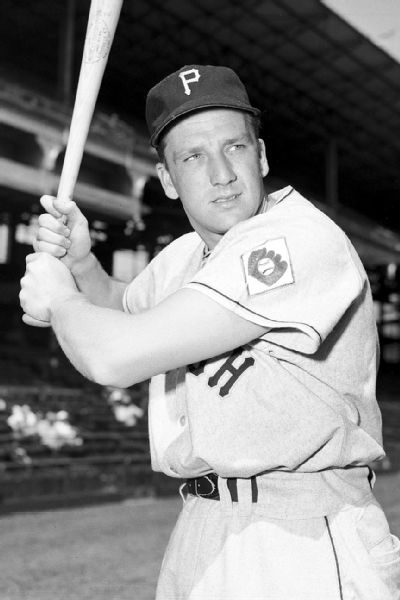
Kiner, who hit 369 homers, playing for the Pittsburgh Pirates in 1947. Associated Press

Ralph Kiner, a Hall of Fame outfielder for the Pittsburgh Pirates who was among Major League Baseball's top post-war sluggers before moving on to a long broadcasting career with the New York Mets, died Thursday in his Rancho Mirage, Calif., home. He was 91.
He died of natural causes, according to statement from the Baseball Hall of Fame.
The right-handed hitting Kiner, a big man for his time at 6-foot-2, 195 pounds, won or shared the National League home run title during his first seven seasons with the Pirates starting in 1946 after serving as a Navy pilot in World War II.
“All of us at the Pittsburgh Pirates have heavy hearts upon learning of Ralph Kiner's passing,” club president Frank Coonelly said. “Ralph was one of the greatest players to ever wear a Pirates uniform and was a tireless ambassador for the game of baseball. He was a treasured member of the Pittsburgh community during his seven years with the Pirates.”
Kiner was traded to the Chicago Cubs in June 1953, literally changing uniforms on a day the Pirates played the Cubs at Forbes Field. He also played with the Cleveland Indians before retiring after the 1955 season because of back problems. In 1962, he began working as a broadcaster for the expansion Mets and continued doing occasional work until shortly before his death.
“Ralph Kiner was one of the greatest sluggers in National League history,” baseball commissioner Bud Selig said Thursday. “His consistent power and patience in the heart of the Pirates' lineup made him a member of our All-Century team and, in many respects, a player ahead of his time.”
Ralph McPherran Kiner was born Oct. 27, 1922. A six-time All-Star, he batted a modest .279 during his relatively brief 10-year career and was not fast or gifted defensively. He was all about power and production, belting 369 home runs and driving in 1,015 runs. He ranks sixth all time in fewest at-bats per home run, yet he struck out 100 or more times in a season just once, as a rookie. In 1947, Kiner hit eight home runs in a record four straight multi-homer games. He did all of this with little help, playing mostly for bad teams.
“It kind of fascinated me how he could hit as well as he did when every team was pitching around him,” said Kiner's former teammate and roommate, shortstop Dick Groat. “We didn't have any thunder. He was the only one who could put a big hurt on someone.”
It wasn't enough. The Pirates finished last or next to last five times in Kiner's seven full seasons with the club. When he traded Kiner and his high salary in a 10-player deal the season after the Pirates lost a franchise-record 112 games, cost-conscious general manager Branch Rickey famously told him, “We finished last with you, and we can finish last without you.” Which they did.
Pirates fans hated the trade. For many, Kiner was the only reason to come to the ballpark. From 1949 through '51, the Pirates finished sixth or lower in the eight-team National League yet ranked second, third and fourth in attendance.
Kiner was elected to the Baseball Hall of Fame in 1975 in his 15th and final year of eligibility, and the Pirates retired his No. 4 in 1987. A sculpture of Kiner's powerful hands gripping a bat is on display at PNC Park.
Based on his short career and poor teams, some baseball observers questioned Kiner's Hall of Fame credentials. But many disagree with that.
“He's in the Hall of Fame, and he belongs,” said former teammate Joe Garagiola, who himself had a long broadcasting career. “I don't want to hear we didn't do this and we didn't do that. You didn't want this guy to beat you.”
Garagiola added, “The biggest tribute a player can get is when the other team is having its meeting, they say, ‘All right, who's the one guy we don't want to beat us?' On our ballclub there was no doubt.”
Kiner was mentored by another Hall of Fame slugger, Hank Greenberg, who came to the Pirates for his final season in 1947 after a 12-year career in Detroit. Kiner, in his second year, and Greenberg became fast friends, and Greenberg spent a lot of time schooling his young protégé. “He used to talk about how Greenberg influenced his hitting,” Garagiola said.
Kiner called Greenberg, “The best thing that ever happened to me.”
Many of Kiner's home runs would sail into the short left-field porch at Forbes Field known as Greenberg Gardens, which then became Kiner's Korner.
Kiner supposedly uttered the oft-quoted line, “Singles hitters drive Fords. Home run hitters drive Cadillacs,” although New York Times columnist Arthur Daley reported it differently. Noting how Kiner challenged defensive shifts, Daley quoted Kiner as saying, “Power hitters who slice to the opposite field ride around in Model T Fords. Power hitters who pull the ball ride around in Cadillacs.”
In 1962, Kiner became a member of the broadcasting crew of the expansion Mets, teaming with Lindsey Nelson and Bob Murphy, and hosted a popular postgame show, Kiner's Korner. The Mets were terrible. Kiner said he knew that wouldn't be a problem “because I have a lot of experience with losing.”
He was famous for his unintentionally humorous malapropisms (“If Casey Stengel were alive today, he'd be spinning in his grave.”). Tim McCarver, Kiner's broadcast partner for 16 seasons with the Mets, said Kiner frequently mispronounced his name, calling him “McArthur” or “McCarthy” and once forgetting it altogether. But Kiner also possessed vast knowledge of baseball history. He wrote two books about his life in the game.
“For seven decades, he was kind of all things to all people,” McCarver said. “He was a home run hitter. He was a young broadcaster and then an older broadcaster. It was a marvelous life. You talk about continuity. And he was such charming man in every way.”
Kiner was affable and well liked as a player and broadcaster. “The nicest man in the world,” Groat said. “An absolute prince.”
Kiner was aware of his talents — he had several salary disputes with Rickey — but he also could be humble, “a modest guy, with the ability he had,” Garagiola said. Coming off a subpar 1954 season with the Cubs, Kiner shocked the baseball world by requesting a 40 percent pay cut from his new team, the Indians. Commissioner Ford Frick voided the request, saying it was too much.
Kiner was an avid golfer and led a Hollywood lifestyle before his marriage to tennis star Nancy Chaffee in 1951. He dated actresses Janet Leigh, who he met on the set of the film “Angels in the Outfield,” and Elizabeth Taylor. Kiner and Chaffee, the first of his four wives, divorced in 1968, and his marriage to Barbara Kiner ended in 1980. Kiner's third wife, Di Ann Kiner, died in 2004. Kiner is survived by his fourth wife Ann, and three children by Chaffee — sons Michael and Scott, and a daughter, Kathryn Freeman.
Kiner was born in the copper mining town of Santa Rita, N.M. When he was 4, his father, Ralph Maclin Kiner, a steam-shovel operator, died, and Kiner and his mother, Beatrice, a nurse, moved to Alhambra, Calif. Kiner grew up idolizing Babe Ruth and became a star baseball player and also played fast-pitch softball. He signed out of high school with the Pirates for $3,000 in 1940 but enlisted in the Navy soon after Pearl Harbor and learned to fly. He served from 1942 to '45, hunting submarines in the South Pacific.
After he signed, Kiner played for a minor league team in Albany, Ga., where his manager was Frankie Frisch, the former St. Louis Cardinals' star second baseman.
“He isn't ready for the big leagues yet,” Frisch said of Kiner then, “but he can hit the ball seven miles.”
Bob Cohn is a staff writer for Trib Total Media. Reach him at bcohn@tribweb.com or via Twitter @BCohn_Trib.


Read more: http://triblive.com/sports/pirates/3329546-74/kiner-pirates-baseball#ixzz2sdNDQnES 
Follow us: @triblive on Twitter | triblive on Facebook


Ralph Kiner leaves behind great memories as ballplayer and Mets broadcaster


His voice and stories and even his malapropos became the baseball soundtrack for one generation of Mets fans after another. There are all these Mets fans of a certain age who had Kiner's gravelly voice in their baseball summers for their entire lives.


By Mike Lupica
http://www.nydailynews.com/
February 6, 2014


AUG. 14, 1982 FILE PHOTO

HARRY HARRIS/AP

Ralph Kiner (r.) shares a moment with Willie Mays (l.) during Old Timers Day at Shea Stadium in 1982.


So Ralph Kiner, a home run hitter and a broadcaster and one of the best storytellers and characters baseball will ever know, does not make it to one more Mets season, after being around for all of them. And you need to know something today, now that we find out that Kiner is gone at the age of 91: He not only planned to come back, he wanted to do more games this season than last.

He was there at the beginning of the Mets with Bob Murphy and Lindsey Nelson in 1962. Then Lindsey moved on to the Giants at the end of the 1970s. Murph retired after the 2003 season and died a year later. But Ralph Kiner was still there in the television booth, even doing only a handful of games at the end, acting as this wonderful elder of the game, still enjoying every day and night at the ballpark the way he always had.

“He always wanted to work more,” Curt Gowdy, the executive producer at SNY, said Thursday night.


The last time I saw him was in a wheelchair in the lobby of Citi Field before the All-Star Game last summer. Even if they had to help him into the place that night, he wasn’t going to miss a baseball night like this in New York, one hosted by the Mets, his baseball family for more than 50 years.

He played on such bad teams in Pittsburgh, but tied or led the big leagues in home runs six straight times, led the National League seven straight times, ended his Hall of Fame career with 369 home runs in 10 years before retiring at 32 because of a bad back.

“Who would’ve thought,” he said to me one night at old Shea Stadium, “that my career as a broadcaster would have lasted five times as long as my career as a ballplayer? Nobody’s had it better than me.”

His voice and stories and even his malaprops became the baseball soundtrack for one generation of Mets fans after another. There are all these Mets fans of a certain age who had Kiner’s gravelly voice in their baseball summers for their entire lives. He moved over to the television booth and then he was with Tim McCarver in the 1980s when the Mets were back on top of the baseball world for the first time since 1969, and he had the biggest audience of his life, because in those days nobody wanted to miss a game.

You would walk into their booth at the end of the press box, and Kiner would have a cigar going and McCarver would have a cigar going and what you remember most about those days and nights is the smoke and laughter. You remember the look on McCarver’s face when Ralph would start telling one about Hollywood in the ’50s, or what it was like when the baseball world first took notice of him, when he hit 51 home runs for the Pirates in 1947.

“People know Ralph for the character he’s become with the Mets,” McCarver told me once. “But go look at the man’s career. Look at all the home runs he hit from last place. You almost feel as if it’s your duty to remind people how great a hitter he really was.”


Kiner wanted to talk about baseball with you, or golf. Even at the end, when he couldn’t really get around well anymore, they would see him at Greenwich Country Club chipping balls. And then he would be in the locker room afterward, and there would be a crowd of people around him, and he would be telling another story about the old days. And if you spent enough time around him, and I did, it was hard to think of a time when he repeated himself very much.
“On top of everything else,” McCarver says, “he was one of the great — and I mean great — after-dinner speakers of all time.”

He once met the actress Jamie Lee Curtis at the ballpark. Ralph, in his courtly way, told Jamie Lee that there had been a time when he was a younger man when he’d dated her mother, the actress Janet Leigh.

At which point, according to Ralph, Jamie Lee leaped into his arms and yelled, “Daddy, I’ve finally found you!”

There was the time in his broadcasting career, of course, when he fought through the after-effects of Bell’s palsy, which made him slur his words, made it difficult to understand him sometimes. Maybe another broadcaster would have sat it all out. Or maybe, if it had been someone else, someone without the history and bond Kiner had with Mets fans, the whole thing would have turned him into some kind of sad, old man.

But it was never like that. He was Ralph Kiner, he was Kiner’s Korner. And just the fact that he was still here, that his voice was still a part of the baseball summer, seemed to be enough. It was as if we all got through it with him together.
He was there when Tom Seaver was young and Willie Mays was old and when you had to believe. He was there when Doc Gooden was striking out the world and the K Corner became even more famous than Kiner’s Korner had been once. He was still around when the kid, Matt Harvey, started that All-Star Game at Citi Field last July.

“Isn’t it great,” Kiner said in the lobby that night, “to be young in this game?”

There have been other long runs in baseball. But tell me a more wonderful one than this, from those first shots over the wall at Forbes Field in 1946 to this gentleman of baseball still showing up for Mets games on television when the man was past 90. All those summers from Ralph Kiner. All those summers with him as such splendid company. Finally, after all this time, after more than a half-century of Mets baseball, comes one without him. And without his voice.


Read more: http://www.nydailynews.com/sports/baseball/mets/lupica-kiner-leaves-behind-great-memories-ballplayer-mets-broadcaster-article-1.1605138#ixzz2sdJmfoQT

Ralph Kiner, Slugger Who Became a Voice of the Mets, Dies at 91

By 
http://www.nytimes.com/
February 6, 2014
Ralph Kiner, baseball’s vastly undersung slugger, who belted more home runs than anyone else over his 10-year career but whose achievements in the batter’s box were obscured by his decades in the broadcast booth, where he was one of the game’s most recognizable personalities, died on Thursday at home in Rancho Mirage, Calif. He was 91.
The Baseball Hall of Fame, which inducted him in 1975, announced the death.
Baseball fans who are short of retirement, especially those in New York, are familiar with Kiner as an announcer who spent half a century with the Mets, enlivening their broadcasts with shrewd analysis, amiable storytelling and memorable malapropisms beginning with their woeful first season in 1962.
His genial, well-informed and occasionally tongue-twisted presence accompanied all of Mets history, from the verbal high jinks of Casey Stengel and the fielding high jinks of Marv Throneberry to the arrival of the fireballer Tom Seaver and the miraculous World Series championship of 1969, from the thrilling 1986 Series victory over the Red Sox to the dispiriting Subway Series loss to the Yankees in 2000 and the Madoff-poisoned, injury-riddled ill fortune of recent seasons.
But long before he referred on the air to Gary Carter as Gary Cooper, declared that “if Casey Stengel were still alive he’d be spinning in his grave,” or watched a long ball disappear from the park with the trademark call “Going, going, gone, goodbye!,” Kiner was one of the game’s great right-handed hitters.
Cut short by a back injury, Kiner’s career on the field was among the most remarkable in baseball history, featuring a concentrated display of power exhibited by few other sluggers. Slow afoot and undistinguished as an outfielder, he was nonetheless among the signature stars of the baseball era immediately after World War II, in the same conversation with Joe DiMaggio, Ted Williams and Stan Musial.
From 1946 to 1955, playing for the Pittsburgh Pirates, the Chicago Cubs and the Cleveland Indians, he totaled 369 home runs, twice hitting more than 50 in a season, and drove in 1,015 runs, an average of more than 100 a year.
During his first seven seasons, all with Pittsburgh, Kiner led the National League in home runs every year, still a record streak for either league. (Twice he tied with Johnny Mize, once with Hank Sauer.)
From 1947 to 1951, he had home run totals of 51, 40, 54, 47 and 42, becoming only the second player in history — Babe Ruth was the first — to hit at least 40 home runs in five consecutive seasons, and the third (after Ruth and Jimmie Foxx) to hit 100 over two consecutive seasons.
From 1932, when Hack Wilson hit 56 homers for the Chicago Cubs, to baseball’s steroid era in the 1990s, Kiner’s 54 homers in 1949 was the highest single-season total for a National Leaguer; Henry Aaron never matched him, nor did Willie Mays, Ernie Banks, Mike Schmidt or Willie McCovey, all Hall of Famers with more than 500 career homers.
Kiner never made it to the World Series; the Pirates of his era were perpetually mediocre (or worse), and so were the Cubs. In 1955, traded to the American League for his last season, he got closest: the Indians finished second to the Yankees.
For a time, Kiner was among baseball’s highest-paid players. But after Pittsburgh’s dreadful 1952 season, when the team’s record was 42-112 in spite of Kiner’s league-leading home run performance, Branch Rickey, the Pirates’ general manager, cut his salary, reportedly telling him, “Son, we can finish last without you.”
His short career, along with his longtime residence at the bottom of the standings, perhaps explains Kiner’s relative lack of recognition. When he was finally elected to the Hall of Fame, in 1975, his 15th and final year of eligibility, he sneaked in with 273 votes out of a possible 362, two more than needed for election.
But Kiner was appreciated in other circles. Tall, good-looking and well spoken — as a player, he aspired to the career in broadcasting that came to define him — he was, in the parlance of the era, a highly eligible bachelor. Introduced to Elizabeth Taylor by Bing Crosby, who was a part owner of the Pirates, he escorted her to the Hollywood premiere of the 1949 war film “Twelve O’Clock High,” starring Gregory Peck. When the movie “Angels in the Outfield” (1951) was filmed at Pittsburgh’s Forbes Field, Kiner dated its star, Janet Leigh.
His courtship of the tennis star Nancy Chaffee, winner of three consecutive national indoor championships, was avidly chronicled by gossip columnists. Their engagement was announced on the radio by Walter Winchell before Kiner actually proposed, and shortly after their marriage, in 1951, the bride wrote an article for The Saturday Evening Post (as told to Al Hirshberg) with the headline “Why I Married Ralph Kiner.”
After she met him, tennis was no longer the most important thing in her life, Chaffee wrote.
“Even if invited, I won’t go back to Wimbledon unless it’s agreeable to Ralph,” she went on. “It’s too far from Forbes Field, where the Pirates play their home games. For that matter it’s too far from the cities I hope to visit as a ballplayer’s wife.”
Kiner and Chaffee had three children in a 17-year marriage that ended in divorce in 1968. Chaffee later married the sportscaster Jack Whitaker; she died in 2002. Kiner’s second marriage, to Barbara George, also ended in divorce. A third marriage, to DiAnn Shugart, ended with her death in 2004. His survivors include his sons Ralph and Scott; his daughters Kathryn Chaffee Freeman, Tracey Jansen and Kimberlee Manzoni; and 12 grandchildren.
Ralph McPherran Kiner was born in Santa Rita, N.M., on Oct. 27, 1922. His father, a baker, died when Ralph was 4, and he moved with his mother, Beatrice, a nurse, to Alhambra, Calif., where he grew up playing ball. He signed with the Pirates after graduating from high school, playing two seasons and part of a third in the minor leagues before training as a Navy pilot during World War II. He served in the Pacific, assigned to search for Japanese submarines, though he acknowledged he did not see combat — or much else.
“I was on a few patrols but, gosh, we didn’t even spot a whale,” he told The New York Times in 1947.
At the start of that year, his second in the big leagues, the Pirates acquired the great slugger Hank Greenberg from the Detroit Tigers, and Greenberg became Kiner’s roommate and mentor (and later his best man at his wedding to Chaffee), advising him on his swing, his preparation, his work ethic.
Greenberg’s acquisition helped Kiner in more tangible ways as well. For one thing, Greenberg hit behind him in the batting order, protecting him, making sure he got better pitches to hit, and Kiner hit .313, the highest average of his career. What’s more, to accommodate Greenberg, the Pirates had modified Forbes Field, moving in the left field fence to bring it in line with other ballparks and installing the bullpens behind it, an area that came to be called Greenberg Gardens for the long balls the new Pirate was expected to plant there.
But it was Kiner who was the primary beneficiary of the change, hitting 51 home runs. Playing what turned out to be his last season, Greenberg hit 25. Greenberg Gardens was rechristened Kiner’s Korner.
The two men were reunited in 1955, when Greenberg, then the general manager of the Indians, acquired Kiner from the Cubs, a transaction complicated by Kiner’s curious decision to sign a contract for $40,000 a year, less than he was offered and far less than he made the previous year in Chicago, reported to be $65,000.
Major league player representatives objected to the contract because it violated the agreement between players and club owners that a player’s salary could not be reduced by more than 25 percent in a season. Baseball’s commissioner, Ford C. Frick, indicated that he would void the contract, and Kiner and Greenberg, who did not want to pay him so little in the first place, eventually renegotiated it.
“I did not have too good a year with the Cubs, and my salary might have been resented by some players,” explained Kiner, who was among the players who fought owners for an improved pension plan. “I thought if I had a good season with the Indians in 1955, I could more than make up the cut the following year. At first Greenberg was against it, but he then thought the publicity would be good. At no time did I have in mind to undermine the players. Everyone knows I’ve been fighting for them for years.”
In Cleveland, his back problems worsened. He played only 113 games for the Indians in 1955 and hit a career-low 18 homers, prompting his retirement. For five years afterward he was general manager of the San Diego Padres, then a minor league team, and in 1961 he got his first broadcasting job, calling games on the radio for the Chicago White Sox. The next season the Mets began life in New York, and he was offered a job on their broadcast team, he once said, “because I had a lot of experience with losing.”
Over half a century of Met broadcasts, while sharing the microphone with Lindsey Nelson, Bob Murphy and Tim McCarver — whom he once called Tim MacArthur — among many others, Kiner proved himself especially valuable in explaining the nuances of hitting, and though occasionally criticized for a flat affect and a penchant for phrase-bungling — “On Father’s Day we again wish you all happy birthday!” — he was known as an amusing raconteur who was generally well prepared with both facts and stories, and his intended wit was often as memorable as his unintended humor.
“Two-thirds of the earth is covered by water,” he declared about an especially fleet outfielder. “The other third is covered by Garry Maddox.” Cutting to a commercial after mistaking McCarver’s name for that of the World War II general, he said: “MacArthur once said ‘I shall return,’ and we’ll be back after this.”
In addition to his game broadcasts, he was the host of the popular postgame interview show “Kiner’s Korner,” itself a source of legendary Kinerisms, though he was sometimes outdone by his guests. In one exchange from the early days of the Mets (though not on the show “Kiner’s Korner”), he asked a young Mets catcher, Choo Choo Coleman, “What’s your wife’s name, and what’s she like?” Coleman replied, “Her name is Mrs. Coleman — and she likes me, bub.” (Years later, Coleman denied this ever happened.)
In 1996 Kiner disclosed he had Bell’s palsy, but he continued to work, albeit with slurred speech. In later years he appeared on broadcasts only sporadically.
In 2010 Kiner was described in The New York Times as “a human archive of Mets and baseball history,” and indeed he had the kind of longevity in the game that allowed him to put one career in perspective as he began his second. In 1961, as Roger Maris and Mickey Mantle pursued Babe Ruth’s record of 60 home runs in a season, achieved in 1927, Kiner recalled that in 1949, when he was chasing the same mark, it was so revered that he dreaded breaking it. He’d even written a magazine article under the headline “The Home Run I’d Hate to Hit.”
“Twelve years after I had my 54-homer season, I find myself saying that I wish I’d broken the Babe’s record,” he said, going on to predict, wrongly, that Ruth’s career record of 714 home runs would never be broken. (Henry Aaron and Barry Bonds have both done so.) He could not have known that a new chance at fame awaited him on the airwaves, but he already felt that his accomplishments on the field had faded to obscurity.
“I’ve reached a point now that I’m surprised when I’m asked for an autograph,” he said. “Yesterday doesn’t count anymore, only today.”

Thursday, February 06, 2014

‘No No,’ a Documentary on MLB Pitcher Dock Ellis, Who Pitched a No-Hitter While Tripping on Acid

Pittsburgh Pirates pitcher Dock Ellis was quite a character. He sported hair curlers in the dugout, took handfuls of amphetamines before games, and pitched a no-hitter on LSD. He was also, in his own unique way, a torchbearer for racial equality.
By Marlow Stern
http://www.thedailybeast.com/
February 5, 2014
Photo courtesy Pittsburgh Pirates
Photo: Pittsburgh Pirates
He was, in the immortal words of Pulp Fiction’s Jules Winnfield, “a mushroom-cloud-layin’ motherf—ker.” His style was pure Youngblood Priest, a mélange of gold rings, colorful polyester suits, and hair-curlers, cruising in the front seat of a big, shiny Cadillac with a vanity plate that said, “DOCK.” His attitude was bold, intimidating batters with his menacing glare and violent gum chewing, and planting verbal dynamite in the belly of institutional racism. According tofilmmaker David O. Russell, he even served as the inspiration for American Hustle’s hotheaded-yet-sartorially fresh FBI agent Richie DiMaso, played by Bradley Cooper.
Meet Dock Ellis.
The late, self-described “Muhammad Ali of Baseball” pitched in the major leagues from 1968-1979, mostly with the Pittsburgh Pirates, and had a career record of 138-119. He was an All-Star in 1971, and helped lead the Pirates to a World Series championship that year. He’d later compile a 17-8 record while pitching for the American League champion New York Yankees in 1976. But he’s probably best known for pitching a no-hitter while tripping on acid. Ellis is given the documentary treatment in director Jeffrey Radice’s No No: A Dockumentary, which made its world premiere at the 2014 Sundance Film Festival, and will soon play SXSW. And Beastie Boy Adam Horovitz, a.k.a. Ad-Rock, produced the film’s funky soundtrack.
No No opens on that fateful day: June 12, 1970.
“We flew in to San Diego and I asked the manager if I could go home because we had an off day,” explained Ellis in the film. “So I took some LSD at the airport when I took off with the car ’cause I knew where it would hit me, in L.A.” 
He’d take LSD two or three more times on Thursday at his friend’s place in Los Angeles, and again the following day at around noon. At 2 p.m. on Friday, the house received a call from the Pirates’ manager asking where the heck Ellis was, since he was supposed to be at the ballpark. His friend’s girlfriend woke up a sleeping Ellis, screaming, “You have to pitch today!” to which Ellis replied, “What happened to yesterday?” Ellis rushed to the airport, and somehow made a 3 p.m. flight from Los Angeles to San Diego, arriving at the stadium at around 4:30 p.m. The first pitch was at 6:05 p.m.
“So there I was out there, high as a Georgia Pine, trippin’ on acid,” he said. “I really didn’t see the hitters. All I could tell was if they were on the right side, or the left side. As far as seeing the target, the catcher put tape on his fingers so I could see the signals. The opposing team and my teammates, they knew I was high. But they didn’t know what I was high on. They didn’t really see it, but I had the acid in me, and I didn’t know what I looked like with that acid. I had lost all concept of time.”
Nine innings, eight walks, six strikeouts, and two hit batsmen later, and Ellis had done the impossible: he’d pitched a no-hitter high on LSD.
“It was ugly but it was still a no no,” he said in the film, grinning. “It was easier to pitch with the LSD because I was so used to medicating myself,” added Ellis. “That’s the way that I was dealing with the fear of failure. You know that if Dock’s pitching, he’s high. But how high is he? I pitched every game in the major leagues under the influence of drugs.”
In addition to LSD, Ellis took loads of cocaine, marijuana, alcohol, mescaline, crank, and later, heroin. Before starts, he’d take as many “Greenies”—or amphetamines—as he could swallow to keep himself sharp.
“I would try to out-milligram any opponent,” said Ellis. “Before a game, I would take a maximum of 15-17 pills. Not to say that I didn’t have enough stuff to pitch in the major leagues, I just tried to get a little edge.”
Since Ellis didn’t have overpowering stuff—he was armed primarily with a curveball and a slider—the key to his game was intimidation. He’d stand tall on the mound, eyes bugging out of his head, violently smacking his chewing gum. He’d bean you just to get his message across, and if you crossed him, he’d bean you in the face. Just ask Reggie Jackson, who hit a towering, 600-plus ft. home run off Ellis in the 1971 All-Star game—one of the longest in history. The next time they met, in 1976, Ellis beaned him in the face. And the curlers in his hair weren’t just to be hip and slick, or to defy the stringent rules of management (Ellis was suspended once by the Pirates for 10 days for the curlers).
“I was throwing spitballs,” he said. “I was wearing a perm, so I just had to go to the back of my neck and I had a fist full of sweat.”
Throughout the course of No No’s 1.5-hour running time, via interviews with friends, family, and fellow ballplayers—as well as the late Ellis himself—the film paints a picture of a rebellious man filled with contradictions.
Ellis grew up in Gardena, California. His family members came to nickname him “The Nut” as a child because, they say, he was “selectively crazy.” He came up in the minors in 1964, at a time when the players’ hotel rooms were segregated by race. When he finally joined the Pirates in 1968, his first roommate was Roberto Clemente, whom he looked up to. By the ’71 season, Ellis was a star. He led the National League in victories and ERA at the season’s halfway point with a 14-3 record and 2.10 ERA. Before the game, Ellis publicly called out National League manager Sparky Anderson, claiming he’d never start “two brothers” against one another in the All-Star game (him and Vida Blue). Ellis ended up starting. Due to his outrageous style and no-BS attitude, Ellis was the recipient of racist threats daily.
“They threatened to shoot me,” said Ellis. “If you stick your head over the dugout, we’re going to shoot you. So I’d have my head over the dugout the whole game.”
On Sept. 1, 1971, the Pirates started nine black and Latino players, the first all-minority starting lineup in MLB history. They were down by seven runs but came back and won the game 9-7, and later that year, they won the World Series. Sports writers called them “The Team that Changed Baseball,” and Ellis was the most outspoken of the bunch, fighting for African-American player’s rights by destroying cultural taboos.
But Ellis’ drug use escalated following the tragic death of Clemente in a 1973 plane crash. He choked his first wife, Paula, in a drug-fueled rampage, and she left him. After that, the drugs and partying got worse. There were attractive women everywhere. Teammates would get calls from Ellis out of his gourd at 3:30 a.m. on nights before games. During spring training, he’d sit around in the outfield, guzzle booze, and plant weed.
With the exception of the aforementioned 1976 season with the Yankees, and a resurgent 1977 season with the Texas Rangers, Ellis never reached the heights he achieved in ’71. When he retired in 1979, his drug usage got completely out of control, and that night, he attacked his second wife, Austine.
“From about 12 in the evening until five o’clock in the morning, he took it out on me with guns and rifles and shotguns, revolvers in my mouth,” she said in the film. “It was devastating. He had never done that before.”
After that horrific episode, Austine left Ellis in 1980, and the ex-pitcher went straight to rehab, kicking drugs and alcohol that year and never turning back. He eventually became a drug and alcohol abuse counselor for the Yankees, and later, got a job counseling prison inmates about the dangers of substance abuse. Ron Howard even cast him in a bit part in his 1986 movie Gung Ho. Ellis was diagnosed with cirrhosis of the liver in 2007, and passed away from the ailment on Dec. 19, 2008.
At one point in the film, Ellis tears up while reading a letter sent to him by Jackie Robinson.
“Try to get more players to understand your views and you will find great support,” wrote Robinson. “You have made a real contribution.”